

Executive Overview
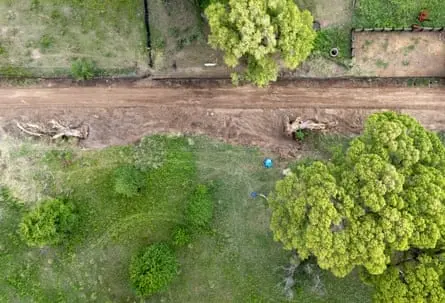
In the remote, high-elevation expanse of the San Rafael Valley in southern Arizona, a profound ecological and cultural conflict culminated in the destruction of a natural landmark known simply as the "Grandmother" tree. Standing for approximately two centuries in the ghost town of Lochiel, this ancient cottonwood tree was more than just timber. To local land defenders, environmental advocates, and Indigenous community members, it served as a living monument, a vital pillar of a fragile riparian ecosystem, and a potent symbol of resistance against the relentless expansion of the United States southern border infrastructure.
Despite a high-profile, 70-day tree-sit and months of peaceful activism, federal law enforcement and private construction contractors ultimately prevailed. On a Monday morning at dawn, a massive contingent of federal agents swarmed the private land where the protest camp was established. Using heavy machinery, specialized crane lifts, and physical force, authorities cleared the site, arrested demonstrators, and allowed private contractors to push the historic cottonwood to the earth with an excavator.
The felling of the Grandmother tree highlights a volatile intersection of national security policy, environmental degradation, and civil disobedience. As construction on Donald Trump’s border wall surges forward—backed by billions in federal funding and empowered by sweeping legislative waivers—environmentalists warn that the irreparable damage inflicted on the Arizona borderlands extends far beyond a single tree, threatening regional wildlife corridors, scarce water supplies, and an endangered ecotype that has sustained the American Southwest for centuries.
Detailed Chronology: From Peaceful Occupation to Federal Raid
The battle to save the ancient cottonwoods of Lochiel began in earnest in late July, catalyzed by the sudden destruction of nearby centuries-old trees. On July 27, private contractors working on behalf of the federal border project knocked over and killed three ancient cottonwood trees in the immediate vicinity. Fearing that the area’s remaining natural heritage was slated for total obliteration, land defenders mobilized rapidly, establishing an encampment on private property near the international boundary.
The 70-Day Tree-Sit
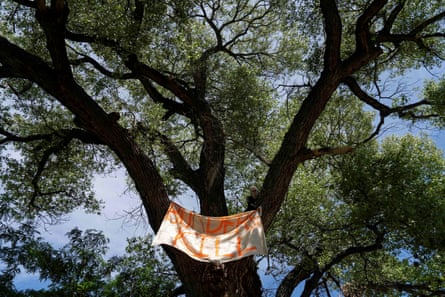
Shortly after the initial destruction, activists initiated a high-altitude tree-sit, scaling the 200-year-old cottonwood and constructing a wooden platform high within its dense canopy. Over the next 70-plus days, a rotating cast of protesters maintained a continuous occupation of the tree. The site transformed into a makeshift community hub of morning prayers, vigils, and nonviolent resistance.
The protest was not limited to the canopy. Activists employed a variety of civil disobedience tactics to stall the advance of heavy machinery. On August 7, a protester locked herself directly to a cement truck intended for wall construction. Witnesses reported that federal border agents responded with physical aggression, deploying mace directly into the activist’s face, forcing her limbs into painful positions, and ultimately driving the truck away while she remained physically attached to the vehicle. She was subsequently cut free, placed under arrest, and remanded into custody.

The Dawn Raid
The culmination of the standoff arrived on a Monday at dawn. More than 80 federal agents—comprising standard border patrol officers and members of the elite Border Patrol Tactical Unit (Bortac), a special forces unit originally created to respond to high-risk terrorist threats—swarmed the private encampment.
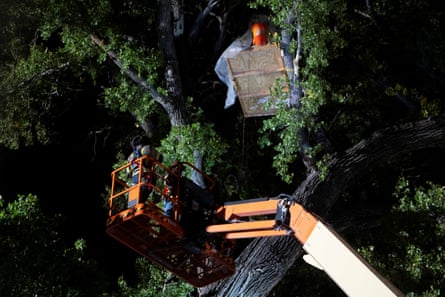
According to eyewitnesses, video footage, and social media documentation, the raid was swift and forceful. Agents deployed a steel basket mounted on an extendable crane lift to forcibly extract the remaining tree-sitter from the platform. Down on the ground, other activists attempting to rush toward the tree to shield it with their bodies were shoved, tackled, and blocked by law enforcement lines.
Simultaneously, a camera crew from the far-right political organization Turning Point USA was embedded with border authorities, granted free and unhindered access to roam the closed public roads to film the dismantling of the camp.
The Final Blow
With the protesters subdued and removed from the immediate danger zone, private contractors working for Fisher Sand & Gravel—the primary construction firm tasked with building this specific sector of the barrier—brought in a heavy excavator. The machinery was driven directly to the base of the 200-year-old cottonwood.
With a mechanical push, the trunk cracked under the pressure, and the towering canopy crashed violently to the earth. The sound was met with shrieks, crying, and outraged shouts from the remaining land defenders gathered at the perimeter.
Following the destruction of the main cottonwood, authorities turned their attention to a second ancient tree situated directly on the international border, where another activist had established a secondary lookout. On Thursday, border patrol agents and cooperating Mexican police officers dismantled the second platform and systematically cut off the tree-sitter’s access to food and water supplies. Deprived of provisions for several days, the final tree-sitter was forced to descend voluntarily late Friday evening, bringing an end to the physical occupation of the canopy.
Supporting Context & Metrics: Ecology, Water, and the San Rafael Valley
To fully understand the gravity of the Lochiel protests, observers must examine the unique ecological landscape of the San Rafael Valley. Situated in a remote, high-elevation prairie where the classic film Oklahoma was once shot, the valley is framed by the Patagonia and Huachuca mountains. It represents one of the most critical and intact regional wildlife corridors linking the United States and Mexico.
A Severed Wildlife Corridor
Conservation biologists have long designated the Arizona borderlands as a biodiversity hotspot. The valley floor and its adjacent mountain ranges provide vital migratory pathways and habitat for endangered and sensitive species, including:
- Jaguars: Historically native to the region, apex predators attempting to repopulate southern Arizona from Mexico face near-impassable physical barriers.
- Ocelots: Rare wild cats whose northern migration routes depend heavily on unbroken riparian corridors.
- Black Bears and Mountain Lions: Large mammals requiring vast, contiguous territories for foraging and breeding.
- Local Fauna: Smaller native species, including beavers and porcupines, whose aquatic and arboreal habitats rely entirely on healthy valley ecosystems.
The Riparian Crisis and Water Depletion
The cottonwood trees targeted by construction crews are not ordinary flora; they are the literal anchors of riparian forests—an endangered ecotype across Arizona and the broader American Southwest. These trees possess deep root systems that depend entirely on consistent, underground water tables to survive.
The construction of the border wall has placed an astronomical strain on these subterranean water reserves. Massive quantities of water are required to mix concrete, compact soil, and suppress dust at active construction sites. While U.S. Customs and Border Protection (CBP) refuses to disclose exact consumption metrics for the current project, historical data underscores the alarming scale of resource extraction. A 2008 CBP environmental assessment estimated that a smaller wall project nearby could consume up to 710,000 gallons of water per mile of construction. Given that the current infrastructure initiative is significantly larger and utilizes dual-wall systems, experts estimate actual water usage is vastly higher.
This aggressive extraction has measurably depleted regional wells throughout the Southwest, threatening natural historical landmarks such as Quitobaquito Springs and drying out sensitive desert oases that local wildlife relies upon during extreme seasonal droughts.
The Physical Scale of the Barrier
Under directives funded by billions of dollars allocated through the "One Big Beautiful Bill Act," government contractors have dramatically accelerated construction timelines. According to Department of Homeland Security (DHS) tracking data:
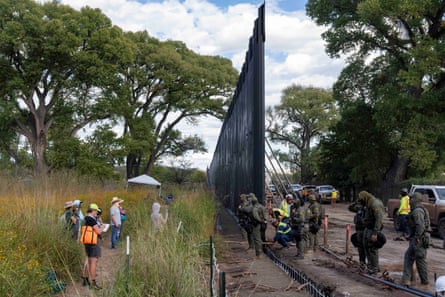
- Completed Infrastructure: 88 miles (140 km) of secondary wall have been fully constructed.
- Active Construction: An additional 444 miles of secondary wall—consisting of dual 30-foot steel-slat fences driven deep into cement and rebar trenches—are currently underway, heavily concentrated within the state of Arizona.
Official Statements and Institutional Responses
The destruction of the Grandmother tree and the aggressive tactics employed by federal law enforcement have triggered a fierce political and legal backlash.
Federal and Local Authorities
U.S. Customs and Border Protection declined repeated requests for comment regarding the pre-dawn raid, physical clashes with protesters, and the environmental impact of felling the trees. The agency has consistently maintained that expansive border barriers are an essential operational necessity required to curb unauthorized immigration and secure remote sectors of the frontier.
Local law enforcement has expressed starkly contrasting views. Santa Cruz County Sheriff David Hathaway, who declined a direct interview for this report, has previously publically criticized the push for border wall construction in his jurisdiction. Sheriff Hathaway characterized the push to wall off the San Rafael Valley as senseless and driven by political theater, noting that the remote valley has virtually no historical record of significant illegal border activity or high-traffic smuggling corridors. Fisher Sand & Gravel also declined requests for comment.
Political Retaliation and Legislative Pushback
Elected officials representing the region have moved quickly to condemn the actions of federal contractors. In an impassioned press conference held on October 8, U.S. Representative Adelita Grijalva expressed heartbreak over the destruction of the ancient cottonwoods. Grijalva announced plans to introduce federal legislation explicitly revoking the Department of Homeland Security’s sweeping statutory authority to waive environmental, cultural, and historic preservation laws during the construction of border infrastructure.
For decades, the REAL ID Act of 2005 has granted the DHS Secretary the unilateral power to bypass any federal law—including the Clean Water Act, the Endangered Species Act, and the National Environmental Policy Act—to expedite border barrier completion. Activists and lawmakers argue that this legal loophole is the root cause of unchecked ecological destruction in protected border regions.
Future Outlook: A Movement Takes Root
While the physical trunk of the Grandmother tree now lies broken on the Arizona soil, land defenders and environmental groups insist that its felling marks the birth of a broader, more militant ecological resistance movement rather than an ultimate defeat.
"Seeing that—it crushes your heart," reflected Erick Meza, the Sierra Club’s Borderlands coordinator, who spent months attempting to engage CBP through formal administrative channels before the bulldozers arrived. "That tree brought a lot of people together. Now, there’s a community response of outrage. People are pissed off."
Kate Scott, one of the primary organizers of the Lochiel tree-sit, echoed this sentiment with a message of enduring defiance against federal overreach.
"In felling the tree, they try to break us, but we are not broken," Scott declared. "We are starting a movement, and we’re not going anywhere. We are rooted, like the grandmothers."
As construction crews continue to pour concrete and drive 30-foot steel panels into the fragile soils of the San Rafael Valley, the legal and physical battles along the Arizona border show no signs of abating. The destruction of the Lochiel cottonwood has transformed a quiet, remote valley into a national flashpoint, pitting the unyielding momentum of federal border enforcement against a galvanized coalition of environmentalists, Indigenous groups, and citizens determined to defend the natural heritage of the American borderlands.



