Executive Overview
For years, the environmental debate surrounding personal transportation has been anchored by a seemingly bulletproof intuition: “The greenest car is the one already built.”
This conventional wisdom suggests that keeping an older, internal combustion engine (ICE) vehicle running until its final mechanical gasp is inherently superior to manufacturing a brand-new battery-electric vehicle (BEV). After all, manufacturing a new car incurs an immediate carbon debt—from mining raw materials and processing metals to stamping body panels and forging battery packs—whereas continuing to drive an existing car avoids a fresh industrial footprint entirely.
However, this comforting maxim relies on a major accounting blind spot. It treats every gallon of gasoline an existing vehicle will burn over the remainder of its lifespan as a carbon-neutral event.
A landmark lifecycle study published in Science by researchers J. Elliott Campbell (UC Santa Cruz) and Roland Geyer (UC Santa Barbara) blows that assumption wide open. By rigorously modeling the dynamic trade-offs between early ICE retirement and immediate BEV replacement, Campbell and Geyer demonstrate that the carbon debt of manufacturing a new EV is typically paid off in just a few short years. More importantly, early retirement yields massive cumulative emissions reductions over a multi-year horizon because it halts years of recurring tailpipe combustion.
Yet, translating these findings into coherent public policy is not a straightforward matter of handing out cash to crush old gas-guzzlers. In a car-dependent society like the United States, removing functioning vehicles from the road threatens to destabilize the "used car ladder"—the vital economic pipeline that delivers affordable, secondhand transportation to lower-income households. Designing a next-generation vehicle retirement program requires balancing aggressive climate economics with socioeconomic equity, ensuring that the transition to clean mobility does not pull up the ladder for those who need it most.
Detailed Chronology: From "Cash for Clunkers" to the Science of Scrappage
To understand how the automotive carbon debate evolved, one must look back at the historical precedents of fleet turnover policy and the slow evolution of lifecycle analysis (LCA).
The Legacy of "Cash for Clunkers"
In 2009, in the wake of the Great Financial Crisis, the United States government enacted the Car Allowance Rebate System—widely known as "Cash for Clunkers." The program offered financial incentives to consumers trading in old, inefficient vehicles for new, more fuel-efficient ones. While the program successfully stimulated economic activity and removed some smog-heavy vehicles from the road, economists and environmentalists later criticized it for treating all vehicle retirements equally. A flat bounty paid the same incentive regardless of whether a vehicle was driven 3,000 miles a year or 20,000, leading to uneven climate returns relative to public expenditure.
The Rise of the Lifecycle Skepticism
Throughout the 2010s and early 2020s, as EVs began penetrating the mainstream market, critics pointed to the heavy environmental footprint of battery supply chains. Skeptics argued that discarding a running gasoline car to purchase an EV was counterproductive. This perspective gained widespread cultural traction under the banner that preserving existing machinery is always greener than consuming resources to build replacements.
The 2024 Policy Re-Evaluation
By 2024, energy analysts began reconsidering early scrappage in light of rapidly improving grid decarbonization and the urgent need to accelerate fleet electrification. However, policy advocates remained haunted by the lifecycle objection: What if keeping the old car really is better? Recognizing that intuition was no substitute for data, researchers needed a comprehensive, multi-variable model that accounted for real-world driving behaviors, regional electricity grids, and varying battery manufacturing footprints.
The Campbell and Geyer Breakthrough
Enter the definitive work by Campbell and Geyer, published in Science. Rather than relying on a single, idealized scenario—such as an ultra-efficient EV charged exclusively by solar panels running against a catastrophic gas-guzzler—the researchers deployed a highly sensitive, multifaceted matrix. They varied vehicle efficiency, annual mileage, battery manufacturing emissions, battery sizing, and regional electricity grids across thousands of possible permutations. The results challenged the anti-scrappage dogma, revealing that for the vast majority of real-world use cases, early retirement of fossil-fuel vehicles is a powerful climate lever.
Supporting Context & Metrics: What the Science Study Reveals
The Campbell and Geyer study changes the conversation by moving past generalized slogans and anchoring the debate in hard numerical realities.
The SUV Benchmark: Repaying the Manufacturing Debt
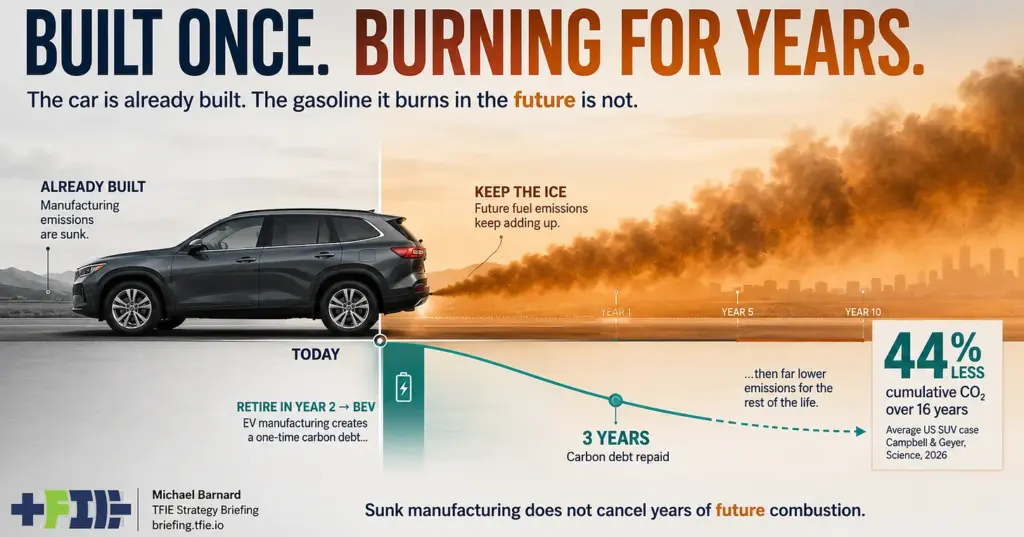
Consider a representative production-weighted SUV operating on the average United States electricity grid. If a motorist retires this internal combustion vehicle in its second year of life and immediately replaces it with a battery-electric vehicle, the cumulative emissions over a 16-year period drop by 44%.

While manufacturing the replacement EV introduces an immediate carbon spike (the manufacturing debt), the lower operating emissions of the electric powertrain completely wipe out that debt in approximately three years. Because the vehicle is retired early, over a decade of continuous tailpipe emissions is successfully avoided, driving down the long-term carbon total significantly.
Sensitivity Analysis: When Scrappage Wins (and Loses)
The study’s broader sensitivity analysis proves that the SUV example is not an isolated anomaly:
- 92% of all modeled scenarios produced lower net emissions from early retirement.
- Under fleet-average assumptions, the average net emissions reduction sat at 58%.
- The full spectrum of results ranged from an 82% reduction to a 77% increase in deliberately extreme outlier cases (such as swapping a clean plug-in hybrid for an inefficient EV on a coal-heavy grid).
This dispersion underscores a critical truth: avoiding a second manufacturing event is far less decisive than previously believed. The single largest variable in the equation is not the carbon cost of building the battery, but how much fuel the old vehicle would have continued to burn.
Sunk Costs vs. Future Emissions
From an accounting perspective, the emissions generated during the original manufacturing of the gasoline vehicle are already trapped in the atmosphere; they are sunk costs. The relevant calculation starts today:
- How much future gasoline will the aging vehicle consume?
- How do those cumulative combustion emissions stack up against the manufacturing and grid-charging emissions of a replacement EV?
Keeping the gasoline vehicle avoids a fresh industrial build, but it locks in a compounding cycle of fossil fuel consumption.
The Thresholds of Efficiency and Mileage
Crucially, the study does not argue that every single gas car should be crushed. The researchers identified precise annual mileage thresholds below which an EV’s manufacturing emissions cannot be recovered within a reasonable timeframe:
- Passenger Cars: ~7,054 kilometers (approx. 4,383 miles) per year.
- SUVs: ~6,837 kilometers (approx. 4,248 miles) per year.
- Pickups: ~10,794 kilometers (approx. 6,707 miles) per year.
While these thresholds sit well below the average American driving distance of roughly 20,000 kilometers annually, lightly driven weekend cars or vintage vehicles clearly exist and are environmentally better left in service.
Similarly, efficient hybrids, plug-in hybrids (PHEVs), and EVs powered by exceptionally carbon-intensive grids (exceeding 500 kg of CO₂ per MWh paired with vehicles consuming over 30 kWh per 100 kilometers) make poor candidates for early retirement. For instance, replacing a PHEV car with a pure BEV in a high-emission grid increased net emissions by 11% in the model.
Official Perspectives & Economic Realities
While the environmental math favoring early retirement is robust, translating it into public policy collides head-on with American infrastructure and economic structures.
The Trap of Extreme Car Dependence
A foundational challenge in the United States is spatial and structural car dependence. Urban planning research, including metrics from Prieto-Curiel and Ospina’s The ABC of mobility, illustrates a stark divide:
- 91.9% of urban trips in US and Canadian metropolitan samples are conducted by car.
- In contrast, European urban samples rely on cars for 44.9% of trips, and East Asian cities sit at 18.8%.
Furthermore, US car dependence remains stubbornly high even as cities scale in size. For the average American, owning an automobile is not a lifestyle luxury; it is an absolute biological and economic necessity required to commute to work, secure groceries, transport children to school, and access healthcare.
The Used Car Ladder and Lower-Income Households
Because new vehicles are prohibitively expensive for a vast segment of the population, lower-income households rely heavily on the secondary market. Federal Reserve survey data indicates that roughly two-thirds of lower-income individuals who recently acquired a vehicle purchased used, with 78% of privately purchased used vehicles costing under $10,000.

New vehicles purchased today by affluent families, corporate fleets, and government agencies systematically filter down over a 6-to-15-year lifecycle into the affordable tiers of the used car market.
Destroying functioning combustion vehicles prematurely can inadvertently shorten this ladder. While a scrappage program achieves undeniable carbon reductions on paper, it risks tightening supply at the bottom of the automotive market, leaving future working-class buyers with fewer affordable options. As Campbell and Geyer acknowledge, vehicle resale creates system effects that lifecycle carbon models alone cannot solve.
Future Outlook: Designing a Smart, Equity-First Fleet Turnover Policy
To reconcile climate imperatives with economic justice, policymakers must move beyond blunt-instrument subsidies like traditional cash-for-clunkers programs. A modernized vehicle-retirement framework must be sophisticated, targeted, and equitable.
1. Dynamic Scrappage Incentives
Scrappage bounties should no longer be dictated solely by a vehicle’s age. Instead, incentive payouts must reflect:
- Real-world fuel economy and efficiency ratings.
- Verified recent annual mileage (targeting high-mileage gas guzzlers like commercial pickups and inefficient SUVs).
- Remaining expected operational lifespan.
- The carbon intensity of the local electricity grid.
Under this model, a gas-thirsty pickup truck racking up 25,000 miles a year on a clean grid receives maximum financial support for retirement. Conversely, a fuel-sipping Prius driving 4,000 miles a year on a coal-heavy grid is left alone or repaired rather than crushed.
2. Fortifying the Used EV Market
If older ICE vehicles are retired early, the policy must actively backfill the affordable end of the market with electric alternatives. Used EVs must qualify for robust point-of-sale tax credits and incentives, paired with specialized financial support for lower-income buyers.
Moreover, accelerating the electrification of corporate, delivery, and rental fleets—entities that accumulate mileage at astonishing rates—will quickly churn out 3-to-5-year-old electric vehicles, feeding affordable inventory into the secondhand market much faster than private consumer turnover alone.
3. Protecting Market Equilibrium
Regional monitoring is essential. If local markets experience sharp supply contractions for sub-$10,000 or sub-$15,000 vehicles, government agencies should possess the agility to scale back retirement incentives temporarily. This dynamic modulation ensures that climate policy does not inadvertently inflict economic pain on vulnerable drivers.
Conclusion
The debate over whether to keep or scrap functioning internal combustion vehicles has reached a scientific turning point. Campbell and Geyer have proven that early retirement of high-emitting, high-mileage gas vehicles is a formidable tool for cutting cumulative greenhouse gas emissions.
Yet, treating the climate transition as a math problem divorced from human economics is a recipe for failure. The green transition and the used-car ladder do not have to be mutual enemies, but aligning them requires moving past lazy slogans and designing policy with surgical precision. By targeting the worst polluters while protecting affordable mobility for all, we can decarbonize our roadways without leaving working families behind.