

By Global Energy Desk
Published: December 2025
Executive Overview
The global automotive landscape has crossed a historic threshold. According to comprehensive new analysis published by the energy think tank Ember, more than 25% of all new cars sold worldwide in 2025 are electric vehicles (EVs). What was once viewed as an exclusive luxury transition confined to wealthy Western nations and early-adopter tech hubs has officially transformed into a truly global phenomenon.
This milestone is not merely a reflection of mature markets incrementally phasing out internal combustion engines (ICE). Instead, it is the direct result of a rapid, aggressive pivot toward electric mobility across emerging economies—regions that, only half a decade ago, exhibited near-zero EV adoption rates. Nations across Southeast Asia, Latin America, and the Middle East are leapfrogging traditional automotive development phases, recognizing the immense macroeconomic, environmental, and geopolitical advantages of transitioning directly to battery-electric propulsion.
At the heart of this market transformation is the proliferation of affordable, high-efficiency Chinese electric vehicles. As major economies in the OECD grapple with domestic protectionism, trade tariffs, and infrastructure bottlenecks, emerging markets have opened their doors wide to cost-competitive models. Supported by forward-thinking government policies, tax exemptions, and local manufacturing incentives, these nations are no longer just participating in the electric transition—they are leading it.
Detailed Chronology: The Evolution of the EV Landscape (2019–2025)
To understand the magnitude of the 2025 milestone, one must examine the velocity of change over the preceding six years. The global EV market has transitioned from a niche, heavily subsidized sector into a dominant force in mainstream consumer purchasing.
2019–2021: The Western-Centric Genesis
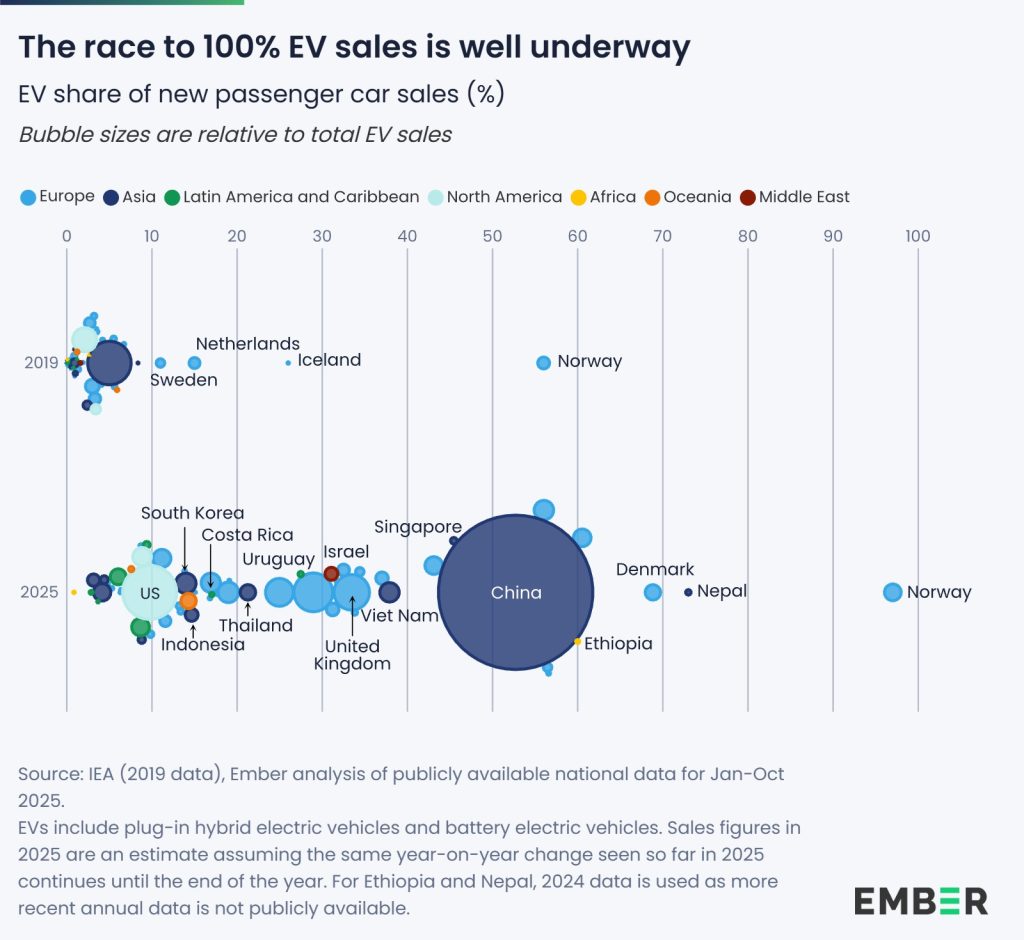
At the close of the last decade, the electric vehicle market was heavily concentrated. In 2019, only four countries globally boasted EV sales shares exceeding 10%. These pioneering markets were primarily localized in Northern Europe—led by Norway—alongside pockets of early adoption in California and select Tier-1 Chinese mega-cities. For the vast majority of the developing world, EVs were regarded as prohibitively expensive, technologically inaccessible novelties lacking the necessary supporting infrastructure.
2022–2023: The Supply Chain Maturation and Export Surge
The post-pandemic years catalyzed severe supply chain reconfigurations. As battery manufacturing capacity scaled dramatically—primarily driven by Chinese conglomerates such as CATL and BYD—unit production costs plummeted. By mid-2023, domestic Chinese automotive manufacturing reached a point of hyper-saturation. Faced with fierce domestic price wars, Chinese automakers turned their sights outward. Crucially, almost all export growth during this window bypassed traditional OECD trade barriers, flooding instead into non-OECD emerging markets where demand for personal mobility was rising alongside disposable incomes.
2024–2025: The Emerging Market "Leapfrog" Effect
The years 2024 and 2025 marked the breaking point for global market dynamics. Rather than following the slow, linear growth curve experienced by early adopters, emerging markets experienced a profound "leapfrog" effect. Drawing parallels to how developing nations bypassed traditional landline telephone infrastructure to leap straight to mobile cellular networks, countries across ASEAN, Latin America, and West Asia bypassed decades of localized ICE vehicle dependency. By the close of 2025, the number of countries where EVs account for more than 10% of new car sales skyrocketed from just four in 2019 to an astonishing 39 nations worldwide.
Supporting Context & Metrics: Regional Breakdowns and Market Shifts
The geographical center of gravity for the global automotive market has decisively shifted. While traditional powerhouses like the United States and Japan experience measured, sometimes politically fraught transitions, emerging regions are breaking records at an unprecedented pace.
The ASEAN Powerhouse: Singapore, Vietnam, Thailand, and Indonesia
The Association of Southeast Asian Nations (ASEAN) emerged as the most dynamic engine of EV growth in 2025.
- Singapore and Vietnam have surged ahead, capturing roughly 40% EV sales shares—metrics that comfortably surpass adoption rates found in the United Kingdom and the broader European Union.
- Thailand achieved a 20% EV market share in 2025, remarkably selling more electric vehicles in the first three quarters of the year than Denmark, a European green transition leader.
- Indonesia, leveraging its vast domestic nickel reserves to court battery and EV manufacturing, crossed the 15% adoption threshold this year, officially surpassing the United States in terms of market penetration percentage.
Latin American Momentum and Eurasian Surprises
The shift is equally pronounced outside of Asia:
- Uruguay reached a 27% EV sales share, aligning itself directly with EU adoption averages.
- Brazil and Mexico demonstrated sustained, exponential growth curves, steadily outpacing Japan, where the domestic EV share has flatlined at approximately 3% since 2022.
- Türkiye recorded a remarkable 17% EV market share, leapfrogging Belgium to establish itself as Europe’s fourth-largest Battery Electric Vehicle (BEV) market by total volume.
The Chinese Export Engine
The fuel accelerating this global democratization of electric mobility has been the influx of Chinese manufacturing prowess. Brazil, Mexico, the United Arab Emirates, and Indonesia now anchor the top 10 destinations for Chinese EV exports. These countries have implemented pragmatic industrial policies—including slashed import tariffs, consumer purchase subsidies, and mandatory local assembly requirements—that have successfully enticed foreign investment while making zero-emission vehicles accessible to middle-class buyers.
Tangible Impacts on Fossil Fuel Demand
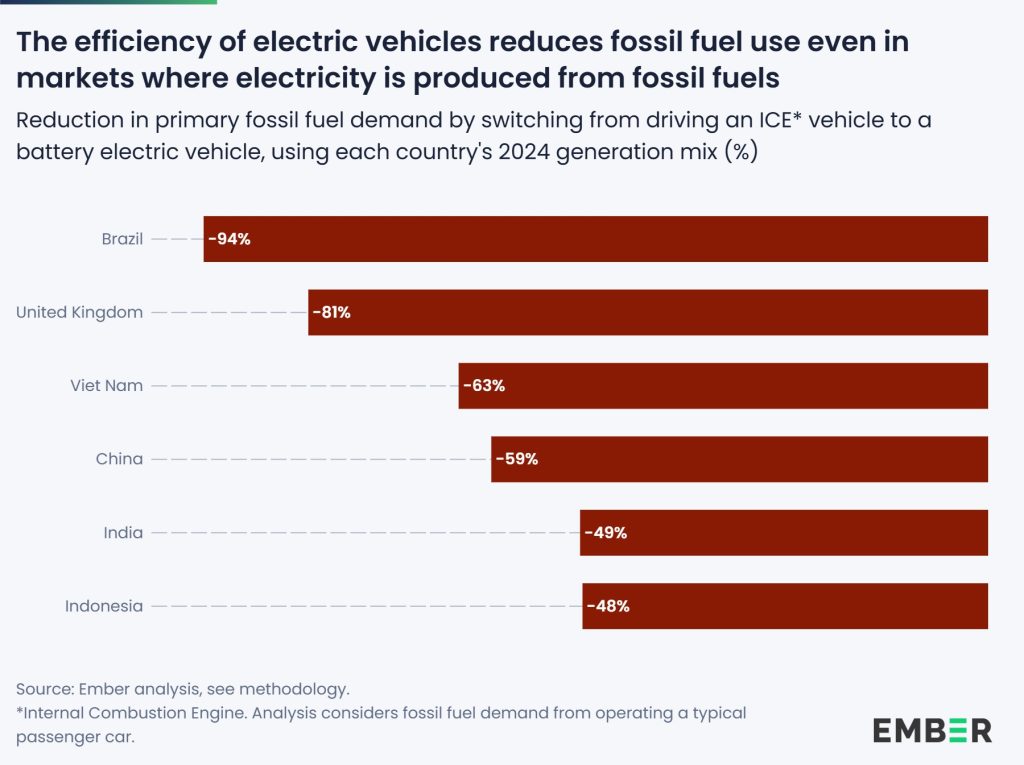
The environmental and macroeconomic implications of this adoption wave extend far beyond carbon accounting; they are fundamentally altering global energy consumption patterns. Because electric vehicles are roughly three times more efficient than internal combustion engine vehicles, their deployment delivers immediate reductions in oil consumption.
The efficiency dividends are profound, even in grids that retain a heavy fossil-fuel baseline:
- In Brazil, where the electrical grid is predominantly decarbonized through renewables and hydro-power, transitioning to BEVs slashes oil and fossil fuel demand associated with transport by an astonishing 90%.
- In Indonesia, despite a coal-heavy electricity generation mix, the deployment of EVs has successfully cut direct transport-related fossil fuel demand by nearly half.
Official Statements and Industry Analysis
Industry experts emphasize that 2025 represents a permanent structural break from past automotive trends.
Euan Graham, a leading electricity and data analyst at Ember, encapsulated the paradigm shift in his assessment of the data:

"This is a major turning point. In 2025, the center of gravity has moved. Emerging markets are no longer catching up; they are leading the shift to electric mobility. These countries see the strategic advantages of EVs, from cleaner air to reduced fossil fuel imports."
Graham further underscored the urgency of foundational infrastructure investment, noting that the long-term trajectory of these markets depends heavily on current strategic choices:
"Emerging markets will shape the future of the global car market. The choices made now on charging infrastructure and early support will determine how fast this momentum continues."
Governments across the global South are increasingly viewing the EV transition not merely as an environmental imperative, but as a critical national security measure. By decoupling local transportation networks from volatile international oil markets, emerging economies are insulating their trade balances and simultaneously mitigating crippling urban air pollution crises.

Future Outlook: The Road Beyond 2025
As the global EV market solidifies its position past the 25% tipping point, the next phase of the transition will present both formidable challenges and unprecedented opportunities.
Infrastructure Deficits and Grid Modernization
The primary bottleneck for sustained growth in emerging markets will not be consumer demand—which has proven robust and price-sensitive—but rather the rapid deployment of charging infrastructure. Nations in ASEAN and Latin America must concurrently upgrade their electrical distribution grids to manage localized surges in charging demand, particularly as commercial fleets and heavy-duty transport begin their own electrification cycles.
Trade Policy and Protectionist Pressures
The dominance of Chinese automakers in non-OECD markets has intensified trade anxieties within Western capitals. As emerging nations successfully industrialize their domestic assembly sectors using Chinese platforms, traditional Western OEMs risk being permanently locked out of some of the fastest-growing consumer markets on the planet. The commercial battlegrounds of the late 2020s will likely be defined by whether local manufacturing ecosystems in Latin America and Southeast Asia can mature into self-sustaining innovation hubs.
The Inevitability of Full Electrification
With nearly 40 countries surpassing the 10% adoption milestone and global sales comfortably exceeding a quarter of all new vehicle transactions, the argument over whether the mass market will adopt electric vehicles is definitively settled. The momentum recorded in 2025 proves that the electric transition is no longer a luxury experiment for affluent nations, but an unstoppable, globally distributed economic reality. The future of the automobile is electric, and its vanguard now resides in the global South.



