Executive Overview
The global transition to electric mobility is entering a hyper-accelerated phase, driven not only by the traditional green energy markets of Europe and North America, but increasingly by a dynamic powerhouse closer to the equator: Southeast Asia. Driven by surging manufacturing capabilities out of China, aggressive localized policy incentives, and volatile fossil fuel markets tied to geopolitical friction in the Middle East, Southeast Asia has cemented its status as one of the fastest-growing and most crucial electric vehicle (EV) markets on earth.
Recent data compiled by energy think tank Ember underscores the staggering velocity of this shift. In May, China’s EV export machine shattered previous milestones, shipping a record $9.2 billion worth of electric vehicles overseas. This represents a robust 49% increase year-over-year, marginally eclipsing the previous all-time high of $9.1 billion established just a month prior in April. To put this industrial scaling into perspective, China’s monthly EV exports hovered below the $1 billion mark as recently as 2020.
A substantial portion of this outbound volume is finding a willing, enthusiastic home in the Association of Southeast Asian Nations (ASEAN) region. In May alone, Chinese EV exports to ASEAN member states touched a historic watermark of $1.2 billion. As Western markets grapple with fluctuating subsidies, protectionist tariffs, and trade barriers, Southeast Asia is emerging as a vital playground for affordable, mass-produced Chinese battery electric vehicles (BEVs) and plug-in hybrid electric vehicles (PHEVs). This comprehensive analysis examines the macroeconomic forces, regional policy shifts, and staggering shipment metrics fueling this unstoppable transport revolution.
Detailed Chronology: The Ascent of China’s EV Exports and ASEAN Integration
The trajectory of China’s transformation from a domestic automotive consumer market to an unmatched global manufacturing juggernaut is one of the most remarkable industrial stories of the 21st century.

The Rapid Scaling (2020–2025)
- The Inflection Point (2020): At the dawn of the decade, China’s monthly passenger EV exports were valued at under $1 billion. Domestic giants like BYD, SAIC, and Geely were primarily focused on securing market share within mainland China, supported by robust central government subsidies and expanding charging infrastructure.
- The Production Surge (2021–2023): As domestic production capacities matured and supply chains for lithium-ion batteries localized, Chinese automakers achieved unprecedented economies of scale. Confronted with a hyper-competitive domestic market marked by fierce price wars, manufacturers looked outward, setting their sights on developing markets where affordable transport alternatives could capture high-growth populations.
- The European and Global Expansion (2024–2025): Chinese brands began aggressively establishing footholds in Europe, Latin America, and Southeast Asia. While regulatory scrutiny tightened in Western jurisdictions—culminating in contentious tariff investigations—Southeast Asia remained welcoming, open, and eager for investment.
The Spring 2026 Milestone
- April 2026: China establishes a temporary benchmark by exporting $9.1 billion worth of passenger EVs globally.
- May 2026: That record is swiftly broken. China ships approximately 448,000 electric passenger vehicles overseas—comprising roughly 279,000 BEVs and 169,000 PHEVs—driving total export value to an unprecedented $9.2 billion. Concurrently, exports to the ASEAN bloc surge to an all-time high of $1.2 billion for the month, proving that regional demand is not a temporary spike but a deeply structural transformation.
Supporting Context & Metrics: Decoding the Numbers
Behind the headline-grabbing financial figures lies a complex matrix of regional shipment data, macroeconomic pressures, and national policy revisions.
Breakdown of May Shipments and Regional Leaders
The sheer volume of vehicles moving across borders illustrates the vast appetite for electrification in Southeast Asia:
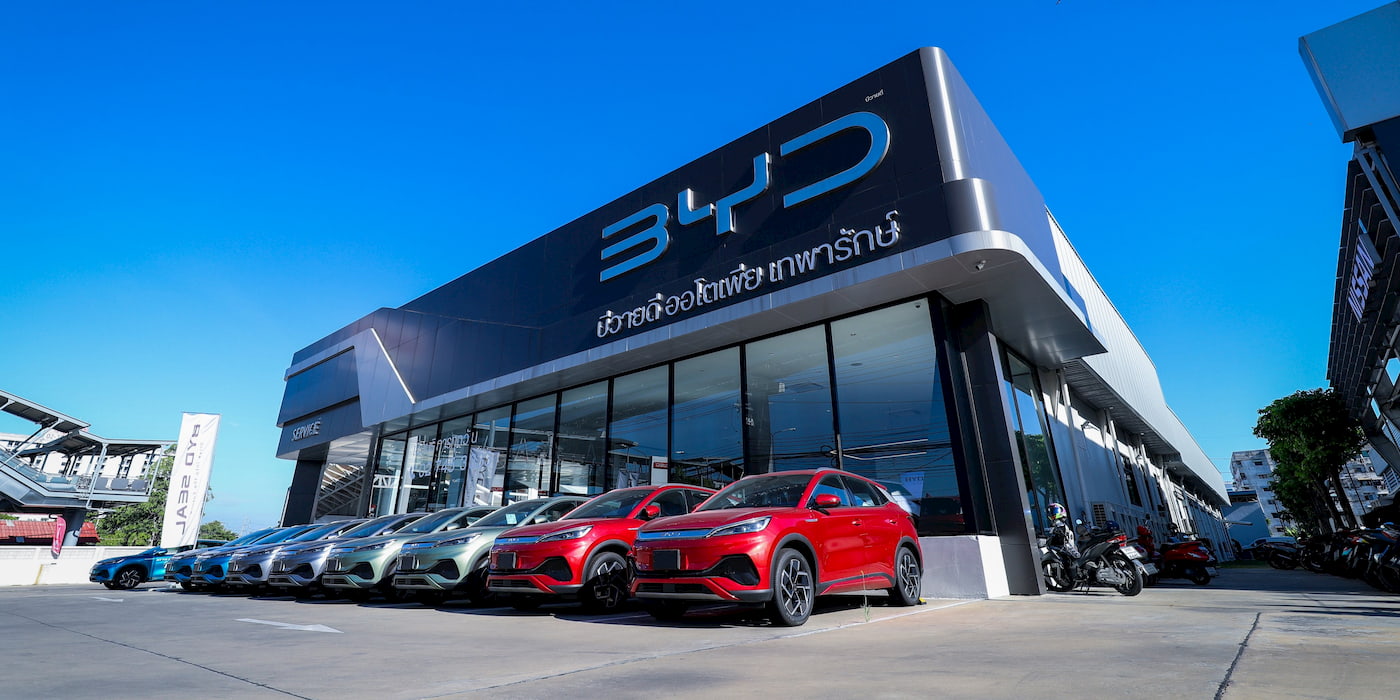
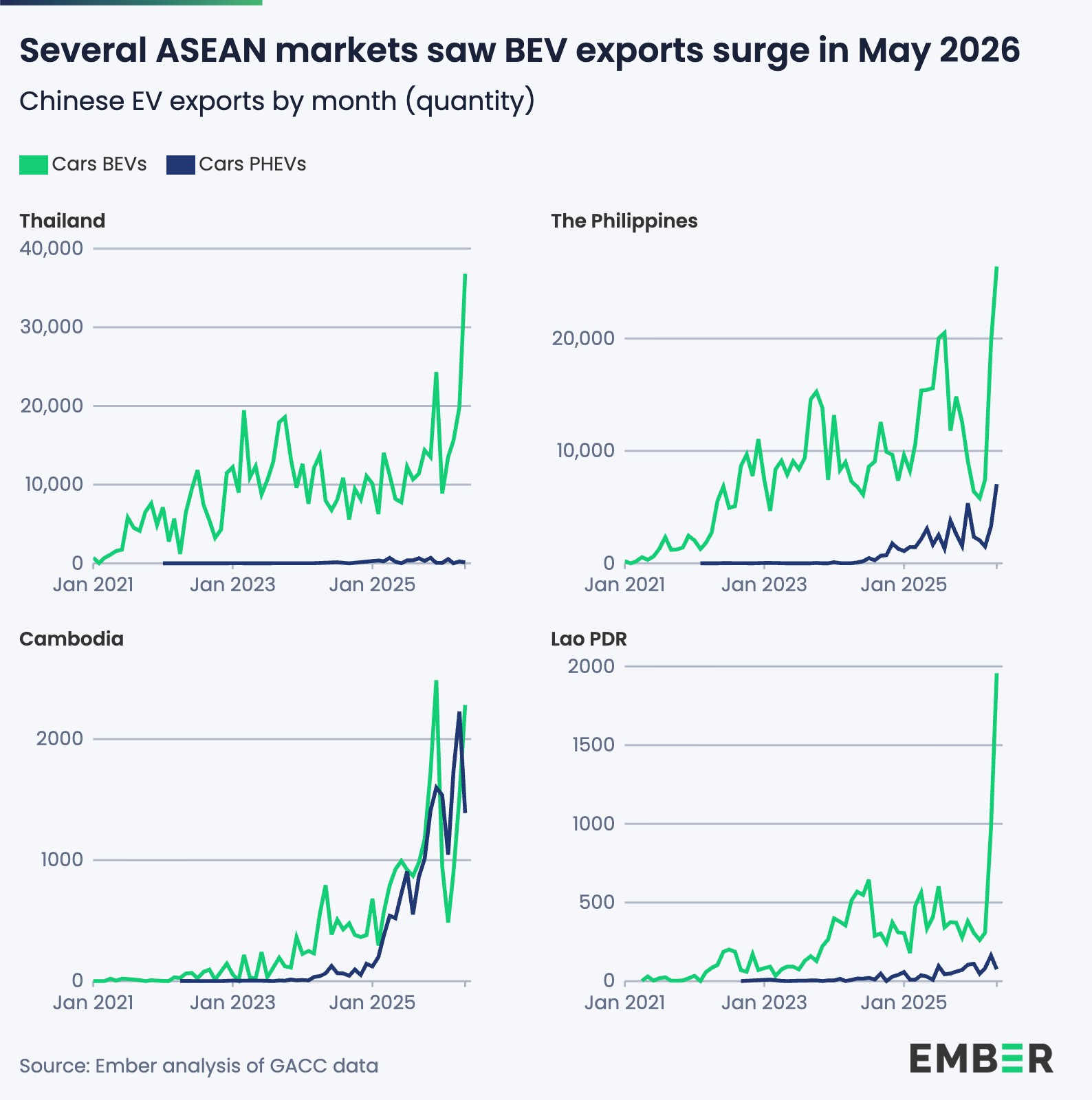
- Thailand: Leading the charge within the ASEAN corridor, Thailand imported over 36,000 Chinese EVs in May. Long recognized as the "Detroit of Asia" due to its legacy internal combustion engine (ICE) manufacturing base, Thailand has pivoted rapidly to attract Chinese EV investments, offering generous consumption subsidies and production incentives.
- The Philippines: Close behind Thailand, Philippine imports of Chinese electric vehicles topped 33,000 units in May. Urban centers across the archipelago are increasingly turning to electric alternatives to mitigate acute traffic congestion and air pollution.
- Cambodia and Laos: Both nations recorded historic monthly import volumes, spurred by aggressive regulatory overhauls designed to pull international green investments into their borders.
The Role of Macroeconomic Pressures: Fuel Prices and Energy Security
While government incentives provided the spark, escalating fossil fuel prices poured accelerant on the fire. Ongoing conflict and instability in the Middle East have reverberated through global oil markets, driving up local gasoline prices across developing Asian economies.
For importing nations heavily reliant on foreign crude, expensive fuel directly undermines national trade balances and consumer purchasing power. The current energy crisis has thus reframed electrification from an environmental aspiration into an urgent matter of national security and economic resilience. Citizens and commercial fleet operators alike are discovering that transitioning away from petroleum yields immediate, long-term transport cost savings.
Official Statements and Industry Insights
Industry analysts monitoring the data emphasize that the convergence of Chinese industrial scale and Southeast Asian market hunger represents a structural turning point for global trade.
Lam Pham, Ember’s energy analyst for Asia, pointed directly to the broader economic motivations driving the shift:
"The current energy crisis has reinforced the value of electrification as a pathway to greater energy security, reduced fuel import exposure, and long-term transport cost savings."
Echoing this sentiment, Euan Graham, Ember’s senior electricity and data analyst, highlighted the speed at which the region is transforming:
"Southeast Asia is fast becoming one of the most dynamic destinations for electric vehicles, and China is supplying that demand at scale and speed."
This perspective highlights a stark reality: while Western analysts frequently fixate on trade protectionism and EV adoption slowdowns in the US and Europe, developing nations in Asia are moving decisively to integrate affordable electric mobility into their national infrastructure.
National Policy Overhauls: How ASEAN Governments Are Turbocharging Adoption
The staggering import figures seen in mid-2026 are not happening in a vacuum. Governments across Southeast Asia have systematically dismantled traditional trade barriers and implemented aggressive policy frameworks to make EV adoption irresistible.
Cambodia: Zero Customs Duties
In late March, Cambodia fundamentally altered its automotive landscape by cutting customs duties on Battery Electric Vehicles (BEVs) to zero. Simultaneously, tariffs on Plug-in Hybrid Electric Vehicles (PHEVs) were drastically reduced from 35% to 7%. While BEVs continue to account for the lion’s share of Chinese EV imports entering Cambodia, the steep reduction in PHEV tariffs has opened the door for hybrid alternatives, bridging the gap for drivers hesitant to make a complete leap to pure battery power.

Laos: Registration Perks and ICE Bans
Laos has taken an even more aggressive multi-pronged approach:
- Fee Reductions: The government has slashed EV registration and recurring service fees.
- Fleet Mandates: Under new regulatory targets, all commercial transportation companies operating within Laos must ensure that EVs comprise at least 10% of their active fleets by the end of 2026.
- The ICE Import Ban: In a landmark move in May, Laos instituted a temporary ban on the importation of new and used internal combustion engine (ICE) vehicles through the end of the year. Designed explicitly to curb the nation’s dependence on imported fossil fuels, this policy is expected to create an unprecedented captive market for electric alternatives in the months ahead.
Future Outlook: Electrek’s Take and What Lies Ahead
When global discussions focus on the electric vehicle transition, the conversation disproportionately orbits the United States, Europe, and mainland China. Yet, as the 2026 data clearly demonstrates, Southeast Asia is quietly evolving into one of the most vital growth engines for the global EV industry.
Chinese automakers have played their cards masterfully. Rather than merely dumping vehicles into foreign ports, companies like BYD, Great Wall Motor, and SAIC have pursued a strategy of aggressive regional integration. They are deploying affordable EV models tailored to local consumer budgets, establishing manufacturing and assembly hubs within ASEAN borders, and building strategic partnerships with local conglomerates.
When paired with regional governments proactively deploying charging infrastructure, cutting tariffs, and—in the case of Laos—banning legacy ICE vehicles outright, the growth trajectory is set in stone. The energy crisis triggered by Middle Eastern instability has merely compressed a decade-long transition into a frantic, hyper-accelerated sprint.

As China’s monthly EV export valuations continue to shatter historical records, Southeast Asia will remain a primary beneficiary of this output. The region proves that when affordable technology meets desperate economic necessity and visionary public policy, the shift toward sustainable transport is not just possible—it is unstoppable.