

Executive Overview
The automotive landscape in the United States continues its slow, uneven, but undeniable transformation toward electrification. While standard quarterly electric vehicle (EV) reports typically focus on aggregate sales numbers, absolute delivery volumes, or the dominance of specific market leaders, a more telling metric often hides beneath the surface: EV penetration rate per brand.
Understanding which automotive brands and corporate parent groups are successfully transitioning their internal sales portfolios away from internal combustion engines (ICE) and toward battery-electric vehicles (BEVs) reveals a clearer picture of long-term market sustainability. This analysis evaluates the performance of individual auto brands and major automotive alliances across the United States during the first and second quarters of 2026.
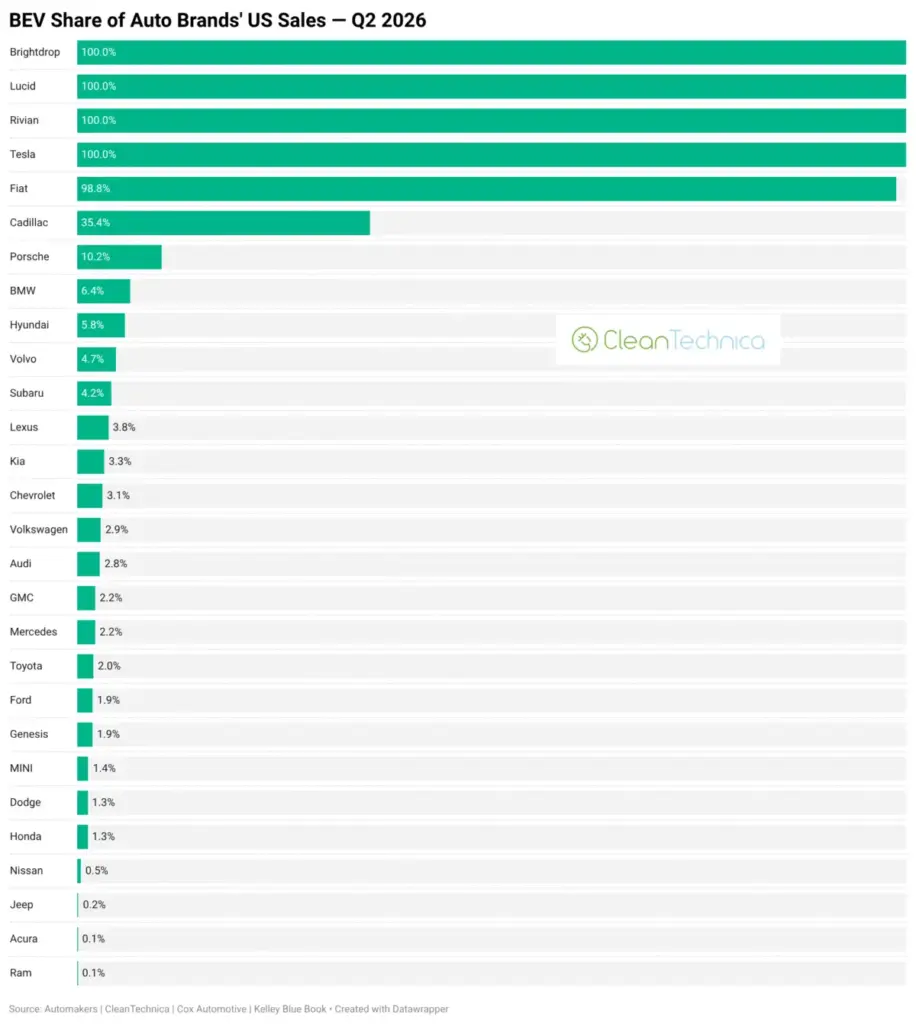
Our findings indicate a bifurcated market. On one end, dedicated 100% EV manufacturers continue to anchor the top of the charts, setting the standard for the industry. On the other end, legacy automakers exhibit drastically mixed progress. While luxury and niche players like Fiat, Cadillac, and Porsche have made notable strides in electrification share, the vast majority of mainstream brands still lag behind, generating only single-digit percentages of their quarterly sales from electric powertrains.
Across major auto groups, the BMW Group maintains its leadership position, closely contested by surging legacy giants like General Motors (GM) and steady performers like Hyundai-Kia. However, as macroeconomic headwinds, supply chain shifts, and changing regulatory environments test the automotive sector, the data from Q1 and Q2 2026 demonstrates that the race to full electrification is far from uniform.

Detailed Chronology: Q1 vs. Q2 2026 Performance Breakdown
The First Quarter of 2026: Slow Starts and Clear Leaders
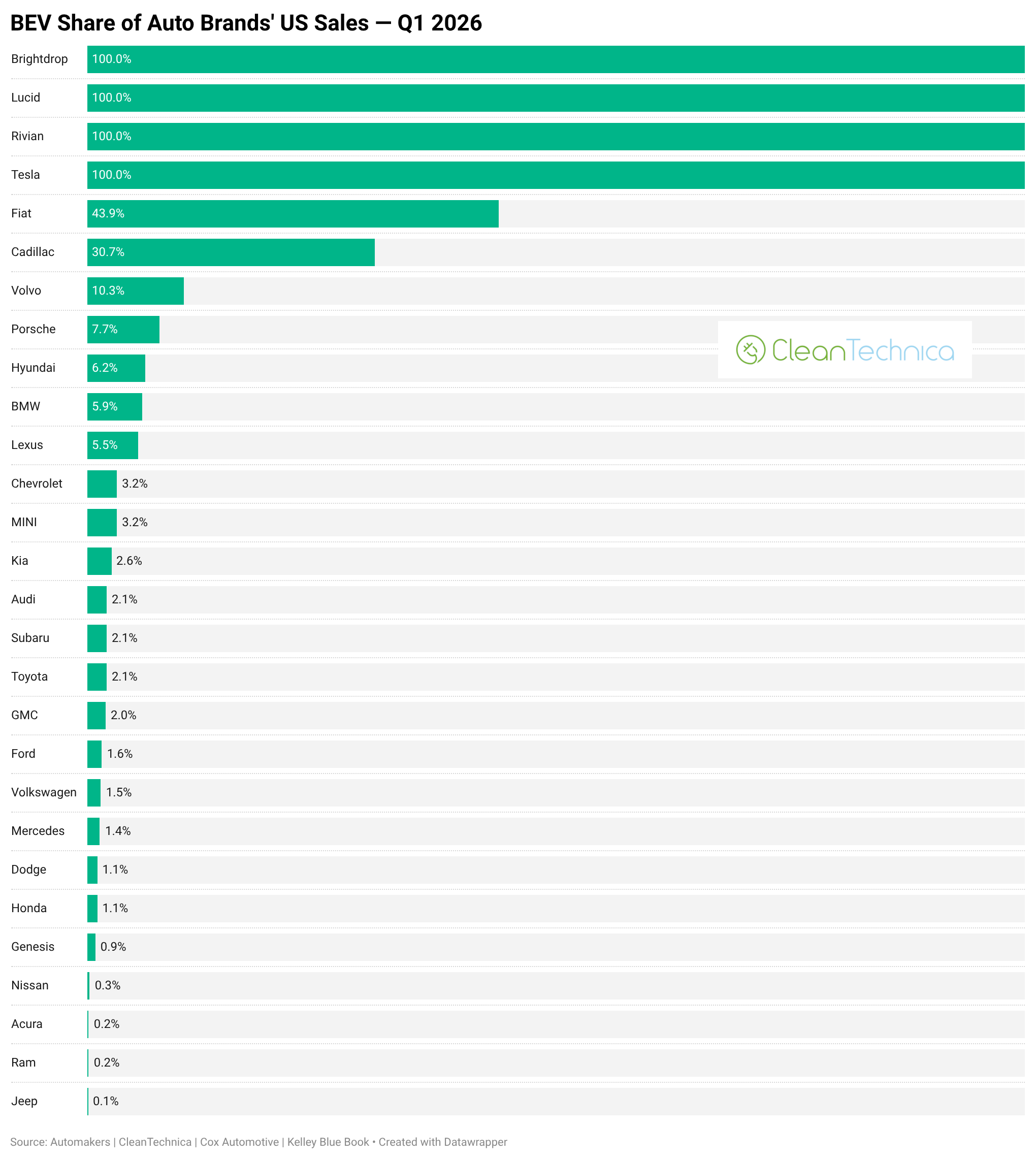
Analyzing the data for the first quarter of 2026 required a deep dive into individual brand registrations and corporate deliveries. When evaluating BEV share as a percentage of total brand sales, pure-play EV manufacturers naturally occupy the absolute top tier, establishing a benchmark for what a 100% electrified portfolio looks like.
Looking past dedicated EV brands, legacy automakers showed stark contrasts in their early-year performance:
- Fiat: Claimed the top spot among traditional legacy-backed brands in Q1, with an impressive 43.9% of its total sales coming from battery-electric vehicles. However, context is vital: Fiat’s overall sales volumes in the US market during this period were exceptionally low (recording just 155 total sales in Q1), making its high percentage a reflection of a niche footprint rather than mass-market dominance.
- Cadillac: Emerged as a genuine bright spot for American manufacturing, securing second place in Q1 with 30.7% of its sales portfolio consisting of BEVs. Driven by the expanding rollout of its Ultium-based electric SUVs, Cadillac proved that traditional luxury buyers are increasingly receptive to electrification.
- Volvo Cars: Stood as the only other brand to clear a double-digit threshold in the first quarter, capturing 10.3% EV share.
- The Moderate Tier: A middle tier of brands demonstrated steady, albeit modest, integration of BEVs into their sales mix. This included Porsche (7.7%), Hyundai (6.2%), BMW (5.9%), and Lexus (5.5%).
- The Laggard Majority: Beyond these select brands, the rest of the legacy automotive landscape remained heavily reliant on fossil fuels, with single-digit or near-zero percentages highlighting the immense work still required to meet long-term climate targets.
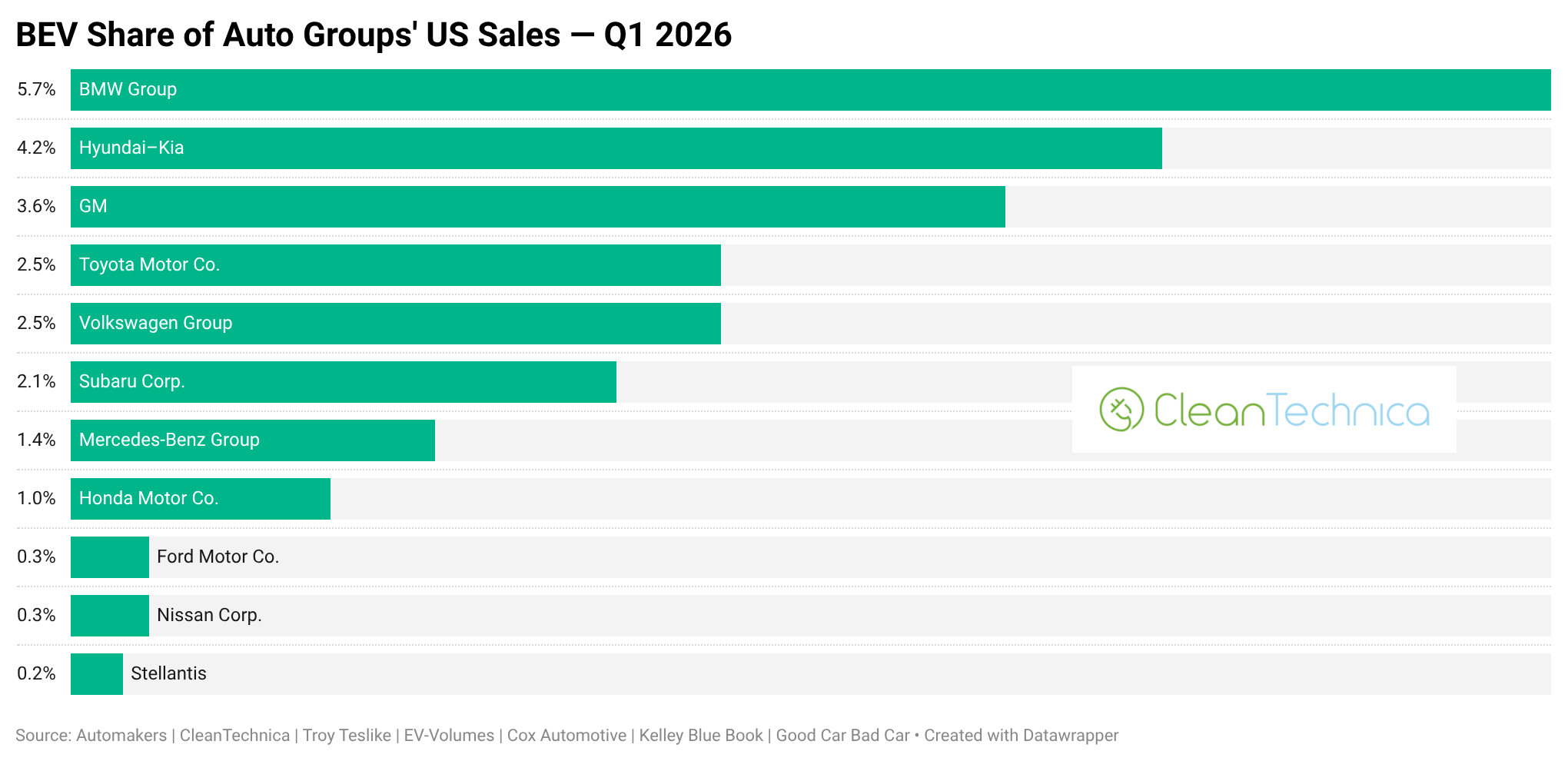
When shifting the lens to overarching auto groups and corporate alliances, the BMW Group captured the #1 position in Q1 with 5.7% of its total corporate sales coming from pure electric vehicles. While 5.7% may seem modest, it outpaced competitors by carefully scaling its electric offerings across both core BMW models and the MINI lineup.
The Hyundai–Kia alliance secured second place among auto groups with 4.2% EV share, leading all major mass-market volume manufacturers. General Motors (GM) followed in third place with 3.6%, reflecting steady early-year output as its production lines ramped up following previous software and battery supply bottlenecks.
The Second Quarter of 2026: Growth, Volatility, and Surprises
As the industry transitioned into the second quarter of 2026, the data revealed interesting shifts—some driven by organic market growth, and others influenced by low-volume statistical anomalies.
Brand-Level Dynamics in Q2
- Fiat remained technically ranked at the top of the brand percentage chart, surging to 98.8% EV share. Yet, a closer examination of the underlying metrics shows that Fiat recorded a minuscule 82 total sales in Q2 2026. This extreme volume constraint underscores why raw percentages must always be weighed against absolute delivery figures.
- Cadillac fortified its position as the premier high-volume legacy EV brand, climbing from 30.7% in Q1 to 35.4% in Q2. Achieving a multi-percentage point increase while handling significantly higher delivery volumes signals robust consumer demand for Cadillac’s electric lineup.
- Porsche displaced Volvo in Q2 to claim the third spot, pushing its BEV share just above the 10% threshold. Meanwhile, Volvo experienced a notable contraction, with its BEV share dropping sharply to 4.7% for the quarter, highlighting quarterly volatility in shipping schedules and regional allocation.
Auto Group Dynamics in Q2
At the corporate alliance level, Q2 2026 brought notable movement:
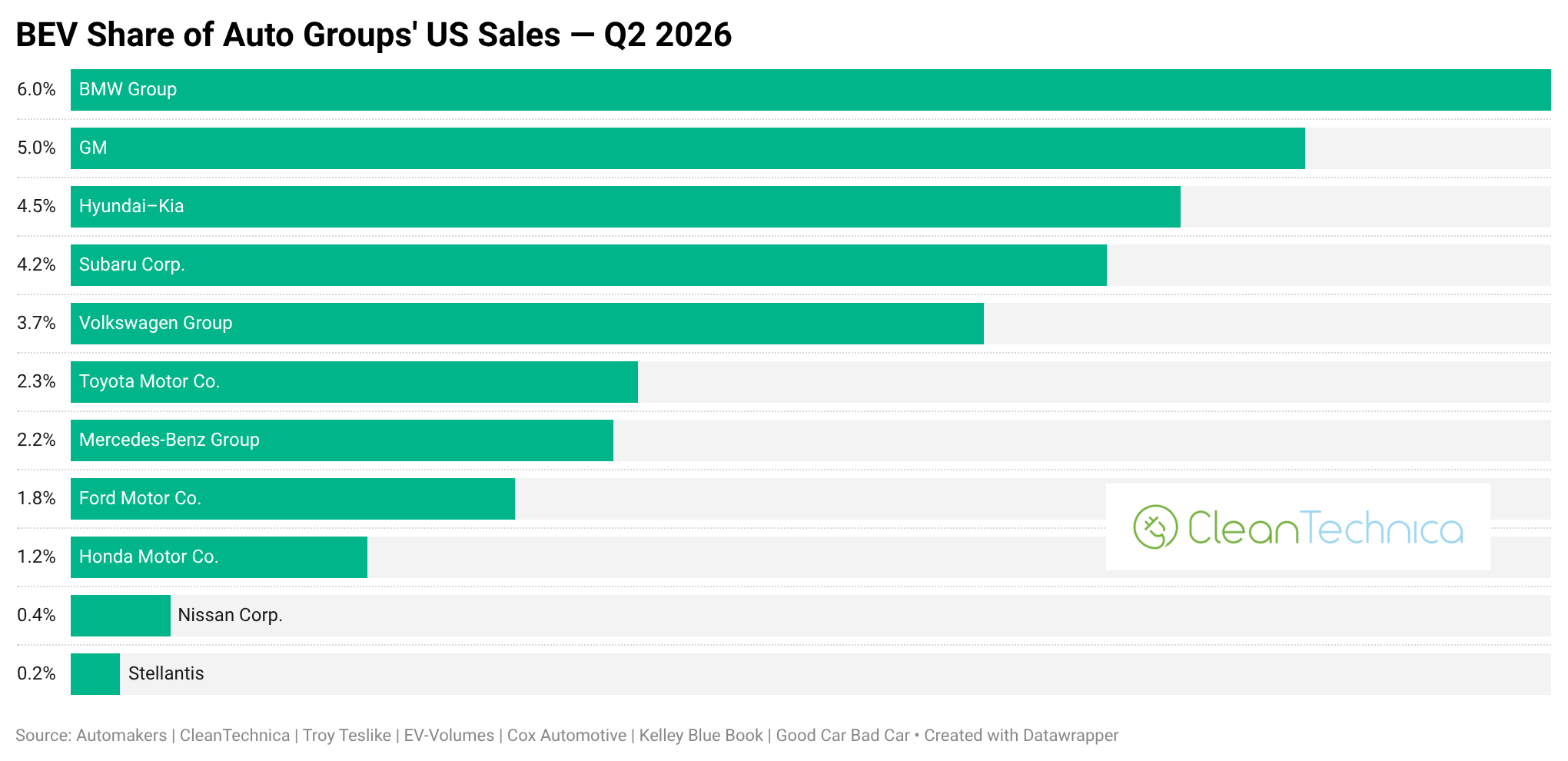
- BMW Group defended its crown, retaining the #1 spot among auto groups and ticking slightly upward from 5.7% to 6.0% total EV share.
- General Motors (GM) engineered the most significant corporate leap of the quarter, shooting up from third to second place. GM’s overall EV share expanded from 3.6% in Q1 to 5.0% in Q2, demonstrating that its manufacturing ramp-up efforts were finally translating into sustained retail deliveries.
- Hyundai–Kia experienced internal growth, increasing its EV share from 4.2% to 4.5%. However, because of GM’s aggressive surge, the Korean automotive giant was pushed down to third place in the group rankings.
- The Subaru Surge: Perhaps the most unexpected development in Q2 was Subaru, which experienced a massive jump from 2.1% EV share in Q1 to 4.2% in Q2. This sudden acceleration highlights how the introduction or wider availability of a single dedicated EV model can rapidly alter a brand’s quarterly metrics.
Supporting Context & Metrics: Analyzing the Data
To fully comprehend the trajectory of US auto sales in 2026, these brand and group percentages must be viewed through the lens of structural market changes.
| Auto Group / Alliance | Q1 2026 EV Share (%) | Q2 2026 EV Share (%) | Trend / Direction |
|---|---|---|---|
| BMW Group | 5.7% | 6.0% | 📈 Steady Growth |
| General Motors (GM) | 3.6% | 5.0% | 🚀 Significant Surge |
| Hyundai–Kia | 4.2% | 4.5% | ↗️ Moderate Growth |
| Subaru | 2.1% | 4.2% | ⚡ Sharp Acceleration |
The Volume vs. Percentage Dilemma
A recurring challenge in analyzing "EV share of sales" is distinguishing between high-percentage niche players and low-percentage mass-market giants. For instance, while Fiat’s nearly 100% EV share in Q2 2026 makes for an eye-catching statistical headline, its sub-100 unit sales volume means its impact on the actual national transition to electric mobility is negligible.
Conversely, when an automotive conglomerate like General Motors—which sells hundreds of thousands of vehicles quarterly—moves its aggregate EV share from 3.6% to 5.0%, it represents thousands of additional internal combustion vehicles replaced by zero-emission alternatives on American roads.
Luxury vs. Mass-Market Electrification Curves
The data from the first half of 2026 reinforces a well-established economic trend: luxury buyers are leading the adoption curve. Brands like Cadillac and Porsche are successfully convincing premium consumers to make the switch. Luxury buyers are typically less sensitive to upfront vehicle purchase costs, have easier access to home charging infrastructure, and value the immediate performance benefits of electric powertrains.
Meanwhile, mass-market brands face steeper hurdles. Affordability, high interest rates, consumer hesitation regarding public charging networks, and lingering range anxiety continue to slow down mainstream adoption. Brands like Hyundai-Kia and Subaru are proving that competitive pricing and practical crossover styling can successfully bridge this gap, but the broader mass market still requires time to catch up.
Official Industry Perspectives and Expert Commentary
Industry analysts tracking the 2026 automotive reports point out that legacy automakers are currently navigating a delicate balancing act. Meeting regulatory compliance while managing capital expenditure on both legacy ICE platforms and next-generation EV architectures creates intense financial pressure.

According to automotive market researchers, the steady leadership of the BMW Group throughout the first half of 2026 illustrates the success of a "flexible manufacturing" strategy. Rather than committing exclusively to bespoke, standalone EV platforms from day one, BMW deployed shared-architecture strategies that allowed them to scale production efficiently in response to shifting consumer demand.
Similarly, General Motors’ Q2 surge to 5.0% corporate EV share validates the long-term investment the company made in its proprietary Ultium battery platform. Despite early production bottlenecks that frustrated executives and dealers alike in previous years, the architecture is finally yielding the economies of scale necessary to drive volume growth in the competitive North American market.
Future Outlook: What Lies Ahead for the US EV Market
As the automotive industry looks past the midpoint of 2026, several critical factors will determine whether brands can accelerate their transition toward electrification or whether growth will continue at a measured, incremental pace.
1. Infrastructure Expansion and Consumer Confidence
The ongoing buildout of fast-charging networks across major US highway corridors remains a vital catalyst. As range anxiety gradually subsides—aided by the broader adoption of standardized charging plugs and the expansion of reliable public DC fast-charging stations—mainstream consumers are expected to display greater willingness to purchase BEVs during their next vehicle lifecycle replacement.
2. Regulatory Pressures and Corporate Strategy
With tightening federal and state emissions standards looming over the horizon, legacy automakers cannot afford to stall their electrification roadmaps. Brands currently lagging in the single-digit percentages—such as those hovering around 2% to 5% EV share—will face mounting pressure to introduce compelling, competitively priced electric models by late 2026 and into 2027.
3. Pricing Pressures and Supply Chain Resilience
The cost parity tipping point between ICE vehicles and EVs continues to edge closer. Improvements in battery chemistry, localized cell manufacturing facilities coming online across North America, and reduced raw material volatility are expected to give automakers more breathing room to offer attractive lease deals and purchase incentives.
Conclusion
The Q1 and Q2 2026 sales data paints a nuanced picture of the American automotive market. While dedicated EV manufacturers continue to blaze the trail, legacy auto groups are moving at distinctly different speeds. Brands like Cadillac and BMW are proving that legacy marques can successfully capture EV market share, while others are still searching for the formula to engage mainstream buyers. As the second half of 2026 unfolds, all eyes will be on whether the surging momentum seen at GM and Subaru can spread to the rest of the industry, pushing overall US electrification numbers to new heights.



