

By Mongabay Founder’s Briefs Series / Special Investigative Report
Executive Overview
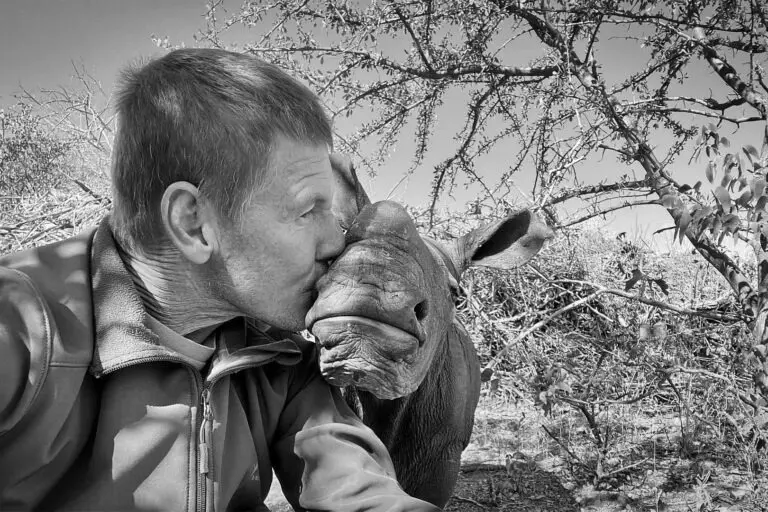
On September 19, conservation the world over lost an unconventional, deeply committed, and fiercely polarizing figure. Jaco Muller, the 53-year-old visionary behind Namibia’s renowned Rhino Momma Project, died tragically when his gyrocopter crashed near Outjo while he was monitoring white rhinos (Ceratotherium simum) and tracking dangerous wildfire flare-ups across his private reserve. Muller’s death marks a devastating end to a personal crusade that began humbly in 2010 as a 15-year-old boy’s high school project and blossomed into one of the most prominent privately run rhino-breeding operations in southern Africa.
Muller was a man caught in the complex crosscurrents of modern wildlife management. Operating in a landscape historically plagued by violent poaching syndicates, he pioneered aggressive, practical defense mechanisms, including routine dehorning and ecotourism-funded security. Yet, his methods and philosophies frequently rattled the international conservation establishment. A vocal proponent of legalizing the international rhino horn trade, Muller argued against the efficacy of prohibition, comparing horn harvesting to shearing sheep to finance anti-poaching security. Furthermore, his 2024 decision to export 42 white rhinos from his Kifaru Lodge to private buyers in Texas sparked international outrage.
Despite these controversies, Muller’s boots-on-the-ground impact is undeniable. Under his stewardship, the Rhino Momma Project recorded nearly 200 live births, serving as an ark for a species under siege. This report examines the life, operational philosophies, controversial strategies, and tragic final flight of Jaco Muller, while analyzing what the future holds for the private conservation model he left behind.
Detailed Chronology: From a Schoolboy’s Dream to a Continental Ark
The Genesis: 2010–2013
The story of the Rhino Momma Project does not begin in corporate boardrooms or international wildlife conventions, but around a family dinner table. In 2010, Jaco Muller’s son, then just 15 years old, proposed an ambitious conservation concept for a school project: what if the family’s traditional antelope-breeding operation in Namibia’s rugged Kunene region was converted into a sanctuary to breed and protect white rhinos?
Muller, recognizing the escalating threats facing African megafauna, embraced the idea. He recognized that state-run parks alone were often underfunded and ill-equipped to handle the surging wave of transnational poaching cartels. Partnering with a rhino-custodianship farm and the nonprofit organization Help Our Rhinos Now (HoRn), Muller pivoted his family land into a dedicated breeding sanctuary.
The endeavor required intensive habitat management, advanced fencing, and round-the-clock surveillance. The gamble began to pay off in 2013, when the project welcomed its very first white rhino calf. That initial birth broke a psychological and operational barrier, proving that private landowners in Namibia could successfully breed megafauna if given the proper security infrastructure.
Scaling Up and Economic Sustainability: 2018–2022
As the rhino population expanded, so did the financial burden of keeping them safe. Feeding, monitoring, and guarding rhinos against heavily armed poachers requires astronomical capital. To bridge this financial gap, Muller inaugurated Kifaru Lodge in 2018.
Kifaru Lodge served a dual purpose: it welcomed international tourists to experience Namibia’s wilderness firsthand, while routing tourism revenue directly into the coffers of the Rhino Momma Project. Visitors paid premium rates to catch glimpses of massive white rhinos roaming the Kunene landscape, providing a sustainable cash flow that reduced reliance on unpredictable philanthropic donations or state grants.
However, external pressures intensified dramatically by 2022. Poaching rings, driven by skyrocketing black-market demand for rhino horn overseas, grew increasingly ruthless. Within a brutal six-week window in 2022, poachers slaughtered 14 white rhinos across private farms in Namibia alone.
Faced with an existential threat, Muller and his team made the agonizing decision to dehorn their herd. One majestic cow carried a horn measuring an impressive 86 centimeters (34 inches). Muller admitted he was nearly in tears the day the horn was sawed off. "It is such a magnificent animal," he reflected at the time. "Pero for the animal’s sake, it is for the best." For Muller, the living, dehorned silhouette of a rhino was infinitely preferable to rotting carcass plundered by poachers.
Global Expansion and the Texas Controversy: 2024
As the breeding program flourished, Muller became convinced that concentrating Namibia’s white rhinos in a single geographic region posed an unnecessary extinction risk. He argued that international dispersal—establishing healthy, insurance populations outside of Africa—was essential for long-term species survival.
This philosophy culminated in a deeply controversial move in 2024, when 42 white rhinos originating from Kifaru Lodge were exported across the Atlantic to private properties in Texas, United States. The transaction triggered immediate outcry from orthodox conservationists and animal welfare groups, who questioned the welfare of African megafauna transported to foreign ranches and criticized the commercialization of wildlife.
Muller, however, stood his ground. He pointed to historical precedents like the Arabian oryx (Oryx leucoryx), which had been pulled back from the absolute brink of extinction through captive breeding networks and international reintroduction programs. To Muller, borders were irrelevant; survival was paramount.
The Final Flight: September 19, 2025
Jaco Muller’s operational style was hands-on to a fault. Rather than managing his thousands of acres from a desk, he took to the skies. He frequently piloted a gyrocopter—a nimble, open-cockpit aircraft—to survey the expansive reserve from an aerial vantage point, checking fence lines, tracking rhino movements, and looking for signs of human intrusion.
On September 19, 2025, that hands-on approach met with tragedy. While monitoring rhinos and battling treacherous wildfire flare-ups near Outjo, Muller’s gyrocopter crashed. The 53-year-old conservationist was killed instantly. At the time of his death, the enterprise that began as a teenager’s school assignment had achieved a staggering milestone: the Rhino Momma Project recorded its 197th birth since 2013.
Supporting Context & Metrics: The Economics and Realities of Rhino Conservation
To fully understand Jaco Muller’s legacy, one must examine the stark economic realities governing African rhino conservation. Protecting a single rhino 24/7 involves intelligence networks, anti-poaching patrols, veterinary care, fuel, communications gear, and aerial surveillance. Without sustainable revenue models, private reserves inevitably bleed money until they collapse—leaving the animals vulnerable.
The Numbers Behind the Rhino Momma Project
- Founding Year: 2010 (converted from an antelope-breeding farm).
- First Calf Born: 2013.
- Total Births Recorded: 197 calves (as of late 2025).
- Geographic Focus: Kunene region, Namibia.
- Key Infrastructure: Kifaru Lodge (opened 2018 to fund conservation through ecotourism).
- Scale: One of Namibia’s largest privately run rhino-breeding operations.
The Dehorning Calculus
Dehorning is an extreme, invasive procedure, but conservation biologists increasingly view it as a necessary triage measure. Keratin—the same protein found in human fingernails and hair—makes up the rhino horn. Because it has no biological necessity for the animal’s survival, it can be safely removed without causing physical pain, provided the procedure is executed under veterinary supervision.

By removing the horn, landowners strip poachers of their primary financial incentive. While dehorned rhinos have occasionally been killed by poachers seeking the small base stub left behind, statistics consistently show that dehorning dramatically reduces mortality rates during poaching surges.
Official Statements and Philosophical Debates
Perhaps the most enduring—and contentious—element of Jaco Muller’s public profile was his staunch advocacy for legalizing the international trade in rhino horn.
The Pro-Trade Argument
Under international law established by CITES (the Convention on International Trade in Endangered Species of Wild Fauna and Flora) in 1977, the commercial trade in rhino horn is strictly prohibited. Proponents of the ban argue that any legal market will stimulate global demand and provide a laundering mechanism for poached horns.
Muller vehemently disagreed. He argued that the prohibition model was fundamentally flawed because it ceded all economic power to criminal syndicates while forcing legitimate landowners and conservationists to shoulder 100% of the security costs.
In a 2025 interview, Muller articulated his perspective with characteristic bluntness:
"Right now, only poachers make money from horns."
Muller compared the harvesting of rhino horns to shearing sheep or harvesting fleece from alpacas. A rhino’s horn naturally regrows over time. Under a regulated, legal framework, private farmers could harvest horn sustainably, sell it into established markets, and reinvest every cent of those profits directly into anti-poaching patrols, habitat restoration, and local community development. To Muller, treating horn as a renewable agricultural commodity was the only way to make private rhino conservation economically self-sufficient over the long haul.
The Conservation Establishment’s Counter-Perspective
Critics of Muller’s philosophy, including major international NGOs and wildlife crime investigators, maintained that introducing legal trade would inevitably catastrophic consequences. Their concerns centered on three main pillars:
- Enforcement Loopholes: Corruption, weak border controls, and fraudulent paperwork in developing nations could allow illegal, poached horns to be easily laundered through legal stockpiles.
- Demand Stimulation: A legal market could destigmatize the consumption of rhino horn in consumer nations (primarily in East Asia, where it is prized in traditional medicine), driving up total demand beyond what captive breeding farms could sustainably supply.
- Ethical Boundaries: Many conservationists argue that treating wild animals as livestock commodifies sentient beings in a way that undermines their intrinsic value.
Regardless of where one stands on the ideological spectrum, Muller’s willingness to challenge orthodoxy forced the global conservation community to confront uncomfortable questions regarding funding, property rights, and the practical economics of keeping endangered species alive in the 21st century.
Future Outlook: The Post-Muller Era for Private Conservation in Namibia
The sudden passing of Jaco Muller leaves an immense vacuum at the heart of the Rhino Momma Project. As Namibia and the broader southern African conservation community mourn his loss, urgent questions loom regarding the long-term viability and direction of the sanctuary.
1. Leadership and Institutional Resilience
For 15 years, Muller was the beating heart, chief strategist, and operational pilot of the project. Transitioning leadership to a structured management team or family board will be critical. The project’s ability to survive will depend on whether its administrative, veterinary, and security protocols have been institutionalized deeply enough to endure without its charismatic founder at the helm.
2. Ecotourism and Financial Sustainability
Kifaru Lodge remains a vital economic engine. Maintaining high tourist occupancy rates in the wake of Muller’s death will be essential to fund the armed patrols, fence maintenance, and veterinary care required to protect the nearly 200-strong lineage of rhinos on the property. Tour operators and conservation partners must step up to reassure international travelers that the reserve remains secure and operational.
3. The Future of Private Custodianship in Namibia
Namibia has long been a global leader in community-based natural resource management and private wildlife custodianship. However, escalating security threats, climate shocks, and regulatory debates over exports (such as the 2024 Texas transfer) mean that private landowners face mounting pressures.
The Rhino Momma Project will serve as a bellwether. If it continues to thrive, produce calves, and secure its borders following Muller’s death, it will cement the private breeding model as a vital pillar of African conservation. If it falters, it will fuel skepticism regarding the sustainability of private megafauna initiatives.
Conclusion
Jaco Muller was never a passive observer of nature. From the moment his teenage son pitched a wild idea in 2010 to his final, fatal flight over the rugged landscapes of Outjo, Muller lived on the frontline of the war to save the white rhino from extinction.
He was a man of bold contradictions: a conservationist who sawed off the magnificent horns of his animals to save their lives; a private landowner who shipped rhinos across oceans to hedge against regional annihilation; and an economic rebel who argued that the only way to defeat poachers was to beat them at their own capitalist game.
As the dust settles over the Namibian veld and the Rhino Momma Project looks toward an uncertain future without its founder, Jaco Muller’s legacy is etched permanently into the landscape. With 197 recorded births, he did not merely talk about conservation—he bred life back into a species that the world was dangerously close to losing.



