

Executive Overview
In the rapidly evolving landscape of global electric mobility, unexpected champions often emerge from the most unlikely places. While automotive analysts and policymakers frequently fixate on massive markets like China, the United States, and Western Europe, a quieter, far more accelerated transformation is taking place in South America. Uruguay—a nation historically reliant on imported internal combustion engine (ICE) vehicles—has shattered every conventional timeline for electric vehicle (EV) adoption.
In a staggering display of consumer preference and structural shift, Uruguay has catapulted from an early-adopter fringe market to a majority-adopter nation. Achieving a monumental milestone that many industry insiders deemed radically optimistic just two years ago, battery electric vehicles (BEVs) captured an astonishing 50% market share in August, while total electrified vehicles (including plug-in hybrids) surged to account for 56% of all new vehicle sales.
This meteoric rise is not merely a statistical anomaly. It represents a fundamental recalibration of consumer demand in a developing market. Over the course of just thirty months, Uruguay has compressed a transition phase that took European leaders nearly a decade to navigate. As combustion-based powertrains rapidly melt away in the face of competitive, high-value Chinese and global EV offerings, Uruguay is no longer just leading Latin America—it is outpacing major industrial economies worldwide, sitting comfortably alongside global pioneers like Norway, Sweden, and Denmark, while eclipsing the adoption rates of China, the Netherlands, and the United Kingdom.
Detailed Chronology: The Road to Majority Adoption
The trajectory of Uruguay’s electric vehicle market over the past several years reads like a masterclass in market disruption. To understand the magnitude of the current shift, one must look at the unprecedented acceleration that characterized the first eight months of the year.
The 2026 Surge
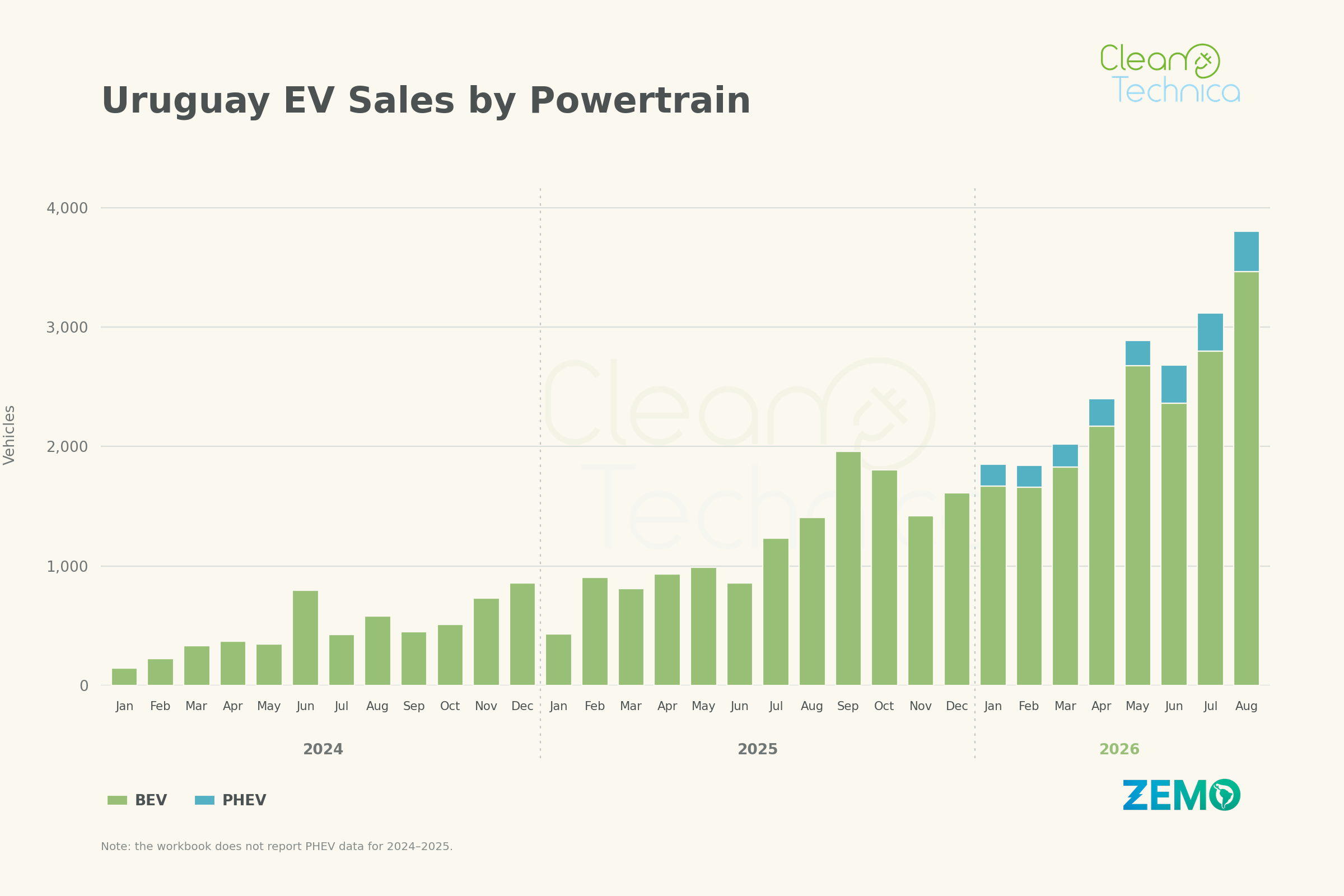
Throughout the year, the Uruguayan vehicle market has experienced a powerful broad-based expansion, with total vehicle sales growing by 16% between January and August compared to the same period in the previous year. However, within this growing market, a severe internal cannibalization has occurred. EV sales skyrocketed, setting monthly volume records in six out of the first eight months of the year.
By August, this momentum culminated in a milestone that fundamentally altered the country’s automotive landscape: EV sales exploded by an incredible 171% year-over-year. Sales approached the 4,000-unit mark for the month, eclipsing the previous all-time high set just a month prior in July by a notable 22%.

When broken down by powertrain, the data reveals a market uniquely devoted to full electrification. Unlike many European or North American markets where plug-in hybrids (PHEVs) serve as a transitional bridge, Uruguay’s consumers have overwhelmingly opted for pure battery power. PHEVs remain a niche category, accounting for roughly one-tenth of total electrified sales. The market is unmistakably, aggressively BEV-centric.
The Compression of Time
Perhaps the most striking element of Uruguay’s trajectory is the sheer velocity of the transition. Moving from a 5% market share to a 50% BEV market share typically requires robust, multi-year state subsidies, aggressive mandates, and extensive nation-building infrastructure initiatives. In Uruguay, this transition was compressed into a mere two and a half years.
This rapid ascent has triggered a parallel collapse in traditional powertrain sales. Despite the broader automotive market experiencing a 16% year-to-date expansion, sales of traditional fossil-fuel vehicles (ICEVs and traditional hybrids) have plummeted by 16% over the course of the year, and are down 20% compared to 2024 levels. The internal combustion engine is not slowly receding into the background in Uruguay; it is being actively and rapidly displaced in real time.
Supporting Context & Metrics: Decoding the Uruguayan Phenomenon
To fully grasp why Uruguay has become an outlier in Latin America, automotive analysts must examine the unique mix of economic drivers, regional market dynamics, and international trade currents fueling this growth.
Economic Motivations and Fuel Pricing Dynamics
At first glance, economic rationality provides a compelling explanation for the shift. Uruguay has long grappled with some of the most expensive gasoline prices on the South American continent. Operating an internal combustion vehicle carries a heavy, recurring operational tax in the form of high fuel expenditures.
However, a closer look at macroeconomic indicators reveals a more nuanced picture. Global supply chain shifts and geopolitical tensions—including localized disruptions tied to conflicts in the Middle East—have kept international oil prices relatively volatile, yet fuel prices inside Uruguay have seen relatively modest increases, rising only 11% to 13% since late 2023. Therefore, while high baseline fuel costs remain a powerful underlying incentive for long-term savings, short-term spikes cannot entirely account for the violent, hockey-stick growth curve witnessed throughout the year.

The Regulatory Horizon: Anticipatory Buying
Another factor shaping consumer behavior is the impending introduction of revised fiscal policies. The Uruguayan government announced that beginning in 2027, a modest internal tax will be levied on imported EVs based on their price tier: a 5% tax for vehicles priced between $19,001 and $27,000 USD, and a 9% tax for vehicles exceeding $27,001 USD.
While these tax rates remain exceptionally low compared to the punishing 35% duties levied on traditional ICE vehicles—and while entry-level budget EVs remain entirely exempt—the mere announcement of future taxation has acted as a psychological catalyst. Consumers and fleet operators alike have rushed to showroom floors to "jump the gun," securing pre-tax pricing on electric models.
Even so, industry observers note that because the incoming taxes are structurally mild, they are unlikely to cause a dramatic slump in post-2027 sales. Instead, market growth is expected to normalize naturally simply because sustaining triple-digit year-over-year growth rates becomes mathematically impossible once a market surpasses 50% saturation.

Competitive Landscapes: Brands and Models Driving the Shift
The structural health of Uruguay’s EV market is further underscored by a healthy, highly competitive brand ecosystem rather than a monolithic monopoly.
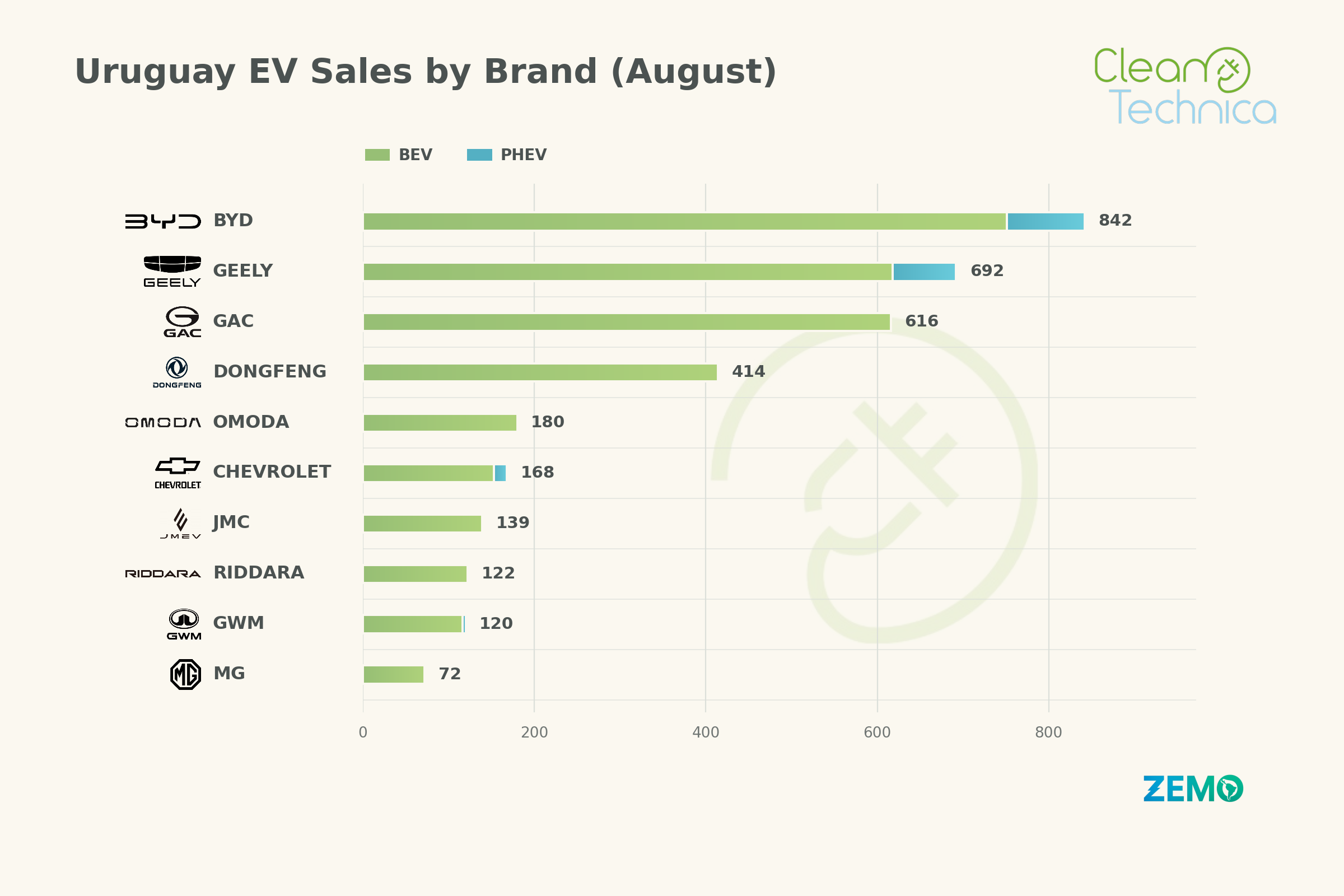
- Brand Performance: In August, Chinese automotive giant BYD maintained its leading position, capturing roughly 25% of the market. However, it faces intense pressure from rival manufacturers such as Geely and GAC. Notably, legacy US automakers have largely struggled to secure meaningful footholds in the region due to pricing and availability pressures, with Chevrolet standing as the sole legacy brand breaking into the upper echelon of the market—largely achieved by successfully introducing rebranded, highly competitive platforms originally developed in Asia, such as localized versions of the Baojun Yep Plus (marketed as the Spark EUV) and Wuling Starlight S derivatives.
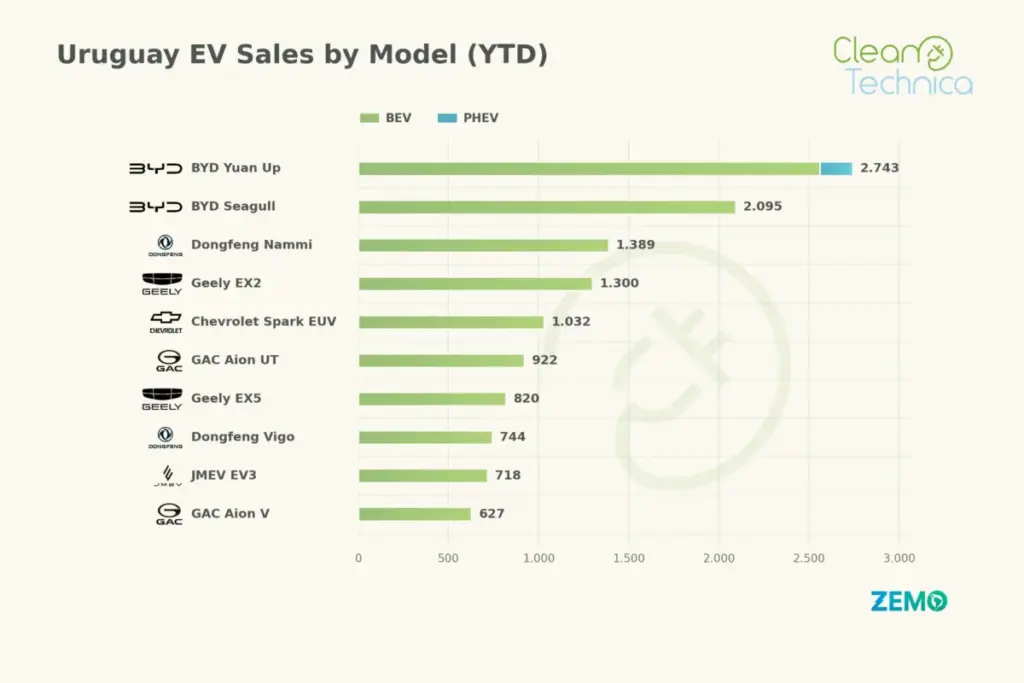
- Model Leadership: At the model level, the competition is fierce and internationally diverse. The Geely Geome (EX2) captured the imagination of Uruguayan consumers to claim the monthly crown, nudging out the immensely popular BYD Seagull into second place. Meanwhile, the GAC Aion UT carved out a prominent podium finish, showcasing the appeal of versatile, feature-rich compact offerings. On a year-to-date basis, BYD maintains a strong cumulative lead anchored by the Yuan Up (which now includes versatile powertrain options) and the Seagull, closely followed by Dongfeng’s value-driven Nammi and the rapidly rising Geely EX2.
Crucially, this entire ecosystem has matured and achieved majority status before the formal entry of Tesla into the local delivery market. While Tesla has generated considerable media attention with aggressive regional pricing strategies, it has yet to truly deploy vehicles at scale in Uruguay. The localized success story is, therefore, one written primarily by Asian manufacturers tailoring affordable, high-utility city cars and crossovers to emerging market needs.
Official Statements and Industry Insights
Market experts and regional analysts tracking the Latin American automotive space have expressed astonishment at the pace of Uruguay’s transformation.
"We are witnessing a structural decoupling of market demand from historical norms," notes regional automotive policy researcher Mateo Silva. "For years, the consensus was that Latin America would serve as a late-stage dumping ground for older ICE platforms as developed nations phased them out. Uruguay has aggressively rejected that narrative. Consumers here have recognized a fundamental reality: electric vehicles simply offer superior total cost of ownership, smoother driving dynamics, and immunity from the volatility of fossil-fuel import markets."
Government officials have echoed the sentiment that the transition is driven by organic consumer adoption rather than heavy-handed state mandates. While state-level incentives—such as exemptions from high initial import tariffs—opened the initial door, the sheer momentum of the 2026 sales figures demonstrates that the market has crossed an inflection point of self-sustaining consumer preference.
"Once the infrastructure reaches a critical density and word-of-mouth regarding maintenance savings spreads through communities, the tipping point arrives faster than any bureaucratic forecast predicts," Silva added. "Uruguay proved that when affordable, compelling BEV options arrive at dealerships, buyers do not need to be forced into making the switch; they choose it willingly."

Future Outlook: The Domino Effect Across Latin America
As the final quarters of the year unfold, the central question facing automotive analysts shifts from whether Uruguay will complete its transition to how quickly neighboring nations will follow suit.
Uruguay’s current market share puts it in elite global company. In terms of pure BEV penetration, the nation now sits comfortably behind recognized global electrification vanguard states like Norway, Sweden, Denmark, Ethiopia, and Nepal, while remarkably outperforming massive industrial automotive markets such as China, the Netherlands, Belgium, and the United Kingdom.
The implications for the broader Latin American market are profound. Historically, regional automotive trends ripple outward from early adopters to larger neighbors like Argentina, Chile, and Brazil. If Uruguay serves as the testing ground for how affordable, globally competitive electric vehicles can rapidly annihilate the market share of traditional combustion engines, it acts as a bellwether for the entire continent.

In the coming years, industry watchers will monitor several critical milestones in Uruguay:
- The Post-Tax Adaptation: How the market absorbs the implementation of the 5% and 9% internal import taxes in 2027, and whether consumer demand remains resilient in the face of slightly adjusted price ceilings.
- The Tesla Factor: How the eventual rollout of high-profile, aggressively priced North American entries impacts an already hyper-competitive market currently dominated by Chinese automakers.
- Fleet Electrification: The speed at which corporate fleets, public transit, and commercial logistics transition to mirror the private passenger vehicle market’s dramatic shift away from liquid fuels.
For now, Uruguay stands as an inspiring blueprint. It demonstrates that the electric vehicle revolution is not constrained by geographic size, macroeconomic wealth, or delayed infrastructure buildouts. When consumer economics align with sustainable technology, change happens not in decades, but in months. As combustion-based cars continue their steady retreat toward irrelevance in Montevideo and beyond, the rest of Latin America is watching closely—waiting for the next regional domino to fall.



