

By Basten Gokkon
Published by Mongabay Conservation News
DOI: https://doi.org/10.66709/news-329426
Executive Overview
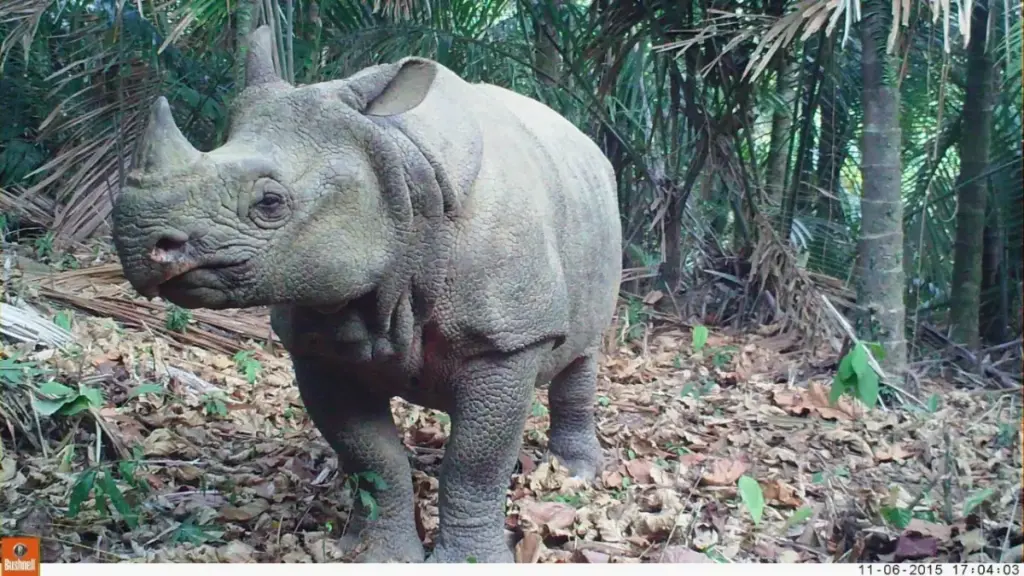
Indonesia’s critically endangered Javan rhinos have narrowly escaped direct harm from an ongoing series of volcanic eruptions at Mount Anak Krakatau, conservation authorities have confirmed. Located approximately 50 kilometers (30 miles) from the volcano, Ujung Kulon National Park—the world’s absolute final stronghold for the species (Rhinoceros sondaicus)—experienced minimal physical disruption following the initial seismic shocks and ash explosions that began in early September. While park rangers on the ground report that the animals appear calm and unaffected by the rumbling mountain, the event has once again cast a harsh, unforgiving spotlight on the precarious plight of a species forced to put all its evolutionary eggs in one fragile, disaster-prone basket.
With the global wild population confined entirely to this single peninsula on the southwestern tip of Java, conservation biologists, independent watchdogs, and government agencies remain locked in a tense debate regarding population numbers, translocation safety, and the catastrophic risks of localized natural disasters. The near-miss with Anak Krakatau serves as a stark reminder that the Javan rhino remains only a single catastrophic event—such as a major tsunami or epidemic—away from total functional extinction in the wild.
Detailed Chronology: The Anak Krakatau Eruption and Ujung Kulon Response
The sequence of events began on September 4, when Mount Anak Krakatau—an active volcanic island rising dynamically from the Sunda Strait between the major islands of Java and Sumatra—unleashed a sudden series of powerful eruptions. The activity sent towering plumes of ash skyward, blanketing parts of both Java and Sumatra, disrupting regional air travel, and forcing the temporary suspension of local schools, marine navigation, and commercial fishing operations.
By September 7, as ashfall settled and seismic instruments tracked ongoing subterranean tremors, conservation authorities turned their urgent attention to Ujung Kulon National Park. Ardi Andono, the head of the park, provided immediate reassurance via electronic communications with conservation media. He confirmed that the park’s environment had sustained minimal physical damage from the vibrations and noise, and stated unequivocally:
"The Javan rhinos remained safe and still appear normal."
Ardi added that park rangers had been placed on heightened alert, conducting continuous patrols across the dense, humid rainforests of the peninsula to monitor both the volcanic fallout and the immediate behavior of the wildlife.
Wildlife conservation researcher Riszki Is Hardianto, a co-author of a critical 2023 review on rhino census methodologies with the Indonesian environmental group Auriga Nusantara, corroborated that no immediate rhino casualties had been linked to the eruption. However, speaking on September 10, Hardianto issued a sobering caveat:

"What’s threatening the Javan rhinos is if a tsunami occurs there."
This distinction highlights the shifting nature of the threat. While the ash and noise of Anak Krakatau passed without claiming lives, the geological relationship between the volcano and the low-lying coastal forests of Ujung Kulon remains a chronic, ticking time bomb for the species.
Supporting Context & Metrics: Population Estimates and the Numbers Controversy
To understand the gravity of any threat to the Javan rhino, one must examine the fierce debate surrounding its exact population size. The species exists in a state of hyper-isolation, and the numbers reported by international conservation NGOs stand in stark contrast to official government estimates.
- International Assessments: Organizations such as Save the Rhino estimate that the total global population hovers precariously at approximately 50 individuals.
- Government Figures: Conversely, the Indonesian Ministry of Environment and Forestry places the population significantly higher, officially reporting between 87 and 100 individuals.
This statistical discrepancy carries immense weight. The official government narrative had long suggested a steady, encouraging population increase year-over-year since 2011. However, this optimistic trajectory hit a wall in 2023 following a rigorous independent investigation by Auriga Nusantara. The investigation exposed profound flaws in the government’s monitoring methods, revealing that camera-trap data had continued to count individual rhinos that had not been visually recorded for years—and in some cases, individuals whose subsequent deaths had already been documented.
The reliance on a single, isolated habitat compounds the danger of these inflated metrics. If the true population is closer to 50 than 100, the genetic bottleneck is significantly narrower than previously hoped, leaving the remaining animals exceedingly vulnerable to inbreeding depression, stochastic environmental shocks, and disease outbreaks. Furthermore, the loss of Ujung Kulon as a viable habitat would mean the instantaneous extinction of an entire evolutionary lineage with no captive populations or alternative wild habitats left to pull the species back from the brink.
Official Statements and Geological Vulnerabilities
The geological volatility of the Sunda Strait is a matter of historical record. Ujung Kulon’s low-lying coastal topography leaves it directly in the crosshairs of marine-based natural disasters.
The most prominent historical precedent occurred in December 2018, when the catastrophic collapse of Mount Anak Krakatau triggered a massive tsunami that slammed into the shores of Ujung Kulon. That disaster claimed the life of at least one Javan rhino and wrought localized environmental destruction. The event galvanized conservationists worldwide, who renewed impassioned pleas for the Indonesian government to establish a secure, secondary rhino sanctuary far away from tsunami-prone coastal zones.
Despite these persistent warnings, executing a relocation plan has proven remarkably difficult. In 2019, conservation planners evaluated the 5,000-hectare (12,400-acre) Cikepuh wildlife reserve on Java’s southern coast as a leading candidate for a secondary population site. The plan was ultimately abandoned after officials deemed the area too high-risk, largely because portions of the reserve were actively utilized for military training exercises.

With plans for a secondary sanctuary shelved, the Indonesian government shifted its strategy toward expanding and actively managing suitable habitats within the boundaries of Ujung Kulon National Park itself. This strategy relies heavily on internal translocations—moving individual rhinos from overcrowded or high-risk zones to other parts of the peninsula to optimize territory usage and encourage breeding.
However, internal management carries its own profound hazards. These risks were laid bare in late 2025 when Indonesia’s inaugural intra-park Javan rhino translocation project ended in tragedy. A male rhino named Musofa was captured and moved to the Javan Rhino Study and Conservation Area, only to die just days later. A subsequent necropsy revealed that Musofa had been suffering from a severe parasitic infection and underlying chronic health problems. Conservation scientists noted that the stress of capture and transport proved fatal for an animal already compromised by hidden ailments, exposing the immense biological risks inherent in handling critically endangered, stressed megafauna.
Compounding these habitat and management struggles, the species has also faced the insidious, targeted threat of illegal poaching. In mid-2025, Indonesian courts handed down a milestone conviction against a trafficking accomplice linked to a devastating poaching ring that targeted Javan rhinos within Ujung Kulon—a stark reminder that human predators pose just as much of a threat to the species as geological forces.
Future Outlook: A Race Against Time
As the smoke clears from Mount Anak Krakatau and Ujung Kulon National Park returns to its humid, rain-soaked normalcy, the underlying reality for the Javan rhino remains unchanged. The species has survived this volcanic episode, but it continues to walk a perilous tightrope over the abyss of extinction.
The immediate future of Rhinoceros sondaicus depends on a delicate balancing act between intensive, invasive conservation interventions and hands-off natural preservation. Key priorities moving forward include:
- Transparent Population Monitoring: Resolving the disparities between independent watchdogs and government census data by adopting more rigorous, scientifically unimpeachable camera-trap and DNA-profiling methodologies.
- Mitigating Tsunami and Volcanic Risks: Enhancing early-warning systems along the Ujung Kulon coastline to give park rangers and wildlife advanced notice of seismic and marine threats.
- Refining Translocation Protocols: Carefully evaluating the health, parasite loads, and stress thresholds of individual rhinos before attempting any future internal or external relocations, ensuring that management efforts do not inadvertently accelerate mortality.
- Combating Poaching Networks: Strengthening law enforcement, community-based intelligence networks, and judicial enforcement to completely eradicate illegal poaching syndicates operating around the borders of the national park.
The Javan rhino remains one of the ultimate symbols of earth’s fragile biodiversity. While the rumble of Anak Krakatau has faded into the background for now, the survival of the world’s rarest rhino requires constant vigilance, transparent science, and unwavering political will to ensure that this ancient lineage does not slip quietly into the history books.
Cite this article:
Basten Gokkon (2026). Javan rhinos survive eruption in Indonesia, but single habitat leaves species vulnerable. Mongabay Conservation News. DOI: 10.66709/news-329426



