Executive Overview
When South Korean battery giant LG Energy Solution (LGES) formally abandoned its prospective $8.45 billion investment in Indonesia’s flagship EV supply chain endeavor—known internally as Project Titan—it sent shockwaves through Southeast Asia’s largest economy. For years, Project Titan had been touted as the centerpiece of Jakarta’s national industrial strategy: an ambitious, end-to-end manufacturing ecosystem designed to transform the archipelagic nation from a raw commodity exporter into a global powerhouse for electric vehicle (EV) batteries.
The sudden withdrawal of LGES, which cited shifting global market dynamics and prolonged feasibility impasses, exposed the fragility of Indonesia’s grand strategy to attract Western and allied Asian capital. Yet, the vacuum left by Seoul was short-lived. A consortium of Chinese state-backed and private enterprises rapidly moved into the breach, securing a $6 billion investment and cooperation framework with Indonesian state-owned entities.
                                  PROJECT TITAN SUPPLY CHAIN

    [ East Halmahera, Maluku ]                                 [ West Java ]
  +----------------------------+                            +-------------------------+
  |  Mining & Refining Hub     |                            | Battery Manufacturing   |
  |  - Limonite/Saprolite Ore  | ===  2,000+ km Maritime ==>| - Cell Production       |
  |  - HPAL Processing (MHP)   |      Shipping Route        | - Pack Assembly         |
  +----------------------------+                            +-------------------------+
                |                                                        |
                +------------------- Chinese Capital & Tech -------------+
While the intervention saved Project Titan from structural collapse, it underscored a deepening strategic paradox for Jakarta. By relying on Beijing to rescue its premier industrial project, Indonesia has locked itself into an even tighter economic embrace with Chinese industrial conglomerates. This shift secures the immediate capital needed to exploit its vast nickel reserves in East Halmahera and process them in West Java, but it simultaneously heightens concerns over sovereign technology transfers, labor dynamics, and growing diplomatic friction with Western markets that are actively seeking to de-risk their supply chains from China.
Detailed Chronology: From Seoul’s Exit to Beijing’s Intervention
The narrative of Project Titan reflects the shifting tides of the global energy transition, geopolitical rivalry, and fluctuating market appetite for EV materials.
       PROJECT TITAN TIMELINE

       2020–2022 ─── Initial Framework Announced
                     - LGES-led consortium signs multi-billion dollar MoU.
                     - Integrated "mine-to-cell" strategy mapped across Maluku & Java.

       2023 ─────── Market Friction & Delays
                     - Feasibility studies stall over cost allocation and ESG standards.
                     - Global EV demand growth slows; nickel price volatility spikes.

       Early 2025 ── Collapse of LG Deal
                     - LGES formally withdraws from $8.45B commitment, citing market conditions.

       Mid 2025 ──── Chinese Consortium Steps In
                     - Beijing-backed group secures $6B revised framework.
                     - Mine-to-battery corridor saved, but deepens dependency on Chinese tech.
The Initial Ambition (2020–2022)
Under the leadership of former President Joko Widodo, Indonesia enacted a strict ban on raw nickel ore exports to force foreign mining and technology companies to build processing infrastructure domestically—a policy termed hilirisasi (downstreaming).
In response, LG Energy Solution formed a South Korean consortium with state-owned miners Aneka Tambang (Antam) and Indonesia Battery Corporation (IBC). The multi-billion-dollar framework was conceptualized as a fully integrated, zero-to-hero project spanning:
- Mining low-grade limonite and high-grade saprolite ore in North Maluku;
- Smelting and refining the raw material into precursor and cathode materials; and
- Manufacturing finished lithium-ion battery cells in a dedicated facility in West Java.
The Stalemate and Breakdown (2023–Early 2025)
Despite high-level political backing, the project was plagued by delays. Feasibility studies dragged on for years amid disagreements over shareholder equity, power infrastructure costs, environmental compliance standards, and commercial valuation. Simultaneously, global EV adoption experienced a mid-decade deceleration—the so-called "EV winter"—which squeezed margins for South Korean battery makers facing high capital expenditure commitments globally.
In early 2025, LGES officially terminated its involvement in the $8.45 billion venture. Company representatives cited deteriorating market conditions, shifting chemistry preferences (such as the rise of lower-cost Lithium Iron Phosphate, or LFP, batteries over Nickel-Manganese-Cobalt, or NMC), and capital allocation adjustments as primary reasons for the exit.
The Chinese Counter-Move (Mid-2025)
Recognizing that the failure of Project Titan would dismantle the pillar of its downstreaming agenda, the Ministry of Energy and Mineral Resources (ESDM), alongside the Ministry of Investment, moved quickly to recruit alternative partners. Within months, a syndicate of major Chinese battery manufacturers, chemical refiners, and engineering firms—supported by state-backed financing mechanisms—stepped forward to replace the South Korean consortium.
The resulting $6 billion framework agreement reassigned key engineering, refining, and manufacturing roles to the Chinese consortium, effectively reviving Project Titan while significantly restructuring its corporate ownership and technological blueprint.
Supporting Context & Metrics: Logistics, Economics, and Dependencies
The operational design of Project Titan highlights both the extraordinary geographical ambition of Indonesia’s industrial planners and the immense capital requirements needed to bridge its regional disparities.
                         EAST HALMAHERA TO WEST JAVA LOGISTICS

  East Halmahera (North Maluku)                        West Java (Karawang/Cikarang)
  +---------------------------+                        +---------------------------+
  |  Primary Mining Sites     |                        | Manufacturing Complex     |
  |  HPAL Processing Plants   | -- 2,000+ km Sea Transit -> | Cathode/Precursor Facilities|
  |  Intermediate Refining    |                        | Battery Cell Assembly     |
  +---------------------------+                        +---------------------------+
Geographical & Logistical Metrics
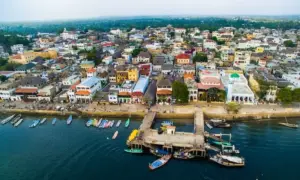
- The Marine Logistics Corridor: Project Titan relies on a maritime supply chain covering over 2,000 kilometers. Raw nickel extracted and partially processed in the remote district of East Halmahera, North Maluku, must be shipped across archipelagic sea routes to industrial manufacturing complexes in Karawang and Cikarang, West Java.
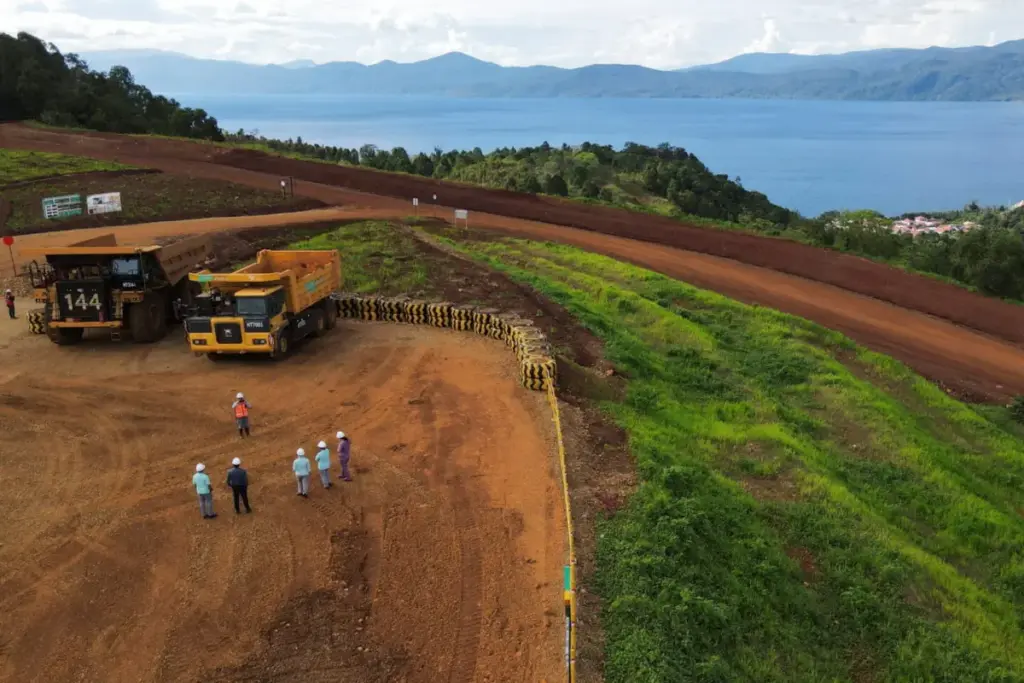
- Resource Scale: East Halmahera sits atop some of the densest nickel deposits on Earth. The region holds billions of wet metric tons of nickel ore, critical for high-energy-density EV battery chemistries.
- Capital Disparity: The replacement framework signed with the Chinese consortium is valued at $6 billion, down from the original $8.45 billion umbrella deal planned by LGES, reflecting a streamlined scope focused heavily on cost-efficient refining technologies.
+------------------------------------+------------------------------------+------------------------------------+
| Metric                             | Original LGES Framework            | New Chinese Consortium Framework   |
+------------------------------------+------------------------------------+------------------------------------+
| Estimated Investment Value         | $8.45 Billion                      | $6.00 Billion                      |
| Primary Processing Technology      | HPAL / Traditional Smelting Mix    | High-Efficiency Chinese HPAL       |
| Primary Downstream Product         | High-Nickel NMC Battery Cells      | Mixed Chemistry (NMC & LFP Formulations) |
| Logistical Scope                   | >2,000 km (Halmahera to Java)      | >2,000 km (Halmahera to Java)      |
| Capital / Equity Origin            | South Korea / Indonesia SOEs       | China / Indonesia SOEs             |
+------------------------------------+------------------------------------+------------------------------------+
The HPAL Dominance and Geopolitical Friction
The integration of Chinese capital brings technological capabilities that traditional Western and allied miners have struggled to execute cost-effectively—specifically, High-Pressure Acid Leaching (HPAL).
                                  THE HPAL CONVERSION PROCESS

  +-------------------+       +--------------------+       +---------------------+
  | Raw Limonite Ore  |  ==>  | HPAL Autoclaves    |  ==>  | Mixed Hydroxide     |
  | (Low-Grade Nickel)|       | (High Temp/Press.) |       | Precipitate (MHP)   |
  +-------------------+       +--------------------+       +---------------------+
                                                                      |
                                                                      v
  +-------------------+       +--------------------+       +---------------------+
  | Precursor Material|  <==  | Nickel Sulfate     |  <==  | Chemical Refining   |
  | & Cathodes        |       | Production         |       | Plant               |
  +-------------------+       +--------------------+       +---------------------+
Chinese firms have mastered the industrial-scale deployment of HPAL plants, which convert low-grade limonite ore into Mixed Hydroxide Precipitate (MHP), an essential chemical intermediate for battery precursor production.
However, this technological efficiency carries significant trade-offs:
- Market Access Restrictions: Under the United States Inflation Reduction Act (IRA), electric vehicles containing battery components or critical minerals extracted, processed, or recycled by a "Foreign Entity of Concern" (FEOC)—defined as entities with 25% or more control/ownership by governments of foreign adversaries, including China—are disqualified from federal consumer tax credits worth up to $7,500.
- ESG and Energy Intensity: HPAL refining is capital- and energy-intensive. Many processing facilities in Eastern Indonesia rely heavily on off-grid, captive coal-fired power plants for operational energy, creating a carbon-intensive paradox for materials intended to support green transport solutions.
Official Statements and Industry Insights
The pivot of Project Titan from South Korean leadership to a Chinese-dominated consortium has provoked varied responses among government officials, economic analysts, and industry observers.
The Official Government Stance
Indonesian officials have framed the arrival of the Chinese consortium as a validation of the nation’s market attractiveness and the resilience of its downstream industrial policies.
Speaking at the signing ceremony for the framework agreement, Minister of Energy and Mineral Resources Bahlil Lahadalia emphasized that national strategic goals take precedence over corporate origins:
"The downstreaming program (hilirisasi) is non-negotiable. Indonesia welcomes partners who bring real capital, proven execution capabilities, and a commitment to processing our commodities domestically. When market forces cause one partner to step back, we move forward with those who are ready to build with us. Project Titan remains alive, and our battery ecosystem will proceed as scheduled."
Critical Analysis from Economic Observers
In contrast to the government’s optimistic framing, independent economists and regional policy experts caution that Beijing’s expanding control over Indonesia’s core industrial assets limits long-term value capture and skill development.
Zulfikar Rakhmat, Director of the China-Indonesia Desk at the Jakarta-based Center of Economic and Law Studies (CELIOS), highlighted the structural drawbacks of this increasing market concentration:
"We get cash, but there is no technology transfer or skilled labor jobs created for the long term. Indonesia’s dependence on China for funding, nickel smelting, and processing capacity is now almost total."
Rakhmat added that the reliance on Chinese engineering turnkey projects frequently leads to the import of specialized personnel rather than upskilling local engineers:
"If the technology remains a proprietary ‘black box’ controlled exclusively by foreign enterprises, Indonesia risks remaining an industrial enclave—a site for extraction and early-stage manufacturing—without developing its own indigenous technological capabilities or intellectual property in energy storage."
Future Outlook: Strategic Balances and Economic Risk
As Project Titan enters its implementation phase under the new partnership structure, the country faces a set of long-term economic, geopolitical, and environmental challenges.
                         JAKARTA'S STRATEGIC TIGHTROPE

                   +-----------------------------------+
                   |     Indonesian EV Ambitions       |
                   +-----------------------------------+
                                     |
         +---------------------------+---------------------------+
         |                                                       |
         v                                                       v
  +-------------------------------+               +-------------------------------+
  |    Capital & Execution        |               |   Market Access & Autonomy    |
  |  - Rapid HPAL Buildout        |               |  - US IRA FEOC Restrictions   |
  |  - Deep Chinese Financing     |               |  - Limited Tech Transfer      |
  |  - Immediate Ore Value Add    |               |  - Captive Coal ESG Risks     |
  +-------------------------------+               +-------------------------------+
The Geopolitical Tightrope
The fundamental challenge facing Indonesia’s new presidential administration is balancing relations with major global powers while maintaining domestic economic development. By relying almost entirely on Chinese conglomerates to execute its battery roadmap, Indonesia risks alienating alternative trade partners. Western automakers, seeking to build supply chains compliant with the US IRA and similar European Union sustainability directives, may find it increasingly difficult to source battery components directly from Indonesian facilities managed by Chinese partners.
Environmental, Social, and Governance (ESG) Challenges
To make its nickel products acceptable to global markets, Indonesia must address the environmental footprint of its industrial hubs. Key priorities include:
- Decarbonizing Industrial Utilities: Transitioning away from captive coal-fired power plants toward renewable energy sources (such as floating solar, hydro, and geothermal) to power smelting operations in Maluku and Sulawesi.
- Waste Management Infrastructure: Implementing environmentally sound tailings management to eliminate the risk of marine ecosystem degradation near East Halmahera.
Economic Sovereignty and Labor Market Upgrading
For Project Titan to serve as a catalyst for broad economic growth rather than just commodity processing, Jakarta must establish stricter operational framework standards. This includes forcing foreign consortia to implement:
- Mandatory technical training programs for local workers;
- Phased integration of domestic joint-venture equity participation; and
- Mandatory procurement of locally produced auxiliary services and machinery.
Conclusion
Project Titan stands as a test case for developing nations attempting to leverage mineral wealth for rapid industrialization. By stepping in to fill the $8.45 billion void left by South Korea’s LGES, China has demonstrated its unrivaled dominance over the global battery supply chain. For Indonesia, the $6 billion rescue deal keeps its dream of becoming an electric vehicle superpower alive. However, without deliberate interventions to secure technology transfers, diversify investment sources, and green its energy grid, Jakarta risks trading its historic dependence on raw commodity exports for a new era of industrial reliance on Beijing.