Executive Overview
KUTZTOWN, PENN. — In an era defined by agricultural vulnerability, supply chain fragilities, and the accelerating impacts of climate change, the conventional metrics of farming are being radically rewritten. On Earth Day 2026, the Davines Group and the Rodale Institute announced Rachel Kulchin, founder of Blue Heron Farm in Bishop, California, as the second annual recipient of The Good Farmer Award U.S.
This prestigious national honor recognizes agricultural pioneers who transcend standard organic methods, engineering regenerative systems that simultaneously restore soil health, protect biodiversity, and secure local food ecosystems. Kulchin’s recognition is a testament to what can be achieved through uncompromising vision. In just a single operating season, she transformed a 10-acre parcel in the Eastern Sierra high desert—a fragile environment where agricultural infrastructure is nearly nonexistent and the vast majority of fresh food is imported—into the region’s largest diversified fruit and vegetable producer.
Producing over 47,000 pounds of nutrient-dense food and engaging more than 3,000 community members through an innovative U-Pick model, Kulchin has not only proved the viability of small-scale farming in hyper-arid climates; she has catalyzed a localized food sovereignty movement. Selected from a highly competitive pool of 118 applicants spanning 25 states, Kulchin’s success, alongside those of finalists Nia Kiara Cole of North Carolina and Nailah Marie Ellis of Georgia, underscores a profound paradigm shift: the future of agriculture lies in localized, climate-resilient, community-integrated organic systems.
Detailed Chronology: From Vision to High-Desert Reality
The journey of Blue Heron Farm and its national recognition did not happen in a vacuum. It is the culmination of strategic perseverance, ecological literacy, and an unwavering belief in the regenerative potential of neglected landscapes.
The Genesis of Blue Heron Farm (2025)
When Rachel Kulchin established Blue Heron Farm in Bishop, California, agricultural skeptics viewed the endeavor with deep apprehension. Situated in the high desert of the Eastern Sierra, the region presents a punishing climate characterized by extreme temperature fluctuations, minimal annual precipitation, arid winds, and poor soil organic matter. For decades, the local population had relied almost entirely on food trucked in from hundreds of miles away, leaving the valley acutely vulnerable to supply chain shocks.
Rather than fighting the desert climate with energy-intensive, resource-depleting conventional methods, Kulchin leaned into ecological mimicry and regenerative organic principles. She planted a mixed orchard and vegetable operation spanning 10 acres, integrating over 1,000 diverse fruit trees alongside companion vegetable crops. From day one, the foundational ethos of the farm was soil regeneration. By focusing on minimal tillage, cover cropping, and intensive water conservation, Kulchin began breathing life back into the desert crust.
The Breakout First Season
The results of Kulchin’s inaugural season defied expectations. By pairing ecological restoration with direct-to-consumer accessibility—specifically through an inclusive U-Pick model that invites community members to harvest directly from the earth—Blue Heron Farm generated immediate local engagement.
In its first year alone, the farm achieved the following milestones:
- Cultivated over 1,000 fruit trees and diversified seasonal crops.
- Produced over 47,000 pounds of fresh, nutrient-dense food.
- Connected directly with more than 3,000 unique customers.
- Established itself as the Eastern Sierra’s premier diversified fruit and vegetable producer.
The Earth Day 2026 Announcement
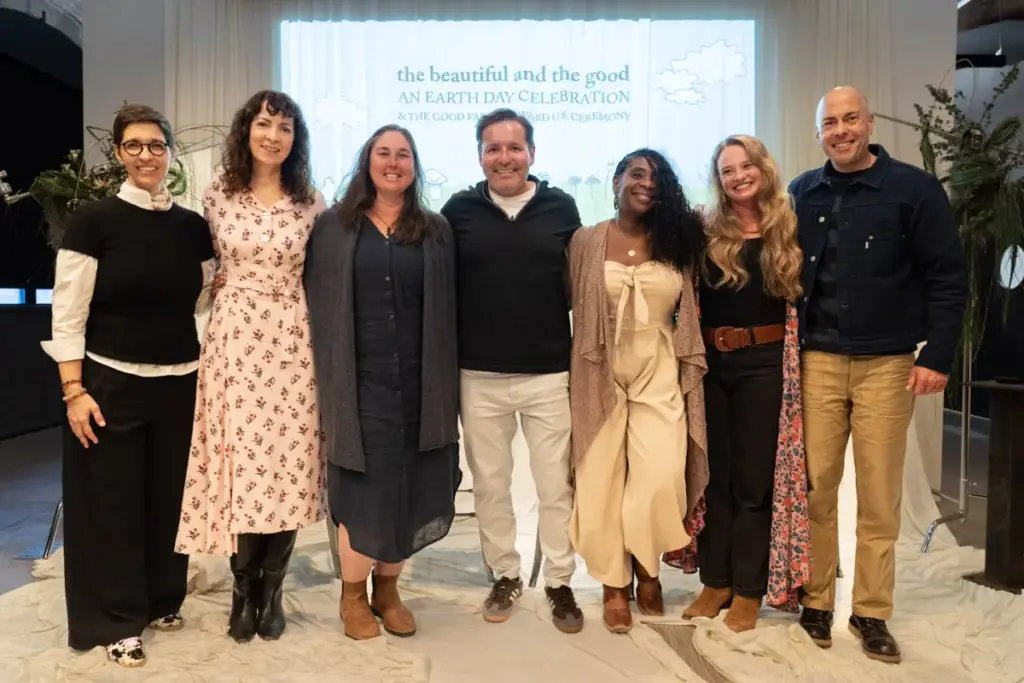
The culmination of this rapid trajectory occurred on April 22, 2026. At a special Earth Day celebration hosted at the Davines Group House in Brooklyn, New York, international leaders in sustainable beauty and regenerative agriculture formally bestowed The Good Farmer Award U.S. upon Kulchin.
The recognition brought immediate international and financial support to the Eastern Sierra. The $10,000 award package is strategically structured to accelerate Blue Heron Farm’s developmental phase: 90% of the funds are designated for critical infrastructure upgrades, specifically targeting advanced water conservation and orchard irrigation systems, while the remaining 10% will support educational signage and public demonstration infrastructure. Additionally, Kulchin secured an all-expenses-paid international exchange visit to the European Regenerative Organic Center (EROC) in Parma, Italy, bridging the agricultural innovations of the American high desert with cutting-edge European soil science.
Supporting Context & Metrics: The 2026 Award Landscape
The significance of Kulchin’s achievement is contextualized by the sheer breadth and competitiveness of the 2026 Good Farmer Award U.S. program.
By the Numbers: The 2026 Applicant Pool
- 118 Farmers applied from across 25 U.S. states, representing a rich mosaic of cultural backgrounds, farm scales, and climatic zones.
- 3 Finalists were honored at the national level, each representing distinct regional challenges and innovative socio-ecological models.
- 3rd Edition of the overarching international award framework, which launched in Italy in 2024 in partnership with the Sustainable Development Foundation before expanding to the United States in 2025.
The Finalists: Diverse Models of Regeneration
While Kulchin captured the top prize for her high-desert innovation, the second- and third-place finalists demonstrated equally transformative approaches to community-centric agriculture:
- Nia Kiara Cole (Kin & Flo Farm, North Carolina): Recognized for her profound work in reclaiming ancestral family land in the North Carolina Piedmont. Cole implements Afro- and Indigenous-descended restorative land practices, actively training the next generation of Black, Indigenous, and People of Color (BIPOC) farmers while building cooperative food systems that advance food sovereignty for historically marginalized communities.
- Nailah Marie Ellis (Blessed Up Blooms, Georgia): Honored for establishing a soil-first, highly urbanized farm model across Atlanta—stretching from Bankhead to Buckhead. Ellis utilizes direct-to-consumer regenerative agriculture to seamlessly weave together food production, ecological beauty, and community nourishment in an urban landscape.
A Rigorous Evaluation Framework
The selection of these agricultural leaders was overseen by a multi-disciplinary judging panel comprised of heavyweights in sustainable agriculture, scientific research, and conscious enterprise. The 2026 panel included:
- Renée Baran, Dean of Education at Rodale Institute.
- Dario Fornara, Research Director of the European Regenerative Organic Center (EROC).
- Kegan Hilaire, Farmer, Owner of Blackbird Farms, and Diversified Vegetable Consultant at Rodale Institute.
- Hayley and Stephanie Painter, Co-Founders of Painterland Sisters (Icelandic Style Skyr Yogurt).
Candidates were rigorously evaluated on their capacity to enhance biodiversity, drive climate change resilience, foster environmental stewardship, and create tangible social equity within their local communities.
Official Statements: Industry Leaders on the Future of Farming
The partnership between the Rodale Institute and the Davines Group represents a growing convergence between corporate sustainability, scientific research, and grassroots agricultural action. Leaders from both organizations emphasized the transformative nature of Rachel Kulchin’s work.
"Rachel embodies the resilient, systems approach that regenerative organic agriculture demands," stated Jeff Tkach, CEO of Rodale Institute. "In just one year, she has built a thriving 10-acre operation that is not only producing nutrient-dense food and restoring soil health, but also inspiring an entire community to reimagine what’s possible for local food security. Her work proves that small farms can be economically viable and ecologically sound, even in the most challenging climates."
For Kulchin, the award represents both a validation of her grit and a vital catalyst for regional change in California.
"I am standing behind a belief that feels both stubborn and bold," reflected Rachel Kulchin. "The recognition through the Good Farmer Award affirms the work we are doing to build something different in the Eastern Sierra. Our goal is not just to grow food, but to demonstrate that regenerative agriculture can thrive in challenging climates and build the resilience our valley desperately needs. This award will be transformational for Blue Heron Farm and for our community."
The international dimensions of the award highlight the interconnected nature of soil health and global corporate responsibility. Davines Group, an Italian family-owned B Corporation operating in over 90 countries, has long championed biodiversity and regenerative growth. In 2021, Davines partnered with the Rodale Institute to establish EROC in Parma, Italy—the first training and research center in Europe dedicated exclusively to regenerative organic agriculture.
"We are delighted to welcome Rachel to Italy and to guide her through our European Regenerative Organic Center," affirmed Davide Bollati, Chairman of the Davines Group. "This year’s award demonstrates why Davines continues to partner with Rodale Institute—not only to source regenerative organic ingredients for our products, but to learn from the Institute’s rigorous research and farmer-first expertise. Rachel’s farm is a living example of building resilient systems with regenerative organic agriculture. By supporting farmers like Rachel, we invest in the future of beauty, agriculture, and the planet."
Future Outlook: Scaling Resilience From Bishop to Parma
As Blue Heron Farm enters its second full year of operation, the trajectory for high-desert regenerative agriculture looks profoundly different than it did just twelve months ago.
With the financial injection from the Good Farmer Award, Kulchin’s immediate focus is the implementation of precision water-saving technologies. In arid ecosystems, irrigation efficiency is the single greatest determinant of long-term agricultural survival. By upgrading her orchard irrigation infrastructure, Kulchin will dramatically reduce water waste while optimizing root-zone hydration for her 1,000+ fruit trees. Simultaneously, the integration of educational signage will transform Blue Heron Farm into an active outdoor classroom, allowing visiting community members and aspiring regional growers to witness firsthand the biological mechanics of soil regeneration in real time.
Looking outward, Kulchin’s upcoming educational exchange at the European Regenerative Organic Center in Parma, Italy, promises to cross-pollinate high-desert American farming techniques with cutting-edge European research. This trans-Atlantic exchange of knowledge embodies the core mission shared by Rodale Institute and Davines Group: proving that regenerative organic agriculture is not a localized trend, but a universally applicable, scientifically validated survival strategy for the planet.
Ultimately, Rachel Kulchin and Blue Heron Farm have redefined the boundaries of what is possible in modern agriculture. By proving that resilient food systems can be successfully anchored in the most fragile and isolated environments, Kulchin stands as a beacon for farmers worldwide, demonstrating that stubborn optimism, paired with sound ecological science, can heal the earth one acre at a time.