Executive Overview
As artificial intelligence workloads scale to unprecedented heights, the technology sector faces an environmental reckoning. The explosive growth of generative AI models, large-scale training pipelines, and real-time inference engines has triggered an insatiable demand for electricity. This surge threatens to derail corporate greenhouse gas (GHG) reduction targets and strain global electrical grids, necessitating the rapid build-out of new natural gas and fossil-fuel-reliant power plants.
Amid this high-stakes backdrop, Advanced Micro Devices (AMD) has laid out an aggressive roadmap to fundamentally rewrite the economics and environmental footprint of AI data centers. According to strategic updates and data released in corporate disclosures, AMD is tracking significantly ahead of schedule in its mission to revolutionize rack-scale energy efficiency.
The chipmaker projects that by 2030, just two AMD-configured server racks will be capable of executing computational tasks that would have required a staggering 570 similar racks in 2024. Stated differently, AMD’s next-generation AI infrastructure will consume 20 times less electricity and operate with a carbon intensity that is 28 times lower than current benchmarks.
This ambitious trajectory is not merely a public relations talking point; it is a structural necessity. With approximately 85 percent of AMD’s total greenhouse gas emissions stemming directly from the operational use phase of its deployed products, energy efficiency has become the single most critical battleground for the company. By tying product-level performance-per-watt targets directly to employee and executive compensation, AMD is institutionalizing sustainability into its core engineering DNA.
However, as tech giants jockey for dominance in the trillion-dollar AI infrastructure market—with rivals like NVIDIA pushing alternative performance and efficiency metrics—investors, climate advocates, and grid operators are demanding a closer look. While technological innovations in silicon design, liquid cooling, and rack-level co-optimization offer a promising path forward, the broader question remains: Can hardware efficiency outpace the exponential growth of total computing demand?
Detailed Chronology: Milestones in AMD’s Efficiency Journey
To understand how AMD arrived at its current 2030 projections, it is essential to examine the chronological progression of its engineering roadmap, corporate disclosures, and sustainability commitments over recent years.
The Foundation and Early Projections (2024–2025)
- Early 2024: As commercial adoption of generative AI accelerated, AMD established its baseline metrics for rack-scale energy efficiency. At the time, standard AI training and inference workloads demanded massive physical footprints, requiring hundreds of server racks to process complex multi-modal models.
- Mid-2025: Responding to shareholder advocacy—most notably from sustainable investment firms like Green Century—AMD published its inaugural climate transition plan. This document formally outlined the company’s long-term decarbonization strategy, aligning product development cycles with Scope 1, 2, and 3 emissions reduction targets.
- August 18, 2025: AMD released its highly anticipated corporate responsibility report. The disclosures revealed that the company had already achieved a remarkable fourfold increase in energy efficiency between 2024 and 2026. This leap was driven by an intentional pivot toward co-optimized, rack-scale system designs rather than relying solely on incremental improvements in individual graphics processing units (GPUs).
Accelerating Toward 2030 (Late 2025–Present)
- Mid-2026: In a series of technical blogs and executive briefings, AMD senior leadership updated the market on its rack-scale trajectory. The company confirmed that it was tracking ahead of its original internal timelines to deliver a 20-fold increase in efficiency by the end of the decade. This rate of progress outpaces historical industry efficiency averages by a factor of three.
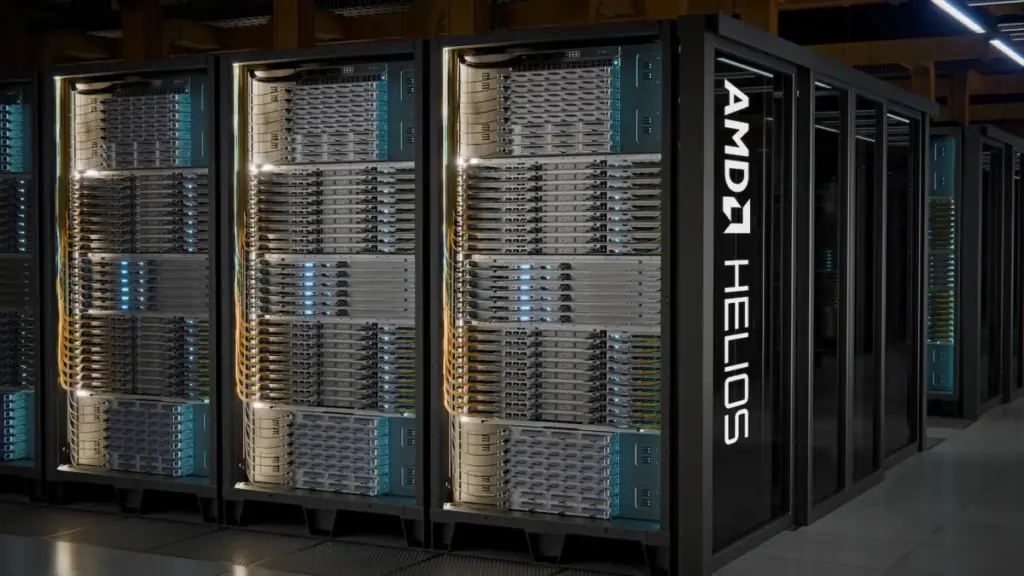
- Current Operations: AMD’s flagship integrated rack system, Helios, has emerged as a cornerstone architecture for hyperscale cloud providers and AI hyperscalers—including Meta, Microsoft, OpenAI, and Oracle. These systems are heavily deployed for both large-scale model training and rapid-response inference tasks, serving as the proving ground for AMD’s advanced cooling and interconnect technologies.
Supporting Context & Metrics: The Physics of Rack-Scale AI
Achieving a 20-fold reduction in energy consumption over a six-year period requires a paradigm shift in how data center hardware is engineered. Historically, chipmakers focused primarily on transistor density and raw processing power (such as Floating Point Operations per Second, or FLOPs), often leaving power delivery and thermal dissipation as secondary considerations for data center operators.
The Systems-Level Approach
Modern AI workloads are bound not just by compute capacity, but by memory bandwidth, data transfer speeds, and thermal limits. According to Sam Naffziger, senior vice president and corporate fellow at AMD, the traditional method of designing chips in a vacuum is obsolete.
"The next wave of AI efficiency will depend on tighter co-optimization across compute silicon, memory, interconnects, software and rack-scale system design," Naffziger noted in an engineering brief.
By treating an entire server rack as a single, unified computer rather than a collection of disparate motherboards, AMD’s engineering teams can optimize power distribution and minimize energy loss across internal data paths. Furthermore, AMD’s efficiency calculations incorporate advanced rack-level cooling technologies—such as direct-to-chip liquid cooling systems—which drastically reduce the auxiliary energy required to maintain safe operating temperatures.
Independent Validation
Jonathan Koomey, an independent industry analyst who has published extensive research on data center energy and water consumption, highlighted the rigor of AMD’s reporting methodology. While AMD’s metrics do not account for the peripheral electricity and water required to cool the broader data center facility outside the rack, Koomey views the company’s transparency as a breath of fresh air in an industry often prone to hyperbole.
"AMD is being very transparent about what it will take, and it is known for being rigorous," Koomey observed. "The systems-level view is very appropriate."
Official Statements and Industry Perspectives
The race for AI infrastructure dominance is defined by fierce competition between AMD and its primary rival, NVIDIA. Both companies pitch energy efficiency as a core value proposition to corporate clients who are increasingly constrained by localized power grid capacities and corporate net-zero mandates.
Perspectives from AMD Leadership
For AMD, sustainability is no longer siloed within a corporate social responsibility (CSR) department; it is embedded into the engineering incentives of every product group. Justin Murrill, AMD’s Chief Sustainability Officer, emphasized that the company’s commercial success and environmental strategy are inextricably linked.
"Our biggest impact and opportunity is the energy efficiency of our products," Murrill stated in an interview.
To ensure accountability, AMD enforces strict efficiency-per-watt targets for every new product pipeline. Crucially, meeting these benchmarks is directly tied to the company-wide employee bonus structure, aligning financial incentives with climate goals.
The NVIDIA Counter-Strategy and Competitive Landscape
Meanwhile, market titan NVIDIA continues to advance its own distinct sustainability metrics. NVIDIA’s primary public pledge focuses on reducing the emissions intensity generated by the use of its products by 75 percent per PetaFLOP by fiscal year 2030.
In its mid-2026 sustainability report, NVIDIA bypassed traditional progress tracking against that baseline, instead highlighting the generational leap embodied by its Vera Rubin product architecture. According to NVIDIA, Vera Rubin delivers a tenfold improvement in energy efficiency compared to its predecessor, the Blackwell architecture. (NVIDIA declined to provide additional on-the-record commentary for this reporting).
The ESG Investor Viewpoint
Despite impressive hardware efficiency gains, financial stakeholders urge caution against viewing chip-level metrics as a silver bullet for corporate climate accountability. Giovanna Eichner, a shareholder advocate at Green Century Capital Management, points out the inherent paradox of efficiency in a hyper-growth market.
"Energy efficiency doesn’t always translate to emissions reduction if you’re continuing to crank out products at a higher rate, and so that’s why transparency is really important," Eichner explained. "They have an energy efficiency commitment, which is great. But that’s not telling us the full story."
Future Outlook: Scope Emissions and the Road to 2030
As AMD and NVIDIA chart their respective paths toward 2030, the broader environmental impact of the semiconductor industry will be judged across all three scopes of greenhouse gas accounting.
Scope 1 and Scope 2: Direct and Purchased Emissions
Both AMD and NVIDIA have committed to reducing their direct operational emissions (Scope 1) and emissions tied to purchased electricity (Scope 2) by 50 percent by 2030.
- AMD has successfully cut its Scopes 1 and 2 emissions by 30 percent from its baseline.
- NVIDIA reported a market-based emissions increase of 13 percent between fiscal years 2025 and 2026, though its cumulative reduction since 2024 stands at approximately 80 percent, buoyed by aggressive renewable energy procurement.
Scope 3: Supply Chain and Product Use Realities
The vast majority of emissions for fabless semiconductor companies—firms that design chips but outsource physical manufacturing to dedicated foundries like TSMC—reside in Scope 3 categories.
For AMD, Scope 3 emissions hovered around 24.1 million metric tons of carbon dioxide equivalent ($textmt of CO_2texte$) across recent reporting cycles. Approximately 85 percent of this total originates from the downstream use of sold products. To mitigate this, AMD has set a goal to slash supply chain carbon intensity by 25 percent between 2024 and 2030, achieving an 8 percent reduction thus far by pushing manufacturing partners to transition fully to renewable electricity. Notably, as of 2025, AMD successfully engaged 100 percent of its primary suppliers to establish verified GHG reduction targets.
NVIDIA faces mounting pressure from investors regarding its Scope 3 disclosures. NVIDIA’s indirect supply chain emissions grew by roughly 54 percent year-over-year to 10.7 million $textmt of CO_2texte$ in fiscal 2026—a total that notably excludes emissions generated by the end-use of its deployed hardware. This omission prompted Green Century and Mercy Investment Services to file a shareholder resolution demanding comprehensive end-use disclosures and a formal climate transition plan. While the initial resolution garnered 18 percent support, investor advocates vow to continue pushing for standardized transparency.
Conclusion
AMD’s pledge to deliver a 20-fold increase in rack-scale efficiency by 2030 represents a monumental engineering ambition. By pairing advanced silicon co-optimization with aggressive supply chain engagement and internal financial incentives, the company is attempting to bend the carbon curve of the artificial intelligence boom.
Yet, as data center power requirements continue to test the limits of global energy infrastructure, hardware efficiency alone will not solve the climate equation. The ultimate success of the AI revolution will be measured not just by how much faster and more efficiently servers can compute, but by whether the industry can decouple computational growth from ecological degradation before the decade is out.