For years, corporate sustainability officers and brand strategists have walked a treacherous tightrope. In an era of intense political polarization, many companies have feared that committing to environmental, social, and governance (ESG) goals—or simply talking openly about sustainability—might alienate conservative consumers. The conventional wisdom has long dictated that climate action is a wedge issue, deeply dividing a progressive base that demands corporate accountability from a skeptical conservative base that views green initiatives as unwelcome ideological intrusion.
However, a comprehensive new survey of 2,000 U.S. voters shatters these long-held assumptions. Conducted jointly by the nonprofit Center for Climate and Energy Solutions (C2ES), communications agency maslansky + partners, and nonprofit marketing firm Potential Energy Coalition, the research reveals that consumer support for corporate climate action is remarkably broad. Crucially, this backing extends even to climate-skeptical Republicans, provided corporations frame their initiatives through the right narrative lens.
The findings offer a vital roadmap for businesses navigating the modern cultural landscape. While the partisan divide on environmental policy is real, it is far more nuanced than political headlines suggest. Approximately three-quarters of all surveyed voters agree that corporations bear a fundamental responsibility to limit their impact on the climate and environment. Astonishingly, support among Republican voters for that sentiment hovers above two-thirds—a strong indicator that the appetite for responsible business practices transcends party lines.
Furthermore, voters across the political spectrum are prepared to put their money where their mouths are. A clear majority favor companies that adopt clean energy strategies and reduce carbon pollution, while actively penalizing those that fail to act. Yet, the survey also uncovers a growing risk: climate actions are increasingly perceived as politically charged, leaving brands vulnerable to accusations of hypocrisy if they backpedal under pressure. This article delves into the nuances of the survey data, explores the evolving dynamics of corporate climate communication, and outlines actionable strategies for businesses seeking to champion sustainability without falling victim to the culture wars.
Detailed Chronology: The Evolution of Corporate Climate Communication
To understand the current state of consumer attitudes toward corporate climate action, it is necessary to examine how the landscape has evolved over the past decade.
Phase One: The Rise of Unfiltered ESG and Green Marketing (2015–2020)
In the wake of the 2015 Paris Agreement, corporate America rushed to embrace sustainability. During this period, climate action was largely treated as a win-win marketing strategy. Companies launched sweeping net-zero targets, transitioned to renewable energy, and marketed their eco-friendly credentials with minimal pushback. For most consumers, corporate greening was viewed as a benign or inherently positive development. Political polarization existed, but it had not yet fully weaponized corporate sustainability efforts.
Phase Two: The Backlash and the Rise of "Greenhushing" (2021–2023)
As sustainability commitments matured, political actors began to target corporate ESG initiatives, framing them as examples of "woke capitalism." Conservative lawmakers launched investigations, threatened boycotts, and accused corporations of prioritizing political agendas over shareholder value. In response, many boardrooms panicked. Fearful of consumer alienation and regulatory blowback, companies entered an era of "greenhushing"—quietly continuing their sustainability efforts while stripping environmental buzzwords from their public-facing marketing materials. Public discourse suggested that talking about climate change was now a liability, particularly when attempting to appeal to conservative or moderate demographics.
Phase Three: The Nuanced Reality Uncovered (2024–Present)
The release of the C2ES and maslansky + partners survey marks a critical turning point in understanding this dynamic. Rather than validating the fear that climate action is universally toxic to conservative consumers, the data proves that the method of communication, rather than the substance of the action, dictates public reception.
When researchers dug deeper into voter sentiment, they found that while partisan rhetoric surrounding climate change remains polarized, the practical outcomes of corporate environmental stewardship—such as cost savings, energy independence, technological innovation, and pollution reduction—resonate universally. The survey captures a public that is increasingly fatigued by political posturing and demanding authenticity, consistency, and common-sense business leadership from the brands they patronize.
Supporting Context & Metrics: What the Data Tells Us
The survey of 2,000 U.S. voters provides a granular look at how the American electorate evaluates corporate environmental responsibility. The quantitative insights dispel several myths that have paralyzed corporate communications teams in recent years.
1. Broad Consensus on Corporate Responsibility
When asked whether companies have a responsibility to limit their impact on the climate and the environment, approximately 75% of all respondents answered in the affirmative. While Democratic support for this statement was predictably high, the conservative baseline defied expectations: more than two-thirds of Republican voters agreed with the premise. This demonstrates that the foundational belief in corporate environmental stewardship is not a partisan fringe view, but a mainstream American value.
2. Purchasing Power and Accountability
Consumer behavior is increasingly tied to corporate environmental performance. According to the survey metrics:
Over 60% of all respondents stated they are more likely to purchase products and services from companies that utilize clean energy or actively reduce carbon pollution.
Consumers are not just rewarding leaders; they are willing to penalize laggards. Voter loyalty is directly influenced by a brand’s steadfastness on environmental commitments.
3. The Danger of Backtracking
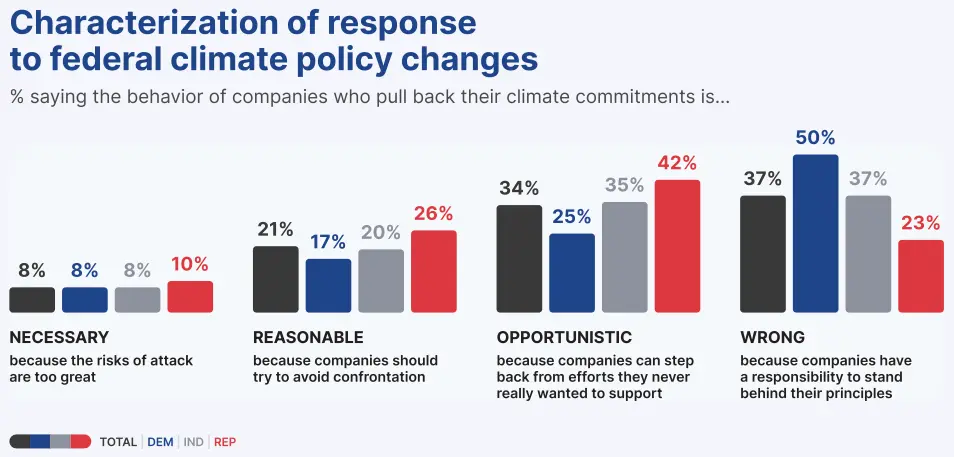
Perhaps the most striking finding of the research revolves around corporate consistency. When companies make climate commitments and subsequently abandon them under political or economic pressure, consumers take notice—and they are deeply critical.
71% of all voters described backtracking on climate initiatives in response to government or political pressure as either "opportunistic" or "wrong."
Even among Republican voters, 65% condemned the practice, viewing corporate retreat as a sign of weakness or insincerity rather than a sensible pivot.
4. The Rising Politicization of Everyday Actions
Despite strong support for green business practices, the survey sounds a note of caution regarding the accelerating polarization of specific environmental actions. The data reveals a troubling trend: routine corporate decisions are increasingly viewed through a partisan lens.
For example, when asked about companies deciding to phase out or end the use of fossil fuels:
In 2024, 40% of Democratic respondents categorized this business decision as "taking a political stance."
By 2025, that figure jumped to 55%.
This upward trajectory indicates that every facet of the energy transition is becoming more politically charged, underscoring the delicate tightrope companies must walk as they modernize their operations.
Official Statements & Industry Perspectives
The insights generated by the survey have surprised even seasoned communications and policy experts, sparking vital conversations across the corporate and non-profit sectors.
Nicholle Manners, Senior Vice President at maslansky + partners, expressed astonishment at the depth of consumer intolerance for corporate flip-flopping. Discussing the finding that 71% of voters view backtracking as wrong or opportunistic, Manners noted:
"I was surprised by that. Consumers value consistency and authenticity far more than brands often realize. When a company abandons its stated values under pressure, it alienates both supporters of the initiative and skeptics who view the retreat as opportunistic."
Verena Radulovic, Vice President for Business Engagement at the Center for Climate and Energy Solutions (C2ES), highlighted the unexpected alignment between climate-skeptical conservatives and smart business logic:
"I did not expect climate-skeptical Republicans to agree that this is smart business. That was really encouraging to see. It proves that when you talk about climate action in terms of efficiency, innovation, and long-term economic viability, the partisan walls begin to come down."
The collaborative effort behind the research—including contributions from the Potential Energy Coalition, a nonprofit marketing firm dedicated to shifting public demand for climate solutions—underscores a growing recognition that effective climate communication requires sophisticated, data-driven messaging strategies rather than blunt ideological appeals.
Future Outlook: Strategic Recommendations for Corporate Leaders
As businesses look toward the future, the mandate is clear: companies cannot afford to abandon climate action, nor can they afford to communicate about it clumsily. To successfully navigate the landscape revealed by the C2ES and maslansky + partners survey, corporate leadership, marketing executives, and sustainability officers should consider the following strategic imperatives:
1. Shift from Ideology to Economics
To win over conservative and skeptical consumers, communications teams must pivot away from abstract moralizing and focus on the tangible business benefits of sustainability. Framing clean energy adoption, waste reduction, and resource efficiency as matters of financial prudence, technological modernization, and risk management broadens appeal. When consumers understand that sustainability leads to lower overhead costs, enhanced supply chain resilience, and cutting-edge innovation, partisan resistance fades.
2. Prioritize Consistency Over Expediency
The data unequivocally shows that consumers despise corporate backtracking. When external political pressure mounts, the temptation to quietly sunset climate targets or strip sustainability pages from corporate websites can be high. However, doing so alienates two-thirds of the electorate who view such retreats as opportunistic. Companies must set achievable, realistic goals and stick to them with unwavering transparency.
3. De-escalate the Rhetoric
With the survey indicating that everyday operational decisions are increasingly seen as political statements, businesses must work proactively to de-escalate the cultural temperature around their transition strategies. This involves communicating changes—such as energy sourcing transitions or efficiency upgrades—as standard business evolution rather than revolutionary ideological crusades.
4. Leverage Trusted Messengers
Corporate leadership must recognize that the messenger matters as much as the message. Partnering with industry groups, local business leaders, and cross-partisan coalitions can help validate corporate climate initiatives. When sustainability is championed not just by corporate headquarters, but by local franchises, workers, and regional partners, it becomes harder to dismiss as an out-of-touch coastal mandate.
Conclusion
The findings from the C2ES, maslansky + partners, and Potential Energy Coalition survey offer a much-needed course correction for corporate America. The narrative that climate action is a political minefield is overly simplistic and ultimately misleading. While the culture wars are fierce, the American consumer base remains deeply pragmatic.
By recognizing that roughly three-quarters of all voters—including a decisive majority of Republicans—expect businesses to act responsibly toward the environment, companies are empowered to move forward with confidence. Success does not require hiding green initiatives or cowering in the face of political pressure; rather, it demands clear, economically grounded communication, steadfast consistency, and an authentic commitment to building a resilient, sustainable future.