Executive Overview
Across North America and Europe, municipal solid waste management is undergoing its most significant structural shift since the introduction of curbside recycling in the late 20th century. Driven by aggressive climate mandates and a growing recognition of the environmental toll of landfills, municipalities have rapidly scaled up curbside organic waste collection. According to data from BioCycle’s nationwide survey, access to household food waste collection in the United States surged to 14.9 million households in 2023—a 49 percent increase from just 10 million households two years prior.
Yet, this rapid expansion of infrastructure highlights a stark, systemic challenge: access does not equal participation. While a handful of highly motivated, progressive urban centers report near-universal utilization of their organics programs, other jurisdictions struggle with participation rates well below 30 percent.
This compliance gap is not merely an administrative headache; it is an environmental catastrophe. Food waste represents approximately 24 percent of the municipal solid waste (MSW) stream entering U.S. landfills. Once buried under layers of inorganic refuse, this highly organic material undergoes anaerobic decomposition, releasing vast quantities of methane—a potent greenhouse gas with a global warming potential up to 80 times greater than carbon dioxide over a 20-year timescale. The U.S. Environmental Protection Agency (EPA) estimates that food waste alone accounts for a staggering 58 percent of all fugitive methane emissions escaping from municipal landfills.
Consequently, an unused or underutilized curbside organics bin is not a neutral policy outcome; it represents a failure of behavioral execution. To bridge this gap, municipal policy analysts and environmental engineers are shifting their focus from macro-infrastructure to micro-behavior, investigating the everyday household frictions that cause residents to abandon their green bins.
Among these frictions, one unglamorous but powerful barrier stands out: the visceral "yuck factor" of bin maintenance. This report investigates why households quit organics programs, the mechanics of organic decomposition within curbside carts, and how targeted, physical design interventions—such as suspended bag frames—can dramatically improve municipal diversion rates.
Detailed Chronology: The Evolution of Organic Waste Diversion
[Pre-2010s: Landfill Dominance] ➔ [2010s-2020s: Infrastructure Push] ➔ [Present: The Participation Crisis]
  - Cheap tipping fees            - Municipal mandates (e.g., SB 1383)   - High bin access rates
  - Low organic diversion         - Bin distribution (Green/Brown)        - Low actual utilization (<30% in places)
  - Rising methane emissions      - Processing facility construction     - "Yuck factor" drives abandonment
To understand the current bottleneck in organic waste diversion, it is necessary to trace how municipal waste management has evolved over the past two decades.
Phase I: The Landfill-First Era (Pre-2010s)
Historically, municipal solid waste management operated on a linear model: collection, transport, and burial. Food scraps, yard waste, and post-consumer paper were co-mingled with plastics, metals, and hazardous household chemicals. Because landfill tipping fees were relatively low and the long-term climate impacts of fugitive methane were poorly integrated into municipal balance sheets, there was little financial incentive to build separate organics processing pipelines.
Phase II: The Infrastructure Push and Legislative Mandates (2010s–2020s)
As climate science advanced, the role of landfills as super-emitters of methane became undeniable. State and provincial governments began enacting aggressive diversion mandates. In California, Senate Bill 1383 mandated a 75 percent reduction in organic waste disposal by 2025. Similar mandates rolled out across the Northeast United States, Canada, and the European Union.

This regulatory pressure triggered a massive capital deployment phase. Municipalities invested billions of dollars in:
- Purchasing and distributing specialized curbside collection carts (alternatively known as "green bins" in Toronto, "brown bins" in New York City, or generic "organics carts" elsewhere).
- Retrofitting waste collection fleets with automated side-loader arms designed to handle heavy, wet organic loads.
- Constructing industrial-scale composting facilities and high-solids anaerobic digestion plants capable of converting food slurry into nutrient-rich soil amendments or renewable natural gas (RNG).
Phase III: The Behavioral Bottleneck (Present Day)
By 2023, the physical infrastructure was largely in place. Millions of green bins lined suburban curbs and urban alleyways. However, waste characterization studies quickly revealed that a significant portion of household food waste was still ending up in the gray trash carts.
Municipalities discovered that distributing a bin is easy; maintaining long-term resident compliance is incredibly difficult. Without high and consistent household participation, the return on investment (ROI) for municipal composting facilities plummets, and cities fail to meet their state-mandated diversion targets.
Supporting Context & Metrics: The Friction Behind the "Yuck Factor"
Why do households drop out of organics programs? While surveys frequently cite confusion over accepted materials, collection schedule changes, and general inconvenience, an overlooked driver of program abandonment is the physical degradation of the collection vessel itself.
               [Household Organic Waste]
                           │
                           ▼
             [Rapid Anaerobic Breakdown]
                           │
             ┌─────────────┴─────────────┐
             ▼                           ▼
     [Moisture Release]          [Volatile Organic Compounds]
             │                           │
             ▼                           ▼
    [Acidic Slurry Pools]        [Pungent Odors]
             │                           │
             ▼                           ▼
  [Flies, Maggots, & Pests]    [Resident Disgust / Abandonment]
The Biology of the "Yuck Factor"
Food waste is fundamentally different from other municipal waste streams. While dry recyclables (paper, cardboard, plastics) are chemically stable, and standard municipal trash is relatively dry, food waste is highly unstable and composed of up to 80 to 90 percent water.
When organic matter is discarded into a standard curbside bin, it undergoes rapid microbial decomposition. In a closed, unventilated plastic bin, this process quickly becomes anaerobic. Under anaerobic conditions, bacteria break down proteins and carbohydrates, releasing volatile organic compounds (VOCs) such as hydrogen sulfide (which smells of rotten eggs), cadaverine, and putrescine.
Simultaneously, the cellular walls of the food break down, releasing bound water. This liquid mixes with decomposing food particles to form a highly concentrated, acidic, and foul-smelling slurry that pools at the bottom of the bin. This liquid pool serves as an ideal breeding ground for dipterous pests (flies), leading to rapid maggot infestations. It also emits strong olfactory cues that attract urban wildlife, including raccoons, rats, and bears.
For the average resident, cleaning this putrid residue out of a 64-gallon plastic cart is an unpleasant, labor-intensive chore. It requires dragging the cart to a lawn or driveway, hosing it out, using chemical disinfectants, and finding a way to dispose of the highly contaminated wash water without flushing it into storm drains. Over time, many residents decide that the environmental benefits of composting are outweighed by the weekly unpleasantness of bin maintenance, leading them to quietly return their food scraps to the standard trash bin.

Case Study: The Essex County Council Food Recycling Project
The impact of addressing this friction was clearly demonstrated in a year-long pilot project conducted by the Essex County Council in the United Kingdom between 2023 and 2024.
The council launched a multi-pronged intervention targeting more than 375,000 households. The initiative aimed to lower the physical and psychological barriers to food recycling by delivering a coordinated package directly to residents’ doors:
- An informational leaflet detailing exactly what materials were accepted.
- An instructional sticker placed directly on the general waste bin as a visual nudge.
- A free roll of certified compostable liners to contain the wet food waste.
| Metric | Target | Actual Result (First 3 Months) |
|---|---|---|
| Increase in Food Recycling Tonnage | 10% | 21% |
The results were immediate and dramatic. Against a control group, households that received the intervention package increased their food recycling tonnage by an average of 21 percent within the first three months—more than doubling the council’s initial 10 percent target.
This pilot program provided empirical evidence for two key concepts:
- Containment is Critical: Providing residents with a reliable method to keep their organic waste contained—preventing it from directly contacting the bin walls—directly correlates with increased participation.
- The Subsidy Limit: While providing free compostable liners is highly effective, it is financially unsustainable for most municipalities over the long term. Once the free distribution ends, residents are left to purchase expensive specialty liners on their own, often leading to a drop-off in compliance.
Technical Analysis: Engineering a Dry Bin Environment
To solve the participation crisis without relying on permanent public subsidies, the focus must shift to self-sustaining household solutions. The primary objective of any such solution is to maintain a dry, well-ventilated bin environment.
The Economics of Bag Sizing
Many residents assume that to line a large curbside organics cart, they must purchase a matching, large-format cart liner. These liners (typically 35 to 64 gallons) are not only expensive, but they are also highly inefficient.
According to the MITRE-Gallup survey—the most comprehensive study of U.S. household food waste behavior to date, encompassing nearly 10,000 households—the average American household generates approximately 6.2 cups of food waste per week. When accounting for inedible parts such as peels, cores, and bones, this figure rises to roughly 8.8 cups (approximately 0.55 gallons) per week.
[Average Weekly Household Food Waste: ~0.55 Gallons]
   │
   ├─► Sized to Cart (35-64 Gal): Excessively expensive, prone to tearing, poor economics
   └─► Sized to Kitchen (13 Gal): Highly cost-effective, standard size, fits suspended frames
Using a massive, expensive liner to collect half a gallon of waste is economically inefficient. Instead, households can use standard, cost-effective 13-gallon (49-liter) bags, which are widely available and significantly less expensive. The challenge, however, is keeping a smaller bag secure and accessible inside a deep curbside cart.

The Suspended Bag Frame Solution (BagEZ)
To bridge this gap, Canadian inventor Sean Rana developed BagEZ, a structural frame designed to change how waste is contained within curbside carts.
       [Curbside Cart Rim]
                │
         [BagEZ Steel Hooks]  ◄── Holds frame securely at the top
                │
      [Folding Steel Frame]   ◄── Keeps bag mouth open and accessible
                │
     [Patented Locking Clips] ◄── Secures any bag thickness (paper/compostable)
                │
         [Suspended Bag]      ◄── Hanging freely (no contact with bin floor)
                ▲
                │  (Airflow Zone: Evaporates condensation, prevents pooling)
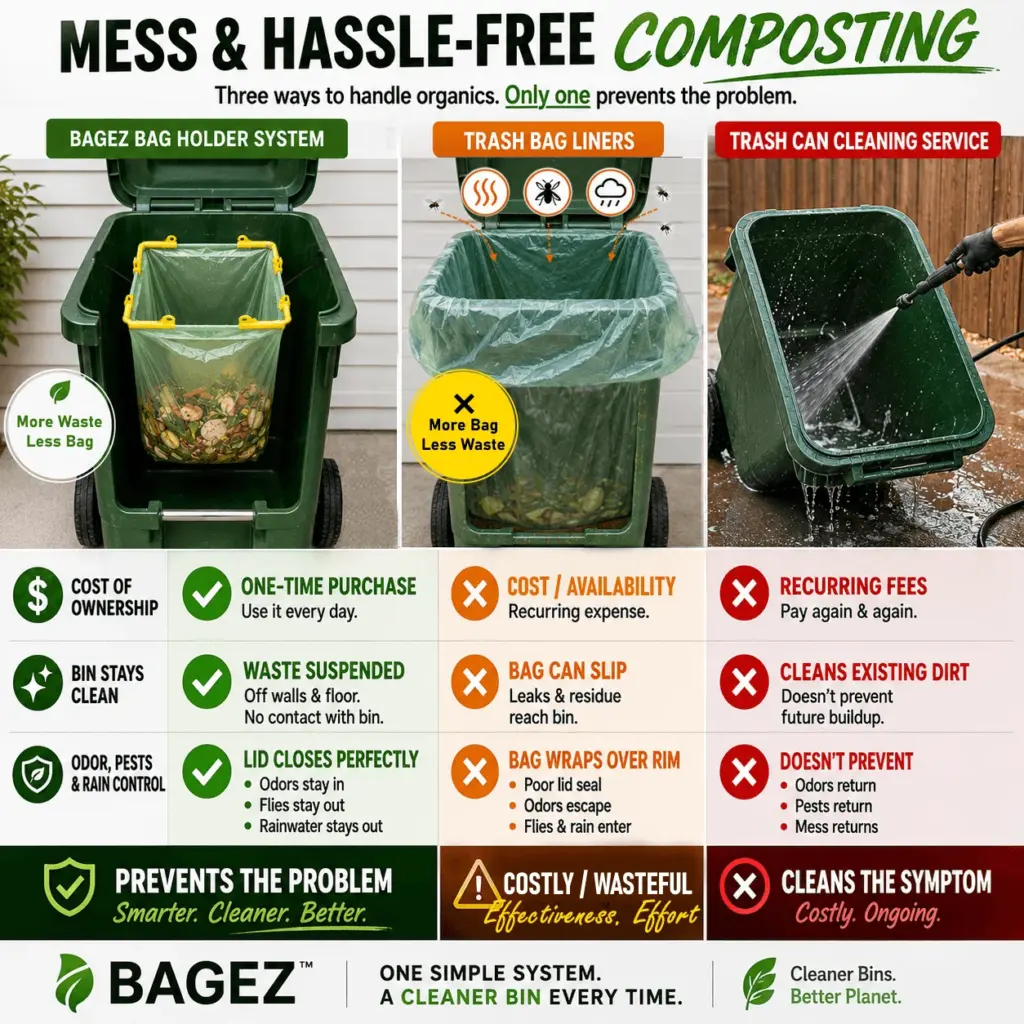
The device is a heavy-duty, folding steel frame that hooks over the rim of standard curbside bins. Using patented, high-tension locking clips, the frame secures any standard bag—whether certified compostable plastic, heavy-duty paper, or repurposed grocery sacks—and holds it wide open.
This design addresses the physical causes of the "yuck factor" through several key mechanisms:
- Elimination of Surface Contact: By suspending the bag from the top rim of the cart, the bag never touches the bottom or sides of the bin. This prevents moisture from transferring to the plastic walls of the cart.
- 360-Degree Air Circulation: Because the suspended bag is surrounded by open space, air can circulate freely around the entire surface of the bag. Condensation that permeates through compostable liners evaporates into the air column rather than pooling at the bottom of the bin. The interior walls of the cart remain dry, preventing anaerobic conditions and mold growth.
- Optimized Chemical Controls: In a dry, suspended system, natural odor-control methods become highly effective. For instance, baking soda sprinkled inside the bag remains dry and active, neutralizing volatile acids. Diatomaceous earth (DE), which is widely used to kill fly larvae by dehydrating them, only works in dry environments; the suspended bag system provides the dry conditions necessary for DE to function effectively.
Official Statements and Industry Analysis
The Inventor’s Perspective
Sean Rana, founder of BagEZ, designed the system out of personal frustration with municipal organic waste programs.
"When we looked at why people were quitting their green bin programs, it wasn’t because they didn’t care about the environment," says Rana. "They cared deeply. But they were tired of dealing with a bin that smelled like a biohazard and required weekly pressure washing. The infrastructure was there, but the user experience was terrible. We realized that if you keep the bag suspended and prevent it from touching the bin, you eliminate 90 percent of the mess, the odor, and the pests. It turns a disgusting chore into a simple, friction-free routine."
Municipal Waste Management Perspectives
Waste management professionals increasingly recognize that physical tools and behavioral design are essential to meeting diversion targets. Public works directors note that while media campaigns and educational mailers are useful, they often fail to change long-term habits if the physical act of recycling remains unpleasant.
According to municipal solid waste analysts, physical interventions like suspended bag systems offer several operational advantages:
- Contamination Reduction: When residents use clear, securely suspended bags, collection crews can quickly verify that the cart contains only organic material before tipping it, reducing contamination at composting facilities.
- Reduced Labor and Maintenance Costs: Clean bins mean fewer resident complaints, fewer requests for replacement carts, and reduced municipal expenditure on bin cleaning public outreach campaigns.
- Broad Compatibility: A mechanical solution that accommodates various bag types allows residents to easily comply with local regulations, whether their municipality requires certified compostable plastics, paper bags, or loose organic waste.
Future Outlook: Bridging the Gap Between Infrastructure and Behavior
As municipalities push toward zero-waste goals, the focus will increasingly shift from large-scale processing facilities to the "last mile" of waste management: the household kitchen and the curbside bin.

                                [Zero-Waste Mandates]
                                          │
                  ┌───────────────────────┴───────────────────────┐
                  ▼                                               ▼
     [Macro-Infrastructure]                          [Micro-Behavioral Design]
- Industrial Composting Facility                - Suspended Bag Frames (BagEZ)
- Automated Collection Fleets                   - Low-Cost Household Liners
- High-Solids Anaerobic Digestion               - Targeted Behavioral Nudges
                  │                                               │
                  └───────────────────────┬───────────────────────┘
                                          ▼
                         [Optimized Organics Diversion]
To build resilient, high-participation organic waste programs, cities must adopt a dual-track strategy:
1. Harmonizing Policy and Technology
Municipalities must establish clear, consistent guidelines regarding acceptable bin liners. As compostable bioplastic technology improves, processing facilities must update their screening systems to accept certified compostable bags. This will allow residents to use containment tools like BagEZ without fear of their carts being skipped or flagged for contamination.
2. Emphasizing Low-Cost, Frictionless Solutions
Rather than relying on expensive municipal subsidies or recurring private bin-cleaning services, the future of organic waste diversion lies in simple, accessible household tools. By enabling residents to use standard, inexpensive bag sizes in a clean, suspended system, cities can lower the financial and physical barriers to compliance.
Conclusion
The green bin programs of the future will succeed not because residents are driven by environmental duty alone, but because the system is designed to be clean, simple, and odor-free. By addressing the physical realities of organic decomposition at the household level, municipalities can finally turn their empty green bins into powerful tools for climate action. For more information on how to implement these household solutions, visit bagez.com.