In contemporary landscape architecture and domestic gardening, ground-cover plants have transcended their historical role as mere functional turf alternatives. Today, they represent a sophisticated strategy for ecosystem management, weed suppression, water conservation, and visual enrichment. As urban environments densify and suburban plots shrink, homeowners and landscape designers increasingly rely on resilient, low-maintenance green carpets to transform difficult patches of earth—ranging from parched sun-baked rockeries to light-starved woodland understoreys—into thriving micro-ecosystems.
This comprehensive review explores twenty elite ground-cover varieties, evaluating their botanical classifications, optimal planting distances, environmental adaptations, and distinct aesthetic contributions. By carefully matching species to localized microclimates, gardeners can achieve dynamic, year-round ecological stability without the relentless burden of intensive weeding and manual irrigation.

Detailed Chronology: Establishing Your Ground-Cover Masterplan
Transforming a barren landscape or problematic garden corner into a lush, self-sustaining tapestry requires a methodical approach. Rather than planting haphazardly, successful ground-cover cultivation follows a deliberate chronological framework spanning site preparation, initial establishment, and long-term management.
Phase 1: Site Assessment and Soil Diagnostics (Weeks 1–2)
Before introducing any plant material, a rigorous evaluation of light exposure, moisture retention, and soil composition is paramount.

- Dry vs. Wet: Assess whether the area suffers from summer drought or waterlogging.
- Light Dynamics: Map out areas receiving full sun, dappled shade under deciduous canopies, or deep shadow.
- Soil Structure: Identify whether your earth is heavy, compacted clay or free-draining sandy loam. Selecting the correct plant for these pre-existing conditions guarantees high survival rates and rapid canopy closure.
Phase 2: Ground Preparation and Weed Eradication (Weeks 3–4)
The primary function of ground cover is weed suppression, but perennial weeds must be thoroughly eradicated prior to planting. Clear the site of invasive roots, gently fork over compacted ground to improve aeration, and incorporate organic matter where necessary—keeping in mind that certain species (such as Mediterranean herbs) actually prefer nutrient-poor, rocky substrates.
Phase 3: Precision Spacing and Installation (Season-Dependent)
Planting distances vary dramatically depending on the species’ vigor and spread rate. For instance, vigorous spreaders like periwinkle require wider berths (30–60 cm), while compact rosettes like Japanese spurge or creeping thyme demand closer spacing (15–30 cm). Adequate initial spacing ensures that plants establish robust root systems before competing for subterranean resources.

Phase 4: Establishment and Supplemental Care (Year One)
During the critical first twelve months, even drought-tolerant specimens require consistent moisture to anchor themselves. Apply a generous layer of mulch between newly spaced plants to lock in soil moisture and block opportunistic weeds until the living green carpet closes its canopy.
Supporting Context & Metrics: The Top 20 Ground-Cover Varieties
To assist landscape planners and home gardeners in curating resilient outdoor spaces, the following catalogue details twenty premier ground-cover choices, complete with their botanical classifications, recommended planting intervals, and ideal placement contexts.

1. Hardy Geraniums (Geranium)
An indispensable group of herbaceous perennials, most varieties form neat mounds less than knee-high. They deliver continuous blooms from late spring to early autumn, followed by foliage that often burnishes to a rich copper hue in the autumn months.
- Spotlight Variety: Multi-award-winning Geranium ‘Rozanne’ (‘Gerwat’) thrives in sunny or part-shaded spots, producing dazzling purple flowers from June through November.
- Type: Herbaceous perennial
- Planting Distance: 50–90 cm apart
- Ideal Placement: Best deployed when continuous, long-season color is desired.
2. Japanese Spurge (Pachysandra terminalis)
A diminutive evergreen perennial that serves as a foundational ground-cover stalwart. Its glossy green rosettes thrive beneath deciduous trees and shrubs, establishing a dense, weed-proof green carpet punctuated by small, whiskery white flowers in early summer.

- Type: Evergreen perennial
- Planting Distance: 15–30 cm apart
- Ideal Placement: Essential for greening up dark, dry, or challenging shady corners.
3. Creeping Thyme (Thymus serpyllum)
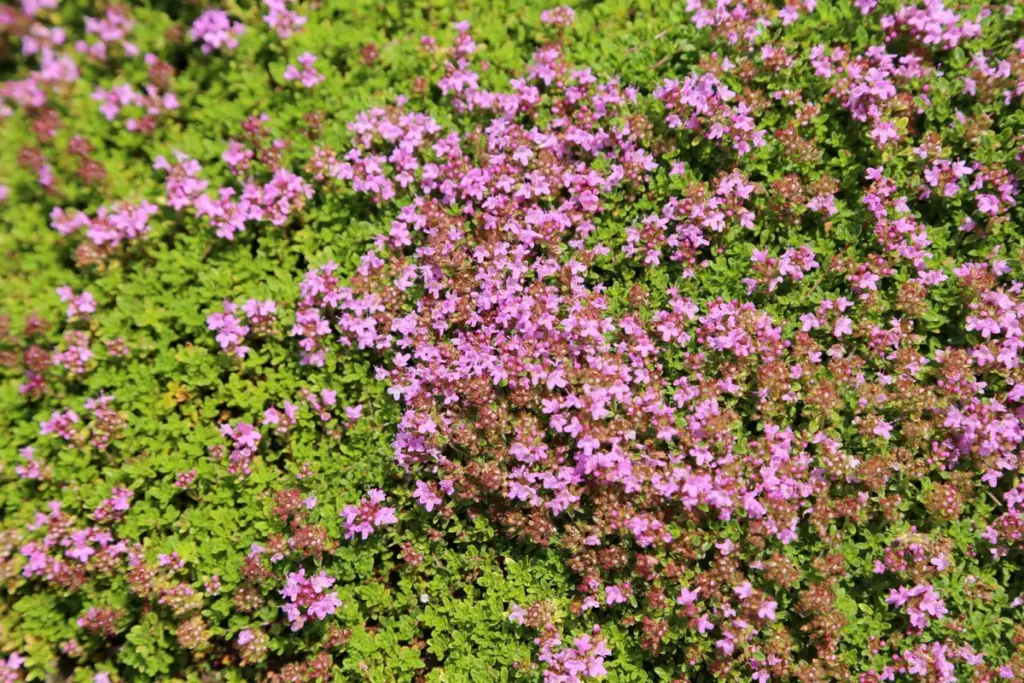
Encompassing various low-growing cultivars, creeping thyme forms aromatic, cushion-like mats of foliage—ranging from silver-grey to variegated greens—that burst into bee-attracting pink or white flowers during summer.
- Spotlight Varieties: Thymus serpyllum ‘Snowdrift’ (white blooms) and Thymus ‘Silver Posie’ (white-edged grey-green leaves with lavender-pink flowers).
- Type: Evergreen perennial
- Planting Distance: 20–30 cm apart
- Ideal Placement: Hot, dry microclimates, rockeries, or tightly knit spaces between paving stones.
4. Elephant’s Ear (Bergenia)
Characterized by bold, leathery, glossy evergreen leaves, Bergenia offers incredible architectural presence. Certain cultivars, such as ‘Overture’, undergo a dramatic seasonal shift, turning deep burgundy in winter before throwing stout spikes of pink or white spring flowers on claret-colored stems.

- Type: Evergreen perennial
- Planting Distance: 40–50 cm apart
- Ideal Placement: Bold, structural evergreen edging along garden paths in sun or partial shade.
5. Periwinkle (Vinca)
With rapid creeping stems and cheerful star-shaped flowers, Vinca makes short work of bare earth in both sun and shade. Vinca minor ‘Ralph Shugert’ brightens dull patches with violet blooms and creamy-gold margins. Note: While Vinca minor suits compact gardens, Vinca major requires expansive spaces due to its overenthusiastic growth habit.
- Type: Evergreen sub-shrub
- Planting Distance: 30–60 cm apart
- Ideal Placement: Stabilizing and coloring steep, difficult-to-manage sloping banks.
6. Lady’s Mantle (Alchemilla mollis)
Deceptively delicate in appearance yet exceptionally hardy, lady’s mantle features scalloped, velvety leaves designed to trap morning dew into shimmering, mercury-like droplets. Summer brings frothy sprays of zesty yellow-green flowers that persist for weeks.

- Type: Herbaceous perennial
- Planting Distance: 40–50 cm apart
- Ideal Placement: Low-maintenance garden borders requiring self-sufficient, textural ground cover.
7. Flower Carpet Roses (Rosa FLOWER CARPET)
Proof that roses can successfully function as ground cover, these specialized cultivars feature a low, arching habit (reaching roughly 80 cm) paired with remarkable disease resistance. Most produce single flowers followed by decorative autumn rosehips.
- Spotlight Varieties: WHITE (‘Noaschnee’) and SUNSET (‘Deseo’), featuring rich red-orange tones.
- Type: Shrub
- Planting Distance: 1.0–1.2 m apart
- Ideal Placement: Expansive sunny banks or elevated beds at the top of retaining walls.
8. Bishop’s Hat (Epimedium)
A remarkably tough, undemanding woodland genus that produces light, airy ground cover roughly 30–40 cm tall. Heart-shaped, intricately veined leaves offer stunning autumn tones, while wiry stems hold nodding flowers in shades of white, yellow, pink, and orange.

- Spotlight Variety: Epimedium x versicolor ‘Sulphureum’ (lemon-yellow flowers), ideal for dry shade.
- Type: Evergreen/semi-evergreen/herbaceous perennial
- Planting Distance: 40–50 cm apart
- Ideal Placement: Difficult dry shade spots beneath mature trees.
9. Knotweed (Persicaria affinis ‘Darjeeling Red’)
Forming dense, disciplined mats of slim green foliage, this resilient semi-evergreen perennial lights up sun or part-shade gardens from midsummer through autumn with brick-red stems topped by soft pink plumes that mature to rusty red.
- Type: Semi-evergreen perennial
- Planting Distance: 50–60 cm apart
- Ideal Placement: Naturalistic cottage gardens and informal planting schemes.
10. Siberian Waldsteinia (Waldsteinia ternata)
A horticultural workhorse capable of bridging disparate soil types—from sand to heavy clay, dry to wet. Glossy, lobed leaves form a dense understorey carpet beneath sprays of bright yellow, strawberry-like flowers in late spring without displaying invasive tendencies.

- Type: Semi-evergreen perennial
- Planting Distance: 50–60 cm apart
- Ideal Placement: Lush underplanting beneath the spreading branches of deciduous trees.
11. Wood Spurge (Euphorbia amygdaloides)
Evoking a wild woodland aesthetic, wood spurges are exceptionally tough. Varieties like ‘Purpurea’ feature beetroot-tinted foliage paired with lime-green spring bracts, while Euphorbia amygdaloides var. robbiae tackles extreme dry shade. (Safety Note: Spurge sap is an irritant to skin and eyes, and plant tissues are toxic if ingested; protective gloves should always be worn.)
- Type: Evergreen perennial
- Planting Distance: 50–60 cm apart
- Ideal Placement: Shaded garden corners where vibrant spring lime tones are desired.
12. Alpine Strawberry (Fragaria vesca)
An underutilized treasure, cultivars such as ‘Semperflorens’ produce dainty white flowers alongside intensely sweet, aromatic berries from June through November. Paired with attractive green foliage, it delivers both aesthetic and culinary rewards.

- Type: Semi-evergreen perennial
- Planting Distance: 40–50 cm apart
- Ideal Placement: Edible woodland gardens and damp, dappled shaded margins.
13. Mexican Fleabane (Erigeron karvinskianus)
A charming daisy-like perennial that produces an endless succession of pink-and-white blooms. It naturally self-seeds into rock crevices, gravel beds, and patio pavers, proving exceptionally drought-tolerant and low-maintenance.
- Type: Herbaceous perennial
- Planting Distance: 30–40 cm apart
- Ideal Placement: Modern patio gaps, gravel pathways, and sun-baked retaining walls.
14. Wall Bellflower (Campanula portenschlagiana)
Forming vigorous, spreading mounds smothered in deep purple, bell-shaped summer flowers, this alpine native thrives in well-drained rocky soils and raised beds. Its vigorous growth means it should be kept away from delicate, slow-growing neighbors.

- Type: Semi-evergreen perennial
- Planting Distance: 40–50 cm apart
- Ideal Placement: Rockeries or spilling gracefully over low stone garden walls.
15. Candytuft (Iberis sempervirens)
A Mediterranean native and rockery favorite, candytuft features a spreading carpet of deep green foliage blanketed in pure-white, scented spring flowers that draw in crowds of beneficial pollinators.
- Type: Evergreen perennial
- Planting Distance: 50–60 cm apart
- Ideal Placement: Sunny gravel gardens and pollinator-friendly rockeries.
16. Lungwort (Pulmonaria)
Characterized by elongated leaves speckled with white or silver, lungwort offers exceptional shade tolerance. Early spring brings open trumpet flowers in shades of pink, purple, and white, providing vital early-season nectar. Pulmonaria ‘Opal’ (‘Ocupol’) offers serene pale violet blossoms.

- Type: Herbaceous/semi-evergreen perennial
- Planting Distance: 40–50 cm apart
- Ideal Placement: The front edge of reliably moist, shaded garden borders.
17. Lily of the Valley (Convallaria majalis)
Renowned for spear-shaped foliage, pendulous white bell flowers, and an unmistakable, intoxicating fragrance, this spreading perennial (propagated via underground "pips") thrives in damp, shaded earth. (Safety Note: Highly toxic if ingested; handle with protective gloves.)
- Type: Herbaceous perennial
- Planting Distance: 20–30 cm apart
- Ideal Placement: Rich, moist soil beneath deciduous shrubs for seasonal fragrance.
18. Ivy-Leaved Cyclamen (Cyclamen hederifolium)
Marbled, heart-shaped leaves provide months of foliage interest, complemented by swept-back pale pink autumn flowers. This tuberous perennial settles effortlessly into damp woodland environments, expanding its footprint year after year.

- Type: Tuberous perennial
- Planting Distance: 10–20 cm apart
- Ideal Placement: Shaded autumn woodland beds.
19. Siberian Bugloss (Brunnera macrophylla)
Delicate sprays of sky-blue, forget-me-not flowers rise above large, heart-shaped leaves in spring. A vigorous grower that self-seeds reliably, it provides exceptional visual impact in shaded garden zones.
- Type: Herbaceous perennial
- Planting Distance: 50–60 cm apart
- Ideal Placement: Brightening up dark, shaded borders.
20. Common Chamomile (Chamaemelum nobile)
Featuring feathery aromatic foliage and white daisy flowers, common chamomile makes an exceptional drought-tolerant ground cover. The non-flowering, compact cultivar ‘Treneague’ can even substitute for a traditional grass lawn under light foot traffic, releasing a soothing apple scent when brushed or walked upon.

- Type: Herbaceous perennial
- Planting Distance: 25 cm apart
- Ideal Placement: Sunny pathways, relaxation seating areas, and low-traffic green spaces.
Official Statements & Horticultural Consensus
Leading botanical institutions and landscape organizations increasingly champion the integration of diverse ground-cover strata over monoculture lawns. According to environmental horticulturists, shifting municipal and residential planting paradigms toward multi-species ground covers significantly reduces municipal water demand, mitigates urban heat island effects, and bolsters declining populations of native pollinators.
Furthermore, professional arborists emphasize that underplanting mature trees with resilient, shade-adapted ground covers—such as Epimedium, Pachysandra, and Waldsteinia—protects vital surface root systems from mechanical damage while preventing soil compaction caused by foot traffic.

Future Outlook: The Next Decade in Ground-Cover Design
As climate volatility introduces stricter water restrictions and unpredictable weather patterns across temperate zones, the horticultural industry anticipates a major surge in demand for hyper-resilient, drought-tolerant ground covers. Future landscape designs will likely pivot away from resource-intensive turfgrass toward complex, polyculture tapestries that combine structural evergreens (Bergenia, Pachysandra), long-blooming perennials (Geranium, Erigeron), and aromatic herbs (Thymus, Chamaemelum).
By embracing these botanical solutions, modern gardeners can achieve resilient, self-maintaining landscapes that harmonize ecological health with timeless visual elegance.