By Heather Clancy Investigative Technology & Environmental Reporter
Executive Overview
For years, the public conversation surrounding the environmental toll of the digital age has focused on a visible, tangible footprint: the hum of server racks, the flashing lights of massive warehouse facilities, and the direct consumption of water used on-site to cool humming computer chips. Communities from Northern Virginia to the arid expanses of the American Southwest have scrutinized how local server farms pull millions of gallons of municipal water through their internal cooling loops to prevent high-performance processors from overheating.
However, this familiar narrative misses the most colossal part of the equation. According to a landmark analysis published by the sustainability nonprofit Ceres, the true water footprint of the data center industry is largely invisible—and it originates miles away at the power plants supplying their electricity.
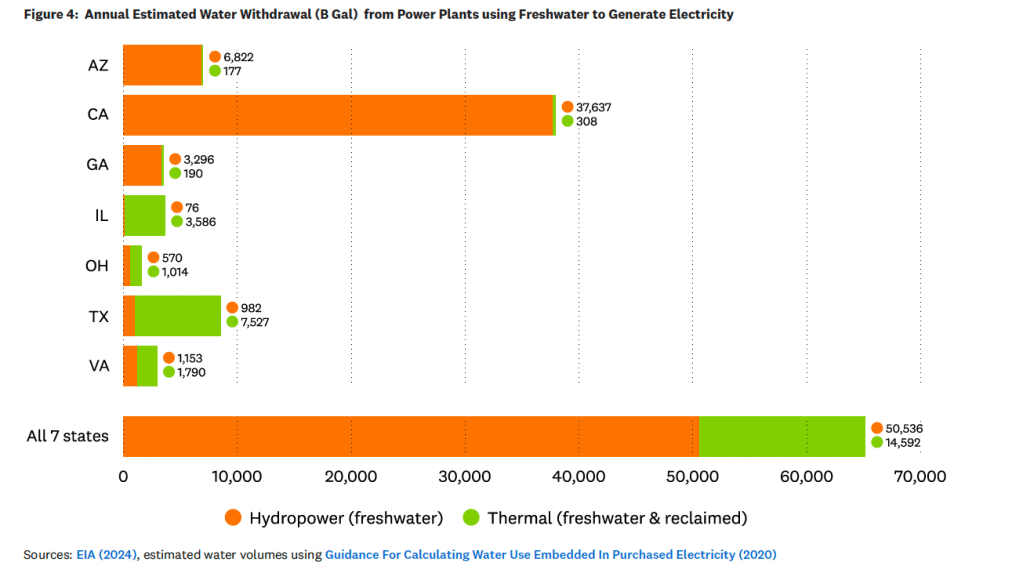
Thermal electricity generation, which encompasses both fossil-fueled and nuclear power plants, demands staggering volumes of water for cooling and steam production. Across just seven U.S. states that host more than half of the nation’s data center capacity, this indirect power generation accounts for 3 to 4 trillion gallons of freshwater withdrawals annually.
To put this consumption into perspective, the water required to generate the electricity powering data centers in Virginia alone during 2024 is an estimated 21 times the amount used by the entire city of Washington, D.C.
As tech giants—including Amazon, Meta, Microsoft, and OpenAI—scramble to secure massive blocks of power to fuel the artificial intelligence (AI) boom, they are increasingly turning to natural gas and other thermal resources. This shift threatens to entrench the tech sector deeper into a water crisis. With independent projections showing that the water footprint of data center power generation is doubling annually—and projected to account for more than 70 percent of total data center water consumption by 2030—industry leaders, policymakers, and environmental analysts face an urgent reckoning. Without standardized disclosure metrics and localized energy planning, the digital revolution risks colliding violently with America’s dwindling freshwater limits.
Detailed Chronology: The Unfolding Crisis of Grid-Connected Water Use
To understand how the data center industry arrived at this critical juncture, it is necessary to examine the compounding pressures of the past decade, culminating in recent data disclosures and regulatory challenges.
Phase 1: The On-Site Blindspot (2010–2020)
During the early buildout of hyperscale cloud computing facilities, environmental impact assessments were largely myopic. Tech companies constructed massive facilities in regions with cheap land and lax zoning laws, focusing primarily on Power Usage Effectiveness (PUE). When communities began questioning the millions of gallons of water evaporated in on-site cooling towers, operators responded by investing in closed-loop systems, air-assisted cooling, and recycled wastewater initiatives. While these steps mitigated direct local water impacts, they completely overlooked the massive energy inputs required to run the servers—and where that energy came from.
Phase 2: The Generative AI Boom and Energy Crunch (2022–2023)
The launch of advanced Large Language Models (LLMs) and generative AI completely transformed corporate computing needs. Training and running models like GPT-4 required orders of magnitude more computational power than traditional cloud storage or search indexing. Suddenly, hyperscalers needed gigawatts of continuous power rather than megawatts. Unable to wait for green energy projects stuck in protracted utility interconnection queues, major tech companies began striking direct deals to keep aging coal plants online or rapidly commission new natural gas-fired generation capacity.
Phase 3: The Ceres Revelation (August 2025)
A significant turning point occurred on August 25, when Ceres published its eye-opening report, "Water Behind the Watts: The Hidden Risk of Powering Data Centers." For the first time, researchers systematically linked regional data center footprints to the specific water withdrawal rates of local electrical grids. The report shattered the illusion that tech companies could achieve water stewardship merely by optimizing their on-site cooling mechanisms. It revealed that a data center’s true water intensity is inextricably bound to the fuel mix of the utility grid it plugs into.
Phase 4: Current Regulatory and Corporate Scramble (2026 and Beyond)
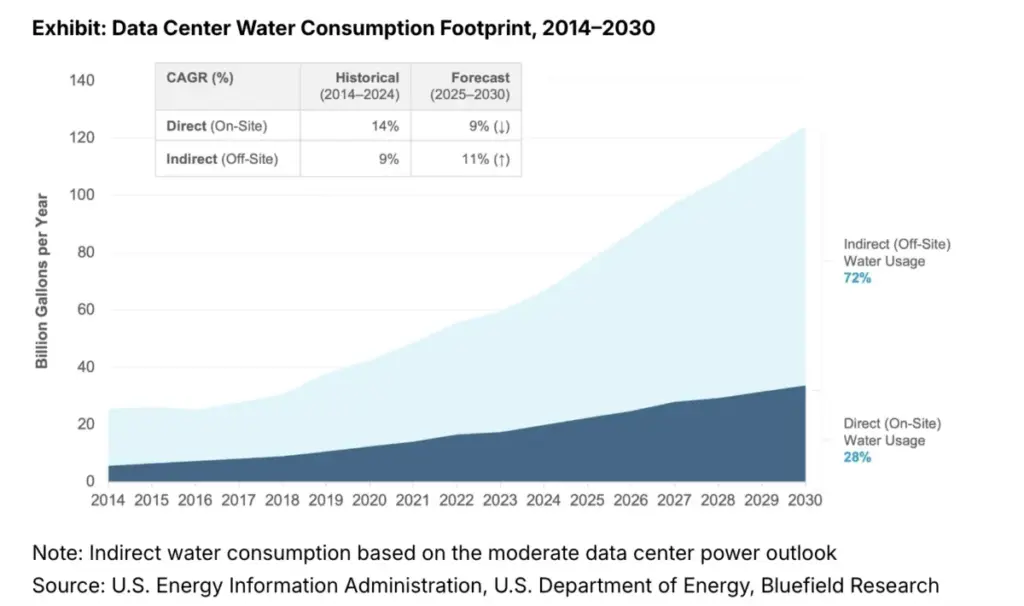
Today, the tech sector is caught between escalating AI electricity demands and tightening environmental constraints. Water stress and grid reliability are no longer abstract concerns for corporate sustainability officers; they are bottom-line risks. As independent research bodies like Bluefield Research forecast exponential growth in water footprints through 2030, corporations face mounting pressure from institutional investors to account for their indirect resource consumption before municipal governments step in with punitive moratoria and water restrictions.
Supporting Context & Metrics: Analyzing the State-by-State Water Ledger
Water consumption and withdrawal rates vary dramatically depending on geography and the underlying energy mix of regional power grids. The Ceres analysis evaluated seven key states that collectively host the vast majority of U.S. data center capacity, revealing stark contrasts in how different energy profiles impact local watersheds.
The Hydro Heavyweights: California
California leads the analyzed states in total freshwater withdrawals linked to data center electricity, accounting for nearly 1.4 trillion gallons. However, this massive volume is primarily a byproduct of the state’s heavy reliance on hydroelectric power. While hydro generation does not consume water in the same chemical or thermal sense as fossil fuel combustion, it requires massive water throughput through turbines, impacting river flows and aquatic ecosystems.
The Thermal Strongholds: Virginia, Ohio, and Georgia
In stark contrast to California, more than 90 percent of the indirect data center water use in Virginia, Ohio, and Georgia is tied to thermal generation sources, including natural gas, coal, and nuclear energy.
Thermal power plants require vast quantities of water to condense steam back into liquid after it spins power-generating turbines. Because Virginia has cemented its status as the global capital of data center alley (particularly in Loudoun County), its electrical demand has skyrocketed. The state’s reliance on a thermal-heavy grid explains why its power-related water withdrawals have ballooned to 21 times the annual consumption of Washington, D.C.
The Renewables Exception: Texas
Texas presents an interesting outlier in the data analysis. On average, the Lone Star State used less water for data center-associated power generation than its peers. This efficiency is driven by Texas’s aggressive integration of grid-tied solar and wind resources through the ERCOT market. Because wind and solar photovoltaics require virtually zero water during operation, data centers powered by a high renewable mix inherently possess a much lighter indirect water footprint.
The High-Risk Zones: Arizona and Illinois
While total volume is critical, the location of water stress matters equally. The Ceres report highlights Arizona and Illinois as the two states most acutely exposed to water stress and drought risks.
Placing energy-intensive and water-adjacent computing infrastructure in arid regions like the Desert Southwest creates systemic vulnerabilities. When a heatwave spikes air conditioning loads, data center processing demands rise concurrently with municipal water shortages, setting up a zero-sum conflict between human communities, agricultural needs, and digital infrastructure.
[Data Center Energy Demand]
       │
       ▼
[Regional Power Grid Mix]
       ├──> Natural Gas / Coal / Nuclear (High Thermal Water Withdrawals: VA, OH, GA)
       ├──> Hydroelectric (High Flow-Through Water Use: CA)
       └──> Solar / Wind (Low Water Impact: TX)
       │
       ▼
[Ecosystem & Community Vulnerability (High Drought Exposure: AZ, IL)]
Official Statements & Industry Perspectives
The disconnect between corporate green marketing and the stark reality of grid-level resource consumption has drawn sharp criticism from researchers and sustainability experts alike.
Shama Perveen, director of water research at Ceres and a co-author of the report, emphasizes that transparency is the missing link in corporate accountability.
"This is the foundation for better understanding water risk linked to procuring electricity and working with power producers and peers in a precompetitive space on best practices to minimize impacts to local water resources, especially in water-stressed areas,"Perveen stated during the release of the analysis.
Perveen points out that very few data center operators currently disclose or even track the freshwater withdrawals tied to their electricity procurement. Without this baseline data, meaningful corporate stewardship remains impossible.
This sentiment is echoed by Jonathan Koomey, an independent researcher who has published extensive academic work on data center energy and water footprints. Koomey warns that the industry is navigating blindfolded through a landscape of unreliable metrics.
"It’s a real problem the industry needs to figure out,"Koomey noted. "They are being confronted with numbers that are all over the general landscape. People don’t have a clear way to measure this, and there aren’t clear standards."
Meanwhile, the tech sector’s race to secure firm power has triggered controversial partnerships. The rapid addition of new natural gas-fired generation capacity by titans such as Amazon, Meta, Microsoft, and OpenAI—often touted as a reliable bridge to maintain grid stability—carries a hidden ecological penalty. Every megawatt-hour generated by these new fossil fuel plants locks the digital economy deeper into high thermal water withdrawal cycles for decades to come.
Future Outlook: Projections Toward 2030 and Beyond
Looking ahead, the trajectory of digital infrastructure growth points toward an unsustainable collision with environmental limits unless structural changes are implemented across both the tech and energy sectors.
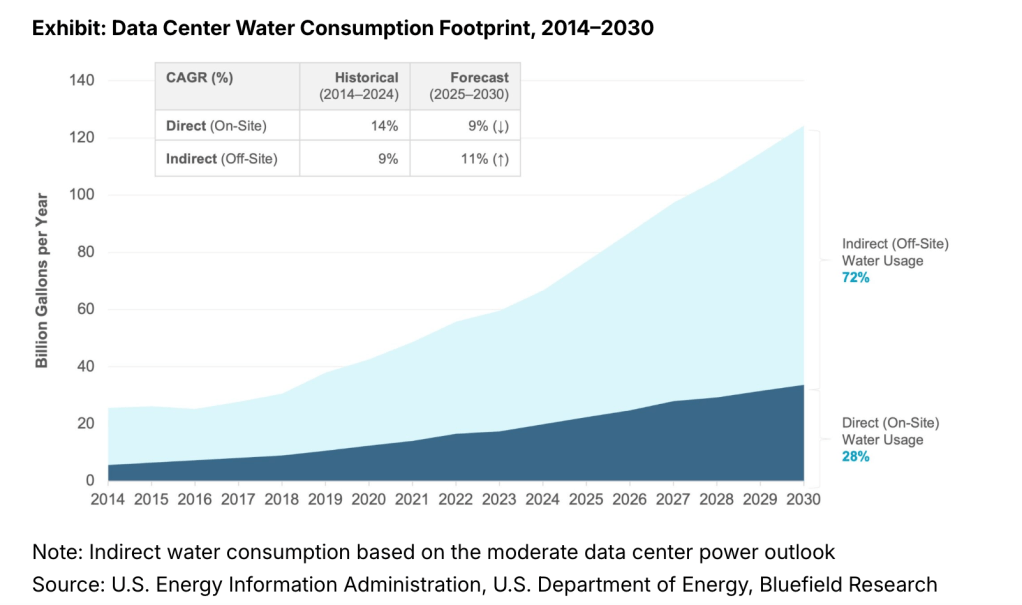
According to a separate market forecast by Bluefield Research, the volume of water needed exclusively for data center power generation is doubling annually. By 2030, indirect power-related water consumption is projected to account for more than 70 percent of all data center-related water consumption, completely overshadowing the water used inside server facilities for direct cooling.
Projected Data Center Water Consumption Split (2030):
[█████████████████████████████████████████████████████████] 70%+ Power Generation (Indirect)
[████████████████████████                                 ] <30% On-Site Cooling (Direct)
To avert this crisis, industry analysts and environmental advocates recommend several urgent interventions:
Standardized Scope 3 Water Accounting: Corporations must expand their ESG reporting frameworks to explicitly calculate and disclose the water intensity of their electricity procurement, treating grid water risk with the same seriousness as carbon emissions.
Strategic Geographic Siting: Future data center developments must factor local watershed health and drought exposure directly into site-selection algorithms, steering away from water-stressed basins in the Southwest and Midwest unless powered exclusively by localized non-thermal renewables.
Precompetitive Utility Collaboration: Tech companies must leverage their immense market power to push regulated utilities toward water-efficient generation portfolios, prioritizing wind, solar, and advanced geothermal systems that do not rely on massive freshwater withdrawals.
Regulatory Oversight: State utility commissions and federal regulators must begin incorporating the water intensity of new power plants into generation approval processes, ensuring that the digital transition does not compromise public drinking water and agricultural security.
The era of treating electricity as a weightless, frictionless resource is over. As artificial intelligence reshapes the modern economy, the digital world’s thirst will ultimately be measured not by the water evaporating from server facility rooftops, but by the gallons flowing through the turbines of America’s power plants. Whether tech companies choose to confront this hidden ledger will determine the resilience of both our power grids and our most precious natural resource.