Executive Overview
A catastrophic flash flood and massive mudslide near the rugged border between Nepal and Tibet have triggered an international emergency, leaving more than 150 people confirmed dead and hundreds more unaccounted for. Among the vast number of missing individuals are dozens of citizens from the United States and Canada, alongside travelers from at least 26 other countries. The disaster, which struck without warning mid-week following torrential monsoon downpours and glacial melt instability, has devastated remote trekking routes, swept away infrastructure, and stranded thousands of tourists in high-altitude zones.
Local authorities in Kathmandu, working in tandem with the Nepal Police and the Nepal Tourism Board, have confirmed that 579 people remain missing following the disaster, an alarming figure that includes 466 foreign nationals. As rescue coordination centers operate around the clock, foreign ministries in Washington, Ottawa, London, and New Delhi have activated crisis response teams. Embassies are scrambling to verify the safety and whereabouts of their citizens trapped in the Himalayan disaster zone.
The scale of the devastation has exposed the increasing vulnerability of high-altitude tourist corridors to extreme weather events supercharged by changing climatic patterns in the Himalayas. With communication lines downed, roads washed away, and unpredictable weather grounding critical aerial rescue assets, the race to locate survivors has entered a deeply perilous phase. This comprehensive report examines the timeline of the disaster, the demographic breakdown of the missing, the diplomatic response from North American and international governments, and the broader structural challenges facing emergency responders in one of the world’s most challenging terrains.
Detailed Chronology: How the Disaster Unfolded
The Prelude: Unseasonal Weather and Meteorological Warnings
The sequence of events leading to the catastrophe began days before the actual strike, as unusual weather patterns settled over the Himalayas. Meteorological offices in the region had noted persistent, unusually heavy rainfall combined with unseasonably high temperatures accelerating glacial melt in the upper elevations of the Tibetan plateau. While monsoon rains are standard for this time of year, the intensity and concentration of the precipitation in the trans-Himalayan border region far exceeded seasonal norms, creating a ticking time bomb of hydrological instability.
The Strike: Wednesday’s Sudden Deluge
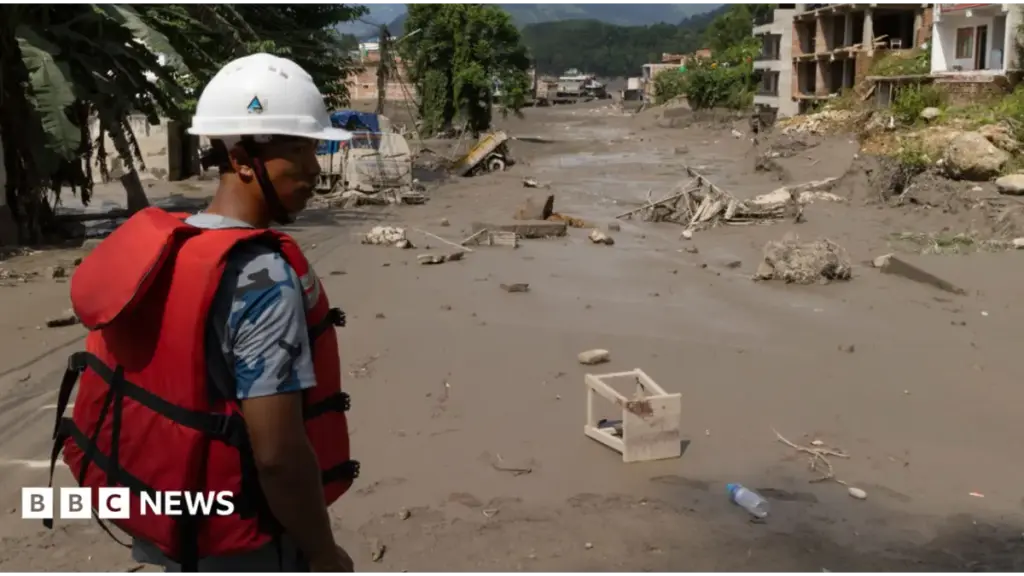
On Wednesday, the atmospheric pressure broke violently. Torrential downpours triggered a massive wall of water, mud, and debris that cascaded down steep mountain valleys toward the borderlands. The flash flood caught hundreds of hikers, guides, and local villagers entirely unawares. Moving at terrifying speeds, the slurry of boulders, uprooted trees, and mud swept away bridges, trekking lodges, and sections of vital roadway infrastructure within minutes.
Immediate Aftermath and the Launch of Search and Rescue
By Wednesday evening, initial reports of widespread destruction began filtering out via satellite phones and intermittent radio communications from remote outposts. Early accounts from local authorities painted a grim picture, with initial death tolls quickly surpassing the 100-mark and climbing steadily as rescue teams pushed past blocked mountain passes.
By Friday, the Nepal Police and the Nepal Tourism Board released disquieting figures indicating the true scale of the human toll: more than 150 dead and 579 missing. Military helicopters, deployed as soon as weather windows permitted, began executing high-risk extraction missions, plucking stranded tourists and injured locals from isolated ledges and rooftops. However, low-hanging clouds, persistent rain, and the sheer remoteness of the impact zone severely hampered the deployment of heavy rescue equipment, leaving ground crews to rely primarily on manual excavation and sheer determination.
Supporting Context & Metrics: The Human Toll and Demographics
Breakdown of the Missing
The disaster has transformed a localized natural hazard into a global crisis due to the heavy presence of international trekkers visiting the region during the peak autumn hiking season. According to official data compiled by the Nepal Police, the 579 missing individuals are distributed across a remarkably diverse demographic:
- Total Missing: 579 individuals
- Foreign Nationals: 466 individuals hailing from 28 distinct countries
- Nepalese Nationals: 113 local residents, guides, and porters
- Indian Nationals: Over 100 individuals
- American Nationals: 54 individuals
- British Nationals: 33 individuals
- Canadian Nationals: 24 individuals
The Plight of Local Guides and Porters
While international media coverage has understandably focused on the Western tourists caught in the deluge, humanitarian organizations and local officials have emphasized the devastating impact on the indigenous workforce. Nepalese guides, porters, and tea-house operators form the economic backbone of the region’s trekking industry. The loss of life and livelihood among these local communities threatens to plunge mountain families into severe economic destitution, compounding the physical trauma of the disaster.
Geographic Challenges of the Impact Zone
The Nepal-Tibet border region is characterized by extreme topography, narrow gorges, and sheer cliffs. Rescue operations are severely bottlenecked by the geography itself. Key arteries connecting lowland supply hubs to high-altitude transit points have been obliterated. Landslides continue to threaten secondary routes, making the delivery of heavy earth-moving machinery nearly impossible. Consequently, rescue workers are operating under the constant threat of secondary mudslides, forcing temporary suspensions of search efforts whenever new rain bands sweep across the mountain peaks.
Official Statements and Diplomatic Responses
United States State Department Position
In Washington, the U.S. State Department acknowledged that American citizens have been directly impacted by Wednesday’s catastrophic floods, though officials declined to release specific figures regarding the American missing or injured, citing privacy regulations and the fluid nature of ongoing investigations.
A State Department spokesperson emphasized that the U.S. Embassy in Kathmandu is operating in close coordination with local tour agencies, emergency services, and Nepalese government authorities to locate and assist affected U.S. nationals.
"We are closely monitoring the situation following the devastating flash floods and mudslides near the Nepal-Tibet border," a U.S. government official stated. "Our embassy personnel are working around the clock to provide consular assistance to affected Americans and their families, while respecting privacy considerations."
Canadian Government and Prime Minister’s Intervention
In Ottawa, the federal government has elevated its diplomatic monitoring of the crisis. Canada’s foreign office confirmed that at least 24 Canadian citizens are among the missing, prompting a direct public response from Prime Minister Mark Carney.
Taking to social media platform X (formerly Twitter), Prime Minister Carney expressed deep concern over the unfolding tragedy and affirmed Canada’s commitment to international humanitarian cooperation.
"As rescue efforts continue, Canada stands ready to provide support," Carney wrote. "Our thoughts are with all those affected by this terrible disaster in the Himalayas, and we are working through diplomatic channels to ascertain the safety of our citizens."
Prime Minister Carney also urged all Canadian citizens currently traveling or residing in the region to register immediately with the Registration of Canadians Abroad (ROCA) service. This free federal program allows the government to quickly contact citizens, provide critical safety updates, and coordinate emergency evacuations during international crises. The Department of Foreign Affairs continues to field inquiries from anxious family members across the country.
International and Regional Coordination
Beyond North America, foreign ministries in London, New Delhi, and European capitals have established dedicated emergency response cells. The British Foreign, Commonwealth & Development Office (FCDO) has updated its travel advisories, warning against all non-essential travel to the affected districts. Indian rescue authorities, leveraging geographic proximity, have offered specialized mountain-rescue teams and logistical support to the Nepalese government to accelerate the search for missing citizens.
Future Outlook: Recovery, Climate Realities, and Resilience
Short-Term Priorities: Recovery vs. Rescue
As the clock ticks past the critical 72-hour window traditionally associated with high survival rates in disaster zones, the focus of operations on the ground is shifting delicately between ongoing rescue efforts and the grim reality of body recovery. Search teams equipped with thermal imaging devices and canine units are concentrating their efforts on riverbanks, debris fans, and areas where valley bottlenecks may have trapped floating wreckage or sediment.
Medium-Term Economic and Infrastructural Fallout
The immediate humanitarian crisis will inevitably give way to a prolonged structural and economic recovery phase. The destruction of bridges, trails, and tourist lodges threatens to paralyze the region’s vital trekking economy for months, if not years. Tourism is a primary driver of GDP for Nepal’s rural northern districts; the loss of infrastructure during the prime autumn trekking window represents a staggering financial blow to an economy already navigating post-pandemic recovery.
Long-Term Climate Implications for the Himalayas
Beyond immediate disaster response, environmental scientists and policy experts are urging a fundamental reassessment of infrastructure resilience in the Himalayan region. The disaster serves as a stark reminder of the escalating risks posed by climate change. Rapid warming in high-altitude zones is destabilizing glacial lakes, increasing the frequency of Glacial Lake Outburst Floods (GLOFs), and saturating fragile mountain slopes with unprecedented volumes of water.
Experts argue that traditional risk-mapping and historical weather data are no longer adequate for predicting Himalayan weather anomalies. Future reconstruction efforts will require massive investments in resilient engineering, advanced early-warning systems, and climate-adapted urban and rural planning. For now, however, the immediate focus remains fixed on the treacherous mountain valleys of the Nepal-Tibet border, where families across the globe wait anxiously for news of their missing loved ones amid the mud and stone.