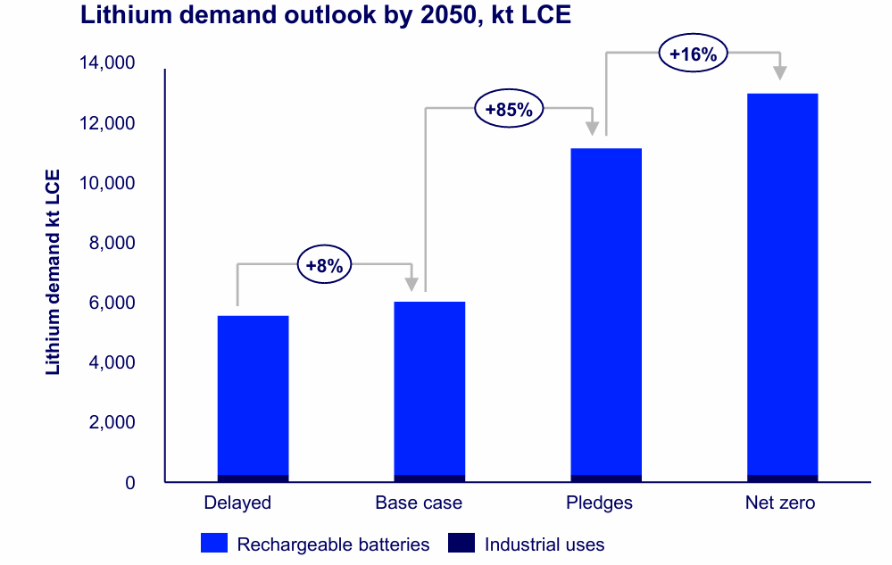
The global transition to a low-carbon economy faces a formidable, fast-approaching bottleneck. According to a landmark analysis released by energy research powerhouse Wood Mackenzie in its latest Energy Transition Outlook for Lithium, worldwide demand for lithium could skyrocket to an astonishing 13 million tonnes annually by 2050—provided the international community aggressively accelerates its climate policies.
However, the report delivers an unvarnished warning: the market is hurtling toward a severe supply crunch much sooner than anticipated. Without an immediate, unprecedented wave of capital investment, exploration, and refinery construction, global lithium shortages could materialize as early as 2028.
As governments worldwide codify aggressive Net Zero mandates, phase out internal combustion engine (ICE) vehicles, and build out massive renewable-dominated power grids, the demand for "white gold"—the fundamental building block of modern electrochemical energy storage—is decoupling from historical supply trajectories. The core challenge facing the green transition is no longer a question of consumer adoption or technological viability, but rather a brutal race against time to unearth, refine, and finance the essential raw materials required to power the electrified future.
Detailed Chronology: The Evolution of the Lithium Supply Crunch
To understand the urgency of the 2028 deficit warning, one must examine how the global energy landscape has compressed a century-long industrial evolution into a matter of decades.
The Pre-2020 Era: Niche Markets and Steady Extraction
For decades, lithium was a specialty chemical utilized primarily in ceramics, glass, high-temperature greases, and early-generation consumer electronics like laptops and mobile phones. Extraction was concentrated in a handful of regions—predominantly the salt flats of South America’s "Lithium Triangle" (Chile, Argentina, and Bolivia) and hard-rock pegmatite mines in Australia. Supply comfortably outpaced demand, and price volatility was relatively low.
2020–2025: The Electric Vehicle Tipping Point
The dawn of the 2020s marked a structural shift. Spurred by tightening global emissions regulations, a dramatic decline in battery pack costs, and the rapid maturation of companies like Tesla, the electric vehicle (EV) market transitioned from a novelty to a dominant macroeconomic force.
2022–2023: A sudden demand spike caught the mining sector flat-footed, sending lithium carbonate and hydroxide prices to historic highs. Automakers scrambled for offtake agreements, igniting a global land grab for mining concessions.
2024–2025: Prices experienced a temporary cyclical correction due to a flood of new supply coming online alongside a slightly slower-than-expected short-term adoption curve in certain Western markets. However, industry analysts repeatedly warned that this lull was masking the structural undersupply looming later in the decade.
Late 2025: Pioneering supply chains began emerging to diversify sources, highlighted by breakthroughs in alternative extraction methodologies, such as the United States’ push to extract commercial-grade lithium from oilfield wastewater.
2028 and Beyond: The Approaching Deficit Horizon
Wood Mackenzie’s models indicate that the breathing room provided by recent supply expansions will be entirely consumed by the end of the decade. Under ambitious decarbonization pathways, structural deficits are projected to tear open as early as 2028. From that point forward, annual demand curves will permanently outpace primary extraction and recycling capabilities unless a multi-billion-dollar capital injection occurs immediately.
Supporting Context & Metrics: Decoding the Demand Surge
Wood Mackenzie’s comprehensive modeling evaluates four distinct energy transition pathways, revealing a wide yet intensely demanding range of future scenarios. By 2050, global lithium demand will span from 5.6 million tonnes of lithium carbonate equivalent (LCE) in a delayed transition scenario, up to 13.2 million tonnes LCE in a true Net Zero trajectory.
What is Driving the Surge?
Passenger and Commercial Electric Vehicles (72% to 80% of Demand):
EVs remain the undisputed engine of the lithium market. Under a moderate "Country Pledges" pathway, EVs are projected to capture roughly 75% of all global vehicle sales by 2040. Under a more aggressive Net Zero framework, that figure climbs to an astonishing 95%. By mid-century, rechargeable batteries across all applications will account for between 96% and 98% of total global lithium consumption.
Grid-Scale Energy Storage Systems (ESS):
As variable renewable sources like wind and solar dominate newly installed electrical generation capacity, power grids require massive, multi-hour stationary storage systems to balance load profiles and ensure grid stability. Wood Mackenzie forecasts that energy storage demand will compound at a steady 6% to 7% annually across all forward-looking scenarios.
The Recycling Paradox: Help Is on the Way, But Not Soon Enough
Industry stakeholders frequently point to battery recycling as the silver bullet for raw material shortages. While recycling will undoubtedly play a transformative role in the circular economy of the late 21st century, it cannot solve the acute supply crunches of the 2020s and 2030s.
Recycled lithium supply is projected to grow at an impressive clip of 13% to 16% annually. However, because EV batteries boast lifespans averaging 10 to 15 years, meaningful volumes of end-of-life batteries will not flood the recycling stream until the 2040s.
By 2050, ambitious transition scenarios suggest recycling could successfully yield between 2.3 million and 2.7 million tonnes LCE annually. Yet, even with this massive secondary supply online, colossal structural shortfalls remain:
Country Pledges Scenario: A supply deficit reaching 6.7 million tonnes LCE by 2050.
Net Zero Scenario: A widening supply deficit hitting 8.5 million tonnes LCE by 2050.
The Multi-Billion-Dollar Buildout Requirement
Bridging these monumental gaps requires an unprecedented mobilization of global capital. Wood Mackenzie estimates that total cumulative investment needs span from roughly $104 billion under a delayed transition scenario up to a staggering $276 billion for full Net Zero alignment.
Base Case: ~$114 billion
Country Pledges Scenario: ~$236 billion
Net Zero Scenario: ~$276 billion
Capital expenditure is expected to peak aggressively between 2030 and 2034, during which time the mining industry, chemical refining plants, and localized supply chains must undergo the largest industrial scaling operation in modern history.
Official Statements and Industry Insights
The findings have sent ripples through both the traditional mining sector and the clean-tech ecosystem, prompting stark warnings from leading market analysts.
"The lithium market is heading into a supply crunch much sooner than many industry players expect,"
— Allan Pedersen, Research Director at Wood Mackenzie
Pedersen emphasized that the market’s current complacency—largely driven by short-term price adjustments over the past year—belies the brutal mathematical reality of cumulative long-term demand.
"Under ambitious climate scenarios, we see deficits emerging from 2028," Pedersen added. "The industry needs to act now, as governments progress policies toward Net Zero. You cannot spin up a multi-billion-dollar hard-rock mine or a complex direct lithium extraction (DLE) facility overnight. Lead times average seven to ten years from initial discovery to first commercial production."
Mining executives and geopolitical strategists echo these concerns, noting that supply chain resilience has transformed into a matter of national security. Western economies, historically reliant on foreign refining monopolies, are racing to legislate and fund domestic mineral processing hubs through initiatives like the United States’ Inflation Reduction Act and the European Union’s Critical Raw Materials Act.
Future Outlook: Can the Industry Build Fast Enough?
As the global community stands on the precipice of the 2030s, the trajectory of the energy transition is inextricably linked to the earth sciences. The fundamental question confronting policymakers, automotive titans, and mining conglomerates is no longer whether the world needs more lithium, but whether capital markets, regulatory frameworks, and engineering firms can mobilize fast enough to fund and construct the necessary infrastructure.
Navigating this precarious window will require a multi-pronged approach:
Geographical Diversification: Expanding exploration beyond traditional jurisdictions into unconventional sources, such as geothermal brines, sedimentary clay deposits, and oilfield wastewater filtration.
Technological Innovation: Scaling Direct Lithium Extraction (DLE) technologies to dramatically reduce processing times and environmental footprints compared to traditional evaporation ponds.
Streamlined Permitting: Reforming bureaucratic environmental review processes without sacrificing ecological safeguards to ensure mines can clear planning hurdles efficiently.
Strategic Partnerships: Fostering deeper vertical integration where automakers directly invest in or acquire stakes in junior mining and refining companies to guarantee long-term material security.
Ultimately, the green energy revolution hangs in the balance. If the financial and industrial sectors fail to heed Wood Mackenzie’s warning, the 2028 deficit will transform from a manageable market correction into a debilitating bottleneck—slowing the deployment of electric vehicles, stalling grid modernization, and jeopardizing international climate commitments. The white gold rush is officially underway; whether humanity can mine fast enough to save its own future remains the defining industrial challenge of our era.