Executive Overview
In the late summer of AD 79, a catastrophic natural disaster unfolded along the sun-drenched shores of the Bay of Naples, altering the course of human history and permanently sealing the fates of Pompeii and Herculaneum beneath suffocating layers of pyroclastic debris. Yet, out of the ashes of this geological apocalypse emerged a literary and scientific legacy that would transcend the Roman Empire and lay the foundation for centuries of Western scholarship: the Naturalis Historia (Natural History) of Pliny the Elder.
Today, as the global scientific and conservation communities celebrate the 20th anniversary of the Biodiversity Heritage Library (BHL) under the banner series BHL at 20: Treasures from the Biodiversity Heritage Library, this monumental work takes center stage. Holding an extraordinary digital archive of historical biodiversity literature, BHL serves as a vital bridge connecting modern ecological research with centuries of human inquiry. Among its crown jewels is an immaculate, highly sought-after 1469 first edition of Pliny’s Natural History, printed in Venice by Johann de Speyer just a decade and a half after Johannes Gutenberg revolutionized human communication with movable type.
This article explores the intertwined narratives of the Plinian family during the eruption of Vesuvius, the geopolitical and philosophical ambitions behind Pliny the Elder’s magnum opus, the revolutionary transition of this text from fragile manuscript to early printed incunabula, and the ongoing mission of the Biodiversity Heritage Library to democratize access to humanity’s rarest intellectual treasures. Through careful examination of rare editions, handwritten marginalia, and the shifting paradigms of historical scholarship, we uncover how a Roman commander’s sweeping compilation of 20,000 ancient facts continues to inform, inspire, and anchor our understanding of the natural world in the twenty-first century.
Detailed Chronology: From the Ashes of Vesuvius to the Printing Presses of Venice
The Afternoon of AD 79: Witnessing the Apocalypse
The story of the Natural History is inextricably linked to its author’s dramatic demise. On a quiet afternoon in AD 79, a family gathered at a coastal villa overlooking the Bay of Naples. Outside, a mother named Plinia and her seventeen-year-old son observed an extraordinary and deeply unsettling meteorological phenomenon on the horizon. Plinia first spotted a strange, towering cloud emerging in the distance—a formation that the young Pliny the Younger would later describe to the historian Tacitus as resembling a Mediterranean pine tree, featuring a long, vertical trunk supported by sprawling upper branches.
From a modern perspective, we immediately recognize this atmospheric spectacle as a colossal volcanic plume—a classic mushroom cloud generated by the cataclysmic eruption of Mount Vesuvius. Recognizing the potential danger and driven by characteristic Roman scientific curiosity, the teenager rushed inside to alert his uncle, Pliny the Elder. Serving as the Admiral of the Roman Fleet stationed in the Bay of Naples, the elder Pliny was a man of boundless intellect, tireless energy, and insatiable inquisitiveness. Abandoning his reading, he immediately ordered his fleet to investigate the phenomenon, transforming what began as a detached scientific observation into an urgent, high-stakes maritime rescue mission.

The Demise at Stabiae and the Preservation of Memory
What began as an intellectual pursuit quickly devolved into a desperate humanitarian crisis as boiling pumice, choking ash, and blistering thermal surges rained down on the coastline. Pompeii and Herculaneum were rapidly obliterated, their vibrant civic lives frozen instantly in volcanic stone.
Pliny the Elder steered his ships toward Stabiae, attempting to rescue stranded friends and coastal residents. However, the environmental conditions proved fatal. Pliny, who already suffered from chronic respiratory issues and a weak constitution, was overwhelmed by a combination of dense volcanic fumes, toxic gases, and physical exhaustion—or perhaps suffered a fatal cardiac event. He perished on the shores of Stabiae, leaving behind a grieving nephew and a staggering literary footprint.
Virtually everything modern historians understand about the final moments of Pliny the Elder survives through two famous epistolary accounts written by Pliny the Younger to the imperial historian Tacitus. While the uncle’s extensive military and technical writings—including a treatise on cavalry combat in Germania and a comprehensive guide to throwing a lance from horseback—have been entirely lost to the ravages of time, his crowning intellectual achievement survived: the 37-book Natural History.
From Manuscript Transmission to the Dawn of Print
Before the advent of movable type, Pliny’s encyclopedia was copied and recopied by hand across medieval monasteries and secular scriptoria throughout Europe. Its authority on matters ranging from botany and zoology to mineralogy and geography was virtually unrivaled. Historical records indicate that when the Venetian Senate granted Johann de Speyer a commercial printing monopoly in 1469, approximately 200 distinct handwritten manuscript copies of the Natural History remained in circulation.
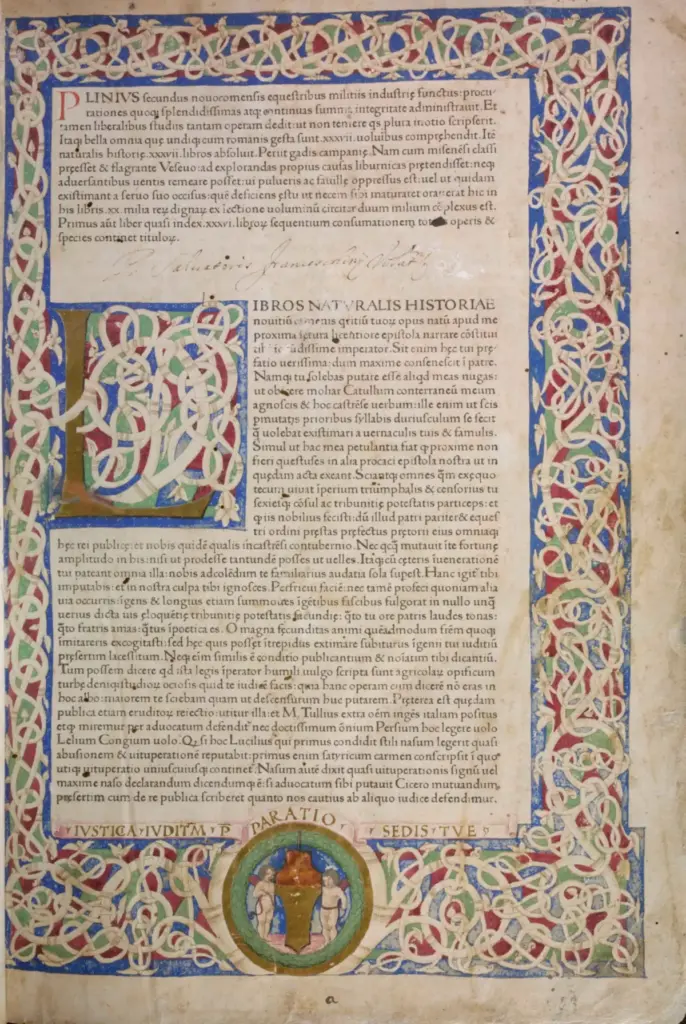
Recognizing the immense commercial potential of the text among Europe’s wealthy humanists, scholars, and patricians, de Speyer selected Pliny’s masterpiece as one of his very first printing projects in Venice. The resulting volume—currently preserved in the library collections of the Natural History Museum (NHM) in London and prominently featured within the Biodiversity Heritage Library—stands as a breathtaking monument to early typographical art. It combined the precision of metal movable type with the luxurious aesthetic conventions of hand-produced manuscripts, featuring generous, uncrowded margins, hand-illuminated initials, and meticulous rubrication.

Supporting Context & Metrics: Decoding the Natural History
To fully appreciate the scope of Pliny’s achievement, one must examine both the mechanics of the text and the quantitative realities of early European printing.
The Architecture of an Empire of Knowledge
Divided precisely into 37 books and published posthumously, the Natural History is frequently mischaracterized by modern commentators as the world’s first encyclopedia. However, contemporary scholarship has complicated this tidy label. In classical antiquity, there was no established genre of "encyclopedias" to which Pliny could consciously align his project.
Instead, Pliny prided himself on accumulating over 20,000 distinct facts and observations drawn from hundreds of Greek and Roman sources—many of which are now lost, making Pliny our sole witness to their existence. Rather than merely offering a neutral reference manual, Pliny constructed a sweeping imperial project. By synthesizing all known knowledge about the natural and physical world, he was metaphorically claiming dominion over nature itself, laying intellectual claim to the earth on behalf of the Roman Empire.
Navigating the Codex: The Role of Book One
One of the most remarkable pedagogical innovations of the Natural History is its structural navigation. Book One serves as a comprehensive summarium—an exhaustive table of contents and bibliographic summary that lists the sources and topics covered in the subsequent 36 books.
In the 1469 de Speyer edition held by the Natural History Museum, historical readers actively engaged with this navigational apparatus. Detailed marginal annotations inscribed in brown ink by at least two distinct early-modern hands demonstrate how Renaissance scholars used the volume as an interactive research tool, cross-referencing botanical descriptions, medicinal minerals, and geographical phenomena across the extensive text.

Incunabula Metrics across the BHL Consortium
Books printed before January 1, 1501, are classified by bibliographers as incunabula (from the Latin word for "cradle," signifying the infancy of printing). The Biodiversity Heritage Library consortium houses an extraordinary collection of these cradle-era editions of Pliny, demonstrating international institutional collaboration in preserving rare scientific heritage:
- 1469 Edition (Venice): Printed by Johann de Speyer; contributed to BHL by the Natural History Museum, London. Widely celebrated as one of the earliest printed books on natural history, with an estimated initial print run of only 100 copies.
- 1472 Edition (Venice): Held and contributed by the Boston Public Library and the Natural History Museum, London.
- 1473 Edition (Rome): Contributed to the digital consortium by McGill University Library.
- 1481 Edition (Parma): Contributed by McGill University Library and the Natural History Museum, London.
- 1497 Edition (Venice): Contributed by McGill University Library.
- Post-Incunabula Milestones: The NHM collection also houses significant later iterations, including the landmark 1601 English translation produced by Philemon Holland, which brought classical natural history to Elizabethan and Jacobean readers.
Official Statements & Institutional Perspectives
The preservation, digitization, and global dissemination of these historical touchstones require unprecedented cooperation among the world’s leading natural history institutions, libraries, and digital archivist networks.
Celebrating Two Decades of Open Access
Marking the 20th anniversary of the Biodiversity Heritage Library, institutional leaders and project contributors have emphasized the profound democratization of knowledge that the digital consortium represents. In recent statements released during the annual BHL meeting in London, curators highlighted the emotional and intellectual impact of bringing scholars face-to-face with primary source incunabula.
"For twenty years, the Biodiversity Heritage Library has systematically broken down the physical and financial barriers that once restricted access to humanity’s greatest scientific treasures," noted a BHL consortium spokesperson. "By transforming fragile, centuries-old volumes into freely accessible digital formats, we ensure that the foundational observations of natural philosophers like Pliny remain living, breathing resources for modern biodiversity research."
The Passing of the Torch: From Pliny to Circa Instans
While the 1469 de Speyer edition of Pliny’s Natural History served for many years as the oldest physical printed item hosted within the BHL ecosystem, recent collection expansions have highlighted the continuous, dynamic growth of the digital library.

As announced in previous archival dispatches, the honor of housing the oldest item in the BHL network has officially passed to a digital copy of Circa Instans—a celebrated twelfth-century pharmacological text by Platearius—contributed by the LuEsther T. Mertz Library of the New York Botanical Garden. This shifting milestone underscores a central truth of the BHL initiative: the library is not a static monument, but a continuously expanding digital commons that actively welcomes new historical treasures from partner libraries worldwide.
Conservation notes inscribed on the flyleaf of the NHM’s 1469 Pliny confirm the exceptional physical condition of the volume. Historically "collated" and verified as "perfect"—save for the later addition of two facsimile folios—experts have marveled at the survival rate of a book subject to nearly six centuries of human handling, institutional migration, and environmental shifts.
Future Outlook: Safeguarding Scientific Heritage for the Next Century
As the Biodiversity Heritage Library looks beyond its twentieth anniversary, the imperative to preserve, digitize, and contextualize historical scientific literature has never been more urgent. In an era marked by rapid ecological transformation, biodiversity loss, and the proliferation of digital misinformation, returning to historical texts offers invaluable perspective on humanity’s evolving relationship with the natural world.
Bridging Classical Philosophy and Modern Conservation
The observations recorded by Pliny the Elder—ranging from early ecological classifications and agricultural observations to mythological folklore and pharmacological properties—represent the embryonic stages of environmental science. By making these texts freely available online through platforms like BHL, researchers, historians, and citizen scientists can trace how human understanding of flora, fauna, and geology has shifted over two millennia.
Furthermore, high-resolution digitization enables advanced computational analysis, such as natural language processing and optical character recognition (OCR) of early printing types, allowing researchers to track the historical nomenclature of endangered species across centuries of Latin, Italian, English, and German texts.

Sustaining Open Access for Future Generations
The ongoing success and expansion of the Biodiversity Heritage Library rely heavily on international institutional partnerships, philanthropic support, and public engagement. Ensuring that rare incunabula like the 1469 Pliny—alongside millions of subsequent taxonomic monographs, field notes, and botanical illustrations—remain open, searchable, and preserved for future generations requires sustained global investment.
As Pliny the Younger immortalized his uncle’s relentless pursuit of knowledge beneath the falling ash of Vesuvius, the modern global community shares a parallel duty: to rescue our collective intellectual heritage from the shadows of obscurity, decay, and institutional isolation. Through the tireless work of the Biodiversity Heritage Library, the enduring spirit of inquiry championed by Pliny lives on—open, accessible, and illuminating the path forward for the next twenty years and beyond.
Further Reading & Scholarly References
- Chibnall, M. (1975). "Pliny’s Natural History and the Middle Ages." In T.A. Dorey (Ed.), Empire and Aftermath, Silver Latin II. London.
- Di Tommaso, L. (2017). "Pliny the Elder: Historia Naturalis." In J. Magee (Ed.), Rare Treasures from the Library of the Natural History Museum, pp. 6–11. London.
- Doody, A. (2010). Pliny’s Encyclopaedia: The reception of the Natural History. Cambridge University Press.
- Dunn, D. (2019). In the Shadow of Vesuvius: A life of Pliny. London: William Collins.
- Gudger, E.W. (1924). "Pliny’s Historia Naturalis: The most popular natural history ever published." Isis, 6(3), pp. 269–281.