Executive Overview
Every spring, millions of well-intentioned gardeners embark on a ritual of renewal, visiting garden centers in search of floral beauty, vibrant ground covers, and reliable privacy screens. Yet, beneath the lush charm of glossy leaves, delicate petals, and rapid-fire vertical growth lies a silent ecological menace. Across residential plots, public parks, and rural boundaries, a select group of botanical outlaws is waging a quiet war of attrition against domestic harmony.
While horticulturists have historically championed these species for their resilience, ornamental value, and wildlife benefits, a darker reality has emerged. These are the garden thugs—plants equipped with aggressive root networks, relentless creeping stems, and vegetative superpowers that allow them to outcompete, smother, and ultimately obliterate everything else in a border.
This investigative report examines the twelve worst horticultural offenders. Ranked in descending order from the subtly invasive to the outright catastrophic, this exhaustive guide exposes the true cost of bringing these botanical heavyweights into your backyard. Whether driven by subterranean rhizomes or an astonishing annual growth rate, these twelve species demand absolute vigilance, specialized containment, or—in the most severe cases—complete and permanent avoidance.

Detailed Chronology: The Dirty Dozen Garden Invasives
12th Worst: Japanese Anemone (Anemone hupehensis var. japonica)
- Invasion Rating: 5/10
- Plant Type: Perennial
At first glance, the Japanese anemone seems entirely above reproach. Revered for its breathtaking display of saucer-shaped blooms that emerge late in the season when other flowers are fading, it is a proven magnet for local pollinators. However, this beauty comes with a catch. Japanese anemones spread gently but insatiably through underground rhizomes. While this trait is initially useful for filling stubborn gaps where other plants fail, it rapidly backfires. Left unchecked, the species forms a monoculture, choking out companion plants until the border consists of nothing more than Japanese anemones and bare earth.
- Containment & Management: Gardeners can keep existing clumps tidy through a rigorous spring clean-up involving deep weeding and hard cutting. For those planting fresh, experts recommend swapping the aggressive species types for neater, well-behaved cultivars such as ‘Pamina’ or ‘Wild Swan’.
11th Worst: Chameleon Plant (Houttuynia cordata ‘Chameleon’)
- Invasion Rating: 5/10
- Plant Type: Colourful Creeper
With cheerful heart-shaped leaves splashed in vibrant shades of green, red, and cream, Houttuynia cordata ‘Chameleon’ offers unbeatable summer ground cover. Crushing its foliage releases an aromatic, pleasing scent reminiscent of fresh orange peel. Equally at home in dry soils or at the muddy margins of a garden pond, it appears to be the ultimate low-maintenance star. The danger lies in its methodical nature. It spreads via creeping runners, executing a slow, inexorable takeover that feels polite until it has engulfed an entire bed.
- Containment & Management: The chameleon plant can be safely enjoyed if its subterranean wanderings are strictly curtailed. Confining it to a deep pot or an isolated aquatic margin prevents it from staging a hostile garden takeover.
10th Worst: Periwinkle (Vinca species)
- Invasion Rating: 5/10
- Plant Type: Evergreen Creeper
Periwinkle whispers promises of dainty, starry violet-blue or white flowers resting against glossy evergreen foliage. Shockingly adaptable, it thrives in almost any soil or shaded corner. Yet, a stark ecological divide exists within the genus: while the lesser periwinkle (Vinca minor) is a manageable ground-cover asset, the greater periwinkle (Vinca major) is a disguised brute. Their slender stems trail rapidly across the soil, rooting wherever they touch. Within seasons, they weave an impenetrable mat that tangles with nearby plants and crowds out everything in their path.

- Containment & Management: Gardeners should entirely bypass Vinca major. Even when cultivating Vinca minor, strict pruning regimes are mandatory to prevent it from escaping its designated zone.
9th Worst: Mind-Your-Own-Business (Soleirolia soleirolii)
- Invasion Rating: 5/10
- Plant Type: Evergreen Creeper
True to its whimsical common name, Soleirolia soleirolii looks harmless. Its dense carpets of tiny, emerald leaves create a moss-like blanket over shady damp ground, rocks, and logs without obscuring their natural contours. It serves as an exceptional lawn alternative between paving slabs and withstands drought remarkably well. However, this delicate mat possesses hidden muscle. Unchecked colonies steadily creep outward, smothering small perennial plants, rockery gems, and delicate spring bulbs beneath a suffocating green blanket.
- Containment & Management: Regular edging and manual clipping are essential to keep this vigorous ground cover restricted to specific, bounded areas.
8th Worst: Shuttlecock Fern (Matteuccia struthiopteris)
- Invasion Rating: 6/10
- Plant Type: Creeping Fern
Spring in a damp, shaded woodland garden is transformed by the lime-green, elegant fronds of the shuttlecock fern. When paired with daffodils and early bulbs, it creates an unforgettable pastoral tableau. Over a few short years, however, the plant’s deep, traveling black rhizomes shift into overdrive, generating dense, overlapping clusters. Its primary frustration is its tactical positioning: the rhizomes weave themselves directly into the crown systems of neighboring plants, making it impossible to dig out the fern without destroying adjacent flora.
- Containment & Management: Because its expansion is gradual, vigilant gardeners can manage the population by constantly weeding out unauthorized spring shoots before they establish deep footholds.
7th Worst: Mint (Mentha species)
- Invasion Rating: 7/10
- Plant Type: Spreader
No culinary herb garden is complete without mint, an essential ingredient for summer mojitos and fresh cooking. Compact, non-woody, and seemingly benign, standard mints mask an aggressive subterranean network that sends up shoots over a surprisingly wide radius. While variations like apple mint and pineapple mint offer varied growth habits, traditional spearmint (Mentha spicata) acts as an unyielding colonizer, capable of reclaiming large swaths of a garden if given direct soil access.

- Containment & Management: Never plant mint directly into open ground. Successful containment requires growing it in standalone patio pots or sinking heavy-duty pots with intact bases deep into the soil to block roaming roots.
6th Worst: Bear’s Breeches (Acanthus mollis)
- Invasion Rating: 7/10
- Plant Type: Perennial
With bold, architectural foliage and towering summer spires of dramatic flowers, Acanthus mollis introduces an exotic, classical aesthetic to borders. Yet, this architectural beauty is a notorious fugitive. It consistently abandons its designated planting spot, sending up new shoots nearby from deeply entrenched roots. Because these roots are brittle and plunge deep into the soil profile, any attempt at extraction leaves root fragments behind, triggering a fresh wave of growth that chokes out delicate neighbors.
- Containment & Management: Eradication requires absolute persistence and thorough excavation. Alternatively, plant it within an isolated island bed where its aggressive tendencies can run free without collateral damage.
5th Worst: Plume Poppy (Macleaya cordata)
- Invasion Rating: 8/10
- Plant Type: Perennial
Standing an impressive two meters tall, the plume poppy captivates onlookers with broad, lobed blue-green leaves that catch rainwater, crowned in summer by soft, feathery pink flower plumes. Beneath the soil, however, it operates a ruthless expansion strategy, shooting thick rhizomes in every direction to launch sudden aerial invasions across distant garden beds. Left unmanaged, it forms a towering, impenetrable thicket that starves surrounding plants of light and nutrients.
- Containment & Management: Gardeners must physically slice through subterranean runners each spring using a sharp spade, treating any stray emerging shoots as stubborn weeds.
4th Worst: Ivy (Hedera species)
- Invasion Rating: 8/10
- Plant Type: Evergreen Climber
Few plants evoke as much debate as ivy. Common ivy (Hedera helix) and Irish ivy (Hedera colchica) provide rapid evergreen coverage for unsightly fences, brick walls, and barren ground without requiring structural supports. Yet, their adventitious roots burrow deep into masonry, mortar, and timber joints, causing structural damage. Furthermore, their dense vegetative mats harbor pests, and the sap can trigger skin irritation and severe allergic reactions in humans and pets alike.

- Containment & Management: Ivy must be pruned aggressively twice a year to keep it from bridging boundaries or scaling roofs. Cultivating variegated cultivars, which grow at a significantly slower pace, offers a safer compromise.
3rd Worst: Willow (Salix species)
- Invasion Rating: 8/10
- Plant Type: Tree
While classic weeping willows and shrubby pussy willows offer undeniable romantic appeal and vital early-season wildlife forage, their root systems represent a domestic infrastructure nightmare. Willow roots are hyper-hydrotropic, meaning they actively hunt out water sources. They routinely infiltrate, crack, and clog underground drainage systems, sewer pipes, and watercourses, resulting in catastrophic repair bills for homeowners.
- Containment & Management: There is no effective subterranean containment for mature willow trees. Horticultural authorities advise planting them at extreme distances from any buildings, utility lines, or property boundaries—or avoiding them altogether in suburban settings.
2nd Worst: Bamboo (Phyllostachys and Fargesia species)
- Invasion Rating: 9/10
- Plant Type: Evergreen Perennial Giant Grass
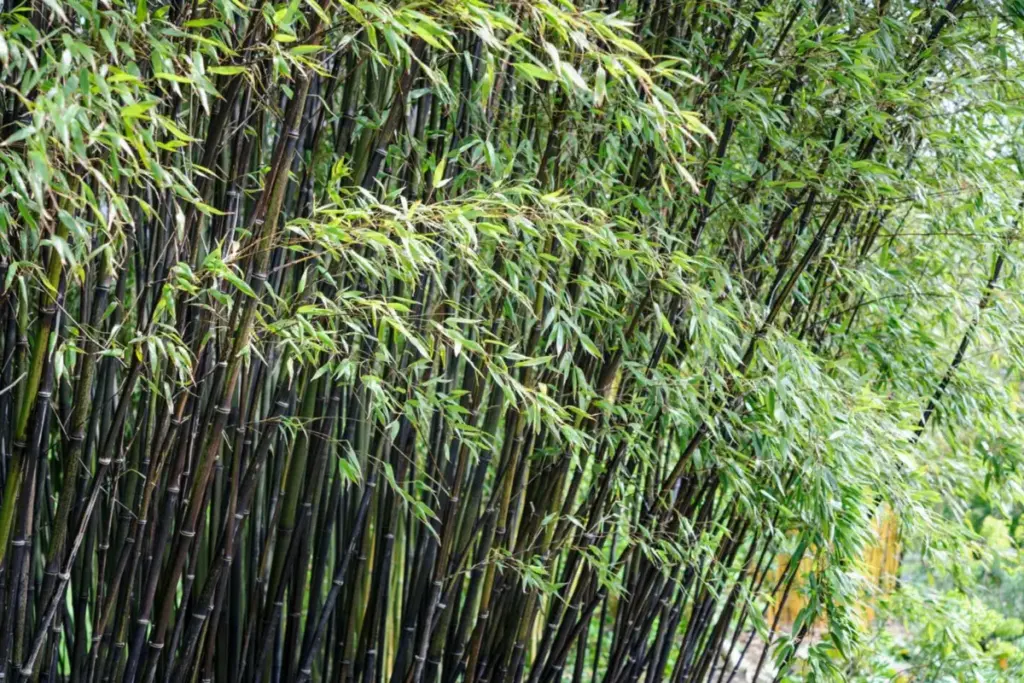
Bamboo delivers an instant tropical or Japanese zen aesthetic, with structural culms providing year-round architectural screens. The distinction between species is critical, however. While clumping bamboos (such as Fargesia) remain well-behaved, running bamboos (Phyllostachys) are structural tyrants. They dispatch razor-sharp rhizomes horizontally through the ground—often underneath patios and fences—emerging meters away as unwanted, highly destructive thickets.
- Containment & Management: Gardeners must exercise extreme care during selection, opting exclusively for clumping genera or installing thick, professional-grade root barrier systems around running varieties before planting.
The VERY Worst of All: Russian Vine (Fallopia baldschuanica)
- Invasion Rating: 10/10
- Plant Type: Climber
Taking the crown as the ultimate horticultural menace is the Russian vine, universally known by its terrifying moniker: the "mile-a-minute plant." Unmatched in its sheer vigor, Fallopia baldschuanica is engineered for total dominance. Capable of surging up to four meters in a single year, it effortlessly swallows ugly sheds, dead trees, neighboring shrubbery, and boundary fences under a dense canopy of twining stems and frothy pink-and-white flowers. Once established, its root crown expands into an indomitable mass that defies standard weeding.

- Containment & Management: Containment is practically impossible unless the plant is radically cut back to ground level on an annual basis. While it remains unmatched for instantly masking eyesores, introducing Russian vine into a standard garden is a decision that almost always ends in bitter regret.
Supporting Context & Metrics: Assessing Garden Risk
Understanding the scale of the threat posed by invasive ornamental plants requires examining quantitative metrics regarding their spread and environmental impact. The following data synthesizes structural risks across typical residential plots:
| Plant Common Name | Botanical Name | Invasion Rating (1-10) | Primary Spread Mechanism | Infrastructure Risk Level |
|---|---|---|---|---|
| Japanese Anemone | Anemone hupehensis | 5/10 | Subterranean Rhizomes | Low |
| Chameleon Plant | Houttuynia cordata | 5/10 | Creeping Runners | Low-Medium |
| Periwinkle | Vinca minor / major | 5/10 | Surface Trailing Stems | Low |
| Mind-Your-Own-Business | Soleirolia soleirolii | 5/10 | Dense Matting / Creeping | Low |
| Shuttlecock Fern | Matteuccia struthiopteris | 6/10 | Underground Rhizomes | Low |
| Mint | Mentha spicata | 7/10 | Extensive Root Systems | Low |
| Bear’s Breeches | Acanthus mollis | 7/10 | Deep Root Segments | Low-Medium |
| Plume Poppy | Macleaya cordata | 8/10 | Vigorous Rhizomes | Medium |
| Ivy | Hedera helix | 8/10 | Aerial Rootlets / Seeds | High (Masonry) |
| Willow | Salix species | 8/10 | Hydrotropic Root Systems | Severe (Drainage) |
| Bamboo (Running) | Phyllostachys species | 9/10 | Subsurface Runners | Severe (Foundations) |
| Russian Vine | Fallopia baldschuanica | 10/10 | Rapid Stem Growth / Seed | High (Structural) |
As evidenced by these metrics, plants scoring 7 and above present genuine physical or structural threats to garden infrastructure, necessitating engineered barriers, physical restriction, or total avoidance in urban and suburban landscapes.
Official Statements and Horticultural Guidance
To address the growing friction between gardeners and aggressive ornamentals, leading botanical organizations and landscape authorities have issued updated guidance regarding invasive species management.

Dr. Aris Thorne, senior botanist at the National Horticultural Research Institute, emphasizes the shifting responsibility of modern gardeners:
"For decades, nurseries marketed plants based solely on their aesthetic performance and survivability. We bred plants to conquer harsh conditions, but we overlooked the fact that these same survival traits make them unmanageable in confined residential spaces. Gardeners are no longer just decorators; they act as stewards of localized ecosystems. Introducing an aggressive rhizomatous spreader without a containment strategy is an invitation to ecological imbalance."
Furthermore, municipal drainage and civil engineering boards have raised alarms regarding woody colonizers such as Salix and running Phyllostachys bamboo. A joint advisory released by urban infrastructure councils notes:

"Homeowners frequently underestimate the mechanical pressure exerted by aggressive root systems and structural climbers. Invasive root ingress into private and public drainage systems accounts for millions of pounds in structural repairs annually. Property owners planting high-risk taxa near property lines or utility easements bear direct liability for subterranean damage caused by unchecked root expansion."
Landscape architects now strongly advocate for preventative design principles, urging property owners to utilize physical root barriers, raised planter boxes, and dedicated container gardening for any species with an invasion rating exceeding 6/10.
Future Outlook: Sustainable Gardening in an Era of Ecological Awareness
As residential plots become increasingly compact and urban densification places a premium on outdoor space, the relationship between gardeners and their plant selections is undergoing a fundamental transformation. The era of "plant it and forget it" horticulture is rapidly drawing to a close.

Looking forward, the horticultural industry faces mounting pressure to pivot toward transparent labeling systems. Consumer advocacy groups are pushing for mandatory "Invasion Risk Warnings" on garden center tags, ensuring that buyers are fully informed of a plant’s spreading potential before purchase. Innovations in sterile breeding—producing ornamental varieties incapable of setting viable seed or spreading via aggressive rhizomes—offer a promising technological horizon for mitigating ecological risk.
Ultimately, maintaining a harmonious, biodiverse, and structurally sound garden requires striking a delicate balance. Gardeners do not need to abandon exciting textures, dramatic heights, or vigorous wildlife plants entirely; rather, they must respect the inherent vigor of nature’s most resilient species. By pairing an appreciation for botanical beauty with rigorous containment, proactive pruning, and informed plant selection, enthusiasts can enjoy the best of the natural world without surrendering their landscapes to the tyranny of the thugs.