Executive Overview
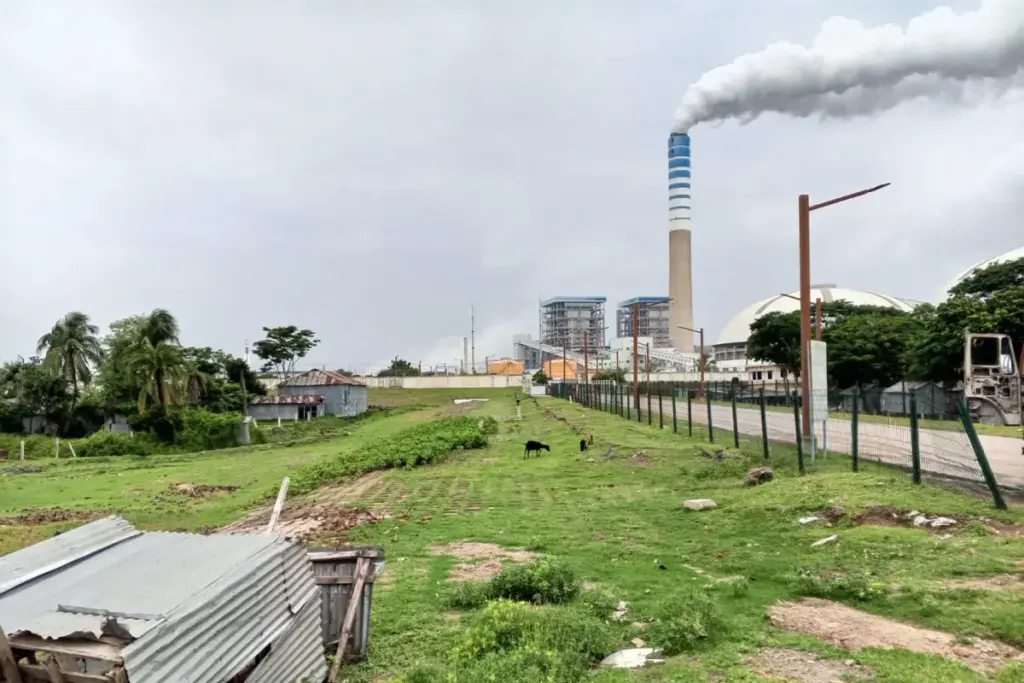
In Madhupur, a tranquil farming village nestled in the southern coastal Patuakhali district of Bangladesh, the seasonal rhythms of agriculture have been upended. Once a prolific producer of cucumbers, okra, bananas, and papayas, Riaz Panchayet now runs a small, dusty tea stall near the gates of the massive Payra Power Plant. Where vibrant green foliage and dependable harvests once defined his livelihood, Panchayet now points to a persistent layer of industrial fly ash blanketing his crops.
"I notice a layer of ash on the leaves of the plants and low production," Panchayet says, running a hand over a soot-stained shirt. "There are coconut trees on my farm; I climb them for pruning or collecting coconuts, and my shirt turns black due to the ash. We are used to bathing in an open pond, but for the last several years, there has been an itching problem. My eyesight is affected, too. It is all happening because of the coal power plant."
Panchayet’s story is far from unique. Across the Kalapara subdistrict, residents living in the shadow of the 1,320-megawatt Payra Thermal Power Plant report identical hardships—diminished crop yields, chronic health issues, and degraded water sources. Operated by the Bangladesh-China Power Company Ltd. (BCPCL), a joint venture between the two nations, the facility burns between 10,000 and 12,000 tons of coal every day to feed the national grid.
However, a damning peer-reviewed study published in the Bangladesh Journal of Physics links this localized suffering directly to systemic regulatory failures. According to the research, the plant’s operators and state overseers have routinely flouted critical environmental guidelines, leaving vulnerable rural communities exposed to unregulated toxic emissions, heavy metal contamination, and severe ecological degradation.
Detailed Chronology of Regulatory Oversight and Failures
The trajectory of the Payra Power Plant is a case study in fast-tracked industrial development overriding environmental prudence. A close examination of government documents, site clearances, and inspection reports reveals a timeline marked by delayed approvals, retroactive adjustments, and a troubling absence of oversight.
August 2015: The Initial Blueprint and Strict Conditions
When Bangladesh’s Department of Environment (DoE) approved the Environmental Impact Assessment (EIA) for the Payra project on August 10, 2015, it issued a site clearance certificate bound by 57 explicit conditions. Condition 56 was unequivocal: the facility was strictly barred from commencing operations without installing a 275-meter (902-foot) chimney, an effluent treatment plant, wastewater management systems, and a comprehensive suite of pollution-control equipment.
This height requirement was not arbitrary. Schedule 11 of the Environment Conservation Rules of 1997 explicitly mandates a minimum stack height of 275 meters for coal-fired power plants with a capacity of 500 MW or greater. The purpose is simple: to ensure sulfur dioxide and other noxious exhaust gases are dispersed widely across the upper atmosphere rather than trapped at ground level.

January to May 2020: Operating Without Clearance
Despite the explicit conditions of the site clearance, the plant’s timeline far outpaced its regulatory compliance. The first 660 MW unit began its trial run on January 12, 2020, and entered full commercial operation on May 15, 2020. The second unit quickly followed, initiating trial generation on August 26 of the same year.
Crucially, the DoE did not issue the mandatory Environmental Clearance Certificate (ECC) until October 20, 2020. This means that both units—consuming thousands of tons of coal daily—were actively running commercial and trial operations months before official environmental approval was granted.
March to May 2020: The Shrinking Chimneys
When DoE inspectors conducted their first pre-ECC inspection on March 2, 2020, they uncovered a glaring discrepancy: the chimneys for both power units stood at just 220 meters (720 feet)—a full 55 meters (180 feet) below the legally mandated height stipulated in the original EIA.
Rather than halting operations to enforce compliance, the joint-venture operators submitted a revised EIA to DoE headquarters on May 17, 2020, officially recording the shortened 220-meter height. To legitimize the change, the DoE subsequently formed an expert committee to review industry practices.
Tanvir Ahmed, a professor of civil engineering at the Bangladesh University of Engineering and Technology (BUET) and a member of the review committee, defended the alteration. "The stack height of 275 m was not mandatory. The height never guarantees better quality. If the flue gas desulfurization [FGD] machine successfully retains the gases properly, then 220 m is enough," Ahmed explained.
However, this rationale depends entirely on the rigorous, unremitting performance of desulfurization technology—machinery that local oversight bodies are structurally ill-equipped to verify.
May 2025: The Quiet Exemption
Regulatory oversight eroded further on May 27, 2025, when the DoE issued an "urgent and confidential" order signed by then-Additional Director General Sohrab Ali. The directive quietly exempted several heavy industries, including power plants, from submitting ambient air quality monitoring results. The justification cited was that the Air Pollution (Control) Rules of 2022 established fugitive emission standards for only five specific sectors: cement, steel, spinning mills, brick kilns, and stone crushing. Consequently, coal-fired power plants were given a regulatory pass on tracking the ambient air their neighbors breathe.

Supporting Context & Metrics: What the Ground Reality Shows
While bureaucrats debate the legal interpretations of stack heights and ambient air rules, independent scientific assessments paint a stark picture of environmental devastation across the Kalapara subdistrict.
Air Quality Violations
A comprehensive 2025 study evaluating 16 villages within a 9-kilometer (5.6-mile) radius of the Payra facility revealed alarming concentrations of atmospheric pollutants:
- Sulfur Dioxide ($textSO_2$): Averaged 65 micrograms per cubic meter ($mutextg/m^3$) near the plant site, significantly exceeding the national standard of $50 mutextg/m^3$.
- Nitrogen Oxides ($textNO_x$): Reached an average of $80 mutextg/m^3$, eclipsing the regulatory threshold of $53 mutextg/m^3$.
- Particulate Matter ($textPM2.5$ and $textPM10$): Both metrics far exceeded World Health Organization (WHO) safety limits, pointing to an acute, ongoing crisis regarding respiratory illnesses among local residents.
Historical DoE data, though sparse, underscores past volatility. During a rare ambient air test on October 24, 2021, particulate matter was recorded at $188.12 mutextg/m^3$ during "half-rainy weather"—dangerously close to the legal limit. An earlier reading that year had spiked to a staggering $310 mutextg/m^3$, well above the permitted ceiling of $200 mutextg/m^3$.
Aquatic and Soil Degradation
The environmental fallout extends far beyond the air. Situated in the delicate estuary of the Andharmanik and Golachipa rivers, the Payra plant dumps massive quantities of thermal discharge and wastewater into local aquatic ecosystems.
The 2025 study found that local river water temperatures have surged by up to 3.5°Celsius (6.3°F) above pre-operation levels, easily breaching the International Energy Agency’s (IEA) strict thermal pollution threshold of 2°C (3.6°F). Furthermore, water samples revealed concentrations of arsenic, mercury, and cadmium that exceeded WHO drinking water guidelines.
The land tells an equally grim story. Acidification driven by sulfur dioxide and nitrogen oxide emissions has caused average soil pH to drop precipitously from 6.2 to 4.8. Soil samples analyzed in the study also registered levels of arsenic, cadmium, and lead that violate Food and Agriculture Organization (FAO) safety thresholds for agricultural land. For Riaz Panchayet, who lost nearly 1 hectare (2.4 acres) to the plant footprint while watching his remaining 1 hectare waterlog due to poor drainage design, the science simply confirms his daily reality.
Official Statements and Bureaucratic Fractures
The crisis at Payra has exposed deep institutional divisions within Bangladesh’s Department of Environment, highlighting a dangerous mix of technical incapacity, conflicting interpretations of the law, and outright denial from operators.

The Laboratory Deficit
The failure to monitor the plant begins at the regional level. The DoE’s Barishal Divisional Office, which holds nominal jurisdiction over Patuakhali, has proven functionally incapable of fulfilling its mandate. Reviewing stack emission test documents from 2021 to 2025 reveals that the Barishal office never once conducted a stack emission test at Payra. Ambient air was checked only sporadically for particulate matter, while sulfur dioxide and nitrogen oxides were tested precisely once—back in 2021.
Md Golam Kibria, senior chemist at the Barishal office, offered a blunt admission regarding these failures: "The office simply cannot do the work. We have a mandate for air, sound and liquid quality tests. But in our laboratory in Barishal, we cannot test air and liquid, though it is mandatory to test them twice a year."
Conflicting National Guidance
While regional officers cite a lack of laboratory capacity, senior officials in Dhaka offer divergent interpretations of legal obligations.
Mohammad Abdul Motalib, Deputy Director for Air Quality at the DoE, defended the agency’s monitoring approach. He noted that while major facilities like Payra, Rampal, and Banshkhali are tracked via online systems, third-party agencies are only engaged when discrepancies arise. Notably, Motalib admitted that no third-party test had ever been conducted specifically for Payra, asserting that "the air is within the standard."
Motalib also dismissed the necessity of ambient air testing for heavy industries: "When we are testing emissions, we don’t need to check ambient air quality. Besides, the standards of ambient air components were not fixed in the latest air pollution control rules. Those who are advocating for ambient air tests lack knowledge."
However, this stance is directly contradicted by regional leadership. Muhammad Mujahidul Islam, Director of the Barishal Divisional Office, countered: "We need to test ambient air because there are other activities rather than emissions, like coal transportation and handling."
Operator Denials
Corporate leadership maintains that the facility is operating well within acceptable parameters. Muhammad Mahmud Hasan, General Manager and Company Secretary of the Bangladesh-China Power Company Limited, dismissed the scientific findings entirely.

"We emit gases below the standard of the government and in full compliance of the rules," Hasan said. "I don’t know what the researchers have found; there may be some mismatches. They may have a deficit of information."
Future Outlook and Expert Warnings
As Bangladesh grapples with an acute energy crisis and the growing demands of industrialization, the fallout from projects like the Payra Power Plant serves as a cautionary tale about the human and environmental costs of lax enforcement.
Independent air pollution experts warn that treating coal-fired power generation as a routine industrial activity ignores the uniquely hazardous nature of fossil-fuel combustion. Dr. Abdus Salam, a chemistry professor at the University of Dhaka and a prominent air quality researcher, did not mince words regarding the government’s policy trajectory.
"A coal power plant is always hazardous to the environment, and it has an impact on the environment and communities even if you have efficient equipment to capture toxic materials. This is why European countries have shifted power production away from coal," Dr. Salam noted.
Commenting on the DoE’s recent decision to exempt heavy industries from ambient air testing, he added: "Emissions and ambient air should be monitored extensively, but if monitoring or tests are not done regularly, it is concerning. The exemption from ambient air tests is a blunder."
For coastal communities in Patuakhali, the future looks increasingly precarious. Without robust, transparent, and independent monitoring—and with regional regulatory bodies starved of testing capabilities—villagers like Riaz Panchayet are left bearing the hidden costs of national energy production. As ash continues to settle on their leaves and black wastewater pools near factory gates, the promise of modern development has translated into an ecological burden that threatens the very habitability of southern Bangladesh’s coastal fringe.