Executive Overview
For decades, the global climate apparatus has evaluated decarbonization through a single, unified lens: carbon dioxide equivalent ($CO_2e$). By converting all greenhouse gases—regardless of their atmospheric lifespan or warming intensity—into a standardized unit of $CO_2$, policymakers aimed to streamline international climate negotiations and carbon accounting. However, groundbreaking research published in Communications Earth & Environment reveals a fundamental flaw in this unified approach. Aggregating short-lived climate pollutants like methane ($CH_4$) with long-lived stock pollutants like carbon dioxide ($CO_2$) blinds policymakers to critical near-term warming dynamics, putting global climate targets at grave risk.
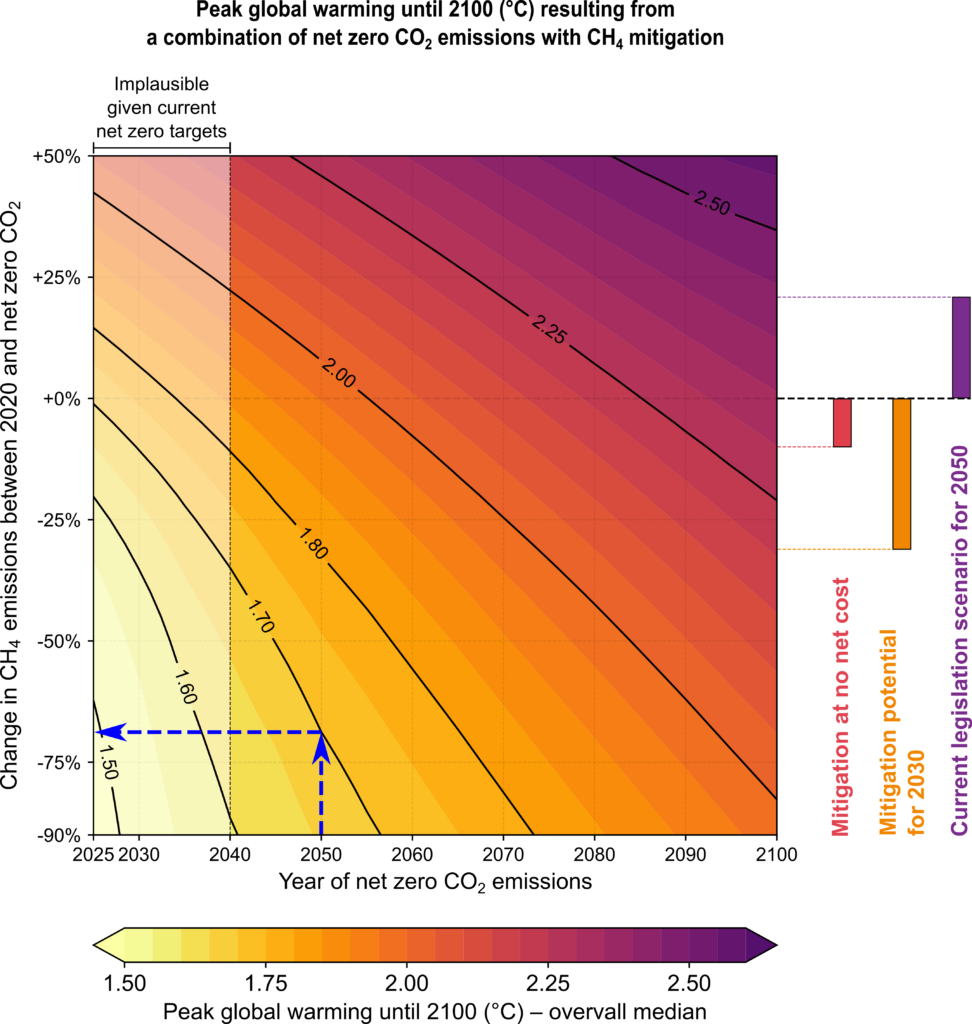
The study, led by K. Weber and a team of international climate scientists, demonstrates that relying exclusively on net-zero $CO_2$ targets without explicit, decoupled methane reduction strategies guarantees an overshoot of safe global warming thresholds. Even under the world’s most ambitious net-zero $CO_2$ targets, failing to curb methane emissions will cause peak global temperatures to exceed 1.85°C above pre-industrial levels—far surpassing the primary ambition of the Paris Agreement.
Methane is a potent greenhouse gas responsible for roughly thirty percent of the rise in global temperatures since the Industrial Revolution. Primarily released through agricultural activities, fossil fuel operations, and waste management, methane traps atmospheric heat with far greater potency than $CO_2$ over short timeframes, though it dissipates within a few decades.
By modeling decoupled pathways for $CO_2$ and $CH_4$, the researchers demonstrate that achieving the Paris Agreement’s target of limiting global warming to well below 2.0°C—specifically aiming for a 1.7°C cap—requires methane emissions to fall by at least 69% by 2050 relative to 2020 levels, alongside net-zero $CO_2$.
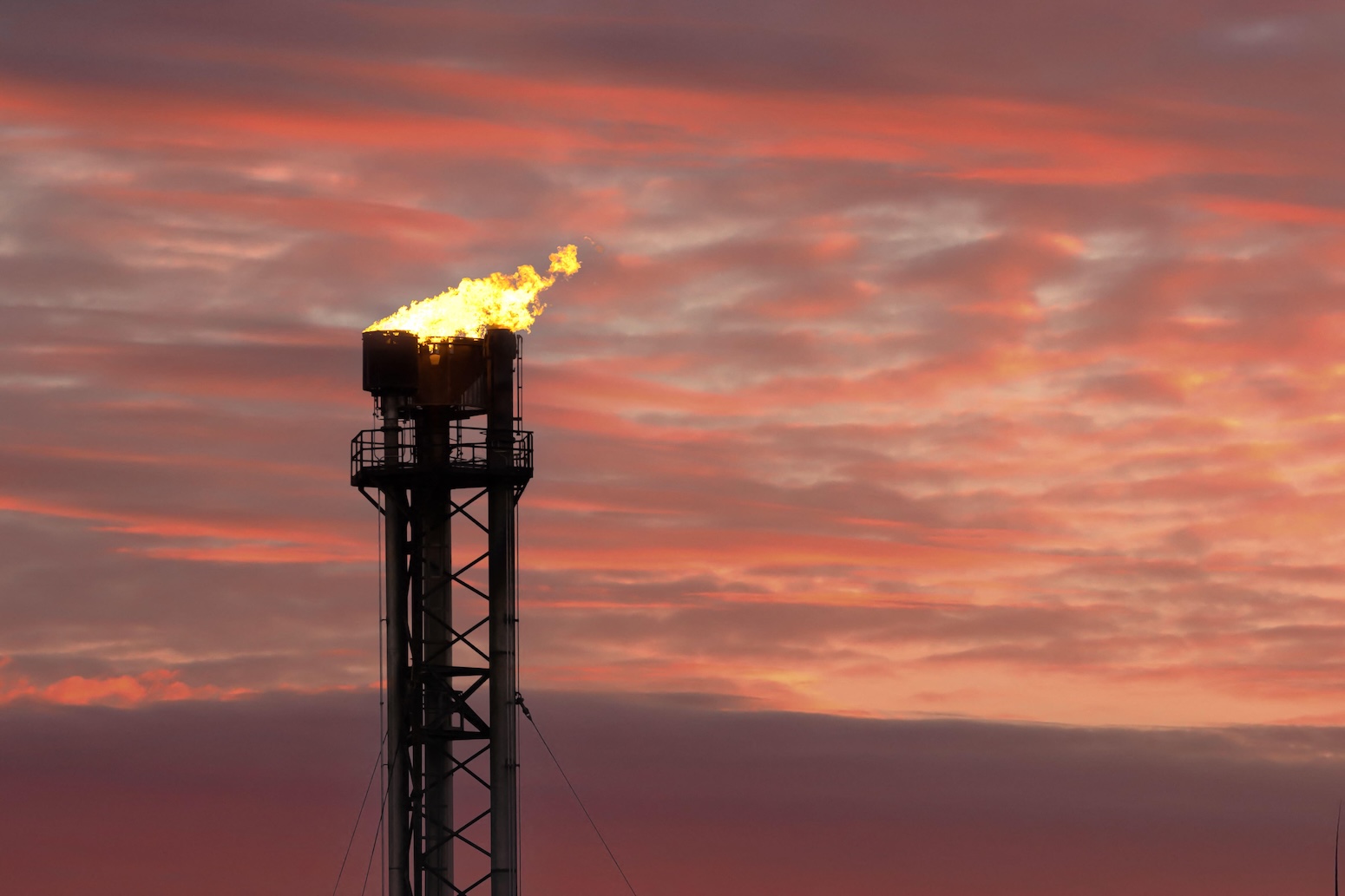
If methane emissions follow their current policy trajectory—projected to increase by approximately 20% by 2050—global temperatures will breach the 2.0°C guardrail by mid-century, even if the world successfully eliminates net $CO_2$ emissions.
                   PEAK WARMING TRAJECTORIES (UNTIL 2100)

     Current Policy Baseline (+20% CH4 by 2050)
     |=======================================================> >2.00°C Peak
     |
     Static Methane Baseline (0% CH4 Change, Net-Zero CO2 by 2040)
     |===============================================> 1.85°C Peak
     |
     Global Methane Pledge (~30% CH4 Cut by 2030)
     |=======================================> 1.70°C to 1.75°C Peak
     |
     Required Decoupled Strategy (-69% CH4 + Net-Zero CO2 by 2050)
     |=================================> 1.70°C Peak Cap
     +-------------------------------------------------------------------+
    1.0°C                            1.5°C                           2.0°C
Detailed Chronology: The Evolution of Methane Accounting and Modeling
To understand why methane has been historically under-targeted, one must trace the evolution of climate policy frameworks and Integrated Assessment Models (IAMs) over the last three decades.
Chronology of Methane Accounting Frameworks:
[1997] Kyoto Protocol adopts GWP100 metric -> Combines all GHGs into unified CO2e.
  │
[2015] Paris Agreement sets "well-below 2°C" goal -> Relies on IAMs using bundled CO2e.
  │
[2021] IPCC AR6 & Global Methane Pledge -> Highlights short-term warming impact of CH4.
  │
[2023] Carbon Budget Revisions -> Confirms remaining carbon budget depends on CH4 cuts.
  │
[2026] Weber et al. Study Published -> Proposes decoupling CO2 and CH4 target-setting.
The Kyoto Legacy and the $CO_2e$ Standard (1997–2015)
The practice of bundling greenhouse gases originated with the 1997 Kyoto Protocol, which formally adopted the Global Warming Potential over a 100-year time horizon ($GWP_100$) metric. This tool allowed governments to convert methane, nitrous oxide ($N_2O$), and fluorinated gases into $CO_2e$. While this framework provided a flexible, cost-effective trading mechanism for industrial nations, it masked the immediate thermal impacts of short-lived gases. Methane possesses an atmospheric lifetime of roughly 12 years, compared to $CO_2$, which persists for centuries to millennia. Over a 20-year horizon, methane is more than 80 times more potent at trapping heat than $CO2$, but over a 100-year horizon, that factor drops to roughly 28–30. By defaulting to $GWP100$, climate policy effectively discounted the near-term warming spikes caused by methane.
The Rise of Integrated Assessment Models (2015–2021)
Following the 2015 Paris Agreement, international climate strategies relied heavily on Integrated Assessment Models (IAMs). These complex computational tools optimize emission pathways based on cost-effectiveness across economic sectors. However, because IAMs treat greenhouse gases through aggregated metric conversions, they prioritize mitigation measures purely on a dollar-per-tonne of $CO_2e$ avoided basis. Real-world climate policy is rarely dictated purely by global cost optimization. Consequently, IAM scenarios routinely omitted sub-optimal political pathways or decoupled gas targets, leaving major blind spots regarding what happens if $CO_2$ mitigation succeeds while methane abatement stalls.
The Global Methane Pledge and Scientific Reframing (2021–2025)
The scientific community increasingly challenged the practice of bundling gases, leading to the launch of the Global Methane Pledge at COP26 in 2021, where participating nations committed to reducing collective methane emissions by 30% below 2020 levels by 2030. Despite this pledge, national commitments (Nationally Determined Contributions, or NDCs) remained largely tied to unified $CO_2e$ targets. Only a handful of nations—including Japan, Mexico, and South Korea—explicitly defined independent methane reduction targets within their national legislation.
The Weber et al. Benchmark (2026)
The 2026 study in Communications Earth & Environment marks a major analytical shift. Rather than asking how much methane equals a tonne of $CO_2$ under a arbitrary conversion metric, Weber et al. inverted the problem. The authors established desired peak global temperature limits (1.7°C, 1.8°C, and 2.0°C) as the non-negotiable starting condition, and systematically evaluated the exact combination of decoupled $CO_2$ and $CH_4$ trajectories needed to avoid overshooting those targets.
Supporting Context & Metrics: Analyzing the Decoupled Pathways
The core difficulty in standardizing greenhouse gas conversions lies in physics: comparing methane to $CO_2$ is fundamentally like comparing distinct physical commodities. As the study authors illustrate, asking how much methane corresponds to one tonne of $CO_2$ is conceptually as incongruous as asking "how many grams of spaghetti equal a chicken?" One can draw comparisons based on calories, protein content, or monetary cost, but each comparison is valid only for that specific parameter. Because $CO_2$ accumulates as a long-term atmospheric stock while methane acts as a powerful but short-lived thermal force, any conversion metric changes depending on the chosen time horizon and warming baseline.
To overcome this, Weber et al. ran systematic, decoupled simulations using a simple, calibrated climate model to determine compatible mitigation limits. Their analysis reveals stark trade-offs between the year net-zero emissions are achieved and the required percentage cuts in global methane.

Minimum Compatible Methane Emission Cuts (Relative to 2020 Levels)
| Peak Warming Limit | Year of Net-Zero $CO_2$ Emissions | Required $CH_4$ Cut (Net-Zero $CO_2$) | Year of Net-Zero GHG Emissions ($CO_2e$) | Required $CH_4$ Cut (Net-Zero GHG) |
|---|---|---|---|---|
| 1.7°C | 2050 | -69% | 2050 | -63% |
| 1.7°C | 2060 | Incompatible | 2060 | Incompatible |
| 1.8°C | 2050 | -32% | 2050 | -11% |
| 1.8°C | 2060 | -56% | 2060 | -47% |
| 2.0°C | 2050 | +8% | 2050 | > +50% |
| 2.0°C | 2060 | -8% | 2060 | +33% |
| 2.0°C | 2100 | -83% | 2100 | -78% |
Note: Incompatible entries ("—") indicate that even with 100% methane elimination, the delayed net-zero $CO_2$ date makes staying below that peak warming limit physically impossible.
                 METHANE REDUCTION VS. NET-ZERO TIMELINE
                      (For a 1.7°C Warming Cap)

   Methane Cut Required
      ^
 100% |
      |
  69% |----------------------* (Net-Zero CO2 by 2050)
  63% |----------------------# (Net-Zero GHG by 2050)
      |
   0% |-----------------------------------------------------> Time
      |                      2050                2060
      |                                           |
      +-------------------------------------------+---> Net-Zero Target Year
                                                  |
                                             Incompatible
                                            (Target Missed)
Key Analytical Takeaways from the Data:
- The 1.7°C Threshold Mandates Extreme Near-Term Action: If global net-zero $CO_2$ is achieved in 2050, methane emissions must fall by 69%. If the net-zero target is delayed to 2060, no amount of methane reduction can prevent the atmosphere from exceeding 1.7°C.
- Current Policy Trajectory Leads to Climate Overshoot: Under existing global policies, methane emissions are projected to rise by 20% by 2050. Under this trajectory, even if global $CO_2$ reaches net-zero by 2050, peak warming will easily exceed 2.0°C.
- The Global Methane Pledge Impact: Reducing global methane by approximately one-third by 2030—in alignment with the Global Methane Pledge—shaves 0.15°C off peak warming. Notably, data from the International Energy Agency (IEA) confirms that 0.05°C of this temperature reduction can be achieved through interventions that carry zero net financial cost, such as capturing fugitive gas leaks during fossil fuel extraction.
Consequences for the Remaining Carbon Budget
The global carbon budget measures the maximum amount of cumulative $CO_2$ humanity can emit while keeping warming below a specific ceiling. The Intergovernmental Panel on Climate Change (IPCC) Sixth Assessment Report and subsequent studies estimated the remaining $CO_2$ budget from 2025 onward for a 2.0°C limit at roughly 1,000 to 1,150 gigatonnes of $CO_2$ ($GtCO_2$).
However, Weber et al. highlight that these official IPCC carbon budgets implicitly assume methane cuts of 27% to 35% by 2050.
               REMAINING CARBON BUDGET FOR 2.0°C WARMING (From 2025)

   Assumed Methane Reductions (27-35% Cut by 2050)
   [==========================================================] 1,000 - 1,150 GtCO2

   GWP* "No Additional Warming" Baseline (Constrained Budget)
   [========================================] ~750 GtCO2 (-30% Shrinkage)

   Zero Methane Reductions (0% Cut)
[*] Budget Exhausted for <1.7°C Targets- The Constrained Budget Scenario: If methane emissions are managed using alternative accounting metrics like $GWP^$, which only aim to stop additional* warming without forcing active deep cuts, the allowable carbon budget shrinks by 30%, down to approximately 750 $GtCO_2$.
- The Zero-Cut Scenario: If global methane emissions are not reduced at all, the remaining carbon budget for maintaining a 1.7°C threshold is completely exhausted today, regardless of future $CO_2$ abatement speed.
Official Statements and Institutional Perspectives
The findings of the study underscore a growing rift between formal international climate accounting metrics and real-world atmospheric dynamics. Leaders across global institutions and climate research laboratories have issued clear warnings regarding the need to decouple methane targets.

"Our research clearly shows that net-zero $CO_2$ targets, while vital, are only half the battle. If we continue to treat methane as a secondary concern or hide it behind generic $CO_2$-equivalent targets, we will blow past safe temperature thresholds even under the best-case $CO_2$ decarbonization scenarios. Decoupling methane from $CO_2$ in policy frameworks is a necessity."
— Lead Study Researchers (Weber et al., 2026)
The International Energy Agency (IEA) has consistently highlighted the low-hanging fruit presented by fossil fuel-related methane leaks, stressing that structural solutions are immediately accessible:
"Methane abatement in the energy sector represents one of the most compelling, low-cost opportunities to slow near-term global warming. More than 40% of current fossil fuel methane emissions could be avoided at no net cash cost, because the captured methane can be sold as natural gas. Failing to act on these operational efficiencies is an unacceptable climate oversight."
— International Energy Agency (IEA) Global Methane Tracker Analysis
Meanwhile, representatives from the United Nations Environment Programme (UNEP) have emphasized the need for explicit national targets ahead of upcoming international negotiations:
"Aggregating gases into generic $CO_2e$ umbrellas allows nations to claim progress on paper while delaying urgent sector-specific structural reforms in livestock management, municipal waste, and leak detection. As countries prepare their next generation of Nationally Determined Contributions under the Paris Agreement, setting explicit, standalone methane mitigation targets must become the baseline standard."
— UNEP Climate Policy Division
Future Outlook: A Policy Strategy for Decoupled Mitigation
To prevent an overshoot of peak warming, international climate policy and corporate target-setting frameworks must modernize their approaches to non-$CO_2$ greenhouse gases. Science shows that achieving net-zero $CO_2$ is a mandatory condition for stabilizing long-term warming, but deep near-term methane reductions dictate how hot the planet will get before that stabilization occurs.
                  THREE-PILLAR DECOUPLED METHANE STRATEGY

        +---------------------------------------------------------+
        |  1. FOSSIL FUELS (Immediate Low-Cost Wins)              |
        |  - Mandated Leak Detection & Repair (LDAR)             |
        |  - Elimination of Routine Flaring & Venting             |
        +---------------------------------------------------------+
                                    |
        +---------------------------------------------------------+
        |  2. MUNICIPAL WASTE (Infrastructure Investments)        |
        |  - Organic Waste Diversion & Composting                 |
        |  - Methane Capture Systems in Existing Landfills       |
        +---------------------------------------------------------+
                                    |
        +---------------------------------------------------------+
        |  3. AGRICULTURE (Technical & Dietary Innovation)        |
        |  - Feed Additives for Enteric Fermentation Emission Cut |
        |  - Alternate Wetting & Drying (AWD) in Rice Paddy Fields|
        +---------------------------------------------------------+
Key Policy Recommendations for the Path Ahead:
- Establish Standalone National Methane NDCs: Governments must move beyond single $CO_2e$ percentage targets. National climate plans submitted to the UN should feature dual-track commitments: one distinct target line for cumulative long-lived pollutants ($CO_2$) and a separate, time-bound target line for short-lived climate pollutants ($CH_4$).
- Target Low-Cost Fossil Fuel Emissions First: The energy sector provides the fastest pathway to non-$CO_2$ mitigation. Enforcing mandatory Leak Detection and Repair (LDAR) programs across natural gas networks, banning routine venting and flaring, and capping abandoned oil and gas wells can achieve a one-third reduction in global methane emissions rapidly, with minimal economic friction.
- Reform Waste Management Infrastructure: Solid waste landfills and municipal wastewater facilities are major urban methane points. Policy mandates must accelerate organic waste diversion, promote industrial composting, and require mandatory methane capture systems on all active landfills.
- Deploy Agricultural Innovation at Scale: Agriculture remains the largest single source of human-caused methane. Mitigating these emissions requires scaling technical solutions, including feed additives (such as red seaweed supplements and chemical inhibitors) that cut enteric fermentation in livestock, alongside alternate wetting and drying (AWD) techniques in global rice cultivation.
- Overhaul Integrated Assessment Models (IAMs): Modeling institutions must adapt their scenario generators to decouple greenhouse gases by default. Unbundling gas pathways within IAMs will allow decision-makers to clearly evaluate trade-offs, identify realistic political options, and avoid relying on false assumptions about gas equivalence.
The Bottom Line
The physics of atmospheric warming are clear: methane and carbon dioxide act on fundamentally different timescales. Attempting to manage them through a single mathematical metric creates a dangerous illusion of climate progress. To keep the Paris Agreement’s climate goals within reach, the global community must split its focus: relentlessly eliminating long-term stock emissions of $CO_2$ while aggressively applying the brakes to short-term bursts of methane.