Executive Overview
For the millions of researchers, historians, and nature enthusiasts who utilize the Biodiversity Heritage Library (BHL) every day, the digital archive appears as an effortless expanse of knowledge. With just a few keystrokes, anyone with an internet connection can instantly access centuries of scientific literature, rare botanical illustrations, and foundational natural history texts. Yet, behind this seamless user experience lies a complex, highly decentralized ecosystem of human dedication, institutional coordination, and cross-border collaboration.
As part of the ongoing celebration of BHL at 20: Treasures from the Biodiversity Heritage Library—a commemorative series marking two decades of open-access preservation—Digital Collections Manager Bianca Crowley sheds light on the unseen labor that powers the world’s largest open-access digital library for biodiversity literature. Rather than focusing solely on the scientific content of a single rare volume, Crowley turns the lens toward the arduous, multi-year administrative and logistical operations required to bring foundational texts from physical library shelves onto global screens.
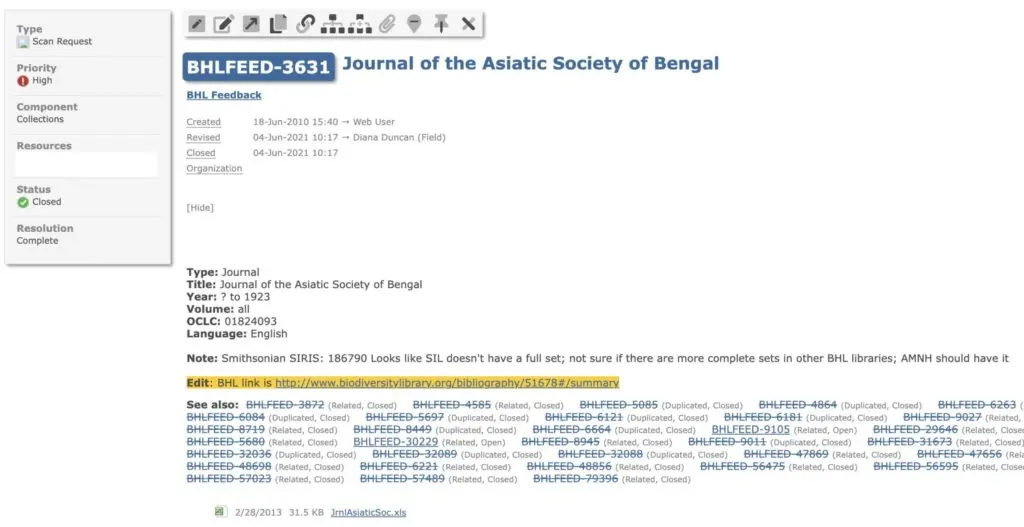
Chief among these monumental efforts is the complete digitization of the historical Journal of The Asiatic Society and its legacy publications. Spanning an astonishing 11 years, 9 global institutions, 19 dedicated contributors, and a labyrinth of issue-tracking tickets, this project stands as a textbook case study in the realities of digital preservation without centralized grant funding. It reveals both the profound resilience of the BHL’s collaborative consortium model and the systemic hurdles faced by digital heritage repositories operating on decentralized labor and shifting resource flows.
Detailed Chronology: A Decade-Long Archival Odyssey
The story of the Journal of The Asiatic Society within the BHL digital ecosystem is not a narrative of rapid, automated mass-scanning. Instead, it is an epic tale of meticulous curation, localized scanning, and global coordination that stretched across more than a decade.
The Origins of a Scholarly Legacy
To understand the scope of the digital archive, one must first look back to 1784, when the Asiatick Society was founded in Kolkata by Sir William Jones under the auspices of British India’s highest court. Conceived with the visionary mandate to study the "History, Civil and Natural, the Antiquities, Arts, Sciences, and Literature of Asia," the organization laid the bedrock for modern academic inquiry in the region.
More than 240 years later, The Asiatic Society endures as India’s oldest surviving publishing house and an Institution of National Importance, recognized by the Indian government for its unparalleled contribution to humanity’s intellectual heritage. Its journals, memoirs, and transaction series—publishing continuously from 1788 to the present day—traverse an interdisciplinary spectrum spanning natural sciences, cultural studies, literature, and medicine.

The 11-Year Digitization Timeline
In June 2010, founding institutions of the BHL consortium embarked on a specialized digitization initiative targeting the myriad historical iterations of the Journal of The Asiatic Society. What began as an ambitious archival goal quickly evolved into an extraordinary test of endurance.
Because the project lacked dedicated, full-time digitization staff or massive, long-term grant funding, the work had to be absorbed into the existing, everyday workloads of participating partner institutions. As libraries across different time zones and continents managed their own internal institutional pressures, equipment upgrades, and staffing fluctuations, the work on the Asiatic Society series progressed in fits and starts.
The project relied entirely on the BHL’s internal issue-tracking system, Gemini. Over the course of the project lifecycle, team members logged 40 distinct operational tickets, exchanged over 82 granular comments, and coordinated the movements of physical volumes and digital files across international boundaries.
Finally, in June 2021—eleven years after the initial scan requests were first entered into the system—the BHL officially declared the digitization of all public-domain volumes of the Journal of The Asiatic Society and its core legacy series "complete" to the best of its ability. Today, the BHL provides open access to an array of foundational titles, including historical transactions, subsequent journal volumes, and the expansive Memoirs of the Asiatic Society, ensuring that centuries of scholarship remain globally discoverable.
Supporting Context & Metrics: The Mechanics of a Decentralized Library
The 11-year timeline required to digitize the Asiatic Society legacy volumes raises a fundamental question for digital humanists and information scientists: Why did it take so long? The answer lies in the unique operational model that sustains the Biodiversity Heritage Library.
The Anatomy of BHL’s Labor Model
Unlike national libraries or heavily endowed corporate archives with dedicated scanning departments, the Biodiversity Heritage Library operates as a consortium of independent partner institutions. Each participant contributes what they can—staff time, equipment access, cataloging expertise, and physical volumes—from their own operational budgets.

For the first several years of its existence, the BHL benefited immensely from major grant funding, most notably through foundational support from the MacArthur Foundation. However, following the conclusion of that grant cycle in 2013, consortium partners experienced a noticeable ebb and flow in dedicated digitization resources.
Without a permanent, centralized financial endowment to underwrite large-scale processing, the BHL relies on an organic, distributed labor model. Partner institutions participate autonomously, stepping up their contributions when local time and resources allow, and stepping back when institutional constraints demand it. While this model fosters deep community ownership and incredible resilience, it inherently introduces operational bottlenecks when managing complex, multi-volume historical runs like those of The Asiatic Society.
The Role of Gemini in Cross-Border Collaboration
Managing a globally distributed workforce across 11 years requires robust, transparent communication tools. For the BHL, the backbone of this operation is the Gemini issue-tracking system.
Originally implemented decades ago for software bug tracking and website maintenance, Gemini evolved into the single source of truth for the BHL’s internal curation projects. Within this system, staff members tracked:
- The real-time status of specific physical volumes across partner libraries.
- The identification and fulfillment of missing journal issues (gap analysis).
- Cataloging discrepancies and metadata remediation tasks.
- Complex workflows involving multi-institutional scanning handoffs.
Configuring and customizing an issue-tracking system designed for software engineering to handle complex library cataloging and physical digitization workflows was no small feat. It required years of trial and error to establish information architectures that could accommodate the nuances of biodiversity literature. Yet, without this centralized digital hub, coordinating the back-and-forth efforts of 19 distinct contributors over more than a decade would have been an administrative impossibility.
Official Perspectives: Reflections from the Digital Collections Manager
In her reflections on the Asiatic Society project, Digital Collections Manager Bianca Crowley emphasizes that the true "treasure" of the BHL extends far beyond the paper pages and ink of historical volumes. It resides in the persistent human network operating quietly behind the interface.

"My take on the treasures of BHL’s collection is less about the content or significance of any particular title, and more about the work over many (many) years behind the scenes by the people within BHL partner institutions to bring these treasures from the shelves to the screen," Crowley notes.
Highlighting the realities of the consortium’s recent institutional evolution, Crowley points out that the BHL has navigated a significant structural transition toward a more autonomous, globally distributed shared-ownership model. This shift deliberately decouples the library’s operations from any single anchor institution, reinforcing its international character.
However, Crowley is candid about the structural vulnerabilities inherent in this model. Factors such as aging digitization equipment, physical wear-and-tear on fragile historical materials, inconsistent cataloging records, and fluctuating institutional capacity continue to impact the speed and scale at which content can be integrated into the BHL collection.
To mitigate these challenges moving forward, Crowley and her colleagues emphasize the urgent need for long-term philanthropic support. Securing a reliable source of recurring funding or planned gifts could establish centralized resources to streamline processing, eliminate backlogs, and accelerate the integration of vital historical literature into the open-access ecosystem.
Future Outlook: Modernizing for the Next Era of Open Access
As the Biodiversity Heritage Library celebrates its 20th anniversary and drafts the blueprint for its next chapter, the lessons learned from the 11-year digitization of the Journal of The Asiatic Society serve as both a cautionary tale and a strategic roadmap.
The core priorities of the BHL’s collection development policy remain clear and ordered: increasing access, enhancing usability, boosting discoverability, and expanding the breadth of the collection. However, acknowledging that an 11-year turnaround time for a single journal series is unsustainable, leadership is actively looking toward platform modernization.

Strategic Imperatives for BHL’s Future
Moving into its third decade, the BHL is leveraging its foundational Guiding Principles for the Transition to reimagine its technological and operational architecture. To ensure that future preservation projects are executed with greater agility and efficiency, the Digital Collections Manager and consortium leadership have identified several critical areas for strategic development:
- Streamlined Workflow Automation: Reducing administrative overhead by modernizing task-tracking architectures and integrating automated metadata harvesting tools to minimize manual data entry errors.
- Enhanced Partner Training and Documentation: Standardizing digitization guidelines across all participating institutions to reduce onboarding times and minimize discrepancies in catalog records.
- Forging New Strategic Partnerships: Expanding the global network of contributing institutions, particularly within regions historically underrepresented in Western-centric digital archives, thereby enriching the diversity of the collection.
- Platform Modernization: Upgrading the underlying digital infrastructure to support faster search speeds, better interoperability with global biodiversity data aggregators, and more intuitive user interfaces.
- Sustainable Financial Modeling: Cultivating recurring donations, institutional memberships, and targeted grants to build a resilient financial buffer that insulates the library against sudden economic shifts.
Sustaining the Global Commons
The completion of the Journal of The Asiatic Society archive in the BHL is a testament to the extraordinary power of persistence. It demonstrates that when librarians, archivists, technologists, and researchers across the globe commit to a shared vision of open access, physical boundaries and institutional limitations can be overcome.
Yet, as Crowley aptly observes, sustainability means far more than simply keeping a website server running. It requires actively maintaining, repairing, and growing a fragile, irreplaceable collection of human knowledge. As the BHL steps into its next chapter, the ongoing dedication of its global community—bolstered by public support and strategic modernization—will ensure that the treasures of biodiversity literature remain open, free, and discoverable for generations to come.