

Executive Overview
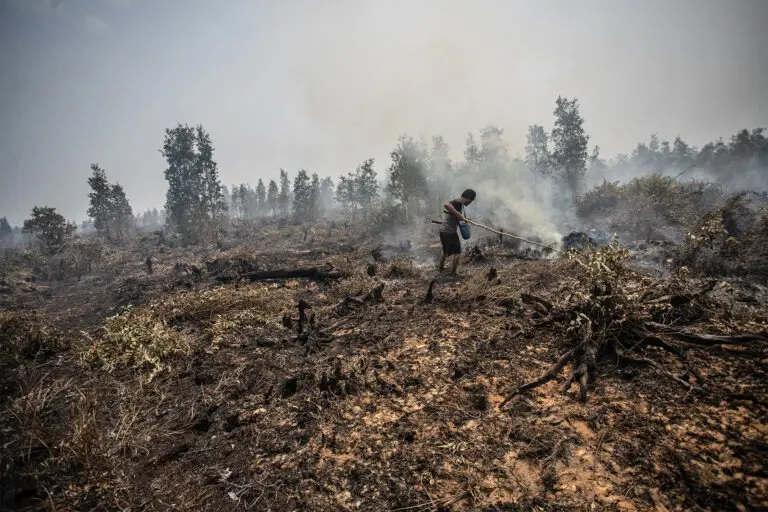
As a potent Super El Niño tightens its grip across the Asia-Pacific region, Indonesia finds itself once again choking on toxic haze and grappling with an escalating ecological catastrophe. Millions of residents are breathing hazardous air as severe forest and peatland fires sweep across multiple islands, threatening local ecosystems, endangered wildlife, and human health alike.
For climate scientists, environmental advocates, and frontline communities, the unfolding crisis evokes a grim sense of déjà vu. Nearly two decades ago, devastating peatland blazes ravaged the same landscapes during a weaker El Niño cycle, forcing local conservationists, researchers, and villagers to fight walls of fire using makeshift tools like brooms, hand-dug wells, and backpack pumps. Today, the scale of destruction has amplified significantly. With over 2 million acres of land estimated to have burned during the first half of the year, the current wave of wildfires underscores an alarming truth: historical patterns of environmental degradation are compounding with rapid global warming to create unprecedented disaster scenarios.
Yet, amid the smoke and systemic challenges, stories of remarkable resilience and cross-border collaboration continue to emerge. Subnational governments, international climate networks, and grassroots organizations are refusing to yield to despair. From last-minute technical summits relocated away from active fire zones to indigenous populations deploying generational knowledge to protect their ancestral lands, the fight against the climate crisis is actively being waged on the ground. This report examines the roots of Indonesia’s ongoing fire crisis, the broader implications of a strengthening Super El Niño, and the unwavering resolve of communities defending the world’s tropical rainforests.

Detailed Chronology: From the Peatlands of 2006 to the Present Crisis
The Crucible of 2006: A Firsthand Encounter with Deforestation and Fire
In October 2006, ecologist Akane Nishimura arrived in Indonesia intending to begin doctoral dissertation research focused on tropical reforestation. Instead, her plans were immediately upended by an ecological emergency. Finding herself deep within the forests of Tanjung Puting National Park in Central Kalimantan, Nishimura joined forces with the local nongovernmental organization Friends of Nature, People and Forests (FNPF).
It was an archetypal "all hands on deck" scenario. Working alongside FNPF Kalimantan program manager Basuki Santoso, as well as local teenagers Adut and Isam, Nishimura spent her days battling active fire fronts using rudimentary equipment. On their inaugural night of firefighting, the team camped on a raised wooden platform intended to serve as a future field station. In the dead of night, Nishimura awoke to the surreal sight of a wild sun bear rifling through a makeshift camp kitchen just 20 feet away. The animal, displaced and fleeing the encroaching flames, moved through the sleeping camp in a silent, humbling display of the broader tragedy unfolding across the ecosystem.
At the time, the severity of the fires was attributed to a volatile convergence of factors: El Niño-induced drought, rampant slash-and-burn agricultural practices, widespread land clearing, and the self-perpetuating grass-fire cycle. That specific year marked a relatively weak El Niño event, yet the resulting haze choked vast swathes of Southeast Asia, signaling deep vulnerabilities in regional land-use policies.

The Return of the Fire: The 2026 Super El Niño
Two decades later, history is repeating itself on a devastating scale. Meteorological experts have confirmed the arrival of a robust Super El Niño, setting the stage for what climatologists project will be record-breaking wildfire activity. Over the past three months, thick, toxic haze has blanketed millions of citizens across Indonesia, impairing air quality and overwhelming healthcare systems.
The crisis prompted logistical pivots even within international climate circles. The Governors’ Climate and Forests Task Force (GCF Task Force) was forced to abruptly relocate its major technical exchange conference—originally scheduled to take place in West Kalimantan—to Bogor, Java, due to the encroaching fires. Compounding these travel hurdles, the ongoing eruptions of the Anak Krakatau volcano added yet another layer of disruption for international delegates attempting to reach the summit. Despite these obstacles, the conference proceeded, serving as an essential forum for vice governors, environmental secretaries, and civil society leaders to strategize collective responses to an escalating crisis.
Supporting Context & Metrics: The Scale of Destruction
The mathematical reality of Indonesia’s current fire season paints a bleak picture of ecosystem loss and carbon release. According to comprehensive monitoring reports from organizations like Auriga Nusantara and spatial mapping platforms such as the Nusantara Atlas:

- Land Area Burned: By the midpoint of the year, at least 1.5 million acres (exceeding 607,000 hectares) of Indonesian land had already succumbed to fire. Current tracking suggests that the cumulative toll has surged well past 2 million acres (over 809,000 hectares).
- The Carryover Effect: Scientific research highlights a direct correlation between the intensity of a given year’s El Niño event and the severity of subsequent fire seasons. Because the current Super El Niño continues to gather strength, researchers warn that elevated fire risks may persist well into the following year.
- Global Temperature Thresholds: The crisis in Indonesia unfolds against a backdrop of worsening global climate markers. United Nations bodies have recently warned that average global temperatures are on track to surpass the critical 1.5°C (2.7°F) threshold above pre-industrial levels within the next few years. This systemic warming has fueled unprecedented fire seasons not only in Southeast Asia, but also across boreal and temperate forests in Canada, Spain, and France.
The Grass-Fire Cycle and Peatland Vulnerability
Ecological studies—such as foundational research by C.M. D’Antonio and P.M. Vitousek—have long emphasized the mechanics of the "grass-fire cycle." When tropical forests and carbon-rich peatlands are cleared, drained, or degraded, they are frequently invaded by exotic grasses and resilient secondary vegetation. These plant communities dry out rapidly during droughts, providing fine fuels that ignite easily and burn repeatedly. Each successive fire edges the ecosystem further away from its native rainforest baseline, converting diverse carbon sinks into fire-prone scrublands.
Official Statements and Institutional Responses
The Governors’ Climate and Forests Task Force (GCF Task Force)
Founded in 2008 under the leadership of then-California Governor Arnold Schwarzenegger, the GCF Task Force has evolved from a modest coalition of states and provinces into the world’s largest subnational network dedicated to tropical forest protection. Headquartered jointly at the University of California, Los Angeles (UCLA) and the University of Colorado Boulder, the network now encompasses 54 subnational governments spanning multiple continents, collectively safeguarding over one-third of the world’s remaining tropical forests.
During the recent technical exchange in Indonesia, GCF Task Force representatives observed firsthand the urgency driving local policy discussions. Civil servants, private sector partners, and regional government officials convened to evaluate best practices in:

- Community-Led Restoration: Scaling up native tree planting initiatives to rehabilitate degraded peatlands and secondary forests.
- Institutional Accountability: Reforming regional legal and administrative frameworks to deter illegal land clearing and incentivize sustainable agricultural development.
- Equitable Climate Solutions: Ensuring that local and indigenous communities are directly involved in designing and benefiting from forest conservation projects.
Future Outlook: Resilience, Hope, and the Road Ahead
The psychological toll of working within the environmental sector during an era of climate breakdown is immense. As global temperatures rise and extreme weather events intensify, maintaining optimism can feel counterintuitive. Yet, as researchers like Akane Nishimura argue, optimism is a prerequisite for survival in the climate space; surrender guarantees failure.
Hope, in this context, is not rooted in naive optimism, but in concrete solidarity with those on the front lines. It is sustained by:
- Grassroots Heroism: Individuals like Basuki, Adut, and Isam in Central Kalimantan, alongside rubber growers in South Sumatra reviving traditional fire-fighting techniques, who put their health and safety on the line to defend their homes.
- Subnational Leadership: State and provincial leaders within networks like the GCF Task Force who refuse to let policy paralysis stall local conservation efforts.
- Adaptive Traditional Knowledge: Indigenous communities drawing upon generations of ecological understanding to protect endangered species—such as dwindling orangutan populations facing local extinction risks—from the dual threats of habitat fragmentation and fire.
As the Super El Niño runs its course, the global community faces a stark choice. The resilience demonstrated by Indonesia’s frontline defenders serves as both an inspiring testament to human fortitude and a stark warning. If subnational actors with limited resources can organize, adapt, and fight to preserve the lungs of the earth, international institutions and industrialized nations must match that dedication with structural reform, financial backing, and decisive climate action before the tipping points of our global ecosystem are permanently breached.



