Healthy soil has long been championed as the foundational bedrock of regenerative organic agriculture. Yet, soil covers less than one-third of our blue planet, leaving the vast majority of Earth’s surface—its oceans—largely unintegrated into modern sustainable farming frameworks. Now, a groundbreaking research partnership between the renowned Rodale Institute and GreenWave, an innovator in regenerative aquaculture, seeks to bridge this divide.
By marrying land-based organic cultivation with ocean-based food production, the initiative aims to solve two critical modern crises simultaneously: the degradation of agricultural soils and the overexploitation of wild marine ecosystems. At the heart of this collaboration is an exploration of how ocean-harvested crops—specifically mineral-rich kelp and bivalve shellfish—can serve as powerful organic biostimulants for land crops. As climate change pressures mount and global populations surge, this coalition between land and sea pioneers presents a scalable blueprint for the future of the global food system.
Detailed Chronology: From Overfishing to Regenerative Aquaculture
The Roots of Crisis on the Water
Before the advent of modern industrial agriculture, human societies relied heavily on coastal foraging and fishing for sustenance. According to a 2024 report by the USDA Economic Research Service, the average American consumer today eats approximately 20 pounds of fish and shellfish annually. While seafood consumption has remained a staple of the global diet, wild capture fisheries have faced severe, compounding pressures for decades due to overfishing, coastal habitat loss, and warming ocean temperatures.
This decline forced a generation of traditional fishers to seek alternative livelihoods. Among them was Bren Smith, a native of Newfoundland, Canada, who began commercial fishing for tuna and lobster on the Georges Bank and Grand Banks at just 14 years old. By the 1990s, however, wild stocks had depleted to the point where commercial fishing was no longer viable.
Seeking a sustainable path forward, Smith transitioned into finfish aquaculture, hoping that "blue jobs" would revitalize coastal economies. Instead, he made a sobering discovery: the commercial finfish aquaculture industry was simply mirroring the worst ecological mistakes of industrial land farming. It relied heavily on intensive resource extraction, artificial nutrients, heavy pesticide applications, and antibiotics, ultimately degrading surrounding waters and disrupting delicate aquatic ecosystems.
Reinventing the Ocean Farm
Recognizing that traditional aquaculture was unsustainable, Smith envisioned a radical departure from conventional practices. Rather than farming mobile species that required massive inputs of feed, he turned to stationary, extractive crops.
"I thought we should grow seaweed and shellfish—crops that don’t swim away and that can feed on the nutrients that already exist in the water," Smith reflects.
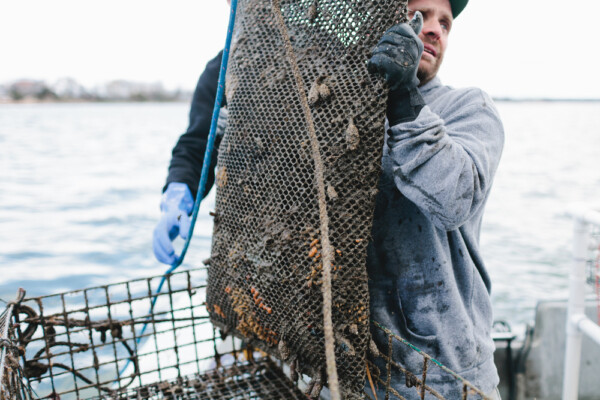
This realization birthed GreenWave’s signature vertical ocean-farming model. Designed with a minimal physical footprint, these farms utilize hurricane-proof anchors at their boundaries and floating horizontal ropes across the surface. From an onshore perspective, the farms are virtually invisible.
Beneath the surface, however, a complex polyculture thrives:
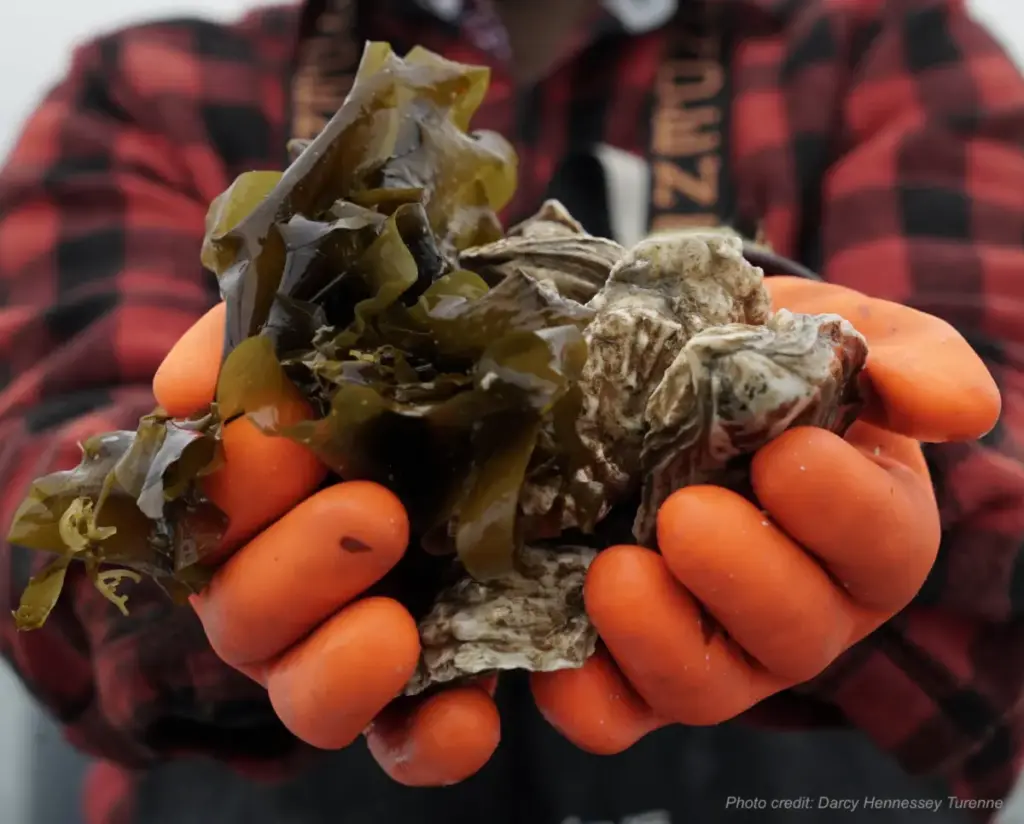
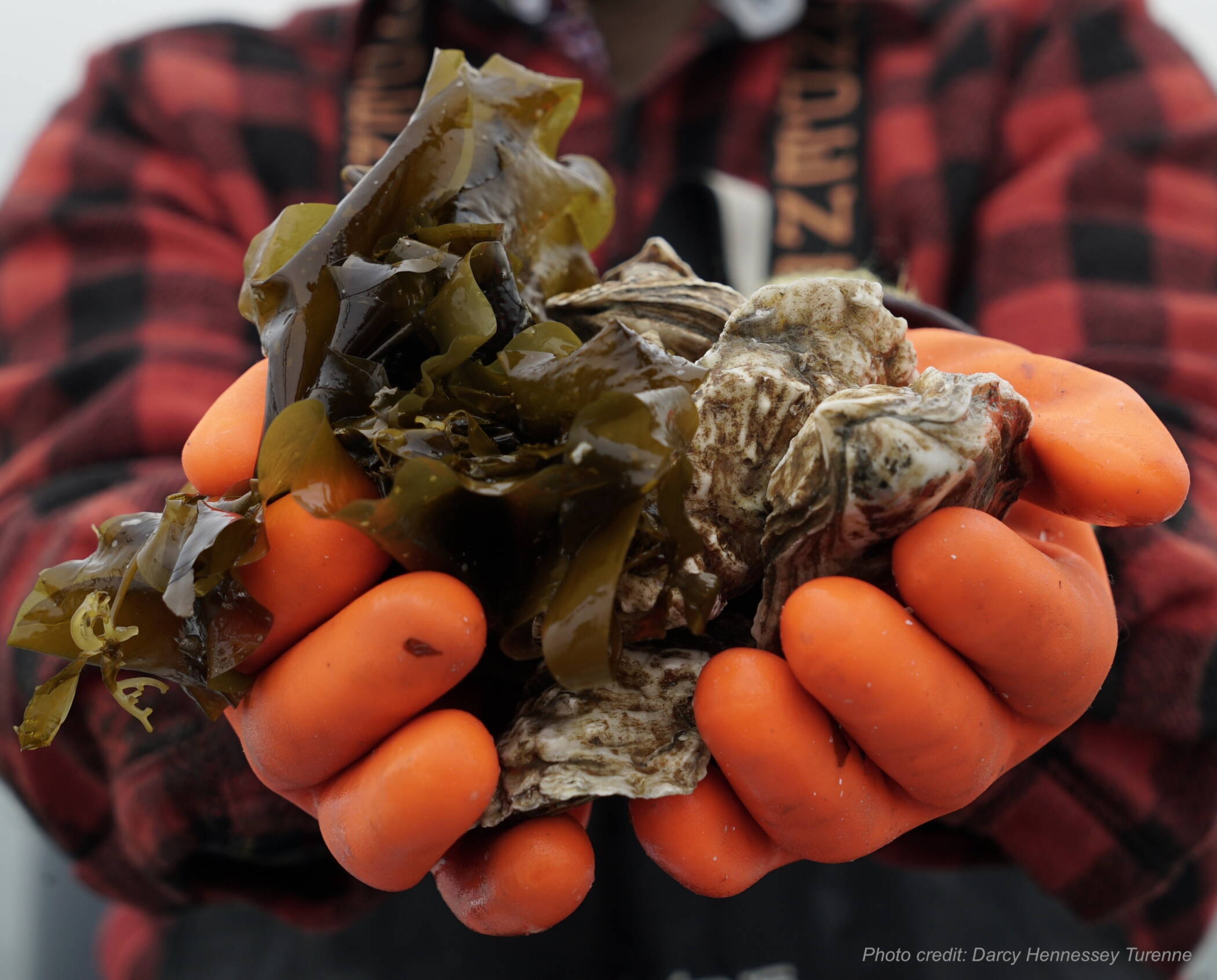
Kelp and seaweeds grow downward from the surface ropes.
Scallops hang suspended in mesh nets.
Mussels are cultivated in vertical mesh socks.
Oysters reside in protective cages at the base.
Clams burrow safely into the benthic sand below.
Crucially, these shellfish are all filter feeders, consuming naturally abundant microorganisms such as phytoplankton and algae without requiring artificial feed, fresh water, or chemical fertilizers.
Supporting Context & Metrics: The Mechanics of a Zero-Input Food System
The productivity of regenerative ocean farming stands in stark contrast to the resource-intensive nature of industrial land and water farming. GreenWave’s vertical multi-trophic aquaculture model yields staggering outputs within compact areas.
Key Production Metrics
Yield per Acre: Every five months, a single acre of GreenWave-managed ocean space can produce up to 250,000 shellfish and 25 tons of kelp and greens.
Resource Input: Classified as a "zero-input" food system, these farms require zero fresh water, zero synthetic fertilizers, zero artificial feed, and zero land.
Demographics and Scale: Since launching its first regional training program in 2017, GreenWave has successfully educated and supported more than 8,500 ocean farmers, nursery operators, and entrepreneurs.
Accessibility: Operating on an open-source model, GreenWave’s toolkit dictates that virtually "anyone with 20 acres, a boat, and $30,000" can access the knowledge required to establish a viable regenerative ocean farm.
The Symbiotic Ecosystem of the Sea
Beyond food production, regenerative ocean farming actively heals aquatic ecosystems. Seaweeds such as kelp absorb dissolved carbon dioxide from seawater and release vital oxygen, a process that helps buffer against ocean acidification driven by climate change. This localized reduction in acidity is critical, as it allows bivalves (such as oysters, clams, and mussels) to build thick, healthy, protective shells.
In turn, the filter-feeding activities of these bivalves remove suspended particulate matter from the water column, increasing water clarity. This enhanced clarity allows sunlight to penetrate deeper, further accelerating kelp growth in a continuous, mutually beneficial loop.
Official Statements & The Soil-Sea Connection
The partnership between Rodale Institute and GreenWave is rooted in a shared philosophy: that sustainable systems on land and sea must collaborate to restore planetary health.
Historical Precedents and Modern Science
Historically, coastal farming and gardening communities routinely used seaweed as a potent soil amendment long before the invention of fossil-fuel-derived synthetic fertilizers.
"Whenever coastal communities needed nutrients for their crops, they’ve gone to the sea—that is, until fossil-fuel fertilizers came along," notes Bren Smith.
Because synthetic fertilizers fail to build true soil biology, certified organic land farmers reject them entirely. Natural marine resources like kelp, however, offer a biological alternative that nourishes crops while enhancing overall soil microbiology.
"We have long known that products harvested from the sea have the power to promote plant growth and plant health," says Dr. Andrew Smith, Chief Scientific Officer at Rodale Institute.
Kelp functions as an advanced agricultural "biostimulant." When applied to land-based crops, it activates beneficial soil microbes, enhances the root system’s ability to absorb vital nutrients, and increases plant resilience against environmental stressors like drought.
Rigorous Scientific Validation
To quantify these benefits, researchers at Rodale Institute have launched a comprehensive, multi-year scientific investigation. Led by soil scientist Dr. Dinesh Panday, the research team is currently conducting a two-year field trial alongside a one-year greenhouse experiment.
The study evaluates the efficacy of GreenWave’s kelp-based biostimulant on specialty crops—specifically lettuce and bell peppers—measuring its impact on both nutritional density and overall soil health metrics. In the trials, kelp applications (administered at varying rates) are compared directly against biochar, a widely accepted organic soil amendment, as well as evaluated in combination plots.
"Kelp has many trace minerals that support healthy plant growth," explains Dr. Panday. "We are studying its value for specialty crops in regenerative organic systems to provide hard data for farmers."
Echoing the necessity of academic rigor, Bren Smith adds: "We need credible science to evaluate kelp’s benefits and find out how to get the most from it. When we were meeting with the research team at Rodale Institute, I knew we were talking farmer to farmer, that we are working toward the same goals."
Future Outlook: A Unified Food System
As the agricultural sector looks toward the middle of the 21st century, the boundaries separating terrestrial and marine sciences are dissolving. The Rodale Institute and GreenWave partnership marks a paradigm shift: moving away from extractive, resource-draining models toward an integrated, circular bioeconomy.
Looking Ahead to 2027 and Beyond
Research Milestones: Dr. Panday’s team expects to release the definitive results of their kelp biostimulant field trials and greenhouse experiments by 2027, establishing standardized application metrics for organic growers.
Community Co-ops: GreenWave continues to scale its efforts to establish farmer-owned and farmer-run cooperatives in vulnerable coastal fishing communities, transforming former hunters of wild fish into stewards of climate-resilient aquaculture.
Consumer Awareness: Programs like the Monterey Bay Aquarium Seafood Watch continue to guide public consumption toward nutrient-dense, low-impact species through resources like their "Super Green List," which prominently features GreenWave staples: mussels, clams, oysters, and kelp.
By uniting the guardians of the soil with the pioneers of the sea, this cross-ecosystem alliance proves that the future of agriculture lies not in conquering nature, but in aligning with its most fundamental, regenerative cycles.