

Executive Overview
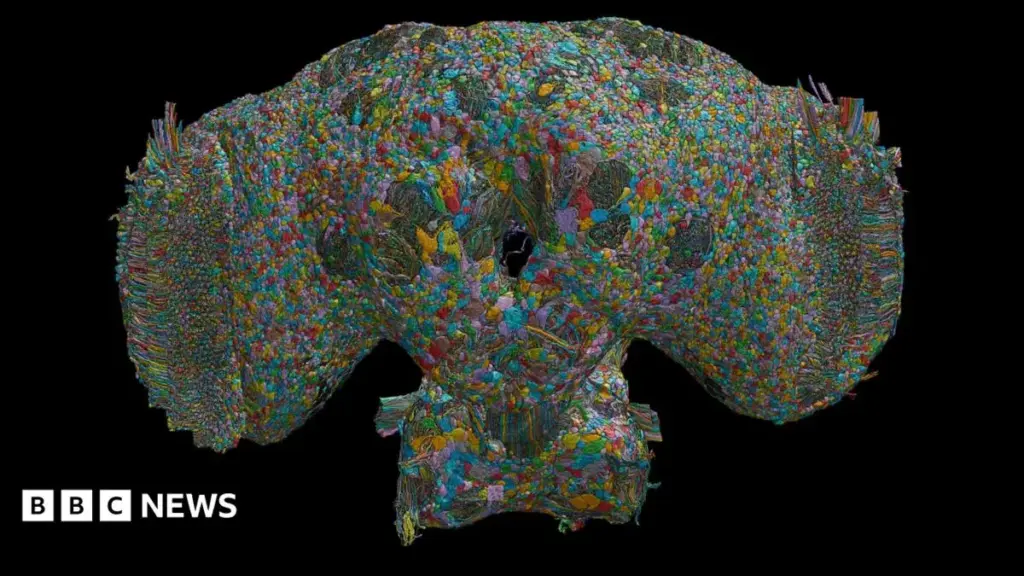
In a landmark achievement that has sent ripples through the global scientific community, researchers have successfully mapped and compared the neural architecture of male and female fruit flies (Drosophila melanogaster) in unprecedented fine detail. By charting all 124 million connections of nerve cells within a male fly’s brain—and pairing this data with the female connectome mapped two years prior—scientists have unlocked a microscopic window into how biological sex dictates complex behaviours.
This monumental effort, spearheaded by a collaborative team from the Medical Research Council’s (MRC) Laboratory of Molecular Biology and the University of Cambridge, reveals structural divergences that directly explain innate traits such as male aggression, intricate courtship rituals, and the melodic "love songs" males serenade females with. However, the research team is quick to issue a critical caveat: these findings do not translate directly to human gender differences. Human behaviour and societal structures are infinitely more complex, shaped by a rich interplay of environment, culture, and vast cognitive architecture.
Instead, the true power of this breakthrough lies in its capacity to illuminate fundamental neurobiological principles. By comparing two brains that share virtually identical genetic blueprints save for the variables of sex, researchers now possess a pristine experimental model to understand how genes construct brain wiring—and, by extension, how that wiring dictates behaviour.
Experts liken the development to the invention of a powerful new telescope for the mind. Just as the Hubble or James Webb telescopes peer into the vast expanses of the cosmos to reveal the origins of galaxies, this complete connectome allows neuroscientists to gaze inward, charting the neural constellations that govern thought, action, and survival. Ultimately, this research paves the way for a deeper comprehension of human neurological conditions where genetic variations disrupt normal brain wiring, offering renewed hope for future breakthroughs in understanding complex disorders such as autism spectrum conditions and schizophrenia.
Detailed Chronology: From Single Neurons to the Complete Connectome
To appreciate the magnitude of this recent breakthrough, one must understand the painstaking evolutionary timeline of modern neurobiology and the technological leaps required to achieve it.
The Foundation: Decades of Genetic Mapping
For decades, scientists have understood that genetics play a profound role in shaping behaviour. Researchers have long identified specific master-switch genes that dictate whether an insect develops male or female neural circuits. Yet, a frustrating chasm remained in the scientific literature: researchers knew which genes controlled these behaviours, and they could observe the resulting actions, but they had no way to visualize the physical circuitry operating in the middle. The physical architecture of the brain—the microscopic bridge connecting DNA to action—remained obscured by technical limitations.
The Female Connectome Breakthrough (2022)
The path to the current discovery began two years prior, when an international consortium of scientists published the first complete wiring diagram of an adult female fruit fly brain. This monumental undertaking required slicing the brain into thousands of ultra-thin sections, imaging them using advanced electron microscopy, and employing a combination of artificial intelligence and exhaustive human proofreading to trace every single neuron and synapse. It was a tour de force in data science and biology, providing the baseline blueprint of the Drosophila central nervous system.
The Male Connectome and Comparative Analysis (Present Day)
With the female connectome serving as a crucial reference point, the Cambridge and MRC team turned their attention to the male brain. Mapping the 124 million nerve cell connections in the male fly required the same grueling, high-resolution slicing and digital reconstruction techniques.
Once the male connectome was fully realized, the researchers performed the ultimate computational juxtaposition: overlaying and comparing the male and female wiring diagrams down to the single synapse. This side-by-side analysis yielded immediate revelations. By isolating the single independent variable of sex, the researchers could pinpoint exact divergences in neural pathways. They discovered that while the vast majority of the male and female brains are strikingly similar—reflecting shared needs for navigation, feeding, and sensory processing—distinct, localized variations account for sexually dimorphic behaviours. These structural variations provide the missing link that science has chased for generations: the precise physical mechanism by which genes sculpt neural pathways to manifest distinct behavioural repertoires.
Supporting Context & Metrics: Decoding the Fly Brain
To grasp the scale and implications of this research, it is helpful to examine the quantitative metrics and specific neurological circuits that govern the Drosophila world.
| Metric / Feature | Male Fly Brain Data | Female Fly Brain Data | Significance |
|---|---|---|---|
| Total Synaptic Connections | ~124 Million | Comparable scale | Represents the complete wiring diagram (connectome) of the central nervous system. |
| Primary Driver Genes | 2 Key Sex-Determination Genes | 2 Key Sex-Determination Genes | Drive the structural divergence in neural wiring between sexes. |
| Visual Tracking Circuitry | Enhanced with specialized visual processing nodes | Standard visual processing | Enables the male to continuously track a moving female during courtship. |
| Aggression Circuitry | Expansive, dense synaptic networks | Reduced structural volume | Correlates with significantly higher frequencies of territorial and competitive fighting in males. |
| Acoustic Production Circuitry | Unique, male-exclusive vocal motor pathways | Absent | Dedicated entirely to wing-vibration mechanics used in serenading potential mates. |
The Mechanics of Courtship and Visual Tracking
During courtship, the male fruit fly engages in a complex behavioural sequence. One of the most critical components is spatial navigation: the male must relentlessly track the female as she darts across surfaces.
Upon analyzing the neural wiring diagrams, researchers identified the specific brain circuits responsible for this trait. The male connectome revealed distinct structural adaptations—effectively, "extra wiring"—integrated into visual processing centers. These specialized circuits enhance the male’s visual acuity and motion-tracking capabilities, ensuring he can maintain visual lock on a fast-moving female in varying lighting and environmental conditions.
The Neural Architecture of Aggression
When observing fruit fly colonies, entomologists have long noted a stark behavioural divide: males engage in aggressive, territorial disputes far more frequently than females.
The connectome data provides the physical explanation for this sociological observation. The neural circuits associated with aggressive behaviours are vastly more developed and densely interconnected in the male brain than in the female brain. By quantifying the volume and synaptic weight of these aggression-associated pathways, scientists can now trace how competitive drives are hardwired into the central nervous system, proving that aggression is not merely a situational response, but a deeply structural predisposition encoded at the cellular level.
The High-Stakes "Love Song" Circuit
Perhaps the most fascinating revelation of the comparative study lies in the acoustic domain. Male fruit flies woo prospective mates by performing a specialized acoustic display. By rapidly vibrating their wings, they produce a highly specific, species-recognizing "love song."
Dr Philipp Schlegel, co-author of the study, notes that the neural circuit responsible for generating this song is entirely unique to the male brain. It exists nowhere in the female connectome. Furthermore, this circuit operates under strict evolutionary tolerances. According to Dr Schlegel, the mechanical output of the song must be executed with absolute precision.
If the male’s neural timing is off, or if the song fails to meet the female’s neurological criteria, the consequences can be swift and severe. If the female is receptive and appreciative of the acoustic performance, she permits the male to approach for mating. If she is unreceptive—or if the song is poorly executed—she will decisively reject him. In the rough-and-tumble world of Drosophila, this rejection often manifests as a swift, physical kick to the face of the hapless suitor. The male’s dedicated neural wiring must therefore coordinate motor neurons, wing muscles, and sensory feedback loops with exquisite harmony to avoid evolutionary failure.
Official Statements and Expert Perspectives
The academic community has received the publication of the dual-sex connectome with profound enthusiasm, tempered by careful scientific contextualization regarding its limitations and ultimate applications.
Prof Gregory Jefferis, co-lead of the research from the Medical Research Council’s Laboratory of Molecular Biology and the University of Cambridge, spoke with BBC News to articulate the gravity of the breakthrough. He categorized the achievement as a watershed moment for the discipline.
"This is a really important new avenue in neuroscience," Prof Jefferis stated. "We have this amazing stuff in our heads that lets us do incredible things such as playing a sonata or solving a scientific problem. And this development could help our understanding of how those systems work."
Elaborating on the broader philosophical and structural implications of comparing the two brains, Prof Jefferis emphasized the elegance of the experimental design:
"The fly brain comparison gives us a really good handle on this. There are patterns of behaviour in humans that seem to have a strong genetic basis. So, for example, there are many gene variants now related to schizophrenia and autism spectrum disorders that we don’t really understand."
Beckett, a key collaborator on the data analysis side of the project, highlighted the sheer methodological purity of the research:
"You just have one independent variable, the sex, and then you can see what’s different. This is a scientist’s dream."
Dr Philipp Schlegel underscored the delicate balance of behavioral execution observed within the newly mapped circuits, emphasizing that the connectome bridges the gap between static genetics and dynamic, high-stakes physical interactions in nature.
Crucially, all researchers involved have strongly cautioned against extrapolating these insect-level findings to human gender politics or behavioural psychology. While the genetic mechanisms governing sex determination are ancient and conserved across many species, the human brain—boasting roughly 86 billion neurons and an estimated 100 trillion synaptic connections—operates under vastly different organizational principles, heavily modulated by neuroplasticity, culture, individual experience, and higher-order reasoning. The research is not an exploration of human gender differences, but rather a foundational blueprint of how complex nervous systems assemble themselves.
Future Outlook: Unlocking the Mysteries of Human Brain Disorders
As the scientific community digests the mountain of data generated by the male and female Drosophila connectomes, the horizon of neuroscience is expanding rapidly. The completion of this comparative map marks not the end of a journey, but the beginning of a new era in functional neuroanatomy.
Bridging the Genotype-Phenotype Gap
For generations, the central dogma of behavioral genetics has grappled with a persistent void: how do abstract genetic sequences translate into concrete, observable actions? By successfully charting how sex-determination genes sculpt specific physical pathways—such as the visual tracking nodes, aggression networks, and acoustic mating circuits in flies—researchers have established a methodological template.
This template can now be applied to other genetic variations. Scientists can begin mapping how genetic mutations associated with specific traits or vulnerabilities alter the foundational wiring of the brain. The fruit fly, with its relatively compact nervous system and prolific genetic toolkit, serves as the ultimate proving ground for these techniques.
Implications for Human Health and Psychiatry
The ultimate horizon of connectomics extends far beyond the humble fruit fly. The principles discovered by comparing male and female brains provide a conceptual framework for understanding neurodevelopmental and psychiatric conditions in humans.
Conditions such as autism spectrum disorders and schizophrenia have long been understood to have strong genetic underpinnings, yet researchers remain stymied by the fact that many associated gene variants do not point to a clear physical pathology. Why do certain genetic profiles manifest as atypical social interaction, sensory processing differences, or cognitive fragmentation?
Just as comparing two healthy fly brains with slight wiring differences reveals the mechanical basis of behavioural change, future connectomic research aims to compare typical human neural wiring with brains affected by developmental disorders. By identifying where and how wiring goes awry during embryonic development or maturation, medical science can move away from purely symptomatic treatments and toward targeted interventions that address the root structural causes of neurological distress.
As imaging technologies advance, computational power increases, and artificial intelligence-driven reconstruction becomes ever more sophisticated, the day when we can map larger, more complex mammalian brains draws closer. The blueprint of the mind is slowly being unrolled, starting with the 124 million connections of a tiny fly, and pointing toward a future where the deepest mysteries of human behavior and brain pathology are finally brought into focus.



