

Executive Overview
For decades, the study of glaciers has been constrained by the limitations of traditional field instruments. Climatologists and seismologists attempting to monitor the health of remote, rapidly melting ice sheets have had to rely on sparse networks of isolated seismometers, braving treacherous crevasses to collect limited data streams that often require months of painstaking laboratory analysis.
Now, an unlikely hero is emerging from the telecommunications sector to revolutionize geophysics: Distributed Acoustic Sensing (DAS). By transforming ordinary fiber optic cables into dense networks of thousands of virtual strain sensors, scientists are suddenly able to "listen" to the internal mechanics of glaciers in real time and with unprecedented spatial resolution.
Recent breakthroughs—including a pioneering study conducted by researchers from ETH Zurich in the Swiss Alps—have deployed DAS to expose a deeply concerning mechanism of glacial degradation known as hydrofracturing. By tracking "icequakes" caused by meltwater forcing its way deep into the subterranean architecture of glaciers, scientists are gaining a terrifyingly clear picture of how ice sheets destabilize from the inside out. As global temperatures rise and sea levels threaten coastal communities worldwide, this revolutionary technology offers not only a clearer scientific understanding of glacial retreat, but a vital glimmer of hope for the future development of early-warning systems against catastrophic ice collapses.
Detailed Chronology: The Evolution of Fiber Optic Glaciology
While distributed acoustic sensing may sound like an esoteric industrial tool, its rapid ascent across multiple scientific disciplines is one of the most exciting technological shifts of the decade.
From Volcanism to the Seafloor
Originally developed for the oil and gas industry to monitor pipelines and borehole integrity, DAS quickly caught the attention of geophysicists looking for broader environmental applications. Over the past several years, researchers realized that the physical vibrations of the Earth could interact with light pulses traveling through standard fiber optic cables, scattering photons in predictable patterns. By analyzing these minute shifts in light, scientists could effectively use cables as continuous microphones.
This capability unlocked a host of unconventional monitoring methods. Researchers began using existing fiber optic infrastructure to spy on subterranean activity, successfully detecting everything from volcanic unrest at Mount Etna to human footsteps traversing urban environments.
The technology soon moved from land to the cryosphere. Last year, in a groundbreaking marine deployment, a team of researchers laid a fiber optic cable across the seafloor directly adjacent to a major Greenland glacier. That deployment yielded immediate, alarming insights into how marine-terminating glaciers deteriorate when warm ocean water undercuts their icy snouts.
Scaling the Swiss Alps: The Gornergletscher Experiment
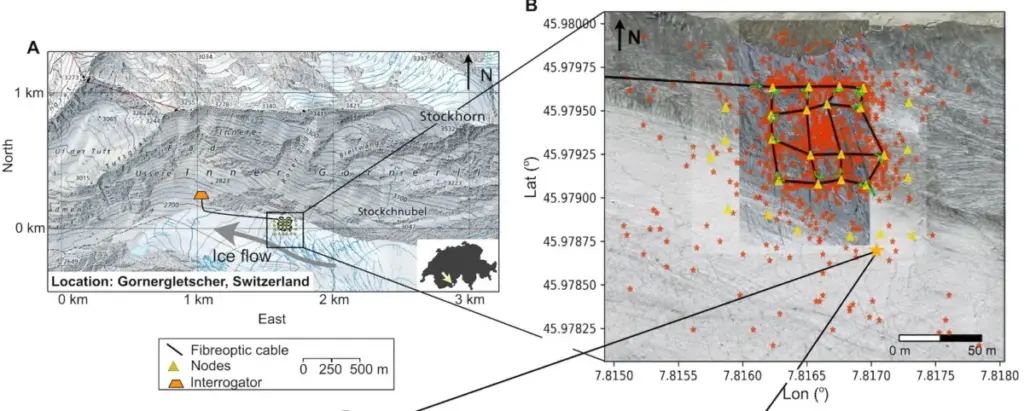
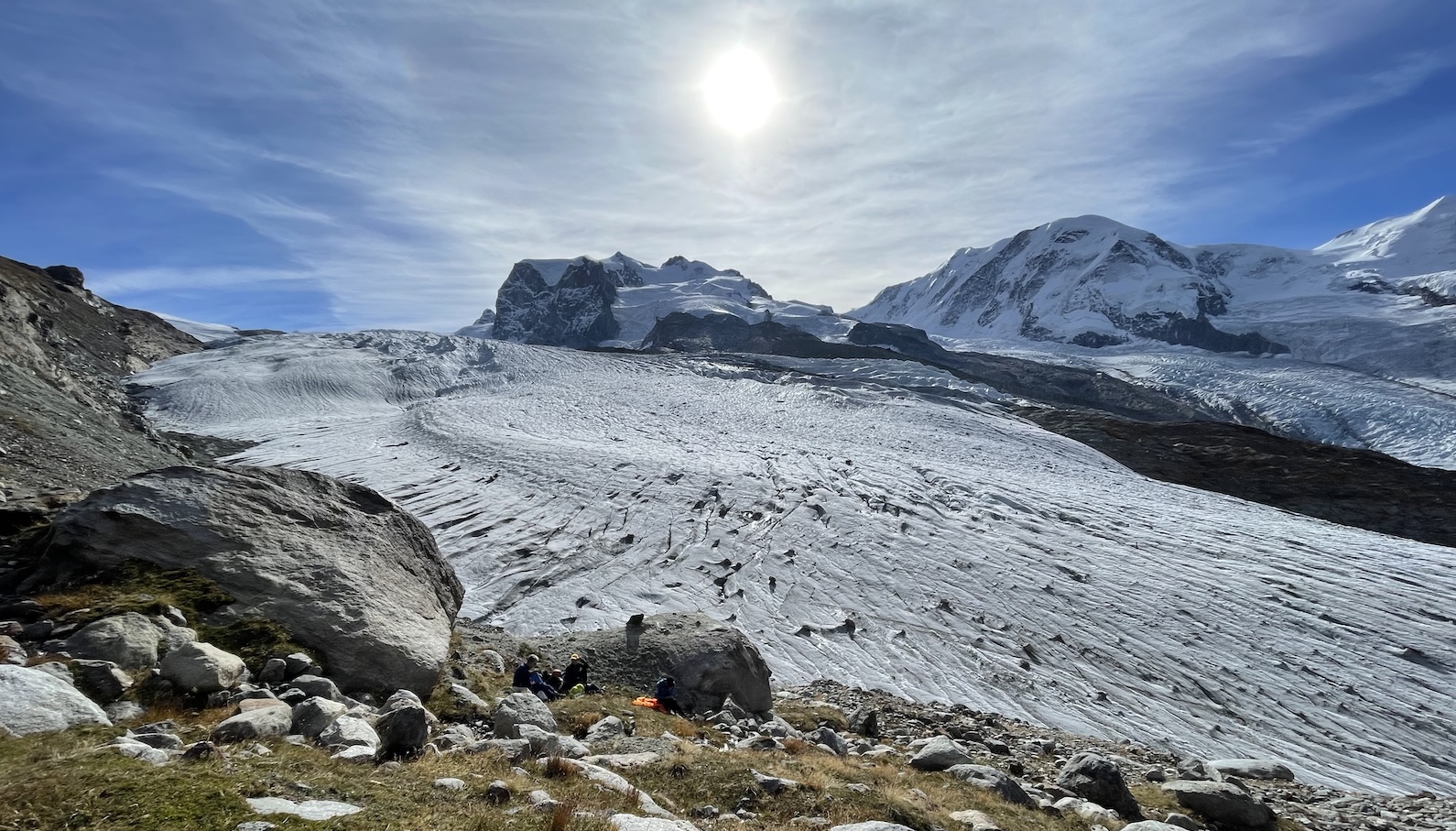
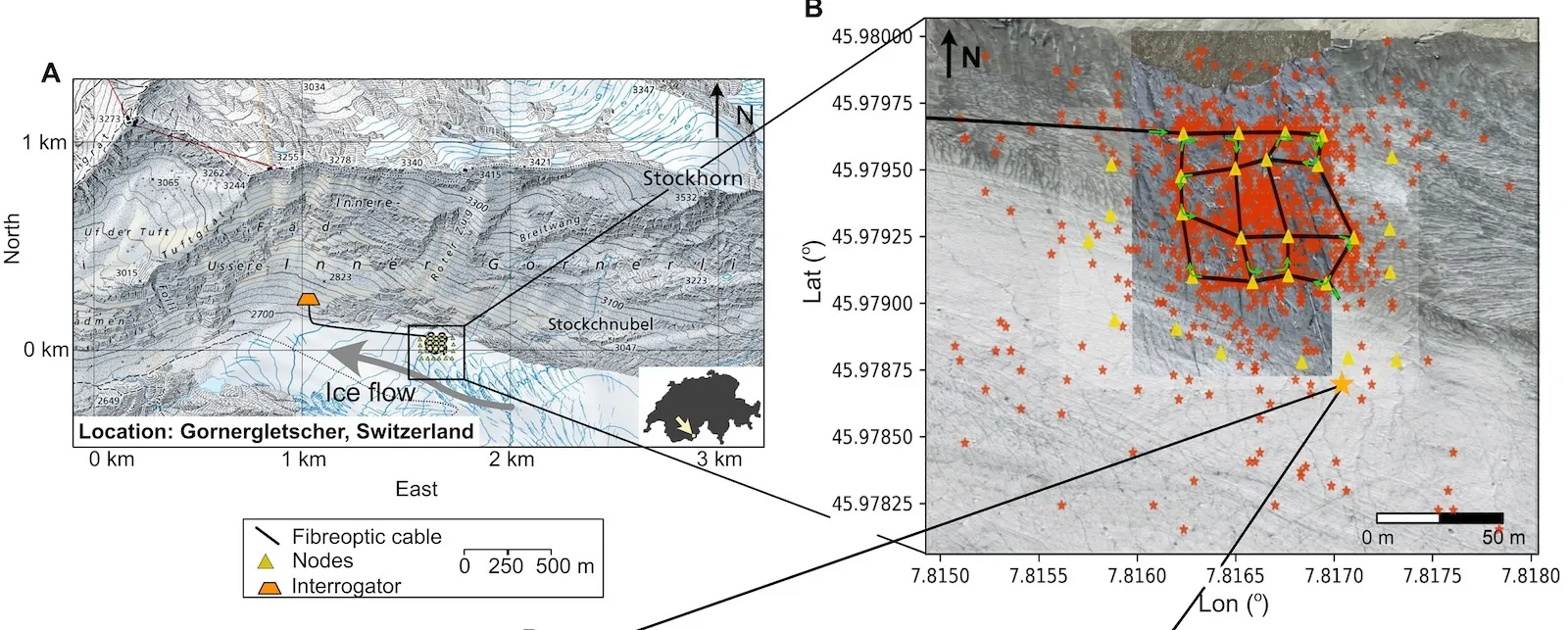
Building upon these marine successes, a team of international researchers led by seismologist Thomas Hudson at ETH Zurich took the technology to the rugged, vertical terrain of the Swiss Alps. Deploying an intricate grid pattern of fiber optic cables across an alpine glacier, the team sought to observe hydrofracturing—a process long theorized to drive the mass disintegration of ice shelves in Greenland and Antarctica, but rarely captured in high-resolution detail.
Instead of relying on scattered, standalone seismometers, the Swiss team connected their cable grid to an instrument known as an interrogator. This device fired rapid pulses of laser light down the length of the fiber. Whenever micro-seismic activity—an "icequake"—shook the glacier, it minutely deformed the cable, altering the return path of the light. By measuring the exact time it took for the scattered light to bounce back (utilizing the constant speed of light), the researchers could calculate the exact location, timing, and magnitude of thousands of individual fracturing events across the glacier’s surface and subsurface.
The results were astonishing. In just one week of fieldwork, the sensor grid recorded over a thousand distinct icequakes, painting a vivid, dynamic portrait of a glacier actively tearing itself apart from the inside.
Supporting Context & Metrics: Unpacking the Mechanics of Hydrofracturing
To understand why the deployment of DAS in Switzerland is a watershed moment for climate science, one must understand the insidious mechanics of hydrofracturing and the data limitations it previously imposed.
The Physics of Self-Destruction
For generations, the public narrative around glacial retreat has focused primarily on surface melting driven by rising ambient air temperatures and atmospheric warming. While atmospheric heat is undeniably a major driver, internal structural mechanics play an equally destructive role.
When surface ice melts, it pools into meltwater. Because liquid water is denser than solid ice, it exploits existing surface cracks, cascading downward under the force of gravity. As this water fills deep crevasses, it creates immense hydrostatic pressure, forcing the ice apart laterally and vertically.
This process compromises the structural integrity of the entire glacial mass. As Thomas Hudson and his team discovered using DAS, these fractures do not merely remain near the surface; they propagate deep into the subsurface. The deeper and more numerous these cracks become, the more vulnerable the glacier is to catastrophic structural failure.
The Data Revolution: Thousands of Sensors in One
Traditional glaciology faced a severe bottleneck when it came to data collection. Standard seismometers capture shaking at a single, isolated point. To cover an entire glacier, researchers would need to deploy hundreds of bulky, expensive instruments, wire them for power, and regularly retrieve physical data cards—a logistical and financial nightmare in environments crisscrossed by unstable crevasses and shifting ice.
DAS completely flips this script:
- Hyper-Dense Coverage: A single fiber optic cable can be partitioned into thousands of discrete sensing segments, effectively turning a single line of glass into thousands of high-end seismometers.
- Cost Efficiency: Fiber optic cable is remarkably inexpensive compared to specialized scientific hardware. If a moving glacier crushes or sweeps away a section of cable, the financial loss is minimal.
- Logistical Superiority: Once laid, the cable can be left unattended. Using an interrogator unit stationed at a safe distance, researchers can stream continuous, real-time data directly back to their laboratories without risking researcher lives in active crevasse fields.
Official Statements and Expert Insights
The integration of telecommunications technology into glaciology has generated immense enthusiasm within the scientific community, tempered only by the sober realization of the monumental challenges ahead.
Reflecting on the motivations behind the ETH Zurich study, lead author Thomas Hudson noted the historical elusiveness of hydrofracturing as a directly observed phenomenon:
"It’s hypothesized to be a mechanism that can cause mass disintegration of ice shelves and ice sheets in the Antarctic, Greenland, et cetera. But no one’s really observed the mechanism in any detail."
By deploying the DAS grid, Hudson and his colleagues bridged that observational gap. Elaborating on the logistical leap forward that DAS represents over legacy instrumentation, Hudson remarked:
"Whereas streaming data back from seismometers is not trivial, and then you have to process all the data back in your lab… DAS is actually more promising as a monitoring method, just purely from a data logistics point of view."
Furthermore, Hudson emphasized that the implications of this technology extend far beyond pure scientific inquiry, touching directly upon public safety. Many alpine glaciers loom dangerously over critical civil infrastructure, including mountain railways, hydroelectric installations, and populated alpine villages:
"How deep these cracks go, and how many cracks there are, really matter for the stability of the glacier. These glaciers overhang critical infrastructure like train lines or villages, and so it’s really important in the future to potentially apply this technology."
Future Outlook: From Scientific Curiosity to Global Early-Warning Systems
As researchers look toward the horizon, the applications for distributed acoustic sensing in cryospheric science are expanding rapidly. However, transitioning from academic discovery to operational deployment involves overcoming significant hurdles.
The Early-Warning Imperative
One of the most compelling long-term goals for DAS researchers is the development of real-time early-warning systems for catastrophic glacial collapses and glacial lake outburst floods (GLOFs). Recent disasters—such as the devastating flash floods and landslides triggered by glacial instability in regions like Nepal—underscored the desperate need for advanced warning tools capable of detecting the micro-seismic precursors of structural failure.
When asked whether DAS could have detected the signals preceding the Nepal disaster, Hudson expressed near-total confidence:
"I would be 99.999 percent certain that there were signals that you could pick up."
Yet, Hudson is quick to inject a note of pragmatic caution. Collecting the seismic data is only half the battle; translating those billions of data points into a coherent, automated alert system capable of saving human lives remains a formidable engineering challenge:
"It’s still challenging, right? Our research still doesn’t address the question of how you turn the signals into an accurate early-warning system."
Confronting Polar Collapse and Sea Level Rise
Beyond alpine valleys, the ultimate battleground for glacial stability lies in the massive ice sheets of Greenland and Antarctica. Here, the threat is multi-dimensional. In Antarctica, warming ocean currents are aggressively eating away at the undersides of floating ice shelves, while violent underwater "storms" create destructive turbulence that accelerates melting from below. Meanwhile, research in Greenland has revealed self-perpetuating feedback loops: as massive chunks of ice calve into the sea, they vigorously churn the water, breaking up the protective, insulating layers of cold water that normally rest against the ice faces and triggering further melt.
By deploying DAS networks across these remote polar expanses, scientists hope to peer through miles of ice to map subsurface fracturing with pinpoint accuracy.
If researchers can successfully utilize fiber optics to quantify the depth and density of subterranean cracks across the world’s major ice sheets, climate models will gain an unprecedented degree of predictive power. Humanity will finally possess a clearer, sharper window into the rate at which our planet’s frozen giants are fracturing—and a better chance of preparing for the rising tides of tomorrow.



