

By the Editorial Desk
Published in collaboration with the Canadian Climate Institute
Executive Overview
By now, the political and economic landscape has shifted fundamentally: Prime Minister Mark Carney’s government is methodically charting a new, distinct course for climate-change mitigation and sustainable economic development in Canada. Moving away from the legacy frameworks of the previous Trudeau administration, the Carney administration has taken a pragmatic yet high-stakes approach to balancing environmental stewardship with national industrial competitiveness.
Reflecting on the inheritance of past policies, Prime Minister Carney remarked candidly:
"The climate plan we inherited from the previous government was well-intentioned and well-suited for the times in which it was designed . . . but as times have changed, we must change our plan to get there."
While the initial contours of this redefined climate strategy were slow to materialize during the administration’s early months, a year and a half in office has brought critical clarity. The government is attempting to walk a fine line—preserving the overarching objective of net-zero emissions by 2050 while overhauling the mechanisms designed to achieve it.
Yet, as Parliament prepares to resume session, the political calculus is shifting. The era of debating how Carney’s policies diverge from the Trudeau-era status quo is drawing to a close. The new litmus test is starker and far more demanding: Is the Carney government actually living up to its own explicit, self-imposed climate and energy commitments?
An analysis of five cornerstone pledges reveals a complex mosaic of ambitious visions paired with implementation hurdles, policy gaps, and pressing execution challenges. Against the backdrop of another destructive wildfire season aggravated by climate change, the urgency for rigorous, effective governance has never been higher.
Detailed Chronology: The Evolution of Carney’s Climate Agenda
To understand where Canadian climate policy stands today, it is vital to trace the legislative and executive milestones that have defined Mark Carney’s first eighteen months in office.
Phase I: The Transition and Retooling (Late 2024 – Early 2025)
Upon taking office, the Carney government signaled an immediate pivot away from rigid, top-down regulatory mandates toward market-based mechanisms and public-private industrial partnerships. The administration argued that Canada’s economic security and climate progress must advance in tandem, coining phrases like "clean and conventional energy superpower" to reassure resource-rich provinces while attempting to court clean-tech investment.
Phase II: Federal-Provincial Realignment (Mid 2025 – Late 2025)
A major milestone arrived in late 2025 when the federal government and Alberta struck a landmark Memorandum of Understanding (MOU). Designed to diversify energy exports, spur industrial decarbonization, and restructure carbon markets, the MOU became the anchor of Carney’s regional engagement strategy. Simultaneously, the federal Department of Finance laid the groundwork for sustainable financial architecture, announcing the development of Made-in-Canada sustainable investment guidelines in Budget 2025.
Phase III: Regulatory Overhauls and Policy Retrenchment (Early 2026 – Present)
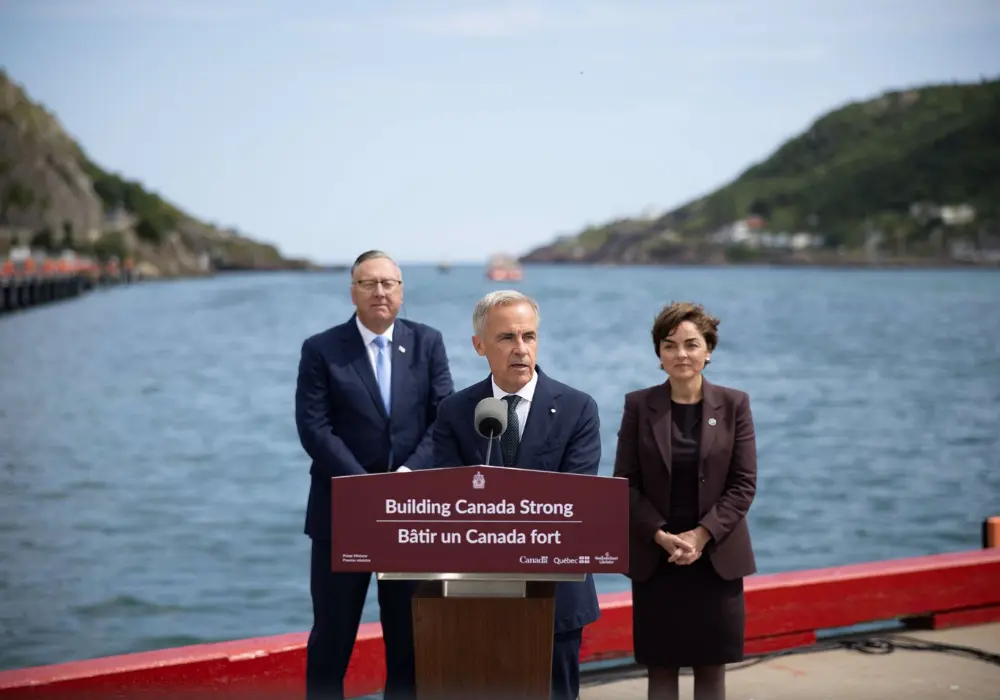
By mid-2026, the administration began rolling out sector-specific strategies, most notably a restructured automotive framework aimed at accelerating electric vehicle (EV) adoption while repealing elements of the previous government’s EV laws. Furthermore, major inter-provincial clean energy pacts—such as the landmark agreement involving Ottawa, Quebec, and Newfoundland and Labrador—underscored the government’s push for mega-scale hydroelectric and grid integration.
However, this transition period has not been without friction. Repealing older policies while delaying the rollout of new standards has created transitional policy vacuums, leaving analysts questioning whether the current trajectory is steep enough to meet Canada’s national and international obligations.
Supporting Context & Metrics: Five Pillars of the Carney Climate Commitment
A granular examination of the Carney administration’s environmental blueprint reveals five explicit climate-related commitments that will dictate the success or failure of Canada’s green transition.
1. "A Carbon Market That Actually Works"
Industrial carbon pricing has long been championed by economists as the most cost-effective tool to slash large-scale emissions. Under Carney, reforming this mechanism became a core fixture of the federal-Alberta MOU.
Proponents argue that industrial carbon pricing can drive substantial emissions reductions at minimal cost per barrel or unit of production. However, independent analyses from the Canadian Climate Institute paint a more sobering picture. The modifications made to Alberta’s industrial carbon market under the new bilateral agreements have thus far proven insufficient to anchor a robust, high-integrity national system. In fact, market data indicates that the price of carbon credits in Alberta actually declined following the MOU’s signing. Industrial carbon pricing needed fundamental repair when Carney assumed power, and expert assessments confirm that it still requires urgent structural reinforcement to ensure proper market signals.
2. The 75% Electric Vehicle Adoption Target (Scaling to 90% by 2040)
Transportation remains one of Canada’s most stubborn sources of greenhouse gas emissions. Prime Minister Carney staked significant political capital on transforming the nation’s auto sector, introducing a strategy centered on strengthening vehicle emissions standards to achieve the equivalent emissions reductions of a 75% EV adoption rate, with an ultimate target of 90% by 2040.
Yet, execution has faltered. By repealing the previous administration’s strict EV mandates and staggering the implementation timelines for the new federal standards, the government inadvertently complicated its own path forward. Current energy modeling suggests that what has been revealed thus far of the new federal tailpipe and sales standard lacks the bite necessary to compel the rapid consumer and fleet adoption required.
3. Becoming a "Clean and Conventional" Energy Superpower
Perhaps no phrase has dominated government communications more than the vision of Canada as a "clean and conventional" energy superpower. In his viral "Forward Guidance" address, Prime Minister Carney set an exceptionally high bar, vowing to build clean energy on a scale that would "astound even Sir Adam Beck"—invoking the legendary Canadian champion of Niagara hydropower.
While the "conventional" half of this dual mandate is abundantly clear, backed by billions of dollars in public capital and guarantees for oil and gas infrastructure, the "clean" half remains a work in progress. Undeniably, recent cooperative energy announcements between Ottawa, Quebec, and Newfoundland and Labrador represent massive, positive progress for clean power integration. Yet, replicating these mega-agreements across every province and territory remains an immense logistical, financial, and political challenge.
4. Made-in-Canada Sustainable Investment Guidelines (Taxonomy)
Recognizing that public funds alone cannot finance the net-zero transition, Budget 2025 embedded a vital commitment: the creation of a Made-in-Canada sustainable investment framework and accompanying sustainable bond guidelines, slated for full publication in 2027.
To ensure credibility, the federal government partnered with the Canadian Climate Institute and Business Future Pathways to collaboratively draft the taxonomy. Following extensive consultations, the first public draft report was published, laying down clear definitions for sustainable economic activities designed to stamp out greenwashing and direct domestic capital toward genuinely green projects. If executed properly, this taxonomy could become the financial bedrock of Canada’s modern economy.
5. Achieving Net-Zero Emissions by 2050
Entrenched in the final text of the federal-Alberta MOU and repeated across countless ministerial speeches, the legally binding commitment to achieve net-zero emissions by 2050 remains the ultimate metric of the Carney government’s environmental credibility.
Yet, policy intent must match policy output. As quantitative tracking from the 440 Megatonnes initiative demonstrates, current policy settings under the revised federal-provincial frameworks leave projected emissions largely unchanged in the near term. Without aggressive, enforceable policy follow-through, the 2050 target risks becoming an aspirational talking point rather than a verifiable destination.
Official Statements and Institutional Perspectives
The friction between political ambition and policy execution has drawn sharp commentary from policy analysts, industry stakeholders, and independent research bodies.
Reflecting on the overarching trajectory of the government’s strategy, Rick Smith, President of the Canadian Climate Institute, offered a balanced appraisal:
"Add it all up and you get a list of policy promises that have the potential to improve people’s lives, electrify the economy, and reduce national emissions. As much of the country continues to feel the impacts of yet another dangerous wildfire season driven by climate change, the urgency to act is clear.
Since Carney’s election, the climate focus has been on where his government stood with respect to Trudeau-era policies. With Parliament set to return, this will now shift to whether the Carney government is living up to its own explicit goals."
Industry groups have generally welcomed the pragmatic tone and financial incentives offered by the Carney administration, particularly regarding sustainable finance taxonomies and resource development partnerships. Conversely, environmental NGOs have expressed mounting anxiety over regulatory rollbacks, warning that softening vehicle mandates and coddling industrial polluters through weak carbon markets could permanently derail Canada’s international climate commitments under the Paris Agreement.
Future Outlook: The Road Ahead for Parliament and Planet
As federal legislators prepare to return to Ottawa, Prime Minister Carney’s administration faces a defining crucible. The honeymoon phase of recalibrating climate policy away from past orthodoxies is officially over.
The coming legislative session will test whether the Carney government possesses the political fortitude to tighten its market rules, accelerate clean energy deployment beyond regional megaprojects, and enforce emissions caps that hold heavy industry accountable. Canadians are no longer grading the government on its rhetorical departures from the past; they are watching the thermometer, tracking the frequency of climate-fueled natural disasters, and demanding tangible proof that the nation’s economic and environmental future is secure.
Ultimately, Mark Carney’s legacy as a climate leader will not be defined by the elegance of his transition blueprints, but by whether his administration can bridge the yawning gap between bold promises and hard, measurable environmental results.
The Weekly Roundup
Want all our exclusive political analysis, energy insights, and environmental reporting delivered straight to your inbox? Get all our stories in one place, every Wednesday at noon EST. Subscribe to our newsletter today.



