

Executive Overview
Deep in the dense, emerald labyrinth of the Ecuadorian Amazon, a quiet technological and cultural revolution is underway. Nicolás Schuldt Durán, founder of the conservation technology organization Neblina Labs, is leading a high-stakes search for an animal so diminutive that an adult can comfortably rest on the palm of a human hand or be weighed against a small apple. The target of this expedition is the pygmy marmoset (Cebuella pygmaea), locally known as the leoncillo, recognized globally as the world’s smallest monkey.
Launched earlier this year in close collaboration with the Siekopai Indigenous community within the Siekoya Remolino territory, this pioneering initiative bridges ancestral wisdom with cutting-edge science. Faced with the daunting task of spotting an arboreal primate weighing just 140 to 150 grams—roughly 5 ounces—that lives high in the canopy and communicates in ultrasonic whistles, Durán turned to passive acoustic monitoring (PAM). By merging the generational tracking expertise of the Siekopai people with automated audio recorders and machine-learning sound analysis, the project aims not only to find a desperately vulnerable species but to establish a robust framework for community-led biodiversity monitoring.
While the initial pilot phase has yet to capture the elusive call of the pygmy marmoset on tape, it has yielded a wealth of acoustic data regarding the surrounding ecosystem. More importantly, it has laid a solid foundation for future conservation strategies. As deforestation and the illegal pet trade tighten their grip on the western Amazon Basin, the presence of the pygmy marmoset serves as a critical biological barometer. Because these tiny primates rely heavily on tree gum and sap, their disappearance is often the first warning sign of forest degradation. This report explores the intricate methodology, the human partnerships, and the technological innovations driving the ongoing quest to protect one of the Amazon’s most sensitive ecological sentinels.
Detailed Chronology of the Expedition
The genesis of this conservation effort traces back to conversations between external technologists and local stewards of the land. Members of the Siekopai Indigenous community, long attuned to the rhythms and subtle shifts of their ancestral territory, approached Durán with concerns regarding the changing dynamics of their local forests. For years, the community had actively defended their lands from illegal loggers and hunters, establishing territorial monitoring programs and deploying camera traps. However, tracking micro-fauna like the pygmy marmoset required a different, more specialized approach.
Phase 1: Community Mapping and Local Expertise
Earlier this year, the collaboration officially took root with a comprehensive community mapping initiative. Rather than relying on satellite imagery alone, Durán and his team tapped deeply into the empirical knowledge of the Siekopai people. Indigenous community members, who spend their lives navigating the multi-tiered jungle, identified specific tree species—particularly those favored by pygmy marmosets for exudate feeding—and pinpointed micro-habitats where leoncillos had historically been sighted or heard.
This localized mapping phase was vital. Pygmy marmosets are notoriously difficult to spot visually. Their pelage acts as natural camouflage against the bark of Amazonian trees, and they occupy the extreme upper strata of the rainforest canopy, well out of the direct line of sight for ground observers. By leveraging Indigenous expertise, the team bypassed random searching, narrowing down their target zones to specific sectors of the Siekoya Remolino forest.
Phase 2: Deploying the Acoustic Sentinels
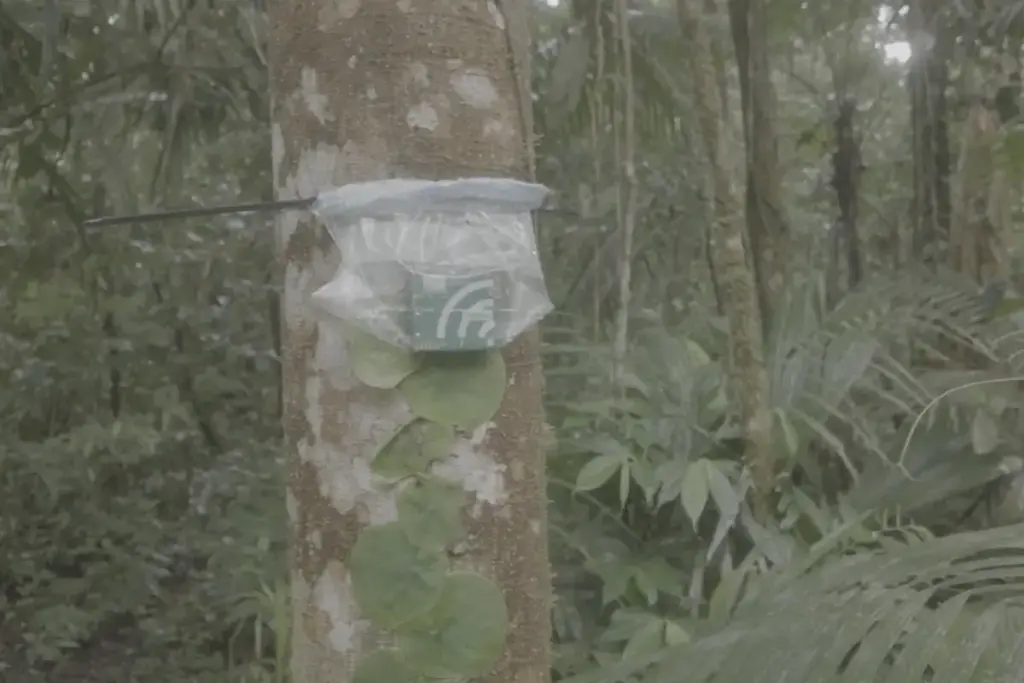
With the target areas mapped, Durán introduced passive acoustic monitoring (PAM) into the field protocol. In March of this year, the team deployed specialized automated audio recorders—small, weatherproof units equipped with sensitive microphones—onto three carefully selected trees within the identified zones.
The strategy behind PAM is straightforward: leave the equipment undisturbed to capture the continuous soundscape of the forest. The recorders were programmed to run uninterrupted for a rigorous 72-hour period. This method minimizes human disturbance in sensitive habitats while maximizing the window of observation, capturing vocalizations day and night without requiring researchers to maintain a physical presence in the field.
Phase 3: Spectrogram Analysis and Initial Findings
Following the 72-hour deployment, the recorders were retrieved, and their massive audio files underwent rigorous computational analysis.

"We got a good feel of what lives there, what doesn’t, and how diverse this place is," Durán noted in a video interview with Mongabay. When the audio was translated into visual spectrograms—graphical representations of frequencies over time—the results were visually striking. "It amazes you to see so many lines of the spectrogram. There are sounds everywhere, especially at dawn."
Despite capturing a symphony of Amazonian biodiversity, the team hit a temporary roadblock regarding their primary target. Spoiler alert: the initial audio analysis did not detect the distinct vocalizations of the pygmy marmoset. The recorders missed the ultra-high-frequency whistles and clicks that leoncillos use to maintain social cohesion within their groups.
However, the pilot was far from a failure. The audio captured a wealth of background data featuring other avian, mammalian, and amphibian species. Durán has since repurposed these recordings to build robust background noise and detection models, refining the algorithms that will be deployed in subsequent phases of the project.
Supporting Context & Ecological Metrics
To understand the urgency of Durán and the Siekopai community’s mission, one must examine the unique biology of the pygmy marmoset and the precarious state of its environment.
The Biology of the Leoncillo
Classified scientifically as Cebuella pygmaea, the pygmy marmoset holds the title of the world’s smallest true monkey. An adult typically measures between 14 and 16 centimeters in length, excluding a tail that can stretch up to 20 centimeters, and tips the scales at a mere 140 to 150 grams.
Their social structure revolves around cohesive family groups, typically consisting of a breeding pair and their offspring across multiple generations. They communicate through a complex array of vocalizations, ranging from low-frequency clicks used for short-range communication to high-pitched, ultrasonic whistles that carry over significant distances through dense foliage—frequencies that can be difficult to capture without specialized acoustic sensors.
Dietary Specialization and Ecosystem Sensitivity
Unlike many other neotropical primates that rely primarily on fruit, insects, or leaves, pygmy marmosets are specialized exudativores. Tree gum, sap, latex, and resins constitute the vast majority of their daily diet. To access this food source, they use specialized, lower incisor teeth to gouge holes into the bark of specific host trees, returning to these same "tapping trees" day after day.
This dietary specialization renders them exceptionally vulnerable to environmental disturbance. When a forest is selectively logged or clear-cut, the specific mature trees favored by pygmy marmosets are often destroyed. Consequently, their populations collapse rapidly in fragmented or degraded landscapes.
According to the International Union for Conservation of Nature (IUCN), Cebuella pygmaea is classified as vulnerable to extinction. Beyond habitat loss driven by agricultural expansion and widespread deforestation in the Amazon Basin, these primates face severe pressures from the illegal wildlife trade. Their minuscule size and appealing appearance make them prime targets for poachers looking to supply the clandestine international pet trade, a market that strips wild populations of breeding individuals and inflicts high mortality rates during transport.

The Power of Passive Acoustic Monitoring (PAM)
Faced with these overlapping threats, conservationists are increasingly turning to passive acoustic monitoring as a cost-effective, scalable solution. Traditional wildlife surveys—such as direct visual line-transect counts—are labor-intensive, require highly trained personnel, and yield low detection rates for rare, cryptic, or canopy-dwelling species.
By contrast, PAM offers what Durán describes as "the best bang for the buck in terms of how many species you can hear for the smallest cost." A single acoustic recorder can capture hundreds of hours of multi-species audio across vast spatial gradients. When paired with machine learning classification algorithms, PAM allows researchers to monitor the presence, absence, and relative abundance of indicator species over extended periods, transforming raw soundscapes into actionable conservation metrics.
Official Statements and Stakeholder Perspectives
The integration of advanced technology with traditional ecological knowledge represents a modern paradigm shift in Amazonian conservation. Rather than operating under a top-down, external-expert model, initiatives like the one in Siekoya Remolino place Indigenous communities at the helm of scientific research.
"The community has already been setting up camera traps and running a territorial monitoring program to catch hunters and loggers," explained Nicolás Schuldt Durán, founder of Neblina Labs, during his interview with Mongabay. "This is just adding one more tool to their toolkit to monitor biodiversity."
This sentiment underscores a vital philosophy in contemporary conservation: technology should serve to empower, rather than bypass, local stewards. The Siekopai people have inhabited these river basins for generations, possessing an intuitive grasp of ecological health that predates modern scientific metrics.
When discussing why the pygmy marmoset was chosen as a focal species, Durán emphasized its role as a living indicator of forest vitality:
"These monkeys are very sensitive to disturbances. They came up when the communities were telling us about the indicators of good forest health. They said they stop seeing the monkeys when the forest becomes degraded."
By focusing on an animal that acts as an ecological canary in the coal mine, the project creates a direct feedback loop between human activities—such as logging incursions or hunting pressures—and the tangible health of the forest canopy. The absence of the leoncillo’s call is not merely a statistical gap; it is a loud, acoustic alarm bell signaling ecosystem stress.
Future Outlook and Next Steps
The search for the world’s smallest monkey is far from over, but the initial pilot project has provided the roadmap for the campaign’s next phase. Armed with refined acoustic detection models and precise community mapping data, Durán and the Siekopai community are preparing to scale up their operations.

Expanding Fieldwork and Deployment Horizons
The immediate future of the project involves long-term fieldwork. While the initial deployment relied on a 72-hour window, upcoming iterations will feature extended deployments where acoustic sensors remain active in the canopy for weeks or months at a time. This extended timeline dramatically increases the probability of recording the sporadic, highly specific vocalizations of transient or resident pygmy marmoset troops.
Furthermore, the team plans to expand the spatial footprint of the acoustic grid. By blanketing larger swaths of the Siekoya Remolino community forest with synchronized audio recorders, researchers hope to triangulate marmoset vocalizations, eventually mapping family group territories and estimating population densities across varied forest management zones.
Defining Broader Ecological Indicators
While the pygmy marmoset remains the primary focal point due to its sensitivity as a forest-health indicator, the acoustic data amassed during the pilot has opened doors to broader ecological monitoring. The automated audio files contain signatures of numerous other vulnerable Amazonian species, ranging from endemic birds to elusive terrestrial mammals.
Durán and his collaborators plan to formalize these auxiliary acoustic signatures into secondary indicators. By tracking a suite of indicator species simultaneously, the Siekopai community will gain a holistic, real-time dashboard of their territory’s biological health.
A Model for Community-Led Conservation
Ultimately, the collaboration between Neblina Labs and the Siekopai people offers a blueprint for grassroots conservation across the Amazon Basin. By pairing the unmatched observational capacity of Indigenous land defenders with scalable, affordable acoustic technology, conservationists can overcome the logistical barriers that have historically hindered protection efforts for micro-fauna.
As the audio recorders are hoisted back into the towering canopy of the Siekoya Remolino forest, the search for the leoncillo continues. Whether the next playback session reveals the faint, ultrasonic whistle of the world’s smallest monkey or simply records the deep, humming resonance of a thriving dawn chorus, the project has already succeeded in forging a powerful alliance between ancestral guardianship and the future of technological conservation.



