

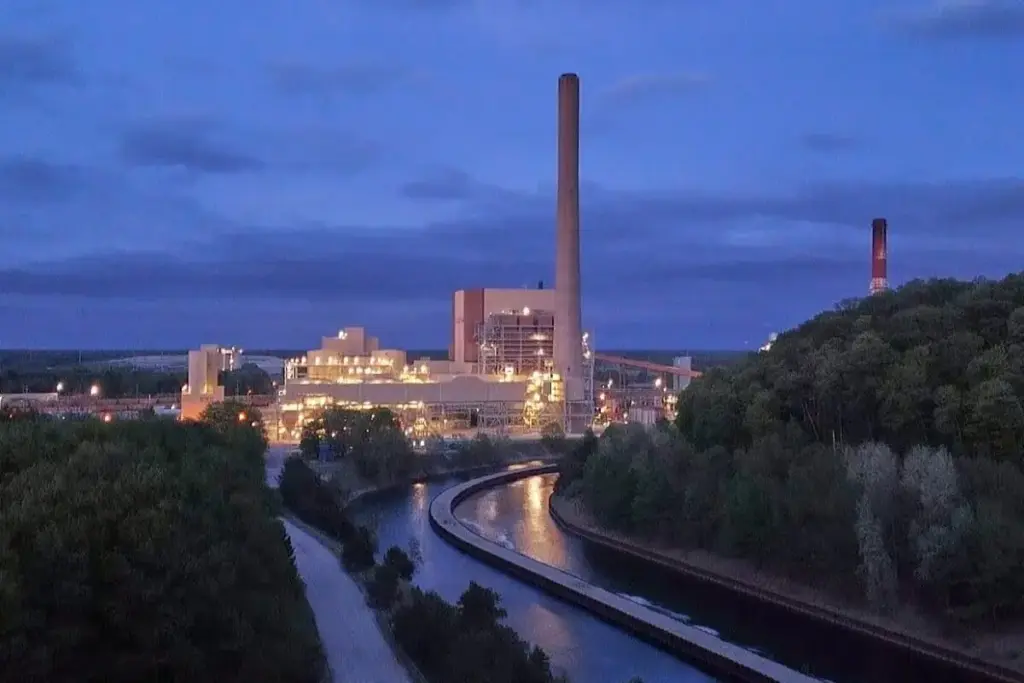
WASHINGTON — In a major legal rebuke to the administration’s aggressive energy strategy, a federal appeals court ruled on Friday that the U.S. Department of Energy exceeded its statutory authority by invoking emergency powers to force the continued operation of an aging, 64-year-old coal-fired power plant in Michigan.
The unanimous decision by a three-judge panel of the U.S. Court of Appeals for the District of Columbia Circuit invalidates an administrative order that had upended the carefully laid retirement plans of the J.H. Campbell plant in West Olive, Michigan. Energy Secretary Chris Wright had previously defended the intervention, arguing that the facility was indispensable to maintaining regional grid reliability. However, the appellate court firmly rejected that justification, ruling that the administration had weaponized a narrow statutory provision designed exclusively for true, unforeseen crises.
The ruling marks a critical turning point in a broader national showdown. Across the country, the Trump administration has deployed emergency directives to halt the decommissioning of roughly half a dozen coal-fired generating stations. Environmental advocates, consumer protection groups, and a coalition of states have mobilized in response, warning that these executive actions are driving up electricity bills, undermining market-based energy transitions, and prolonging the release of harmful air and water pollutants into vulnerable communities.
Executive Overview
Friday’s ruling centers on the legal boundaries of the Federal Power Act, specifically the emergency provisions outlined under Section 202(c). According to the D.C. Circuit, the Department of Energy fundamentally misinterpreted the scope of this statute, treating a routine grid evolution as a catastrophic emergency.
In her opinion for the unanimous panel, Circuit Judge Cornelia Pillard characterized the emergency authority as "essentially a narrow, last-resort backstop." By stepping in to reverse the J.H. Campbell plant’s "long and carefully planned retirement," the administration manufactured a legal fiction of an emergency where none legally existed, leading to outcomes that the court described as inherently "disruptive."
The legal challenge was brought by a unified front consisting of environmental organizations and the states of Michigan, Illinois, and Minnesota. Plaintiffs argued that keeping the decaying facility online served no legitimate reliability purpose that could not be met through standard market mechanisms or regional transmission planning. Instead, they contended, the directive forced captive ratepayers to shoulder exorbitant financial burdens to subsidize an inefficient, high-pollution asset.
For the energy sector, the decision sends a powerful cautionary signal to federal regulators attempting to bypass the traditional regulatory framework to artificially sustain the dying coal economy. Legal analysts suggest the ruling could destabilize similar emergency orders issued in other federal circuits, potentially forcing a rapid reassessment of the administration’s nationwide coal-revival agenda.
Detailed Chronology: The Battle Over J.H. Campbell
The conflict surrounding the J.H. Campbell complex—a sprawling industrial fixture on the shores of Lake Michigan—represents a textbook case study in the friction between federal energy intervention and local utility planning.
Years in the Making: The Planned Retirement
For years, plant operators and regional grid planners had mapped out a disciplined transition away from coal-fired generation at the J.H. Campbell facility, which first began operations in the early 1960s. The retirement schedule was designed to align with broader corporate sustainability goals, tightening federal environmental standards, and the increasing economic competitiveness of renewable energy sources and natural gas. Ratepayers and local communities had been informed of the timeline, and alternative transmission upgrades were already underway to ensure grid stability post-closure.
The Administration Steps In
Last year, however, as part of a concerted federal push by the Trump administration to halt the closure of coal plants nationwide, Energy Secretary Chris Wright intervened. Citing immediate concerns over regional electricity reliability during peak demand periods, Wright utilized the emergency provisions of the Federal Power Act. This executive order abruptly superseded the scheduled shutdown, legally compelling the plant’s owners to keep fires burning and turbines spinning indefinitely.
The Legal Counter-Offensive
Recognizing the precedent-setting nature of the federal mandate, a coalition of states—led by Michigan, alongside Illinois and Minnesota—joined forces with prominent environmental law organizations. They filed emergency motions in federal court seeking to vacate the Department of Energy’s orders. The plaintiffs argued that the administration was misusing emergency powers to prop up favored fossil-fuel industries at the expense of consumer wallets and environmental health.
The D.C. Circuit’s Verdict
The legal showdown culminated in Friday’s decisive ruling from the D.C. Circuit. The court systematically dismantled the Energy Department’s defense, ruling that the administrative record failed to demonstrate an actual, imminent emergency that would justify overriding both state interests and the utility’s operational roadmap. With the emergency order set aside, the path is once again cleared for the permanent decommissioning of the Campbell facility, setting a vital constitutional and statutory precedent for future energy disputes.
Supporting Context & Metrics: The Cost of Forced Reliability
While the administration framed its intervention as a necessary insurance policy against blackouts, critics and independent analysts point to a staggering financial and environmental toll.
Keeping the J.H. Campbell plant operational was by no means a passive administrative act. Maintaining aging infrastructure that was already slated for retirement required massive financial outlays for maintenance, specialized fuel inputs, and regulatory compliance. Official figures indicate that keeping the Michigan plant running for just one year—2025 alone—cost at least $135 million.
These expenditures did not vanish into a vacuum; they were passed directly down to consumers. Across the Midwest, residential, commercial, and industrial ratepayers saw their monthly electricity bills swell to absorb the costs of maintaining a facility that market forces had already deemed obsolete.

Furthermore, the environmental calculus of the extension drew fierce condemnation. Coal-fired power plants of Campbell’s vintage are among the most carbon-intensive industrial operations in the country. Beyond greenhouse gas emissions driving global climate change, the continued operation of the facility prolonged the release of legacy pollutants—including sulfur dioxide, nitrogen oxides, and heavy metals—into surrounding ecosystems and local air basins.
The legal challenge underscored a fundamental economic reality: modern electrical grids are increasingly relying on flexible, low-cost renewables and advanced storage systems. Forcing capital to flow backward into 1960s-era coal technology, critics argue, creates an economic anchor that impedes genuine grid modernization.
Official Statements and Reactions
The court’s decision elicited sharp, triumphant responses from environmental advocates and state officials, while the federal government faced mounting scrutiny over its regulatory overreach.
Ted Kelly, U.S. Clean Energy Director at the Environmental Defense Fund (EDF), did not mince words when evaluating the court’s decision. He framed the ruling as a definitive rejection of a flawed national strategy.
"The court’s decision rightly rejects the Trump administration’s nationwide effort to force unreliable, aging coal plants that are bleeding money and polluting communities to stay online," Kelly said in a statement following the ruling.
Kelly further emphasized the direct harm inflicted upon everyday citizens by the federal directive:
"The Energy Department’s unlawful actions attempted to make families and businesses in the Midwest wastefully pay hundreds of millions of dollars for a coal plant that should have been shut down over a year ago. The Campbell plant and other aging sites are incredibly expensive, dangerous to our health, and break down frequently."
State attorneys general and environmental litigators who spearheaded the challenge similarly hailed the ruling as a victory for the rule of law and the separation of powers. They argued that executive agencies cannot arbitrarily rewrite statutory boundaries to bypass Congress or override state-level authority over local utility markets.
As of late Friday afternoon, the U.S. Department of Energy had not immediately responded to requests for comment regarding whether it would seek an en banc review by the full D.C. Circuit or appeal the decision to the U.S. Supreme Court.
Future Outlook: Implications for the National Energy Landscape
Friday’s ruling reverberates far beyond the shores of West Olive, Michigan. As the Trump administration presses forward with its broader agenda to revive the domestic coal sector, the judiciary has signaled that executive power is not boundless.
National Ripple Effects
The D.C. Circuit is widely regarded as one of the nation’s most influential appellate courts, particularly concerning administrative law and federal regulatory oversight. Its unanimous decision provides a blueprint for plaintiffs challenging similar Department of Energy emergency orders currently affecting coal plants in other regions. If courts in other jurisdictions adopt the D.C. Circuit’s rigorous interpretation of Section 202(c), the administration’s entire strategy of using emergency decrees to halt coal retirements could collapse.
Grid Reliability vs. Economic Realities
The clash highlights an ongoing philosophical and technical debate over how best to manage the transition of the American electrical grid. Proponents of traditional fossil fuels argue that premature retirements threaten grid stability, particularly during extreme weather events driven by climate change. Conversely, clean energy advocates and market operators maintain that grid reliability is best achieved by accelerating investments in modern transmission lines, battery storage, and diversified renewable portfolios—not by artificially propping up deteriorating thermal plants that are increasingly prone to mechanical failure.
The Path Forward for J.H. Campbell
With the legal scaffolding of the federal emergency order removed, the immediate future of the J.H. Campbell plant returns to the domain of state regulators, utility operators, and regional transmission organizations. The stakeholders involved must now pivot back to orderly decommissioning protocols, ensuring that the transition away from the facility is managed safely, equitably, and with minimal disruption to the regional power supply.
Ultimately, the federal court’s decision serves as a powerful reminder that administrative authority must remain anchored within the strict letter of the law. As the nation navigates the complex, high-stakes evolution of its energy infrastructure, executive ambition will continue to face the uncompromising check of judicial review.



