Canada stands at the precipice of its most profound economic and structural transformation since the industrialization of the 20th century. To achieve deep decarbonization and meet ambitious national climate targets, the nation must mobilize a staggering $2.17 trillion in capital investment through 2050, according to new Climate Dollars research from Corporate Knights. This averages out to an annual capital injection of $86 billion—a financial undertaking that will fundamentally reshape the country’s physical landscape, economic architecture, and daily routines.
While public discourse often fixates on gargantuan mega-projects—such as cross-country transmission lines, utility-scale wind farms, and billion-dollar hydroelectric dams—the true engine of the energy transition will be built from the ground up. Roughly 42% of the required capital will be funneled directly into end-use technologies that touch the everyday lives of citizens: residential and commercial heat pumps, deep insulation retrofits, rooftop solar panels, electric vehicles (EVs), local charging hubs, decentralized batteries, and hyper-localized microgrids.
This decentralized paradigm shift presents both a formidable logistical challenge and a generational economic windfall. Because a renewable energy infrastructure is inherently more geographically dispersed than the centralized fossil-fuel system it replaces, it creates an unprecedented opening for community finance. Rather than surrendering the economic returns of the transition entirely to distant multinational corporations or institutional pension funds, local cooperatives, Indigenous nations, municipalities, and everyday citizens have a rare opportunity to own the assets that power their neighborhoods.
The core challenge facing Canada is not a shortage of capital, but rather a question of structural plumbing: Who will own the assets that $2 trillion buys, who will finance them, who will perform the labor, and where will the economic dividends flow?
Detailed Chronology and the Path to 2050
Understanding the trajectory of Canada’s decarbonization timeline requires examining how capital must flow over the next quarter-century. The journey from a high-carbon economy to a localized, resilient green grid is marked by sequential phases of infrastructural integration, technological maturation, and financial innovation.
Phase 1: The Foundation and Early Retrofits (Present to 2030)
In the immediate term, the priority centers on low-hanging fruit and high-impact interventions. This phase is characterized by aggressive building envelope upgrades, early-stage electric vehicle adoption, and the rollout of municipal charging infrastructure.
The Residential and Commercial Push: Millions of individual property owners must be mobilized to insulate walls, seal drafts, and replace aging fossil-fuel furnaces with efficient heat pumps.
Fleet Electrification: Local commercial fleets—including tradespeople’s trucks, municipal service vehicles, and last-mile delivery vans—begin transitioning to battery-electric platforms, establishing the baseline load for local distribution networks.
Financial Aggregation: Because traditional financial institutions struggle with the high transaction costs of underwriting millions of disparate home retrofits, community financial vehicles, green banks, and municipal financing programs emerge to aggregate these small projects into risk-diversified portfolios.
Phase 2: Grid Decentralization and Microgrid Maturation (2030–2040)
As the penetration of renewable energy generation accelerates, the traditional one-way flow of electricity—from central power plants to passive consumers—breaks down entirely.
The Rise of Prosumers: Homes and businesses increasingly operate as both consumers and producers (“prosumers”) via rooftop solar installations and vehicle-to-grid (V2G) capabilities.
Storage Integration: Localized battery storage systems and community-scale microgrids are deployed to smooth out the intermittency of wind and solar power.
Indigenous and Local Ownership Stakes: During this decade, structured partnerships between utilities and local communities mature. Indigenous nations increasingly secure equity stakes in regional wind farms and transmission corridors, transforming resource development into long-term wealth generation.
Phase 3: Complete System Harmonization and Optimization (2040–2050)
By 2050, the transition reaches its terminal velocity. The $2.17-trillion investment program nears completion, resulting in a fully integrated, digitized, and localized energy web.
Algorithmic Load Balancing: Sophisticated local electricity systems dynamically manage power flows between residential batteries, commercial buildings, and parked electric vehicles.
Fossil Fuel Independence: The century-old paradigm of purchasing consumable, imported fossil fuels is permanently replaced by an asset-backed clean energy economy. The economic surplus once drained by foreign oil and gas imports is retained within domestic communities as compounding capital.
Supporting Context and Metrics
To grasp the magnitude of the clean energy transition, one must analyze the raw financial data and physical asset classes modeled by Corporate Knights.
The $1.2-Trillion Local Opportunity
While the total decarbonization bill sits at $2.17 trillion—with roughly 58% allocated to large-scale electricity generation, transmission, and heavy industrial upgrades—more than $1.2 trillion of investment through 2050 is concentrated in asset classes where some degree of local, municipal, or community participation is viable. This localized universe encompasses:
Wind and Solar Generation: Distributed renewable assets embedded within regional landscapes.
Building Decarbonization: Retrofitting millions of residential, commercial, and institutional properties.
Vehicle-to-Grid Infrastructure: EV chargers, smart-charging networks, and localized storage.
Electricity Distribution: Upgrading local poles, wires, and transformers to handle electrified heating and transport loads.
Building Decarbonization (Residential & Commercial)
~$374 Billion
Mortgages, Property Assessed Clean Energy (PACE), Local Loans
High (Co-ops, non-profits, municipal programs)
Transportation Electrification (EVs & Charging)
Trillions in private spend (~$65B annual energy shift)
Auto loans, infrastructure grants, municipal bonds
High (Community charging networks, local fleets)
Local Electricity Distribution & Storage
Regulated asset base
Utility capital expenditure, green bonds
Moderate-High (Microgrids, community batteries)
Shifting from Fuel Consumption to Capital Formation
Canadians currently hemorrhage approximately $235 billion annually on energy consumption, with $179 billion of that total dedicated strictly to natural gas and petroleum products. Personal vehicles alone account for over $41 billion a year in gasoline expenditures. When combined with light and medium commercial trucks—the logistical backbone of local economies—the annual liquid fuel bill reaches an astonishing $65 billion.
In the Climate Dollars low-carbon scenario, as these vehicles are systematically electrified, that comparable annual energy bill plummets to roughly $19 billion.
This highlights the fundamental economic difference between the fossil-fuel era and the clean-energy transition:
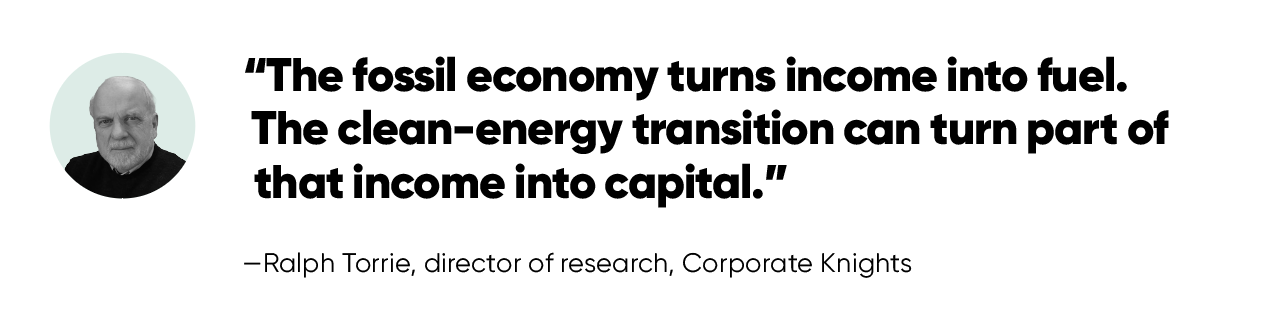
The Fossil Economy: Money spent on a liter of gasoline is consumed, burned, and permanently lost. It is a linear extraction of income that leaves no enduring economic value behind.
The Clean Energy Economy: Money invested in a rooftop solar array, an insulated building envelope, a heat pump, or an EV charging station creates a durable physical asset that generates utility and economic savings for decades.
The transition effectively turns what was once an endless, unrecoverable stream of consumption expenditures into localized capital formation.
Official Perspectives and Expert Analysis
Navigating a $2.17-trillion transition requires aligning the motivations of traditional institutional financiers with the localized aspirations of Canadian communities. Industry leaders and researchers emphasize that community finance must be viewed as an indispensable complement to—rather than a substitute for—conventional capital markets.
"Canada does not suffer from a simple shortage of capital. The challenge is getting capital into the right assets, at the right scale and through structures capable of financing a highly distributed transition," notes Ralph Torrie, Director of Research at Corporate Knights. "An energy system becoming more distributed physically needs a financial architecture capable of being distributed as well."
Traditional financial institutions are structurally optimized for large, standardized, centralized transactions. To a major downtown bank, evaluating millions of distinct residential heat pump installations or micro-scale commercial retrofits introduces prohibitive transaction costs. However, community institutions—such as credit unions, municipal green funds, Indigenous development corporations, and housing cooperatives—possess the localized knowledge required to bridge this gap.
By aggregating smaller projects into cohesive portfolios, community finance structures can effectively diversify risk, lower administrative overhead, and meet the strict underwriting criteria demanded by conventional capital markets.
Furthermore, research into public attitudes toward renewable energy development consistently demonstrates that meaningful local ownership drastically alters community reception. When residents hold an equity stake or financial participation in local wind farms, solar fields, or district energy systems, project acceptance rises exponentially. Ownership transforms citizens from reluctant "hosts" of industrial infrastructure into active builders of their own economic destiny.
Future Outlook: Building Wealth from the Ground Up
As Canada marches toward its 2050 net-zero commitments, the realization of a decentralized energy grid will force a profound evolution in how local economies generate and retain wealth.
The mechanics of this future are already taking shape one address at a time. Decarbonizing Canada’s residential building stock requires an estimated $183 billion in incremental capital, while commercial properties add another $191 billion. Physically, this massive $374-billion figure does not materialize as a single mega-structure; it manifests as millions of discrete interventions executed by local electricians, carpenters, insulation contractors, and project managers in towns and cities from Sudbury to Regina.
Because these physical assets must be installed, maintained, and operated where they stand, the energy transition guarantees a massive, multi-decade boom in local economic activity. The critical variable remaining is ownership.
If these localized assets are financed exclusively by external corporate entities, communities will merely trade one form of imported energy dependency for another—sending local dividends out of province or out of the country just as they once exported wealth to foreign oil producers. Conversely, if deployed through innovative community-finance structures—such as community bonds, cooperative equity shares, and Indigenous-led equity partnerships—the financial returns can be captured locally, funding public services, lowering municipal tax burdens, and fostering intergenerational community wealth.
Ultimately, the green transition offers Canada a once-in-a-generation chance to rewrite its economic DNA. By matching the physical decentralization of renewable energy with a decentralized financial architecture, the nation can ensure that the monumental cost of building a sustainable future translates directly into lasting prosperity for the communities that house, power, and sustain it.