

Executive Overview
The landscape of international security has fundamentally shifted upward. In a landmark acknowledgment that bridges the gap between science fiction and geopolitical reality, the United States has officially confirmed the deployment of a space-based weapon into Earth’s orbit. This unprecedented disclosure—unveiled by Secretary of the Air Force Troy Meink—marks a profound turning point in modern military history. While Washington has remained tight-lipped regarding the specific mechanics, precise deployment timelines, and operational capabilities of this asset, the admission shatters decades of tacit policy regarding the weaponization of low Earth orbit (LEO).
The stated justification from the Pentagon is defensive: the weapon is purportedly necessary to safeguard critical US military infrastructure against hostile actions by near-peer adversaries. However, the revelation has immediately ignited a global debate among defense analysts, astropolitical scholars, and international diplomats. It underscores a terrifying reality: space is no longer merely a peaceful commons utilized exclusively for telecommunications, scientific discovery, and meteorological observation. Instead, it has transformed into a contested operational domain—the ultimate high ground in a multi-polar struggle for global hegemony.
For decades, the militarization of space was defined primarily by passive support systems. Advanced militaries relied on orbital assets for secure, global communications, high-resolution reconnaissance, precise missile-launch detection, and the uninterrupted delivery of Positioning, Navigation, and Timing (PNT) data—the invisible lifeblood of modern, precision-guided warfare. Today, the paradigm has shifted from using space to support terrestrial conflicts to waging war in and from space.
As major military powers—predominantly the United States, China, and Russia—accelerate their technological capabilities, the risk of a high-stakes orbital conflict grows exponentially. This in-depth report examines the shadowy nature of the newly announced US space weapon, evaluates the broader landscape of military developments in Earth’s orbit, analyzes the offensive and defensive doctrines of Washington’s primary rivals, and explores the terrifying precipice upon which global security now balances.
Detailed Chronology: From the Outer Space Treaty to Orbital Weaponization
To understand the gravity of the recent US announcement, one must trace the legal, political, and technological evolution of humanity’s presence in space. The journey from the Cold War space race to the current era of contested orbits spans more than half a century, characterized by shifting doctrines of arms control, covert technological leaps, and escalating geopolitical friction.
1967–1990s: The Cold War Foundation and the Status Quo
The foundational legal architecture governing the cosmos is the 1967 Outer Space Treaty (OST), ratified by the United States, the Soviet Union, and numerous other nations. The treaty explicitly prohibits parties from placing nuclear weapons or any other kinds of weapons of mass destruction in orbit around Earth, installing them on celestial bodies, or stationing them in space in any other manner.
However, the treaty contained crucial legal loopholes. While weapons of mass destruction were explicitly banned, conventional weapons, electronic warfare systems, and terrestrial-based anti-satellite (ASAT) missiles were not comprehensively addressed. Throughout the Cold War, both Washington and Moscow engaged in nascent anti-satellite research—including the Soviet "Istrebitel Sputnikov" (Destroyer Satellite) program and American air-launched ASM-135 ASAT tests. Yet, both superpowers largely adhered to a tacit understanding that LEO and geostationary Earth orbit (GEO) should remain sanctuary environments dedicated to intelligence gathering and strategic stability, rather than active battlefields.
2000–2010s: The Proliferation of Dual-Use Technologies and Asymmetries
As the 21st century unfolded, the democratization and commercialization of space lowered the barrier to entry, enabling a wider array of nations to deploy sophisticated satellite constellations. Simultaneously, military strategists in Beijing, Moscow, and Washington realized that modern Western military dominance—heavily reliant on GPS and satellite communications—represented a critical vulnerability.
China signaled a dramatic escalation in 2007 by successfully using a ground-based kinetic kill vehicle to destroy an aging, defunct Fengyun-1C weather satellite in polar orbit. The test generated thousands of pieces of long-lasting orbital debris, drawing international condemnation.
Shortly thereafter, Russia and China began heavily investing in Rendezvous and Proximity Operations (RPOs). Officially framed as satellite servicing, debris removal, or inspection missions, RPOs allowed spacecraft to maneuver intimately close to foreign assets. To Western intelligence agencies, these maneuvers looked unmistakably like a rehearsal for space-based warfare: learning how to stalk, disable, or capture adversary satellites.
2020–Present: The Shift to Overt Orbital Capabilities
By the dawn of the 2020s, the doctrine of strategic ambiguity began to erode. The United States established the U.S. Space Force in December 2019, formally institutionalizing space as an independent warfighting domain.
Throughout this period, intelligence reports leaked or officially declassified by Western defense agencies repeatedly warned of Chinese and Russian counter-space capabilities, including ground-based lasers, cyber-attacks against ground stations, and orbital stalker satellites. The recent announcement by Secretary of the Air Force Troy Meink—confirming that the US has finally crossed the Rubicon by stationing an active weapon in orbit—represents the culmination of this decades-long drift. It signifies that deterrence through passive resilience is no longer deemed sufficient by Washington, marking the dawn of an overt, active space-arms race.
Supporting Context & Metrics: The Anatomy of Modern Space Warfare
The deployment of an orbital weapon cannot be understood in a vacuum; it is part of a complex, highly technical matrix of space-based assets, kinetic vulnerabilities, and asymmetric doctrines.
The Composition of the Modern Orbital Battlefield
Military space capabilities are generally categorized by the altitude of their deployment:
- Low Earth Orbit (LEO): Ranging from 160 to 2,000 kilometers above the surface. LEO hosts the vast majority of reconnaissance satellites, imagery platforms, and increasingly, mega-constellations like SpaceX’s Starlink. Because satellites in LEO travel at immense speeds (roughly 28,000 kilometers per hour), kinetic intercepts require pinpoint calculation.
- Medium Earth Orbit (MEO): Ranging from 2,000 to 35,786 kilometers. This is the domain of global navigation satellite systems, including the US GPS, the Russian GLONASS, and the European Galileo networks.
- Geostationary Earth Orbit (GEO): Positioned precisely at 35,786 kilometers above the equator, where satellites match the Earth’s rotational speed, appearing stationary from the ground. GEO is critical for uninterrupted, wide-area strategic communications and early-warning missile detection systems.
Assessing the Threat Matrix: Kinetic vs. Non-Kinetic Capabilities
Military space assets are notoriously vulnerable. Operating in a predictable vacuum governed by the laws of orbital mechanics, a satellite cannot easily dodge incoming threats without burning through precious fuel reserves. Consequently, military planners divide space weaponry into distinct operational categories:
| Weapon Category | Operational Mechanism | Strategic Utility | Associated Risks |
|---|---|---|---|
| Electronic Warfare (EW) | Radio-frequency jamming, data spoofing, directed energy. | Non-destructive disruption of communications and command links; highly deniable. | Temporary impact; countered by frequency-hopping and hardened encryption. |
| Kinetic Kill Vehicles (KKVs) | Direct-ascent missiles or orbital impactors colliding at hyper-velocities. | Absolute physical destruction of high-value targets (reconnaissance, GPS). | Generates massive, uncontrollable debris fields (Kessler Syndrome risk). |
| RPO / Grappling Sats | Proximity maneuvers, robotic arms, towing modules to alter orbits. | Inspection, maintenance, or forcible orbital displacement ("space hijacking"). | High ambiguity; difficult to distinguish between servicing and attack. |
| High-Altitude Nuclear / EMP | Nuclear detonation in space generating an electromagnetic pulse. | Wide-scale frying of unhardened satellite constellations across vast orbital planes. | Catastrophic, indiscriminate destruction affecting friend, foe, and commercial assets alike. |
Official Statements and Expert Analysis: Decoding the Pentagon’s Disclosure
The revelation by Secretary of the Air Force Troy Meink was notable both for what it explicitly stated and for the extensive gaps left open to interpretation. By confirming the existence of an "on orbit" defensive weapon designed to shield US forces from hostile action, the Pentagon has shifted its public posture from guarded secrecy to calculated deterrence signaling.
However, independent defense experts emphasize that the technical nature of this weapon remains deeply murky. Dr. Bleddyn Bowen, an associate fellow in military sciences at the Royal United Services Institute (RUSI) and an associate professor in astropolitics at Durham University, offered a measured assessment in commentary provided to media outlets.
"I would expect there to be some kind of electronic warfare or radio-jamming platform, possibly, this would be a non-destructive kind of anti-satellite weapon," Dr. Bowen noted, analyzing the likely profile of the US asset. He drew parallels to terrestrial electronic warfare systems capable of severing critical communication pathways: "If you take out the radio links then your satellite is very useless."
Dr. Bowen also evaluated more aggressive design possibilities, though he categorized them as less probable due to the severe political and physical blowback they would generate. "Less likely would be a kinetic kill vehicle of some sort, so a vehicle that would release a projectile of some sort that could ram into a satellite and destroy it," he explained. Furthermore, he highlighted the possibility of sophisticated mechanical intervention: "Possibly some sort of close inspection and grappling satellite would be another possibility as well."
While the American deployment of an orbital weapon represents a symbolic crossing of a threshold, it mirrors decades of covert and overt escalations by Washington’s primary geopolitical rivals: Russia and China.
Dr. Rod Thornton, a reader in Russian Defence and Security Studies at King’s College London, provided critical context regarding how Moscow and Beijing view the asymmetric balance of power in space. According to Dr. Thornton, both nations have spent the last decade routinely executing Rendezvous and Proximity Operations (RPOs)—colloquially known as "buzzing" Western satellites.
"Theoretically, these RPO sats can become hunter-killer satellites by physically colliding with them or by nudging them out of orbit," Dr. Thornton explained to the BBC.
This assessment is reinforced by Dr. Bowen, who pointed out China’s demonstrated mastery of "space tug capability." A Chinese orbital vehicle, Bowen noted, can approach a target satellite, grapple it mechanically, and physically drag it into a graveyard orbit or an entirely non-functional trajectory. While such technology possesses benign, highly useful commercial applications—such as clearing out dangerous space debris—its inherent dual-use nature makes it a formidable military threat.
The Asymmetric Russian Strategy: Ground-Based Missiles and Nuclear Options
While Russia maintains a smaller, less technologically resilient satellite fleet than the United States and its NATO allies, Moscow has systematically compensated for this disadvantage by investing heavily in asymmetrical counter-space capabilities.
"The Russians… have ground-based missiles which can be launched into space to strike sats in low Earth orbit. They also have ASAT missiles that can be launched from a great height by aircraft," Dr. Thornton detailed. "From the Russian point of view they see Nato as having much better and more sats than the Russian military can call up, therefore they have invested heavily in ASATs in order to ‘level the battlefield’ somewhat."
Perhaps most chilling is Dr. Thornton’s sobering assessment of Russia’s ultimate strategic fallback: "As a last resort, the Russians can also launch nuclear weapons into space and the EPM blast would ‘fry’ any unhardened sats over a wide expanse."
In an all-out orbital conflict, Dr. Thornton suggests that Russia—owing to its minimal reliance on extensive commercial and military satellite architectures—could emerge as the primary tactical beneficiary of a devastated, debris-choked space environment where modern C4ISR (Command, Control, Communications, Computers, Intelligence, Surveillance, and Reconnaissance) capabilities are entirely neutralized. Such a war, military analysts warn, would combine ground-based lasers, hyper-velocity kinetic missiles, and maneuvering orbital interceptors in a catastrophic clash.
Future Outlook: The Precipice of Orbital Anarchy
The public confirmation of a US weapon in Earth’s orbit signals the end of the post-Cold War consensus and the inauguration of a perilous new era in astropolitics. As major powers abandon restraint in favor of operational readiness, the future of human activity in space faces profound existential threats.
The Spectre of the Kessler Syndrome
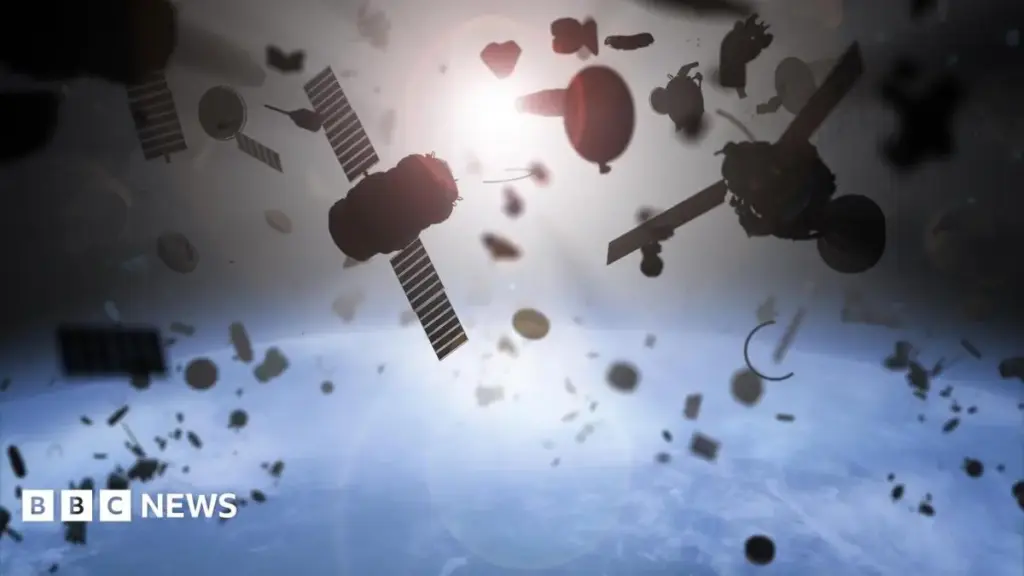
One of the most terrifying long-term consequences of an unbridled space arms race is the realization of the Kessler Syndrome—a theoretical scenario proposed by NASA scientist Donald J. Kessler in 1978. In this cascading catastrophe, the density of objects in low Earth orbit is high enough that collisions between objects spawn a chain reaction. Each impact generates hundreds of high-speed fragments, each capable of destroying other satellites, rendering entire orbital bands completely unusable for generations.
The deployment of kinetic anti-satellite weapons—whether launched from the ground, the air, or other spacecraft—drastically accelerates this threat. By weaponizing orbit, the major powers are playing a high-stakes game of nuclear chicken in an environment where a single miscalculation could permanently trap humanity on Earth, cutting off access to satellite navigation, global weather forecasting, and deep-space exploration.
The Breakdown of Arms Control and Strategic Stability
Decades of diplomatic efforts to establish an international code of conduct or a legally binding treaty banning weapons in space have routinely stalled. Distrust between Washington, Beijing, and Moscow has rendered verification nearly impossible. Because nearly every advanced satellite possesses "dual-use" characteristics—meaning a civilian weather monitor or a commercial telecommunications relay can easily be repurposed for military reconnaissance or orbital maneuvering—consensus on what constitutes a "weapon" remains elusive.
The US decision to openly acknowledge its orbital weapon asset suggests that Washington has calculated that the era of strategic ambiguity is over. Deterrence now requires transparency regarding capability, even if that transparency drives adversarial escalation.
Conclusion
As nations increasingly view space as the ultimate high ground, the risk of miscalculation escalates daily. The transition from peaceful scientific exploration to active orbital militarization represents a failure of international diplomacy and a dangerous escalation of terrestrial geopolitical rivalries. Without renewed, sincere commitments to transparency, verifiable arms control, and norms of responsible behavior in space, humanity risks transforming the pristine expanse of the cosmos into a catastrophic theatre of war—turning the very heavens into a monument to terrestrial folly.



