Executive Overview
In the wake of Russia’s invasion of Ukraine, which sent wholesale gas and electricity prices spiraling to historic highs, the prevailing political rhetoric across Europe converged on a single, compelling slogan: energy independence. For decades, policymakers had treated cross-border energy flows purely through an economic lens—optimizing market efficiency, balancing regional supply and demand, and arbitrating wholesale price differences. Suddenly, physical isolation looked like safety.
Yet, according to a growing consensus among energy strategists, transmission system operators, and regulatory bodies, total energy independence is not only economically inefficient; it is conceptually flawed. The lesson of the European energy crisis was not that nations erred by relying on one another, but rather that they had dangerously concentrated their critical energy supplies within a single, increasingly authoritarian and unreliable counterparty.
As the continent looks toward the latter half of the 2020s, a profound paradigm shift is underway. Rather than retreating into electrical autarky—a scenario where nations attempt to seal off their grids to secure absolute self-sufficiency—governments and grid operators are doubling down on international transmission infrastructure. High-Voltage Direct Current (HVDC) subsea and underground cables are proliferating across borders. Far from shrinking amid rising geopolitical fragmentation, the pipeline of cross-border electricity links is robust, demonstrating that nations are actively choosing strategic interdependence.
This comprehensive investigation examines how cross-border electricity links are evolving from simple market-arbitrage mechanisms into the bedrock of modern grid security. By analyzing upcoming HVDC inventories, changing regulatory frameworks by bodies like ACER (the European Union Agency for the Cooperation of Energy Regulators), and the portfolio logic driving clean flexibility roadmaps in markets like the United Kingdom, we explore how the definition of energy security is being rewritten for an era of climate transition and geopolitical volatility.
Detailed Chronology: From Market Integration to Geopolitical Resilience
To understand the current surge in cross-border transmission infrastructure, it is vital to trace the evolution of how these systems are perceived, planned, and financed.
Phase I: The Era of Market Optimization (Pre-2022)
For much of the late 20th and early 21st centuries, cross-border interconnectors were built primarily to fulfill commercial mandates. Driven by European market-coupling initiatives, interconnectors allowed surplus wind power from Denmark to flow to Norway, or enabled British utilities to import cheap nuclear and hydro power from France.
During this era, project pipelines were justified through cost-benefit analyses centered on wholesale price convergence. If building a subsea cable cost €1 billion but saved consumers €1.2 billion annually by displacing expensive fossil-fuel generation with cheaper cross-border alternatives, the project cleared regulatory hurdles. Security of supply was largely viewed as an engineering metric, solved by domestic capacity markets and strategic fuel reserves rather than international cooperation.
Phase II: The Shock of the 2022 Energy Crisis
The weaponization of Russian natural gas exports following the 2022 invasion of Ukraine shattered the baseline assumptions of European energy policy. As gas flows dwindled, electricity markets—coupled via marginal pricing mechanisms—saw consumer bills skyrocket.
The immediate political reflex was a defensive lurch toward isolationism. Calls for absolute sovereignty over energy resources echoed in parliaments from Berlin to Brussels. However, as the initial panic subsided, energy planners realized a stark physical reality: attempting to run a high-renewables grid on a purely domestic basis is astronomically expensive and technically precarious. A country attempting to balance its own wind droughts and solar slumps entirely within its borders requires immense, costly overbuilding of generation and storage capacity.
Phase III: The 2026 Reality – Interdependence as Defense
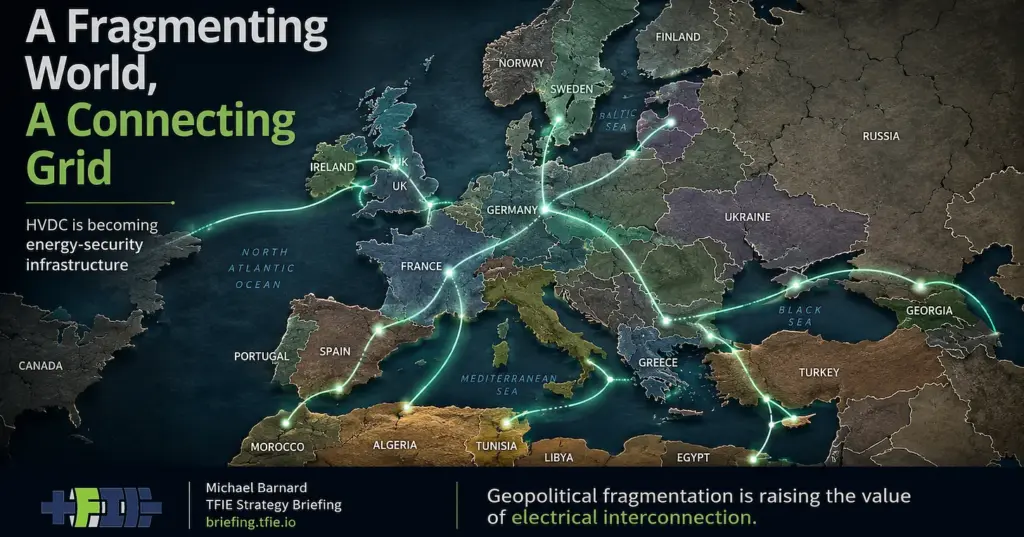
Fast-forward to 2026. Data from infrastructure trackers, such as RTE International’s inventory of Voltage-Source-Converter (VSC) and HVDC projects, reveals a striking counter-narrative to the theory of global fragmentation. Filtering the inventory for cross-national schemes yields approximately 60 prospective international links currently winding their way through various stages of development, with Europe and its immediate neighborhood serving as the epicenter of activity.
A prime illustration of this resilience is the Baltic-German PowerLink. Even after the Baltic states (Lithuania, Latvia, and Estonia) successfully desynchronized their electricity grids from the Russian-controlled BRELL ring, and despite heightened regional security risks, these nations have continued to advance the PowerLink toward EU Project of Common Interest (PCI) status. The strategic context changed radically, yet the chosen response was not a retreat into isolation, but a deliberate forging of deeper electrical ties with Western Europe.
Supporting Context & Metrics: Decoding the HVDC Pipeline
While the headline count of roughly 60 major cross-border HVDC projects in the 2026 inventory points to robust market health, a granular examination reveals a pipeline characterized by varying degrees of maturity, complex permitting hurdles, and evolving technological choices.
The Physics of the Pipe: Electricity vs. Fossil Fuels
To appreciate why interconnectors enhance security rather than undermine it, one must contrast them with traditional fossil-fuel import infrastructure, such as gas pipelines or Liquified Natural Gas (LNG) terminals.

- The Vulnerability of Fuel Imports: A gas pipeline or an LNG import terminal delivers value exclusively on the condition that fuel continuously flows into it. If the supplier cuts off the gas, or if global LNG spot prices spike beyond affordability, the importing nation is instantly exposed. The infrastructure remains hostage to ongoing commodity markets and geopolitical coercion.
- The Reciprocity of Electricity Interconnectors: An electricity interconnector joins two or more power systems that already possess their own diverse portfolios of generation, storage, and demand-response capabilities. Electricity is bidirectional. A well-designed interconnector allows power to flow wherever the deficit lies at any given microsecond.
Furthermore, multiple interconnectors expose a country to a diverse mosaic of weather systems, hydro reservoirs, nuclear assets, and solar resources across different jurisdictions. A wind drought in the North Sea may coincide with high solar output in Southern Europe or heavy hydro generation in Scandinavia. Interconnection acts as a shock absorber, pooling physical resources without stripping domestic generation from a nation’s portfolio.
Regional Case Studies and Regulatory Shifts
The structural shift in how policymakers view interconnectors is clearly visible in the policy documents emerging across Europe:
- ACER’s 2026 Key Developments Report: The European Union Agency for the Cooperation of Energy Regulators has forcefully argued that accelerated interconnection is non-negotiable. ACER’s frameworks now explicitly link high-capacity cross-border links not just to market integration, but to the rapid scaling of variable renewables, the phase-out of remaining fossil generation, and the mandatory democratization of system flexibility.
- The United Kingdom’s Clean Flexibility Roadmap: Britain’s updated roadmap explicitly integrates international interconnectors into its core security-of-supply strategy. Rather than treating subsea links as external trading conduits, UK energy planners evaluate them alongside domestic battery storage, pumped hydro, and industrial demand-side response.
Official Statements and Regulatory Perspectives
The transition from viewing interconnectors as commercial arbitrage tools to recognizing them as strategic resilience assets is reflected in statements from top energy officials and network architects across the continent.
"We are witnessing a fundamental paradigm shift in European grid architecture. The old model of isolated national systems balancing themselves is dead. In a decarbonized energy system, flexibility is our most precious commodity—and flexibility cannot be efficiently hoarded within national borders. Enhanced interconnection is the physical manifestation of European solidarity and mutual security."
— Senior Regulatory Analyst, European Energy Regulators Forum
Network operators echo this sentiment, emphasizing that the economic case for HVDC links is now intrinsically tied to risk mitigation.
"The events of recent years taught us a hard lesson about supply concentration. But the answer to bad concentration is not zero connection; it is smart, diversified interdependence. When you tie together wind assets in the North Sea, hydro in the Alps, and solar in Iberia via a redundant web of HVDC links, you build a system that is infinitely harder to break than any single national grid operating in isolation."
— Lead Transmission System Planning Engineer, Western European Grid
Future Outlook: The Portfolio Logic of Strategic Interdependence
As the energy transition accelerates toward the 2030s, the future of cross-border transmission will not be shaped by blind enthusiasm for connectivity, but by a sophisticated portfolio logic.
Avoiding Concentration Risk
A critical realization among modern grid planners is that not every cable automatically enhances security. Poorly planned interconnection can introduce acute vulnerabilities:
- Single-Point Concentration: Relying on one massive interconnector to supply a double-digit percentage of a nation’s peak demand creates a catastrophic single point of failure. If that subsea cable is damaged—whether through subsea sabotage, mechanical failure, or anchor strikes—the shock to the domestic grid can be severe.
- Correlated Weather and Grid Bottlenecks: Neighboring countries can experience weather anomalies simultaneously (e.g., a continent-wide wind drought). Moreover, if domestic transmission grids lack the internal capacity to move imported power from the landing point to major demand centers, the interconnector remains underutilized.
The True Comparison: Interconnected vs. Autarkic Systems
To evaluate the true value of the future HVDC pipeline, energy economists emphasize a shift in baseline comparisons. The correct analytical question is not whether one cable is safer than one domestic power plant. Rather, it is a systemic comparison: What is the financial cost, material footprint, and operational resilience of the entire domestic energy system a nation would need to build if it chose absolute autarky?
Without cross-border links, nations would be forced to massively overbuild domestic backup generation, utility-scale battery storage, and peaking gas plants to manage worst-case weather scenarios. That redundant capacity would sit idle for months at a time, representing a massive misallocation of capital.
Conclusion
The narrative of modern energy security is graduating past the crude binary of dependence versus independence. The true trajectory points toward strategic interdependence—a diversified network of trusted partners, multiple physical corridors, robust domestic resources, and flexible demand.
As the projects in the 2026 HVDC inventory move from blueprints to energized reality, they are proving that geopolitics and decarbonization are not pulling energy systems apart. Instead, they are welding them together into a more resilient, flexible, and secure continental grid.