

A landmark investigation published in AGU Advances shows that extreme heat is breaching traditional summer limits across more than half the globe, creeping unevenly into spring and autumn and creating unseasonal public health and environmental hazards.
Executive Overview
For decades, public health strategies and climate adaptation plans have operated under a foundational assumption: extreme heat is a peak summer phenomenon. However, a groundbreaking global study published in AGU Advances reveals that this framework is rapidly becoming obsolete. Lead researcher C. Ivanovich and an international team of climate scientists have demonstrated that extreme heat events are breaking out of their traditional seasonal boundaries and invading the "shoulder seasons"—the two-month buffer periods immediately preceding and following local summer months.
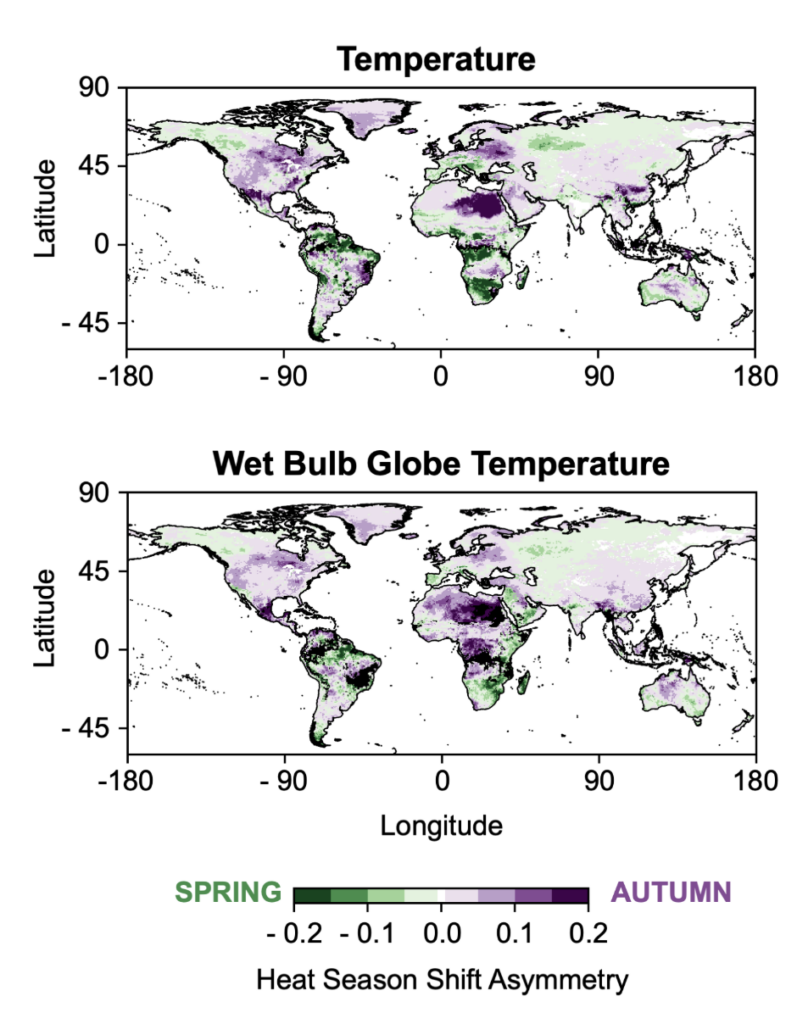
The phenomenon affects more than 50% of the Earth’s land area, but its manifestation is starkly asymmetrical. Rather than expanding uniformly, heat extremes are preferentially creeping into the spring in certain parts of the world—such as Western Europe, Northwestern India, and Southern Africa—while invading the autumn in others, including the United States, Eastern China, Northern Africa, and Eastern Europe.
This temporal shift presents severe risks to human health, agricultural systems, and civil infrastructure. Spring heatwaves strike populations when human physiology is unacclimatized and municipal cooling centers remain closed. Autumn heatwaves extend periods of severe stress on ecosystems, energy grids, and water supplies already exhausted by summer conditions. Crucially, the researchers proved that simple global mean warming cannot explain this asymmetrical expansion, pointing to complex shifts in soil moisture, precipitation patterns, land use, and internal climate variability.
Methodological Framework: Tracking 45 Years of Changing Heat Dynamics
To measure how the temporal distribution of extreme heat has evolved, the research team rejected static, astronomical definitions of summer (such as June through August in the Northern Hemisphere). Because local heat seasons vary significantly across geographic zones, the authors developed a dynamic metric: the Local Heat Season.
+-----------------------------------------------------------------------------------+
|                            THE THREE-PHASE HEAT CALENDAR                          |
+------------------------------------+-----------------------+----------------------+
| Shoulder Season (Pre-Heat)          | Local Heat Season     | Shoulder Season (Post-Heat)
| 2 Months Before                    | Core 3 Months         | 2 Months After       |
| (e.g., Mid-Latitude Spring)        | (Baseline: 1980s)     | (e.g., Mid-Latitude Autumn)
+------------------------------------+-----------------------+----------------------+
1. Establishing the Baseline
Using high-resolution climate data spanning 1980 through 2024, the researchers defined each region’s "Local Heat Season" as the three consecutive months that experienced the highest frequency of extreme heat days during the baseline decade of 1980–1989. The periods two months before and two months after this core window were designated as the shoulder seasons.
2. Cross-Validating Dataset Reliability
To eliminate observational bias and ensure scientific rigor, the study executed identical analytical workflows across two prominent global atmospheric reanalysis products:
- MERRA-2 (Modern-Era Retrospective Analysis for Research and Applications, Version 2), produced by NASA’s Global Modeling and Assimilation Office (GMAO).
- ERA5, produced by the European Centre for Medium-Range Weather Forecasts (ECMWF).
By comparing climate profiles from the baseline period (1980–1989) with those from the most recent decade (2015–2024), the study captured four decades of cumulative climate shifts.
3. Deconstructing the Synthetic Driver
A central question addressed by the researchers was whether shoulder-season heat expansion is simply the byproduct of uniform background warming. If global temperatures rise evenly across all 365 days of the year, days that previously fell just below the threshold for extreme heat would naturally cross it, creating the illusion of an expanded heat season.
To test this hypothesis, the authors constructed a synthetic dataset. They took the 1980s daily baseline temperature series and artificially shifted it upward by adding the exact mean annual warming observed between the 1980s and the 2015–2024 period for each coordinate on Earth.
The results were striking:
- Within the Core Heat Season: Uniform baseline warming accounted for the observed increase in heat extreme frequency.
- In the Shoulder Seasons: The synthetic, uniform warming model failed to match real-world observations. Real-world heat is shifting into spring or autumn at rates far higher—and far more unevenly—than background global warming alone can explain.
Supporting Context & Metrics: Dry vs. Humid Heat Metrics
Understanding the threat posed by expanding heat seasons requires evaluating the distinct impacts of dry heat versus humid heat. The study evaluated both thermal regimes separately, applying specialized atmospheric metrics to capture their differing environmental and human impacts.

+-------------------------------------------------------------------------------------+
|                                 HEAT METRIC COMPARISON                              |
+--------------------------+------------------------------+---------------------------+
| Feature                  | Dry-Bulb Temperature         | Wet-Bulb Globe Temp (WBGT)|
+--------------------------+------------------------------+---------------------------+
| Primary Application      | Atmospheric & Ecosystems     | Human Physiological Strain|
| Primary Variables        | Ambient Air Temperature      | Temp, Humidity, Wind, Sun |
| Dominant Threat Target   | Agriculture, Wildfire Risk   | Outdoor Labor, Sports     |
| Timing Offset            | Often Precedes Humid Heat    | Follows Dry Heat Season   |
+--------------------------+------------------------------+---------------------------+
Dry Heat (Dry-Bulb Temperature)
Dry heat measures ambient air temperature without accounting for moisture. It directly influences evapotranspiration rates, plant stress, soil desiccation, and wildfire susceptibility. In the 1980s baseline, approximately 93% of the world’s land area experienced more than 80% of its extreme dry-heat days tightly consolidated within its historical three-month heat season. Today, those boundaries are fraying as dry heat spreads into surrounding months.
Humid Heat (Wet-Bulb Globe Temperature – WBGT)
Humid heat combines temperature, relative humidity, wind speed, and solar radiation into a single index. Developed by the U.S. Military in the 1950s, WBGT serves as the international gold standard for assessing occupational heat exposure and industrial safety. Humid heat severely impairs the human body’s ability to cool itself through sweat evaporation, making it exponentially more lethal to human populations than dry heat at equivalent temperatures.
Seasonal Offsets and Regional Asymmetries
The study highlighted that extreme dry- and humid-heat seasons rarely coincide perfectly. In monsoon-dependent regions—such as Northwestern Mexico and Central India—the extreme dry-heat season peaks prior to the monsoon, whereas the extreme humid-heat season follows immediately as monsoon moisture surges into the region, creating a staggered double peak of environmental risk.
+-------------------------------------------------------------------------------------+
|                          REGIONAL ASYMMETRY OF HEAT EXTENSION                       |
+-----------------------------------+-------------------------------------------------+
| Spring-Dominant Creep ("Green")   | Autumn-Dominant Creep ("Purple")                |
+-----------------------------------+-------------------------------------------------+
| • Western Europe                  | • Continental United States                     |
| • Southern Africa                 | • Eastern China                                 |
| • Northwestern India              | • Northern Africa                               |
|                                   | • Eastern Europe                                |
+-----------------------------------+-------------------------------------------------+
Scientific Synthesis: The Physiological and Compound Drivers
The finding that extreme heat is invading shoulder seasons unevenly points to a complex mix of atmospheric mechanisms, regional land-atmosphere feedbacks, and localized anthropogenic activities.

                  +----------------------------------------------+
                  |  Drivers of Shoulder-Season Heat Expansion   |
                  +----------------------------------------------+
                                         |
         +-------------------------------+-------------------------------+
         |                               |                               |
+------------------+           +------------------+            +------------------+
| Land-Atmosphere  |           | Oceanic Oscillation|          | Human Land Use   |
|   Feedbacks      |           |     Coupling     |            |  Modifications   |
+------------------+           +------------------+            +------------------+
| • Soil Moisture  |           | • Pacific Decadal|            | • Agricultural   |
|   Depletion      |           |   Oscillation    |            |   Intensification|
| • Shifts in      |           | • Atlantic Multi-|            | • Large-Scale    |
|   Precipitation  |           |   decadal Osc.   |            |   Irrigation     |
+------------------+           +------------------+            +------------------+
Land-Atmosphere Feedbacks
When spring experiences reduced precipitation, soil moisture evaporates prematurely. By early summer—or late spring—the dry soil can no longer cool the surface through latent heat flux (evaporation). Instead, solar energy directly heats the air (sensible heat flux), causing extreme heat to manifest weeks ahead of schedule. Conversely, extended late-summer droughts preserve elevated surface temperatures deep into the autumn.
Climate Modes and Teleconnections
Large-scale, decadal ocean-atmosphere fluctuations—including the Pacific Decadal Oscillation (PDO) and the Atlantic Multidecadal Oscillation (AMO)—alter jet stream paths and pressure blockings globally. These natural oscillations interact with long-term anthropogenic warming, suppressing or enhancing heat buildup during specific transitional months depending on the hemisphere and continent.
Physiological Vulnerability Gaps
Human biometeorology research demonstrates why shoulder-season heatwaves cause disproportionately high mortality:
- The Spring acclimatization gap: During early spring heatwaves, human sweat glands have not undergone the physiological adaptations required to efficiently dissipate heat (such as expanded plasma volume and lowered sweating thresholds). Combined with the absence of active municipal heat alerts or functional public cooling stations, spring heat extremes frequently catch populations unprepared.
- The Autumn exhaustion effect: Late-season heat waves impact populations, civil health workers, and public utility infrastructures that have been worn down by months of sustained summer thermal stress. Accumulative cardiovascular strain during these periods significantly inflates mortality among vulnerable populations.
Future Outlook & Policy Imperatives
The expansion of extreme heat beyond traditional summer boundaries complicates disaster management frameworks, requiring a re-examination of climate adaptation, emergency planning, and occupational health governance.

+-------------------------------------------------------------------------------------+
|                           COMPOUND SEASONAL HAZARD RISKS                            |
+---------------------+----------------------------------+----------------------------+
| Region              | Secondary Intersecting Hazard    | Cascading Impact           |
+---------------------+----------------------------------+----------------------------+
| Western United States| Autumn Wildfire Season           | Unprecedented Fire Weather |
| Eastern United States| Atlantic Hurricane Season        | Compound Evacuation Strain |
| Southern Europe     | Agricultural Planting Windows    | Crop Failure & Water Deficit|
+---------------------+----------------------------------+----------------------------+
Managing Compound and Cascading Disasters
The expansion of heat into autumn poses dangerous compound threats in regions where shoulder seasons align with other severe weather phenomena:
- Heatwaves and Wildfires: Across the Western United States, autumn heat extensions overlap with dry offshore wind events (such as the Santa Ana and Diablos winds). High autumn temperatures dry out vegetation late into the year, lengthening high-risk wildfire seasons and causing intense, unseasonal firestorms.
- Heatwaves and Tropical Cyclones: In the Eastern United States, autumn heat expansion directly coincides with the peak of the Atlantic hurricane season. A major hurricane strike accompanied or immediately followed by extreme heat—especially during long-duration power outages—creates catastrophic conditions for urban populations lacking air conditioning.
Structural Adaptation and Operational Policy Shifts
To mitigate the risks posed by shifting heat seasons, policymakers and civil authorities must adapt across several key domains:
+------------------------------------------------------------------------------------+
|                         POLICY AND ADAPTATION IMPERATIVES                          |
+--------------------+---------------------------------------------------------------+
| Governance Focus   | Strategic Adaptation Action                                    |
+--------------------+---------------------------------------------------------------+
| Public Health      | Extend Heat Early Warning Systems (HEWS) to operating year-round|
| Labor Protection   | Adjust seasonal labor enforcement rules for farm & construction|
| Municipal Planning | Mandate cooling center readiness through spring and autumn    |
| Grid Management    | Re-evaluate power grid maintenance windows outside mid-summer |
+--------------------+---------------------------------------------------------------+- De-seasonalizing Heat Emergency Plans: Municipalities can no longer restrict emergency cooling centers, public health advisories, and outreach programs strictly to June–August (Northern Hemisphere) or December–February (Southern Hemisphere). Emergency response plans must be trigger-based upon actual temperature and wet-bulb thresholds rather than calendar dates.
- Revising Labor Safety Protocols: Occupational safety regulatory bodies must mandate workplace heat protections—such as mandatory shade breaks, hydration protocols, and adjusted work hours—based on real-time WBGT monitoring rather than static summer windows, protecting agricultural and construction laborers during unseasonable spring and autumn heat.
- Grid Resilience and Maintenance Scheduling: Power utility companies traditionally schedule critical infrastructure maintenance, transformer upgrades, and plant overhauls during spring and autumn when demand is low. As shoulder-season air conditioning usage spikes, grid operators must recalibrate maintenance schedules to prevent power failures during unexpected shoulder-season heat events.
The study by Ivanovich et al. makes one thing clear: global warming is not merely raising summer peak temperatures; it is fundamentally altering the global seasonal calendar. As extreme heat increasingly encroaches upon spring and autumn, societal resilience will depend on moving beyond static calendar-based planning to adopt dynamic, year-round heat management frameworks.



