

By Special Contribution for "BHL at 20: Treasures from the Biodiversity Heritage Library"
Executive Overview
In the sprawling landscape of natural history literature, rare book acquisitions often represent quiet additions to institutional archives. Yet, every so often, the acquisition of a centuries-old text unlocks a complex narrative involving international diplomacy, taxonomic controversy, and the foundational architecture of modern science. Such is the case with a recent acquisition by the Field Museum’s Marie Louise Rosenthal Library: a pristine, three-volume edition of Geographische Geschichte des Menschen, und der allgemein verbreiteten vierfüßigen Thiere, nebst einer hieher gehörigen Zoologischen Weltcharte, published between 1778 and 1783 by the German geographer, zoologist, and mathematician Eberhard August Wilhelm von Zimmermann.
This landmark work, accompanied by its revolutionary fold-out map (Tabula Mundi Geographico Zoologica), stands as one of the earliest comprehensive treatises on mammalian biogeography. However, the true significance of this acquisition extends far beyond its historical value as a rare book. The text serves as the focal point of a fascinating historical pivot—one intimately tied to the Field Museum itself—that ultimately led to the official validation of several binomial names still in use today.
By tracing the journey of Zimmermann’s work alongside its predecessor, the rejected 1777 Latin edition (Specimen zoologiae geographicae), and the 1954 ruling by the International Commission on Zoological Nomenclature (ICZN), scholars now have unprecedented digital access to the complete evolutionary story of zoological taxonomy. Today, thanks to the collaborative preservation efforts of the Biodiversity Heritage Library (BHL), both the accepted German masterwork and its rejected predecessor are publicly available online, offering a compelling case study in how historical scientific standards continue to shape our understanding of the natural world.
Detailed Chronology: From Enlightenment Exploration to Taxonomic Validation
To understand the weight of Zimmermann’s contributions, one must step back into the late 18th century—an era defined by maritime exploration, Enlightenment cataloging, and the fledgling efforts of scientists attempting to make sense of a rapidly expanding global map.

1777: The First Foray (Specimen Zoologiae Geographicae)
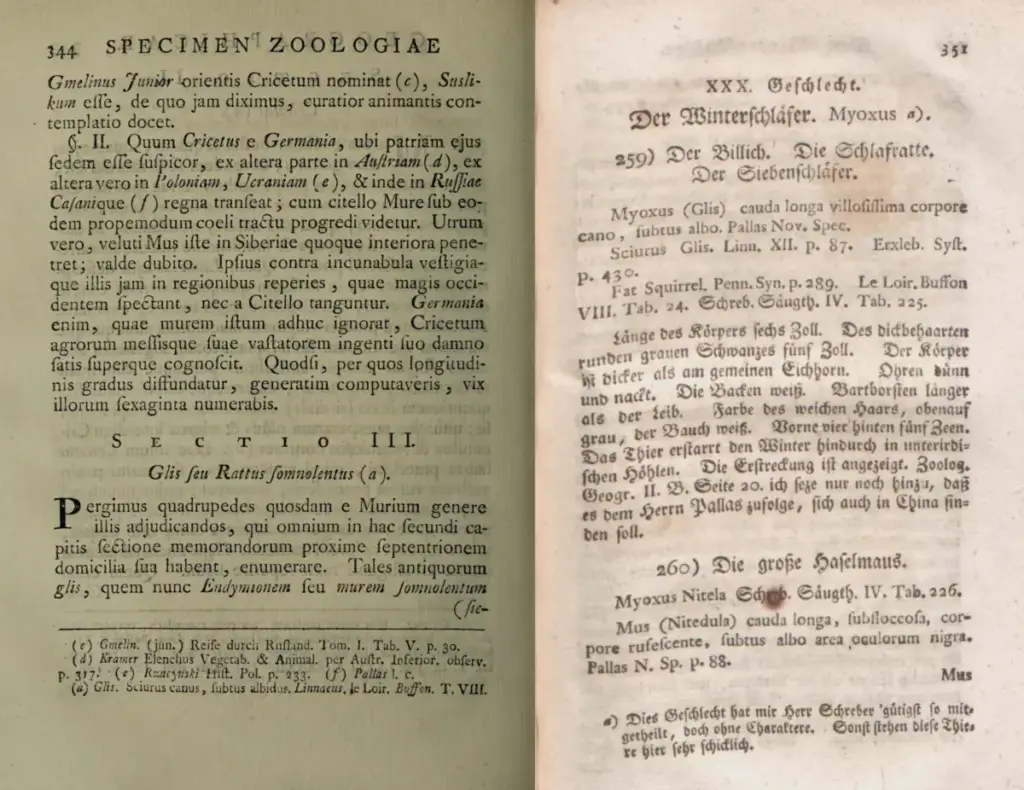
In 1777, Eberhard August Wilhelm von Zimmermann published Specimen zoologiae geographicae, quadrupedum domicilia et migrationes sistens in Latin. Written as an initial attempt to map the global distribution of quadrupeds, the book was ambitious. However, it suffered from a fatal flaw in the eyes of modern nomenclature: Zimmermann failed to apply the principles of binomial nomenclature consistently. Instead of relying on a strict two-part naming system (genus and species), he frequently intermingled descriptive phrases, polynomial expressions, and common vernacular. For instance, where a modern biologist would expect a strict binomial name, Zimmermann might refer to a specific species of dormouse using a cumbersome phrase like Glis seu Rattus somnolentus.
1778–1783: The German Masterwork (Geographische Geschichte)
Recognizing the limitations of his earlier Latin text, Zimmermann significantly revised, expanded, and improved his research. Between 1778 and 1783, he published the three-volume German edition: Geographische Geschichte des Menschen, und der allgemein verbreiteten vierfüßigen Thiere, nebst einer hieher gehörigen Zoologischen Weltcharte.
Crucially, this expanded edition adopted a more rigorous approach to taxonomy. It debuted several vital binomial names that remain officially attributed to Zimmermann to this day, including:
- Cervus muntjak (the muntjac deer)
- Lutra minima (historically classified as Chironectes minimus, the water opossum)
- Canis zerda (today recognized as Vulpes zerda, the fennec fox)
Furthermore, the work featured an updated version of his groundbreaking fold-out map, the Tabula Mundi Geographico Zoologica. This map incorporated fresh geographical intelligence hauled back to Europe by maritime explorers, most notably Captain James Cook and the crew of the HMS Endeavour. The 1783 map proudly reflected Cook’s charting of the Sandwich Islands (Hawaii), rendered a far more accurate outline of the western coast of North America, and noted the Seychelles east of mainland Africa—a mere thirteen years after French colonists established settlements there.
1954: The ICZN Intervention and the Field Museum Connection
For nearly two centuries, the status of Zimmermann’s 1777 and 1778–1783 publications remained a point of discussion among systematic zoologists. The confusion was finally put to rest in 1954 by the International Commission on Zoological Nomenclature (ICZN) in its landmark publication, Opinions and Declarations Rendered by the International Commission on Zoological Nomenclature.

In Opinion 257, the Commission made two critical rulings:
- It formally rejected the 1777 Specimen zoologiae geographicae for "nomenclatorial purposes," placing it on the "Official Index of Rejected and Invalid Works in Zoological Nomenclature" because it violated Article 25 of the Règles internationales de la nomenclature zoologique (the predecessor to the modern International Code of Zoological Nomenclature).
- It officially approved the 1778–1783 Geographische Geschichte for inclusion on the "Official List of Works Approved as Available for Zoological Nomenclature," confirming that Zimmermann had successfully applied binomial nomenclature within its pages.
Archival records reveal that this ruling was not born in a vacuum; it was heavily influenced by prominent scientists at the Field Museum of Natural History in Chicago. The ICZN’s decision stemmed directly from formal correspondence between Francis Hemming, Secretary of the Commission, and Wilfred H. Osgood of the Field Museum, who fiercely advocated for the recognition of Geographische Geschichte. Hemming also consulted Philip Hershkovitz, then Curator of Mammals at the Field Museum, who corroborated Osgood’s arguments. This institutional advocacy ensured that Zimmermann’s vital contributions to mammalian taxonomy were legally and scientifically preserved.
Supporting Context & Metrics
The acquisition and retrospective analysis of Zimmermann’s works highlight several important metrics and contextual factors regarding the curation of rare natural history texts:
- Geographic Scope vs. Taxonomic Precision: Zimmermann’s 1783 map was a triumph of thematic cartography. Quadrupeds (mammals) were plotted directly onto their native geographic ranges across the globe. For example, Castor (beaver) and Bison spanned northern North America; Tigris (tiger) dominated parts of Asia; and Kanguro (kangaroo) was plotted across New Holland (Australia), marking one of the earliest visual representations of the animal introduced to European science by botanist Daniel Solander aboard the HMS Endeavour.
- Institutional Rarity: Original printings of both the 1777 Latin volume and the 1783 German three-volume set are exceptionally rare in public library holdings, making physical access difficult for modern historians of science.
- Digital Preservation Impact: Through the Biodiversity Heritage Library (BHL)—which is currently celebrating its 20th anniversary—these fragile, scattered volumes have been rescued from obscurity. Researchers worldwide can now simultaneously examine the rejected 1777 polynomial nomenclature alongside the accepted 1780 binomial names (such as the transition from Glis seu Rattus somnolentus to Myoxus glis, known today as the European fat dormouse, Glis glis).
Official Statements & Institutional Perspectives
The intersection of historical rare book curation and modern digital access underscores the ongoing mission of institutions like the Field Museum and the Biodiversity Heritage Library.
Library staff at the Field Museum’s Marie Louise Rosenthal Library operate under strict evaluative criteria when utilizing rare book acquisition funds. Before securing a title, curators assess:

- Alignment with the library’s core natural history collecting scope.
- Historical value and scientific significance.
- Global holding distribution among peer institutions.
- The existence of prior digital surrogates within open-access repositories like BHL.
When evaluating Geographische Geschichte, staff realized that while the 1777 precursor was digitized in BHL, the definitive 1778–1783 German edition was missing from the digital corpus, despite its deep historical ties to the museum’s own 20th-century curators (Osgood and Hershkovitz).
"Having access to both this three-volume edition and the rejected 1777 title, alongside the International Commission on Zoological Nomenclature’s ruling, provides a compelling case study in the development of zoological nomenclature," noted library representatives. "It demonstrates the changing standards by which scientific works are evaluated, and the ways in which new evidence can reshape our understanding of the natural world."
Future Outlook: The Living Scientific Record
The resurrection of Eberhard August Wilhelm von Zimmermann’s work via the Biodiversity Heritage Library serves as a powerful reminder that 18th-century scientific literature is not static. Texts published over 240 years ago continue to hold active relevance in modern taxonomic databases, conservation planning, and historical research.
As BHL marks two decades of breaking down physical barriers to knowledge, initiatives that digitize rare literature—and contextualize complex rulings like ICZN Opinion 257—ensure that the historical trail of science remains transparent and accessible. By uniting rare physical archives with open-access digital platforms, the scientific community guarantees that foundational works like Geographische Geschichte will continue to educate, inspire, and inform researchers for centuries to come.
Further Reading & References
- Allen, J. A. (1902). Zimmermann’s “Zoologiae Geographicae” and “Geographische Geschichte” considered in relation to their zoological nomenclature. Bulletin of the American Museum of Natural History, 16, 13–22.
- American Society of Mammalogists. (n.d.). Glis glis (Linnaeus, 1766): European fat dormouse. Mammal Diversity Database.
- Delaney, J. (2012). First X, then Y, now Z: Landmark thematic maps. Princeton University Library.
- International Commission on Zoological Nomenclature (ICZN). (1954). Opinion 257: Rejection for nomenclatorial purposes of the work by Zimmermann (E.A.W.) published in 1777 under the title Specimen zoologiae geographicae and addition to the Official List of Works Approved as Available for Zoological Nomenclature of the work by the same author published in 1778–1783 under the title Geographische Geschichte des Menschen, und der allgemein verbreiteten vierfüßigen Thiere. Opinions and Declarations Rendered by the ICZN, 5(19), 245–262.
- Lotzof, K. (n.d.). Endeavour 250: Natural history through colonial encounter. Natural History Museum, London.



