

Executive Overview
On Sunday, August 23, a historic endurance feat concluded in the icy, majestic depths of Norway’s Sognefjord. Over 30 grueling stages, two elite open-water swimmers completed a continuous 205-kilometre journey through the world’s longest ice-free fjord and its deepest chasm, descending 1,308 metres at its absolute lowest point. In doing so, the team achieved unprecedented milestones: they became the first Norwegians to swim the entire length of the Sognefjord, with Ingjerd securing her place in history as the first woman in the world to accomplish the feat. Concurrently, Dan made history as the first Sámi individual to swim the fjord, bringing a profound cultural dimension rooted in a generational, spiritual connection to the ocean and northern ecosystems.
Yet, this monumental undertaking—organized under the banner of Swim4Fjords, representing the Jæren Coast Mission Blue Hope Spot—was never primarily about athletic records. Every stroke, every breath-hold, and every photographic frame captured during the 30-day expedition served a singular, urgent purpose: to sound the alarm on the hidden ecological degradation unfolding beneath the postcard-perfect surface of Norway’s coastal waters.
While tourists marvel at the breathtaking vertical cliffs, deep blue expanses, and cascading waterfalls from the decks of cruise ships, a quiet crisis is brewing underwater. Armed with waterproof cameras and freediving gear, the swimmers documented a vastly different reality—one characterized by suffocating carpets of filamentous algae (lurv), collapsing wild salmon populations, and an alarming 15% decline in deep-water oxygen levels over the past three decades. By partnering with marine biologists, researchers, and advocacy groups, the Swim4Fjords team has transformed an athletic triumph into hard scientific data, submitting exhaustive underwater documentation directly into the ongoing national protection process for the Sognefjord.
Detailed Chronology: A 30-Day Odyssey Through the Abyss
Breaking Records and Cultural Barriers
The expedition was structured around 30 distinct stages, averaging approximately 7 kilometres per day. This measured pacing was essential not only for managing physical fatigue in cold, unpredictable waters but also for allowing the team adequate time to perform underwater inspections, document local marine life, and engage with coastal communities.
The athletic achievements are significant. Ingjerd and Dan’s dual crossings shattered records, but Dan’s heritage as a Northern Sea Sámi added a deeper layer of environmental stewardship to the journey. For the Sámi people, humanity is not separate from nature; rather, human existence is deeply intertwined with the health of the land, rivers, and oceans. This worldview informed the team’s philosophy: swimming not across the water, but for the water.
The 100-Kilometre Turning Point and the "Fjord with the Flu"
While the upper reaches of the Sognefjord offered mesmerizing views of snow-dusted peaks and deep azure channels, the physical realities of the expedition quickly turned technical and harsh.
Roughly halfway through the journey—just after crossing the 100-kilometre mark—severe and unpredictable weather patterns manifested. Relentless, strong currents forced the swimmers dangerously close to the rocky shoreline for a grueling final 2.5 kilometres of that particular stage. What was initially an unexpected tactical survival measure transformed into an accidental, up-close underwater inspection of the shallows.
What they witnessed was deeply unsettling. The shallow coastal waters revealed a sprawling kelp forest entirely smothered by thick, greyish-green mats of filamentous algae, locally known as lurv. Instead of vibrant, undulating fronds of healthy kelp providing sanctuary for juvenile fish and crustaceans, the team swam past a continuous, choking carpet of algae.
"It felt as if the fjord had the flu," the team reflected. "Seriously ill, yet still breathtakingly beautiful at the surface."
Supporting Context & Metrics: The Hidden Collapse of an Ecosystem
The anecdotal observations of choked kelp forests are backed by a growing body of alarming environmental metrics compiled by institutions like the Norwegian Institute for Water Research (NIVA) and independent marine scientists.
The Aquaculture Crisis and Nutrient Overload
To understand the ecological pressures facing the Sognefjord, one must examine its geographical and industrial context. The team’s migration route deliberately mirrored the historic paths of wild Atlantic salmon, tracking their journey from spawning grounds in the inner river systems out toward the open ocean.
The numbers paint a stark, unsustainable picture:
- Wild Salmon Collapse: Norway’s total wild salmon spawning population is currently estimated at a fragile 300,000 to 400,000 fish nationwide.
- Intensive Farming Density: A single industrial salmon-farming cage can hold upwards of 200,000 farmed fish. Just two cages can house a fish population roughly equivalent to every single wild spawning salmon in Norway combined—and these millions of caged fish share the exact same narrow fjord ecosystems.
- Pollution Equivalencies: According to NIVA data, aquaculture is currently the single largest source of human-caused nitrogen and phosphorus emissions along the Norwegian coastline. The nitrogen emissions alone from the aquaculture sector are equivalent to the untreated sewage output of more than 17 million people—several times the entire human population of Norway.
Beyond nutrient loading—which fuels the explosive growth of destructive filamentous algae like lurv—open-net pen aquaculture acts as a vector for rampant parasite proliferation, particularly salmon lice. These parasites feed on the skin and blood of wild salmon and sea trout, often proving fatal to smolts migrating out to sea. Furthermore, the routine cleaning of fish-farm nets releases accumulated organic waste and chemical residues directly into the water column, compounding the stress on an already over-burdened marine environment.
Suffocating Depths: Oxygen Loss in a Sill Fjord
At its most staggering point, the Sognefjord plunges to a depth of 1,308 metres. Swimming directly above this abyss alongside champion Norwegian freediver Mari Aarbø offered the expedition team a humbling perspective on the vast, hidden worlds existing far below the reach of sunlight.
However, this deep realm is facing an unprecedented asphyxiation event. Over the past 30 years, the oxygen content within the Sognefjord’s deep waters has plummeted by approximately 15%.
This decline is driven by two primary factors identified by NIVA:
- Nutrient Enrichment (Two-thirds of the impact): Excessive organic loading from human activities increases biological oxygen demand as bacteria break down the waste.
- Climate Warming (One-third of the impact): Rising sea temperatures alter thermal layers and slow circulation.
Compounding this is the unique geomorphology of the Sognefjord: it is a sill fjord. At its mouth, an underwater geological threshold sits at a depth of roughly 200 metres, severely restricting the natural exchange of deep water with the open ocean. As global sea temperatures climb, the deep water becomes increasingly difficult to renew. The fjord is quite literally finding it harder to breathe, raising a terrifying question for marine ecologists: How close are we to a tipping point where the ecosystem collapses beyond recovery?
Official Statements & Scientific Collaboration
The Swim4Fjords initiative was designed from its inception to bridge the gap between extreme endurance sports and rigorous scientific documentation.
Documenting the Unseen
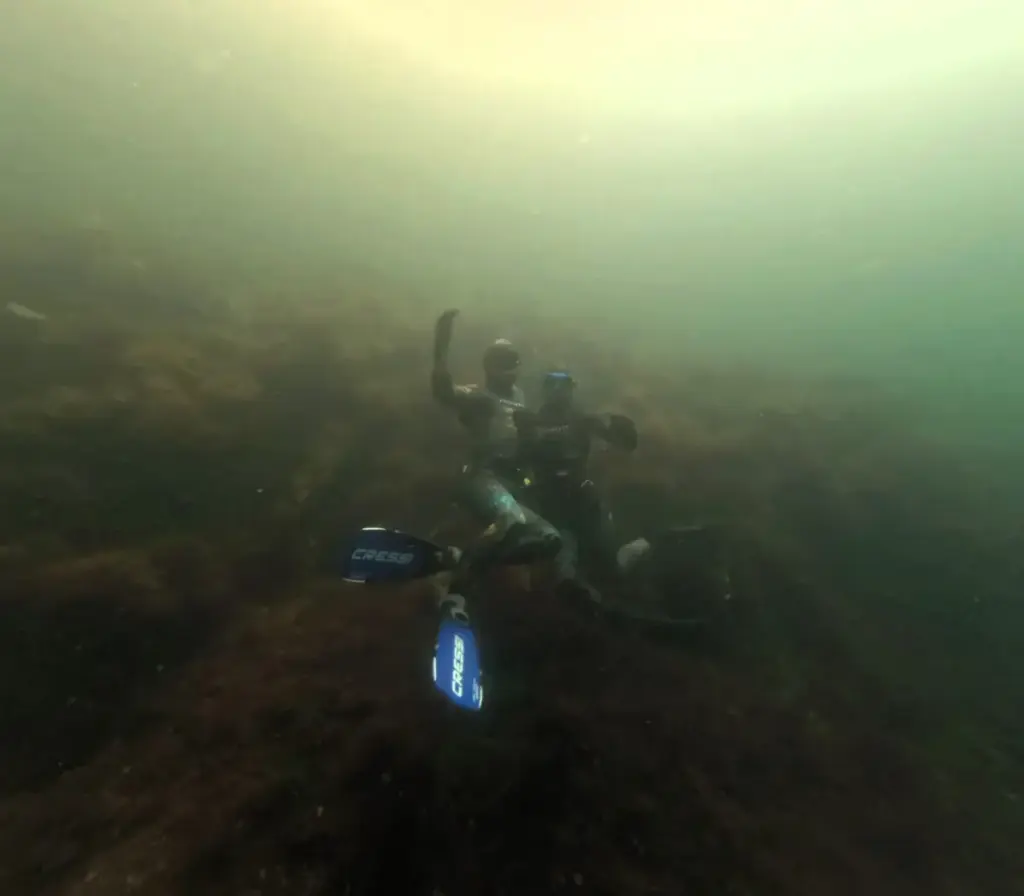
At every single stage of the 205-kilometre route, the swimmers freedived beneath the surface, capturing high-resolution photo and video logs of the benthic environment. This media was not merely published for public awareness campaigns; it was systematically shared with marine biologist and researcher Hartvig Christie.
By translating anecdotal diver observations into empirical data, Christie and his colleagues have been able to map the spatial distribution of lurv overgrowth, kelp forest degradation, and benthic fauna displacement across the entire length of the fjord.
The Deep-Sea Parasite Mystery
Even in the darkest, most pressure-laden depths of the Sognefjord, life has adapted in bizarre and wondrous ways—some of which serve as indicators of deep ecological sensitivity. During their deep dives, researchers noted the presence of Anelasma squalicola, a highly specialized parasitic barnacle found infecting deep-sea sharks at depths between 100 and 1,000 metres.
Unlike filter-feeding barnacles swaying harmlessly in shallow coastal tides, Anelasma has evolved into an invasive endoparasite, sinking root-like tendrils deep into the tissue of deep-water sharks to extract nutrients. While a natural evolutionary marvel, scientists note that such highly specialized organisms are exceptionally vulnerable to shifts in deep-water chemistry, temperature, and food-web stability. They serve as a stark reminder of how little humanity truly understands about the deep biosphere—and how quickly it may vanish before we even realize it exists.
Future Outlook: The Fight for Norwegian Fjords
The Sognefjord expedition is part of a broader, unrelenting campaign led by the swimmers to protect Norway’s aquatic heritage. Prior to tackling the King of Fjords, the team successfully completed endurance swims across the Lysefjord, Repparfjord, and Varangerfjord. Ingjerd has also championed the Jæren Coast Hope Spot and the Førde Fjord.
The Battle Over Submarine Mine Tailings
Norway remains one of the extremely few nations globally that continues to legally permit the submarine disposal of industrial mine tailings—dumping millions of tons of heavy mining waste directly into pristine fjord waters.
In the high-profile case of the Førde Fjord, the Norwegian Supreme Court ruled in June that the government’s mining waste dumping permit was unlawful. Despite this legally binding judicial defeat, the Norwegian government has dragged its feet, failing to issue an immediate halt to the dumping operations in the neighboring Førde Fjord. This ongoing regulatory defiance has galvanized environmental groups, making initiatives like Swim4Fjords more critical than ever.
A Plea for Permanent Protection
As the official protection process for the Sognefjord moves forward, the Swim4Fjords team is preparing to submit their comprehensive 205-kilometre visual archive, freediving logs, and collaborator research directly to policymakers.
The core message of the expedition remains simple, urgent, and unyielding: Every fjord has a tipping point.
We can no longer afford to judge the health of a marine ecosystem by how picturesque its surface appears to passing tourists or cruise ships. If wild Atlantic salmon are to return to Norwegian rivers, if kelp forests are to shake off their suffocating blankets of lurv, and if the deep waters of the Sognefjord are to regain their ability to breathe, society must confront the invisible degradations happening out of sight.
The Sognefjord has survived millennia of glacial carving and elemental shifts. Whether it can survive modern human neglect depends entirely on how quickly we choose to listen to those willing to dive beneath the surface and speak for the water.



