

By Special Contribution for the Biodiversity Heritage Library (BHL) at 20 Series
Executive Overview
In the sprawling ecosystem of natural history literature, rare book acquisitions are rarely straightforward. They require a meticulous balancing act: evaluating historical pedigree, scientific weight, institutional holdings, and digital accessibility. For the staff at the Field Museum’s Marie Louise Rosenthal Library, a modest fund dedicated to acquiring rare texts serves as a gateway to preserving pivotal milestones in scientific history.
In March, that search led to a remarkable zoological discovery: Geographische Geschichte des Menschen, und der allgemein verbreiteten vierfüßigen Thiere, nebst einer hieher gehörigen Zoologischen Weltcharte. Published in three volumes between 1778 and 1783 by the German geographer, zoologist, and mathematician Eberhard August Wilhelm von Zimmermann, this landmark work on biogeography includes a revolutionary fold-out map. Titled Tabula Mundi Geographico Zoologica sistens Quadrupedes hucusque notos sedibus suis adscriptos edidit, it is widely celebrated as the world’s first zoological map, charting late-eighteenth-century understandings of global mammal distributions.
However, acquiring the book was only the beginning of the story. Investigating the volume revealed a fascinating historical tangle involving the International Commission on Zoological Nomenclature (ICZN), lost-and-found scientific naming conventions, Captain James Cook’s Pacific voyages, and a surprising institutional connection to the Field Museum itself. Today, thanks to digitization efforts and the Biodiversity Heritage Library (BHL), this complex chapter in the history of science is fully accessible to researchers worldwide.
Detailed Chronology: From 1777 Latin Draft to 1954 ICZN Ruling
The journey of Zimmermann’s masterwork spans over two centuries, defined by shifts in scientific standards, bureaucratic nomenclature battles, and international diplomacy among natural historians.
1. The 1777 Latin Precursor
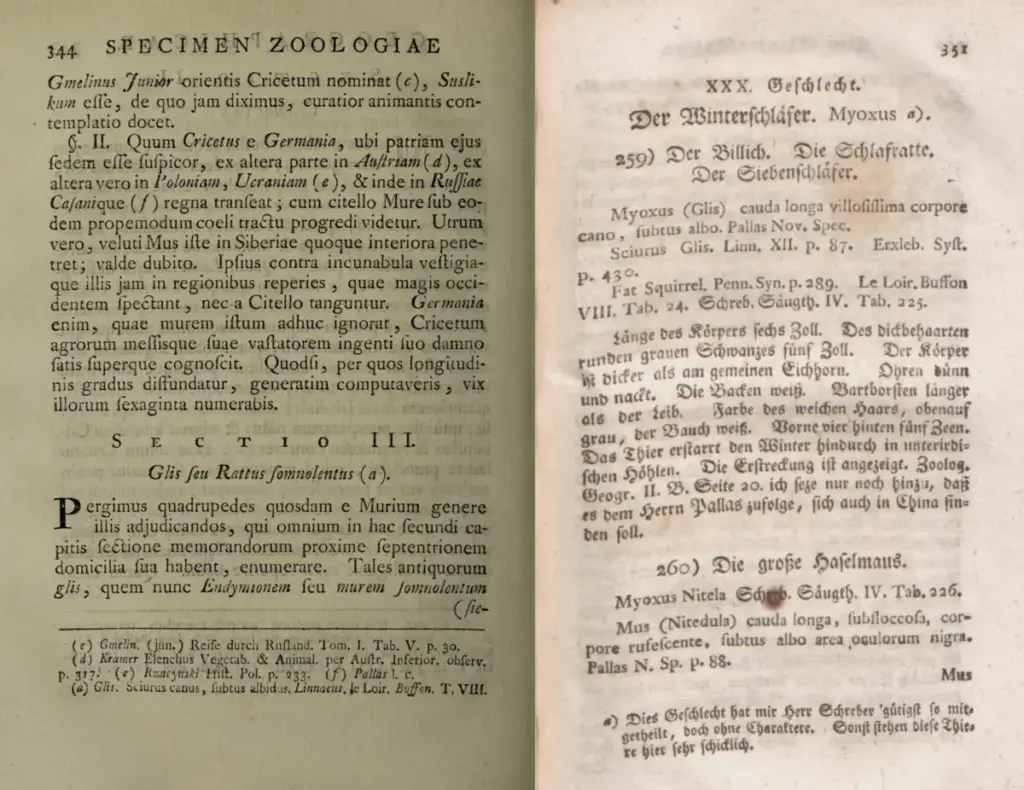
Before publishing his comprehensive three-volume German treatise, Zimmermann tested the waters with an earlier, shorter edition written in Latin. Published in 1777, Specimen zoologiae geographicae, quadrupedum domicilia et migrationes sistens laid early groundwork for mammalian distribution. However, it suffered from a major structural flaw by modern scientific standards: Zimmermann failed to consistently apply binomial nomenclature. Instead of utilizing the strict two-part naming system (genus and species) established by Carl Linnaeus, Zimmermann mixed generic, descriptive, and common names. For example, in the Specimen, a species of dormouse is referred to loosely as Glis seu Rattus somnolentus.

2. The 1778–1783 German Revision
Recognizing the limitations of his earlier work, Zimmermann heavily revised and expanded his research for the subsequent German edition, Geographische Geschichte des Menschen, und der allgemein verbreiteten vierfüßigen Thiere (1778–1783). In this definitive version, he successfully adopted systematic binomial nomenclature. This shift allowed him to introduce several enduring binomial names still attributed to him today, including:
- Cervus muntjak (muntjac deer)
- Lutra minima (now recognized as Chironectes minimus, the water opossum)
- Canis zerda (now classified as Vulpes zerda, the fennec fox)
- Myoxus glis (referring to the fat dormouse, today known as Glis glis)
3. The 1954 ICZN Intervention
As modern biological taxonomy matured, ambiguities in eighteenth-century literature required formal arbitration. The International Commission on Zoological Nomenclature (ICZN) was tasked with evaluating whether Zimmermann’s 1777 Latin text met the strict criteria required for formal scientific naming.
In its landmark 1954 ruling—formalized in Opinions and Declarations Rendered by the International Commission on Zoological Nomenclature (Opinion 257)—the Commission officially rejected the 1777 Specimen zoologiae geographicae for "nomenclatorial purposes." Because it failed to satisfy Article 25 of the Règles internationales de la nomenclature zoologique (the predecessor to today’s International Code of Zoological Nomenclature), the 1777 work was banished to the "Official Index of Rejected and Invalid Works in Zoological Nomenclature."
Conversely, the ICZN confirmed that Zimmermann’s 1778–1783 German edition did properly apply binomial nomenclature. Consequently, Geographische Geschichte was officially added to the "Official List of Works Approved as Available for Zoological Nomenclature."
Supporting Context & Metrics
The survival and re-evaluation of Zimmermann’s texts offer a compelling lens into how scientific knowledge was gathered, vetted, and corrected during the Enlightenment.
The Field Museum’s Hidden Hand
Perhaps the most unexpected twist in the 1954 ICZN ruling was its direct connection to the Field Museum. The Commission’s decision to validate Zimmermann’s German edition stemmed in large part from trans-Atlantic correspondence. Francis Hemming, Secretary of the Commission, actively consulted Wilfred H. Osgood of the Field Museum, who fiercely advocated for the recognition of Geographische Geschichte. Hemming also sought the expertise of Philip Hershkovitz, then Curator of Mammals at the Field Museum, who threw his full support behind Osgood’s position. This collaboration proved instrumental in shaping the global taxonomy record, cementing the Field Museum’s legacy not just as a repository of specimens, but as a shaper of nomenclatural history.

Cartographic Evolution and Captain Cook’s Voyages
A crown jewel of the acquired work is Zimmermann’s updated Tabula mundi geographico zoologica. Between the 1777 Latin edition and the 1783 map, geographic knowledge expanded exponentially, largely driven by the explosive discoveries of British explorer Captain James Cook and his crews aboard ships like the HMS Endeavour.
The 1783 map reflects these cutting-edge geographical insights:
- The Pacific Discoveries: The map documents Cook’s "discovery" of the Sandwich Islands (modern-day Hawaii).
- North American Coastlines: It offers a vastly more accurate and complete rendering of the western coast of North America.
- African Outposts: The Seychelles are explicitly labeled east of mainland Africa—a remarkable inclusion given that French colonists had established settlements there a mere thirteen years prior.
On this fold-out cartographic marvel, Zimmermann plotted the names of quadrupeds directly over their estimated geographic ranges. His naming conventions on the map vary fluidly: sometimes utilizing just the genus, other times the species epithet, a full binomen, or even a localized common name. Castor (beaver) and Bison stretch across northern North America; Tigris (tiger) prowls Asia; and Kanguro (kangaroo) makes a landmark appearance in New Holland (Australia), marking one of the earliest entries of the animal into European science, following observations by botanist Daniel Solander aboard Cook’s Endeavour.
Official Statements and Archival Analysis
The acquisition and processing of rare foundational texts bridge historical preservation with modern digital infrastructure. The integration of these works into the Biodiversity Heritage Library (BHL) highlights the collaborative ethos driving modern digital libraries during BHL’s 20th-anniversary milestone.
The Power of Comparative Access
Having access to both the rejected 1777 Specimen and the validated three-volume 1778–1783 Geographische Geschichte—alongside the ICZN’s 1954 ruling—creates a priceless pedagogical resource. It demonstrates how scientific standards evolve, how historical errors are systematically corrected, and how contemporary researchers can audit centuries-old taxonomies.
As the 1954 ICZN opinion proves, eighteenth-century texts do not simply expire; they maintain an active, dynamic life within the scientific record. When new historical evidence or archival correspondence surfaces, past taxonomic decisions are revisited, ensuring that our understanding of biodiversity remains tethered to rigorous historical accuracy.

Future Outlook
As the Biodiversity Heritage Library celebrates two decades of open-access preservation, the inclusion of Zimmermann’s Geographische Geschichte (now available via BHL bibliography ID 221536) underscores the ongoing mission to rescue foundational texts from obscurity.
Rare book funds at institutions like the Field Museum ensure that physical archives continue to feed global digital repositories. By bridging physical rare book rooms with open-access digital platforms, the scientific community ensures that works whose significance is still being rediscovered centuries later remain available to researchers, historians, and citizen scientists around the globe.
Moving forward, the intersection of historical cartography, taxonomic nomenclature, and archival correspondence will continue to yield insights into how humanity maps, names, and understands the natural world.
Further Reading & References
For researchers interested in diving deeper into the history of zoological nomenclature and eighteenth-century biogeography, consult the following foundational literature:
- Allen, J. A. (1902). Zimmermann’s “Zoologiae Geographicae” and “Geographische Geschichte” considered in relation to their zoological nomenclature. Bulletin of the American Museum of Natural History, 16, 13–22. Available via AMNX Digital Library
- American Society of Mammalogists. (n.d.). Glis glis (Linnaeus, 1766): European fat dormouse. Mammal Diversity Database. View Taxon Profile
- Delaney, J. (2012). First X, then Y, now Z: Landmark thematic maps. Princeton University Library. Explore Digital Exhibit
- Lotzof, K. (n.d.). Endeavour 250: Natural history through colonial encounter. Natural History Museum. Read Article



