WASHINGTON/NEW YORK/BOSTON — A ferocious and sprawling autumn nor’easter has locked the northeastern United States in its crosshairs, threatening tens of millions of residents with severe coastal inundation, hurricane-force gusts, widespread power outages, and catastrophic travel disruptions. Spanning from the Mid-Atlantic up to the rocky coasts of New England, the high-impact storm system has prompted sweeping states of emergency, triggered hundreds of flight cancellations, and forced the wholesale dismantling of the region’s cultural, sporting, and entertainment calendar.
Meteorological agencies have warned that the compounding factors of heavy, persistent rainfall, gale-force winds, and an astronomical high tide driven by a full moon are pushing coastal waters past historic thresholds. As communities grapple with the immediate fallout, emergency management teams are racing to safeguard lives and property across a corridor that has become increasingly vulnerable to extreme weather events.
Executive Overview
The powerful low-pressure system, classified as a classic nor’easter, intensified rapidly as it stalled over the coastal waters of the Northeast. Delivering relentless precipitation and fierce winds, the storm has directly impacted major metropolitan hubs, including New York City and Boston, while creating hazardous maritime conditions stretching from Virginia to Maine.
The immediate consequences of the storm have been severe:
States of Emergency: Declared urgently across multiple states, most notably in New York and New Jersey, where coastal regions experienced rapid, unprecedented deluges.
Infrastructure Strain: Over 100,000 households and businesses plunged into darkness as power grids buckled under falling trees and wind-swept debris.
Mobility Paralysis: The Federal Aviation Administration (FAA) reported cascading flight delays and cancellations, affecting major airports like Boston Logan and JFK.
Cultural and Athletic Shutdowns: High-profile stadium concerts, professional soccer and baseball fixtures, and major outdoor gatherings—including the flagship Global Citizen Festival in Central Park—were abruptly canceled or relocated.
Authorities have issued unequivocal warnings urging citizens to avoid non-essential travel, stay clear of low-lying coastal zones, and exercise extreme caution as emergency responders battle treacherous conditions to rescue stranded residents.
Detailed Chronology: The Storm Unfolds
The Build-Up and Initial Landfall
The meteorological roots of the system began forming days prior, as a cold Canadian air mass collided with unusually warm, moisture-laden air sweeping upward from the Atlantic seaboard. By early Saturday morning, the system had officially achieved nor’easter status, steering intense winds inland from the northeast and driving wall-like tides directly against vulnerable barrier islands and coastal inlets.
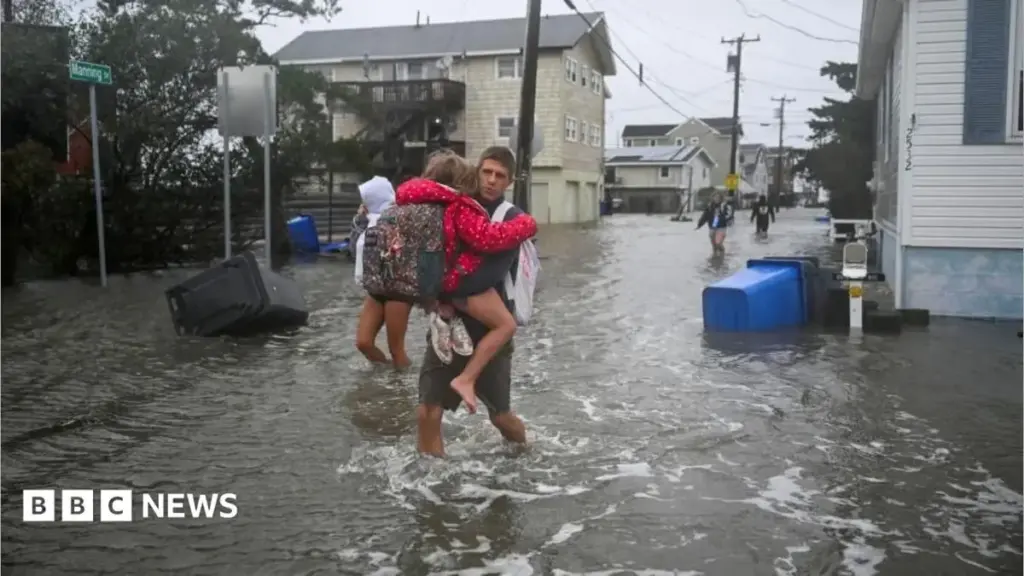
In coastal New Jersey communities such as Surf City, Manasquan, and Beach Haven West, the progression of the storm was swift and punishing. As the tide rose in tandem with Saturday’s full moon, ocean waters spilled effortlessly over sea walls and dunes, transforming local roadways into impassable nautical channels. Images from Beach Haven West captured surreal scenes of residents navigating neighborhood streets in kayaks—complete with household pets—and pulling children on paddle boards through knee-deep saltwater.
The Peak Impact in the Tristate Area and New England
By midday Saturday, the core of the storm was punishing the New York metropolitan area and southern New England. Sustained winds began ripping through urban canyons, with gusts hitting upwards of 55 mph (86 km/h) in parts of New York City. The ferocious winds began uprooting mature trees and tangling overhead power lines, setting off a domino effect of localized blackouts.
In Boston and the surrounding Massachusetts coastline, pounding waves battered sea defenses, eroding beaches that were already compromised by previous seasonal storms. Floodwaters breached low-lying infrastructure, forcing municipal authorities to close major thoroughfares and commuter routes. The National Weather Service (NWS) upgraded alerts from advisory status to urgent warnings, instructing residents in coastal flood zones to evacuate or move immediately to higher floors within their homes.
Supporting Context & Metrics: Assessing the Damage
The sheer geographical reach of the storm has strained regional response mechanisms. While nor’easters are common occurrences along the Eastern Seaboard during the autumn and winter months, the unique convergence of this system with a full moon has driven tidal anomalies well above standard predictive models.
Infrastructure and Aviation Metrics
Power Outages: According to real-time grid tracking data from PowerOutage.us, more than 100,000 customers lost electricity at the height of the storm, with the overwhelming majority concentrated in New Jersey, New York, and Massachusetts. Utility crews have struggled to deploy repair trucks safely due to high wind speeds and flooded access roads.
Aviation Disruption: FlightAware metrics indicated a catastrophic breakdown in regional air traffic schedules. More than 2,400 domestic and international flights suffered severe delays, while at least 1,199 flights were grounded entirely. Major transit hubs, including Boston Logan International Airport and LaGuardia, reported scenes of stranded passengers staring helplessly at departure boards dominated by cancellation notices.
Cultural and Sporting Casualties
The timing of the storm—hitting squarely on a major weekend—dealt a massive blow to the region’s economy and entertainment sector. Organizers were forced to pull the plug on several high-profile events:
Concerts and Festivals: Ed Sheeran’s highly anticipated, sold-out concert at Gillette Stadium in the Boston area was canceled outright due to unviable safety conditions. In New York City, the star-studded Global Citizen Festival in Central Park—which featured a lineup boasting Lauryn Hill, Wyclef Jean, and John Legend—was scrubbed to protect thousands of attendees from wind-borne hazards and electrical risks.
Professional Sports: Sporting fixtures were heavily reorganized or canceled. Major League Soccer’s fixture between Red Bull New York and St. Louis City SC was called off. Meanwhile, in Major League Baseball, the Boston Red Sox were forced to take the unprecedented step of moving the final game of their series against the Chicago Cubs to a neutral site in Florida.
Official Statements and Emergency Directives
Government officials at local, state, and federal levels have adopted an aggressive posture, emphasizing public safety above all else.
New Jersey Governor Mikie Sherrill addressed the public via an emergency broadcast, emphasizing the gravity of the situation:
"I urge all New Jerseyans to take this storm seriously, stay alert, and follow local guidance. This is not a time for complacency. Coastal inundation is moving fast, and our primary objective is preventing loss of life."
In New York City, Mayor Zohran Mamdani delivered a blunt video message directed at the city’s millions of residents:
"Don’t travel if you don’t have to. Do not drive or walk through floodwater. Hidden hazards, downed electrical wires, and open manholes make standing water a lethal trap."
The National Weather Service echoed these warnings in a special operational bulletin:
"Prepare immediately for significant inundation in low-lying areas near the shore, including roads underwater and impacts to homes and businesses. This storm poses a direct threat to life and property."
Emergency response units, including the Coast Guard and local swift-water rescue teams, have been placed on maximum alert, executing proactive welfare checks and preparing for post-storm extraction missions in deeply flooded municipalities.
Future Outlook: Recovery and Long-Term Resilience
As the center of the nor’easter begins its slow crawl eastward into the open Atlantic, meteorologists predict a gradual tapering off of wind speeds and precipitation by late Sunday evening. However, emergency management officials caution that the end of the rainfall does not signal an immediate return to normalcy.
The Immediate Recovery Phase
The immediate aftermath will be defined by massive cleanup operations. Municipal sanitation and transportation departments face the grueling task of clearing thousands of downed trees, repairing severed power lines, and pumping millions of gallons of brackish water out of subway stations, basement levels, and subterranean infrastructure.
Utility companies have warned that full power restoration could take several days, particularly in heavily wooded suburban enclaves where fallen timber has completely blocked distribution lines.
Broader Implications for Infrastructure
This latest weather event has reignited urgent policy discussions regarding the long-term resilience of the Northeastern seaboard. With sea levels rising and severe weather events becoming increasingly frequent and intense, coastal municipalities are facing mounting pressure to accelerate capital investments in resilient infrastructure. Proposals ranging from artificial barrier reefs and elevated roadways to systematic marshland restoration are expected to take center stage in upcoming legislative sessions as local governments scramble to future-proof their communities against the intensifying impacts of climate volatility.