

Executive Overview
The boundary between the urban sprawl of Brighton and the sprawling, untamed countryside of East Sussex is rarely a hard line. Instead, it is a gradual, green transition—a frayed edge where human habitation bleeds into ancient ecosystems. For one resident who recently traded the kinetic energy of city life for the quiet, arboreal outskirts of Lewes, this transition has manifested as an immediate and immersive immersion into the British wilderness.
With a back garden that directly abuts the remnants of an ancient oak wood, the property has rapidly transformed from a standard suburban plot into a thriving sanctuary for native fauna. From badgers excavating nocturnal pathways across manicured lawns to a family of tawny owls presiding from the high branches, and a bustling colony of bats roosting within the chimney stack, the domestic sphere has been completely subsumed by nature.
Yet, the crown jewel of this burgeoning wildlife sanctuary is not the grand oak canopy overhead, but a singular, enigmatic tree standing right outside the bedroom window. Weather-beaten, drought-stressed, and teetering on the edge of mortality, this standing dead tree has become an accidental epicenter for avian biodiversity. Offering a rare vertical ecosystem in a residential setting, the mystery tree has drawn a diverse array of woodland species, most notably the elusive and mesmerizing treecreeper (Certhia familiaris).
This journalistic feature explores the ecological significance of urban-rural interfaces, the vital role of dead wood in modern gardens, and the intimate, daily interactions between humans and wildlife at the edge of the Sussex Downs.
Detailed Chronology: From Urban Pavement to Woodland Haven
The Great Migration: Leaving Brighton Behind
The journey began with a deliberate relocation away from the bustling, densely populated coastal hub of Brighton. Seeking a slower, more deliberate rhythm of life, the homeowner secured a property on the immediate periphery of Lewes. While urban living offers cultural proximity, it often divorces the individual from the seasonal rhythms of the natural world. Here, the transition was instantaneous. The urban concrete was swapped for damp earth, leaf litter, and the profound, damp silence of the Sussex countryside.
[Urban Brighton]
       │
       ▼ (Relocation)
[Periphery of Lewes]
       │
       ▼ (Ecosystem Integration)
[Back Garden Adjoining Ancient Oak Wood]
       │
       ├── Nocturnal Visitors: Badgers & Tawny Owls
       ├── Chimney Residents: A Cauldron of Bats
       └── The Focal Point: The Mysterious, Aging Tree
Almost immediately upon arrival, the domestic space was claimed by the local fauna. The lawn began to bear the characteristic, conical excavations of foraging badgers (Meles meles)—quiet, nocturnal engineers turning over the soil in search of earthworms and grubs. Overhead, the melancholy, hooting calls of a family of tawny owls established an auditory backdrop to the rural nights, while a bustling colony—or "cauldron"—of bats set up a maternity roost within the home’s chimney structure, emerging at dusk in erratic, acrobatic sweeps to hunt flying insects.
The Arrival of the Mystery Tree
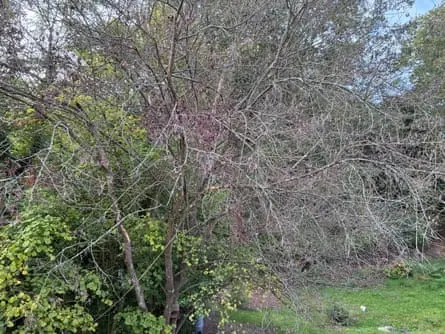
While the wider garden offers ample space, the most compelling ecological drama unfolds just inches from the second-story bedroom window. A tall, weathered tree—its species still subject to debate among local arborists and naturalists—dominates the immediate view. While some observers have pointed to the structural characteristics of a stressed willow (Salix), the homeowner suspects it may be an ornamental or cultivated species, planted decades prior by a previous occupant and now left to weather the elements.
The tree’s vitality has visibly waned. Plagued by successive years of severe summer droughts that have gripped the south of England, and nearing the natural twilight of its lifespan, the tree is largely defoliated across its lower and mid sections. Without the obscuring curtain of summer leaves, flowers, or fruit, identifying its exact lineage has proven nearly impossible. However, this arboreal nakedness has inadvertently yielded an unprecedented window into the local avian underworld.
Stripped of its vegetative cover, the branches have laid bare a bustling avian highway that would otherwise remain hidden behind a wall of green.
Supporting Context & Metrics: The Ecology of Standing Dead Wood
To understand the ecological value of the Lewes property, one must examine the broader environmental crisis facing British woodlands and gardens alike. Modern gardening culture has historically favored manicured tidiness—a sterile aesthetic that demands the removal of fallen timber, the pruning of dead branches, and the felling of "hazardous" standing dead wood.
However, conservation biologists and ecologists increasingly view dead wood not as waste, but as the lifeblood of forest regeneration and urban biodiversity.
The Micro-Habitat Economy of Dead Wood
Standing dead timber—often referred to by arboriculturists as a "snag"—undergoes a prolonged, decades-long process of decomposition that sustains hundreds of dependent species.

┌────────────────────────────────────────────────────────┐
│               THE STAG-HEADED ECOSYSTEM                │
├────────────────────────────────────────────────────────┤
│ 1. Primary Demise     │ Drought stress, age, pathogens │
│ 2. Fungal Colonization│ Mycelium breaks down heartwood │
│ 3. Insect Inhabitants │ Beetles, wood wasps, spiders   │
│ 4. Avian Predators    │ Woodpeckers, nuthatches, tits  │
│ 5. Mammal Utilization │ Bat roosts, squirrel dreys     │
└────────────────────────────────────────────────────────┘- Fungal Inoculation: As the tree loses its vigor, saprotrophic fungi colonize the heartwood, softening the timber and creating internal cavities.
- Invertebrate Explosion: Insects—ranging from sap-feeding beetles to wood-boring larvae and active colonies of spiders—move into the fissures of the bark.
- Avian Foraging: This concentrated protein source transforms the standing dead tree into a natural larder for insectivorous birds.
avian Biodiversity Index of the Lewes Garden
Observations over the winter and early spring months reveal a remarkable density of species utilizing the mystery tree as a staging ground:
- Blue Tits & Great Tits: Darting through the bare upper canopy, inspecting twig junctions for dormant pupae.
- European Robins (Erithacus rubecula): Utilizing the lower, sturdier branches as singing posts to defend their winter territories.
- Blackbirds & Song Thrushes: Perching atop the broken crown before descending to the leaf litter below.
- Great Spotted Woodpeckers (Dendrocopos major): Testing the softening trunk with powerful, rhythmic drumming to locate deep-boring beetle larvae.
- Nuthatches (Sitta europaea): Navigating the bark with upside-down agility, leveraging their powerful bills to pry open bark crevices.
- The Treecreeper (Certhia familiaris): The undisputed star of the morning watch.
Official Statements & Expert Perspectives
To contextualize the behavioral patterns of the garden’s most prized visitor, ornithologists and wildlife trusts emphasize the unique physiological adaptations that allow creatures like the treecreeper to thrive in such specialized niches.
"The treecreeper is an engineering marvel of the avian world," notes Dr. Elena Vance, an urban ecologist specializing in passerine behavior.
"Its physical form is entirely subordinated to its lifestyle. You cannot look at a treecreeper without marveling at how evolution shapes an organism to exploit a very specific micro-habitat—the vertical bark highway."
Anatomical Adaptations of Certhia familiaris
Ornithological data highlights several key evolutionary traits that enable the treecreeper to dominate the vertical bark zone:
- The Stiffened Tail (Rictal Rectrices): Unlike many small birds that rely solely on their feet, the treecreeper uses its rigid, pointed tail feathers as a structural prop—acting precisely like the third leg of a surveyor’s tripod pressed against the trunk.
- The Decurved Bill: Long, slender, and sharply curved downward, this specialized tool functions like fine forceps, reaching deep into micro-fissures, beetle galleries, and curled bark flakes where other birds’ bills cannot penetrate.
- Asymmetrical Claws: The rear-facing toes are exceptionally long and sharply hooked, allowing the bird to lock its weight against vertical timber surfaces with minimal muscular exertion.
According to data compiled by the British Trust for Ornithology (BTO), resident treecreepers maintain stable populations across the UK, though their movements shift dynamically between breeding seasons and winter months. While they remain year-round residents, individuals frequently abandon localized breeding territories in late autumn to roam through larger woodland blocks, municipal parks, and mature suburban gardens, often attaching themselves temporarily to mixed-species foraging flocks of tits and goldcrests.
Future Outlook: Preservation vs. Pruning
As spring approaches and the first flush of fresh canopy growth begins to crown the mystery tree’s upper extremities, the property owner faces a delicate ecological and logistical balancing act.
┌────────────────────────────────────────────────────────┐
│                 THE CONSERVATION DILEMMA               │
├────────────────────────────────────────────────────────┤
│ OPTION A: Fell the tree   │ Eliminates domestic hazard │
│                           │ Destroys micro-habitat     │
│                           │ Evicts local wildlife      │
├────────────────────────────────────────────────────────┤
│ OPTION B: Retain & Water  │ Preserves ancient ecology  │
│                           │ Attracts rare species      │
│                           │ Requires risk management   │
└────────────────────────────────────────────────────────┘
Managing Risk in the Wild Garden
The proximity of the aging, drought-stressed tree to the main dwelling introduces legitimate structural concerns. Winter gales across the Sussex Downs have grown increasingly violent and unpredictable due to shifting climatic patterns, raising the specter of windthrow or limb failure threatening the roofline. Standard horticultural advice in such scenarios routinely leans toward reduction or complete removal to mitigate liability.
Yet, bowing to the instinct for domestic safety would mean erasing a critical stepping-stone habitat in a landscape increasingly depleted of dead wood. Modern arboricultural practices are slowly shifting toward "retention pruning"—reducing the height of a hazardous tree to create a safe, stable habitat totem (or "stag") rather than removing it entirely.
A Hopeful Horizon
For now, a middle path has been chosen. Rather than reaching for the chainsaw, the homeowner has turned to the garden hose, actively delivering deep hydration to the tree’s root system during dry spells. The gamble is simple: to encourage whatever resilient cambium layer remains active beneath the fissured bark, coaxing a final, defiant burst of spring foliage from the dying wood.
Whether the mystery tree recovers its full vigor or continues its slow, dignified descent into a completely dead snag matters little to the local wildlife. For the treecreeper currently probing its bark for overwintering spiders, the great oak wood expanding from the garden boundary, and the badgers turning over the dew-soaked lawn, this Sussex fringe remains a living laboratory of coexistence—a testament to what happens when human boundaries soften and the wild is invited right up to the windowpane.



