

Executive Overview
In the dusty borderland community of Malala Drift, situated near the town of Musina in South Africa’s northernmost Limpopo province, the proximity of a major waterway offers a cruel paradox. Stretching directly alongside the mighty Limpopo River—the natural international boundary separating South Africa from Zimbabwe—local agricultural operations are nevertheless collapsing under the combined weight of chronic drought, volatile weather patterns, and structural water insecurity.
For generations, the fertile soils flanking the Limpopo supported a thriving agricultural belt, supplying regional markets with fresh tomatoes, potatoes, and butternut squash. Today, however, the landscape tells a very different story. Rotting support poles for long-abandoned tomato vines litter fallow fields, once-vital irrigation infrastructure is choked by creeping weeds, and once-vibrant commercial plots have reverted to scrubland.
Agricultural viability in this semiarid zone is hanging by a thread. While regional rainfall totals have not exhibited a statistically uniform long-term decline, the temporal distribution of precipitation has become wildly erratic. Intermittent dry spells, climbing seasonal temperatures, and escalating evaporation rates have turned traditional farming into an untenable gamble. Farmers are caught in a cycle of diminishing yields, crippling operational expenses, and rising food insecurity.
Scientific studies underscore the severity of the crisis. Recent research from institutions including the University of Venda and the University of Limpopo reveals that drought episodes have not only accelerated in frequency over the past three decades, but are also increasingly compounded by thermal stress. As local smallholders and commercial growers alike attempt to navigate these converging climate pressures, the traditional economic foundations of the Limpopo river valley are fracturing, forcing communities to confront an uncertain and rapidly changing environmental reality.
Detailed Chronology: The Slow Collapse of Malala Drift’s Farming Economy
To understand how Malala Drift arrived at this precarious juncture, one must examine the gradual erosion of agricultural predictability over the past several decades.

The Shift from Abundance to Uncertainty (1991–2009)
Historically, farming along the Limpopo River relied on a predictable rhythm of seasonal rains supplemented by direct river abstraction. Local agricultural laborers and farm managers recall periods of stable harvests, where fluctuations in yield were manageable and seasonal workers could find steady employment planting, tending, and harvesting cash crops.
Scientific tracking of the Musina local municipality region between 1991 and 2009 recorded roughly nine distinct drought episodes. While dry spells were a known factor of life in this semiarid environment, they were spaced out enough to allow water tables to recharge and local ecosystems to recover. Minimum temperatures hovered around 21° Celsius (69.8°F), while maximums averaged a manageable 30°C (86°F), keeping agricultural evapotranspiration rates within sustainable boundaries.
The Acceleration of Climatic Shocks (2010–2023)
The following decade marked a profound structural shift in regional weather patterns. Researchers documenting spatiotemporal drought trends in Musina identified a dramatic spike in dry episodes, registering approximately 15 distinct drought events between 2010 and 2023.
This era was defined by severe, prolonged meteorological shocks, most notably the devastating regional droughts of 1991–92 and 2015–16. During these periods, water levels in the Limpopo River plummeted dramatically. Farmers who had traditionally relied on gravity-fed or simple pump systems found themselves entirely cut off from surface water.
The Breaking Point: 2025 and Beyond
For many operations, the tipping point arrived in 2025. At a prominent local property visited by field researchers, commercial production ground to a complete halt after a decade of fighting an uphill battle against water scarcity.

Kanny Ndou, a former farm laborer who now serves as a caretaker for the dormant property, bears witness to the decline. "We used to grow a variety of vegetables for sale in Musina," Ndou explained, noting that the farm routinely produced substantial yields of potatoes, butternut squash, and tomatoes. However, inconsistent water availability made long-term planning impossible. "For years, we faced unpredictable outcomes: a good harvest one season, a bad one the next. Finally, due to inconsistent water supply, the farm decided to stop farming last year."
Today, the physical remnants of that enterprise—weathered wooden stakes, silent pumps, and rusting irrigation pipes swallowed by tall grass—serve as monuments to an agricultural sector retreating in the face of environmental attrition.
Supporting Context & Metrics: Data, Climate Science, and Socioeconomic Fallout
The crisis in Malala Drift is not an isolated local anomaly; it is part of a broader, well-documented regional transformation sweeping across South Africa’s Limpopo province. A series of recent academic investigations paints a stark quantitative picture of a landscape under severe ecological duress.
Thermal Stress and Evapotranspiration
According to a July 2026 study published in the journal Sustainability by researchers from the University of Venda, temperature metrics in the Musina region have undergone a concerning upward trajectory over the past thirty years. Minimum temperatures climbed from an average of 21°C in the 1990s to roughly 23°C (73.4°F) in the 2010s. Concurrently, maximum temperatures rose from 30°C to 32°C (89.6°F).
While total annual rainfall volume has not displayed a clear, statistically significant linear decline, its timing and distribution have become erratic. This rainfall variability, coupled with higher baseline temperatures, has exponentially increased evapotranspiration rates. Soils dry out faster, plants lose moisture at accelerated rates, and crops experience acute water stress even during periods when nominal rainfall totals might otherwise appear adequate on paper.

Household Vulnerability and Food Insecurity
The cascading socioeconomic impacts of these climatic shifts are laid bare in a 2025 comprehensive household assessment published in Discover Sustainability. Surveying nearly 500 rural households across various districts of Limpopo province, the study revealed that an alarming 89% of respondents had experienced severe drought conditions within a strict five-year window.
The consequences of these recurring dry spells were catastrophic for rural livelihoods:
- Crop Failures: Widespread agricultural collapse wiped out staple and cash harvests.
- Livestock Mortality: Persistent foraging shortages and a lack of reliable drinking water led to high rates of livestock death.
- Food Insecurity: Approximately 70% of surveyed households reported facing direct food insecurity, stripped of their ability to grow or purchase adequate nutritional supplies.
- Income Depletion: Loss of agricultural output triggered widespread economic destitution, particularly among day laborers and small-scale landholders.
Similar distress indicators emerged from the University of Venda survey of 120 local respondents in the Musina municipality, where over half reported acute water shortages, diminished yields, and plunging household incomes.
The Livestock Dilemma: Goats and the Mopane Landscape
Crop farmers are not the only ones bearing the brunt of environmental volatility. Pastoralists and livestock breeders in the region are finding it increasingly difficult to sustain healthy herds.
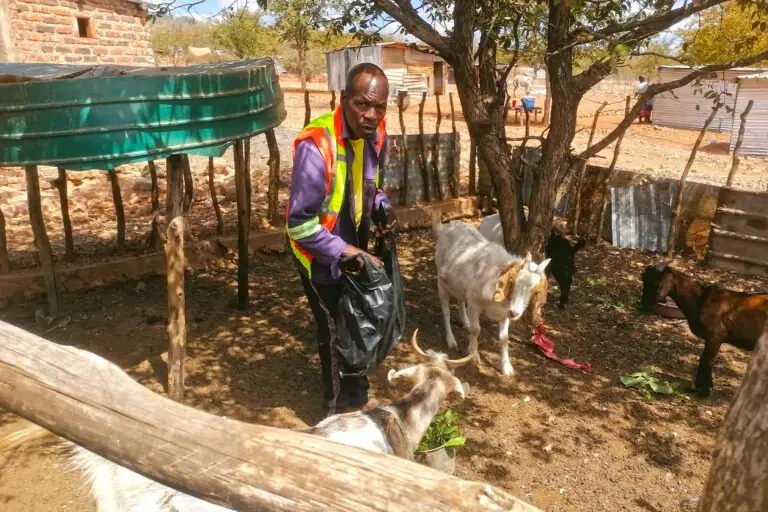
Kwinda Tshirundu, a Malala Drift resident who established a smallholding with the intention of building a viable goat-farming operation, has watched his economic aspirations stall. Settling in the area with high hopes, Tshirundu expected his herd to expand rapidly. Instead, growth has stagnated.

"From the time I started staying here, my goats should have multiplied to 30, but I only have five; I am not sure whether it is drought-related," Tshirundu remarked while watching his remaining animals browse on the tough leaves of a mopani tree (Colophospermum mopane).
While Tshirundu remains uncertain whether environmental factors are solely to blame for his slow herd growth, broader veterinary and animal science literature—such as recent studies published in Frontiers in Animal Science—confirms that severe drought directly impairs livestock reproduction rates, reducing fertility, birth survival, and milk production due to chronic nutritional stress.
Official Statements and Expert Analysis: Moving from Reaction to Preparedness
As the agricultural framework of Limpopo strains under cumulative pressures, scientists and environmental policy experts are issuing urgent calls for a paradigm shift in how local authorities and agrarian communities approach resource management.
Dr. Ephias Mugari, a postdoctoral research fellow at the University of Limpopo’s Centre for Global Change, emphasizes that Musina’s inherent status as a semiarid, low-rainfall zone makes it uniquely susceptible to systemic climate shocks. According to Mugari, the current crisis stems from a compounding "nexus" of environmental and anthropogenic pressures.
"It’s the interaction of these three—less water arriving, more water lost to heat, and more water being asked for—that compounds the pressure," Mugari noted. He explains that as temperatures climb and evaporation accelerates, rising socio-economic demands for water from both human populations and agricultural sectors push the ecosystem past its tipping point.

Crucially, Mugari argues that regional stakeholders must abandon short-term, reactive disaster management in favor of long-term climate resilience planning.
- Early-Warning Systems: Developing robust, accessible meteorological forecasting networks to give farmers advanced notice of impending dry spells.
- Enhanced Water Infrastructure: Investing in modern storage facilities, localized water harvesting systems, and efficient irrigation technologies to maximize the utility of every drop.
- Crop Diversification: Transitioning away from highly water-intensive commercial crops toward drought-tolerant native cultivars better suited to fluctuating precipitation regimes.
- Livelihood Diversification: Encouraging rural communities to develop alternative income streams outside of traditional rain-fed agriculture to cushion against seasonal crop failures.
These recommendations mirror the findings of the University of Venda study, which highlighted that local communities are already experimenting with bottom-up adaptation strategies—ranging from sinking private boreholes and harvesting rainwater to modifying grazing patterns and conserving scarce moisture resources. However, researchers caution that piecemeal, individual coping mechanisms are insufficient without coordinated institutional support.
Future Outlook: Navigating the Limpopo’s Uncertain Horizon
The situation in Malala Drift offers a sobering preview of the challenges facing agricultural heartlands across southern Africa as global climatic baselines shift. The mere physical presence of the Limpopo River is no longer a guaranteed lifeline for those who farm its banks.
When surface flows diminish and water tables drop, desperate growers resort to costly and environmentally disruptive stopgap measures—such as hiring excavation companies to dig deep trenches into the dry riverbed or unilaterally diverting remaining channels. These reactive interventions impose severe financial burdens on cash-strapped smallholders while offering little in the way of permanent security. Furthermore, such practices risk exacerbating ecological degradation along an already fragile international river ecosystem shared by South Africa, Zimbabwe, and Mozambique.
For the farmers who remain in Malala Drift, the daily routine is a tense calculus of risk, debt, and hope. Some continue to gamble on the next rainy season, while others pack away their equipment, leaving behind silent fields and empty migrant worker quarters.

Without targeted structural intervention—spanning upgraded public water infrastructure, advanced drought preparedness protocols, and comprehensive agricultural extension services—the fertile floodplains of the Limpopo risk becoming a casualty of chronic climate volatility. The future of South Africa’s northern borderlands will depend entirely on how rapidly policymakers, researchers, and local farmers can translate scientific warnings into actionable, climate-resilient realities.



