An area of the Amazon rainforest roughly equivalent to the size of the US state of New Jersey—or the nation of Slovenia—remains standing today as a direct result of the political shift in Brazil’s leadership, according to an extensive analysis conducted by climate policy portal Carbon Brief. Following the 2022 presidential election, in which Luiz Inácio Lula da Silva defeated incumbent Jair Bolsonaro, Brazil experienced a dramatic reversal in its environmental trajectory. Where Bolsonaro’s far-right administration oversaw soaring deforestation driven by deregulation and the weakening of federal protection agencies, Lula’s left-wing administration reinstated rigorous enforcement mechanisms, aiming for "zero deforestation" by 2030.
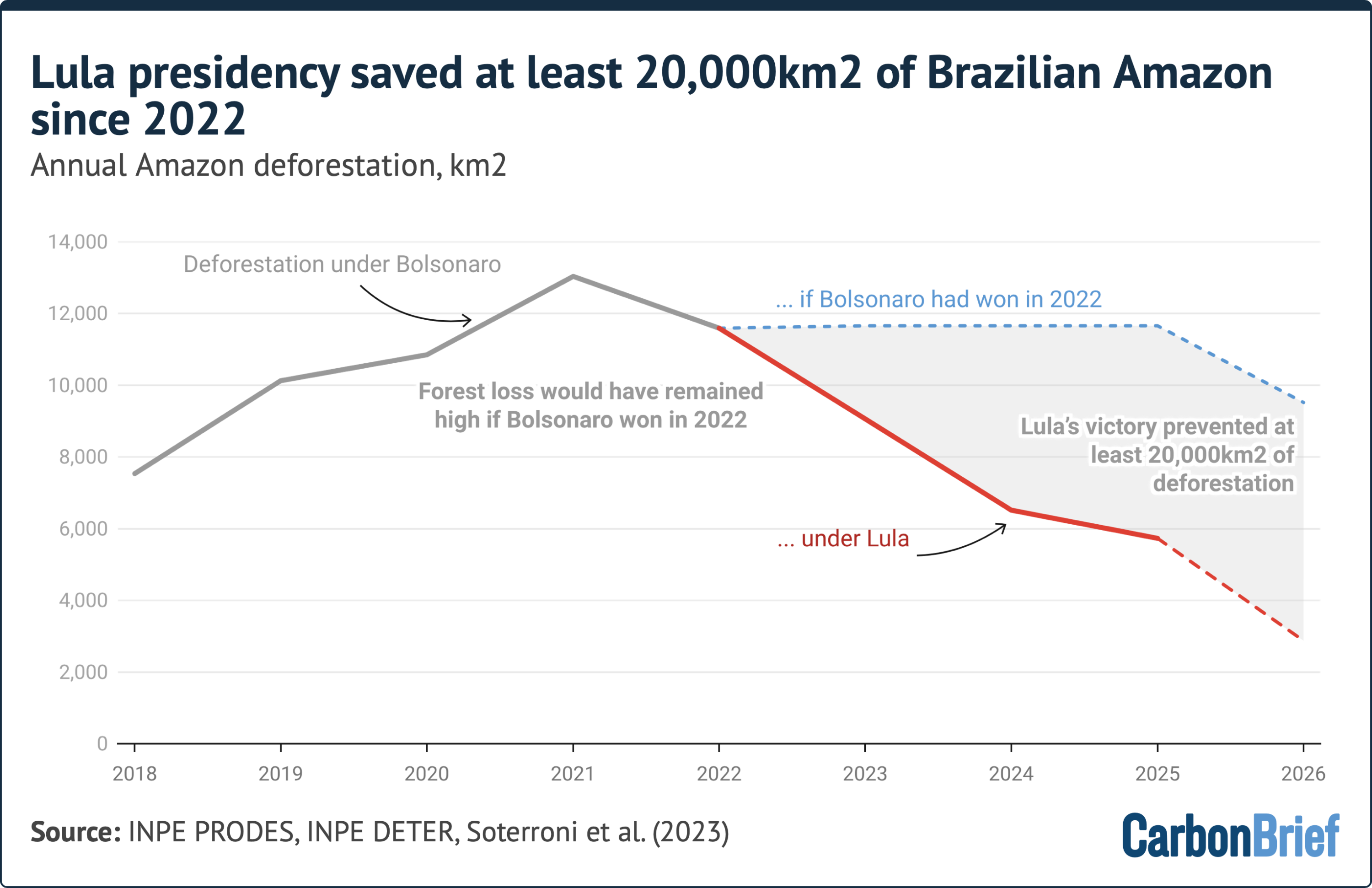
The analysis, grounded in predictive spatial-economic modeling from the University of Oxford, the International Institute for Applied Systems Analysis (IIASA), and Brazil’s National Institute for Space Research (INPE), indicates that at least 20,000 square kilometers ($textkm^2$) of forest loss has been averted since Lula assumed office. Experts emphasize that this metric is likely conservative, as it assumes a baseline scenario without accounting for the uncontrolled expansion of illegal land-grabbing and wildcat mining that characterized the previous regime.
However, these fragile ecological gains face an imminent systemic test. As Brazil approaches its next presidential contest, President Lula finds himself locked in a dead heat with Senator Flávio Bolsonaro—son of the incarcerated former president. With opinion polls showing both candidates tied and right-wing blocs consolidating power in the National Congress, the future of the world’s largest carbon sink hangs in a delicate balance, carrying immense implications for global climate stability.
Detailed Chronology: From Unchecked Destruction to Policy Restoration
The Bolsonaro Era (2019–2022): Institutional Deconstruction
During Jair Bolsonaro’s four-year term, environmental governance in Brazil was systematically dismantled. Championing the country’s powerful agribusiness sector (agronegócio), the administration severely curtailed the budgets and enforcement capacities of federal environmental monitoring agencies, notably the Brazilian Institute of Environment and Renewable Natural Resources (IBAMA) and the Chico Mendes Institute for Biodiversity Conservation (ICMBio).
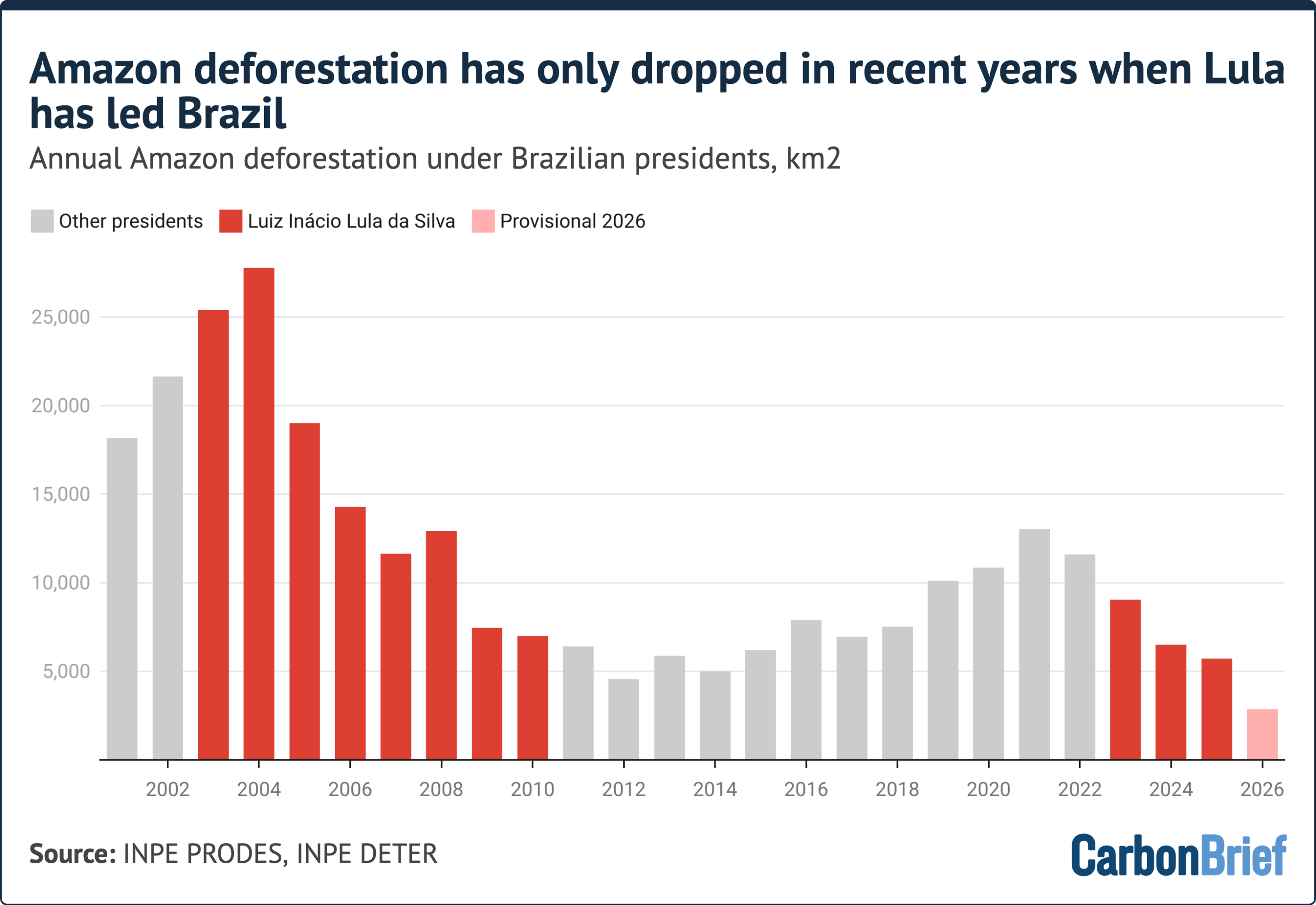
Key regulatory frameworks were gutted, field inspections were scaled back, and rhetoric from the highest levels of government emboldened illegal loggers, miners (garimpeiros), and agrarian land-grabbers (grileiros). Consequently, the enforcement of Brazil’s flagship Forest Code—which mandates that private landowners in the Legal Amazon preserve 80% of their property under native forest cover—virtually collapsed. Annual Amazon deforestation surged, consistently exceeding 10,000 $textkm^2$ per year and peaking at over 13,000 $textkm^2$ in 2021.
The 2022 Turnaround and ‘Brazil is Back’
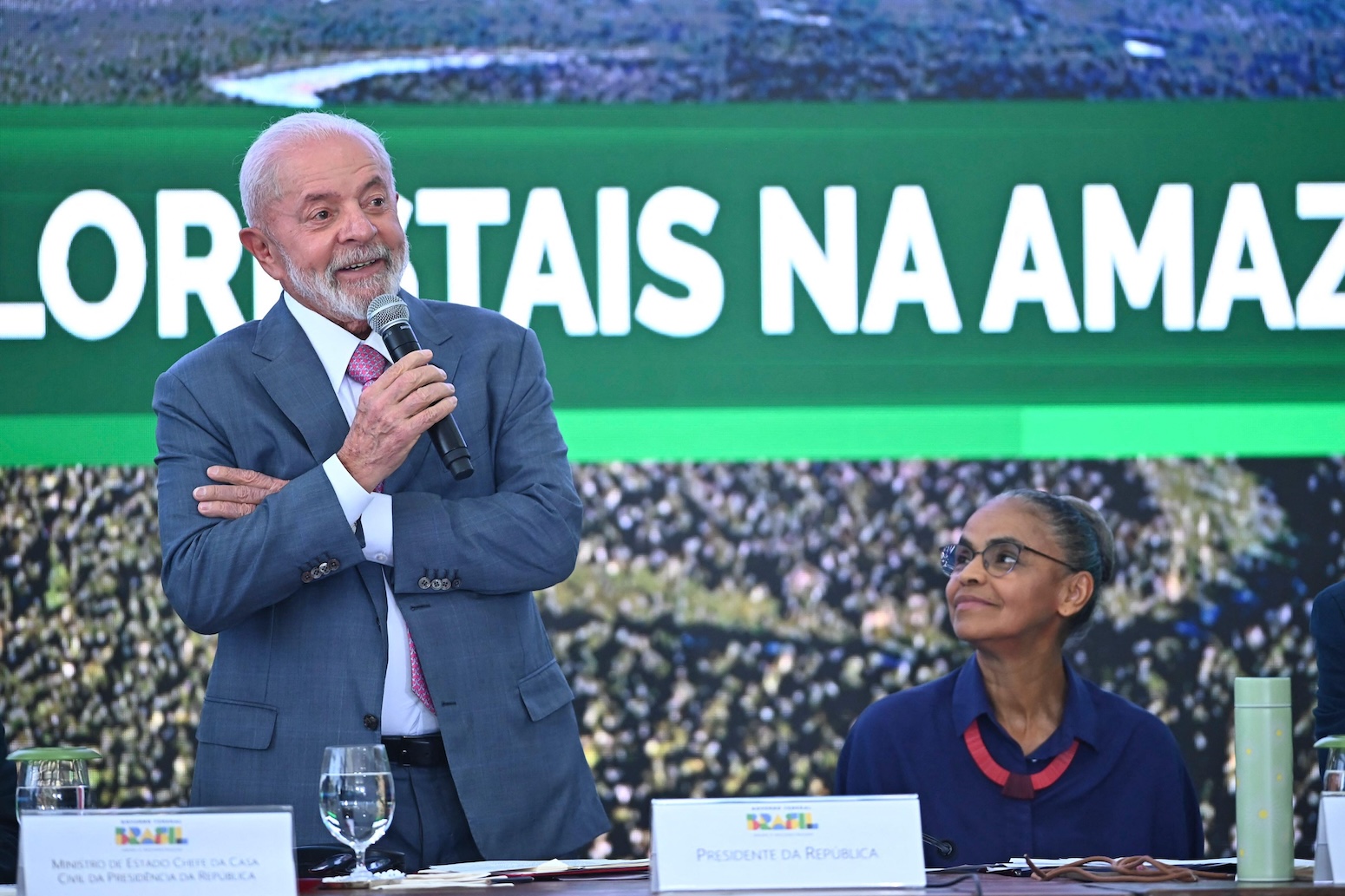
The political tide turned in October 2022 when Luiz Inácio Lula da Silva won the presidency. Declaring at the COP27 UN Climate Summit in Egypt that "Brazil is back" as a global environmental leader, Lula appointed internationally renowned environmentalist Marina Silva to head the Ministry of Environment and Climate Change.
The new administration immediately launched a concerted counter-offensive:
Reinstatement of the Action Plan: Lula reactivated the Action Plan for the Prevention and Control of Deforestation in the Legal Amazon (PPCDAm), an enforcement strategy credited with major historical declines in deforestation.
Empowering Field Inspectors: IBAMA and federal police forces resumed armed operations, seizing illegally grazed livestock, destroying heavy machinery used by illegal wildcat miners, and issuing heavy fines to non-compliant landholders.
Resumption of Indigenous Rights Protections: The administration restored process pathways for demarcating protected Indigenous territories, which serve as crucial ecological buffers against deforestation.
Measurable Ecological Impact (2023–2026)
The institutional pivot delivered immediate, measurable results:
2022 to 2025: Annual forest loss in the Legal Amazon dropped by more than 50%, falling from 11,594 $textkm^2$ in 2022 to 5,731 $textkm^2$ in 2025 (measured according to INPE’s official PRODES satellite monitoring program, which runs annually from August to July).
2025 to 2026 Cycle: Preliminary satellite alert data from INPE’s real-time DETER system recorded just 2,874 $textkm^2$ of clear-cutting. While final PRODES figures typically adjust upward, researchers project that 2026 Amazon deforestation could reach its lowest point since systematic satellite monitoring began in 1988.
Supporting Context & Data Metrics: The GLOBIOM-Brazil Analysis
To quantify the environmental dividends of Lula’s presidency, Carbon Brief relied on predictive modeling derived from the GLOBIOM-Brazil framework—a comprehensive spatial economic model co-developed by researchers at the University of Oxford, IIASA, and INPE.
Understanding the Model
The modeling framework contrasts two primary governance pathways:
Full Enforcement Scenario: Complete implementation of the Forest Code, active monitoring, and penalization of illegal land clearance.
Weak Governance Counterfactual: A "no forest code" enforcement baseline used as a analytical proxy for the continued presidency of Jair Bolsonaro or an equivalent right-wing administration.
Comparing actual deforestation recorded under Lula against the baseline model reveals that at least 20,000 $textkm^2$ of primary Amazon rainforest was spared between 2023 and 2026.
Why the 20,000 $textkm^2$ Figure is Conservative
Lead study researcher Dr. Aline Soterroni of the University of Oxford emphasizes that the counterfactual estimate represents a floor rather than a ceiling:
Economic Demands: The baseline model assumes moderate growth in global market demand for Brazilian beef and soy, naturally dampening projected conversion rates.
Unmodeled Illegal Dynamics: Land-use models struggle to capture sudden spandrels of lawlessness, such as illicit land-grabbing sprees, political incitement, and impunity for wildcat mining syndicates—phenomena that exploded during Bolsonaro’s term.
Delayed Response Times: Institutional enforcement cannot reset overnight. As Soterroni points out, reversing years of agency decay is a "gradual and imperfect process," meaning actual avoided deforestation would likely be far higher had the institutional infrastructure remained intact prior to 2023.
Official Statements & Expert Analysis
The contrasting environmental visions driving Brazilian politics have drawn sharp commentary from leading climate scientists, policy analysts, and conservation leaders.
Dr. Aline Soterroni, University of Oxford: "The reversal seen under Lula shows how quickly deforestation can respond to political will… The key message from our modeling is the contrast between these trajectories: weak environmental governance keeps deforestation substantially higher than full implementation of the Forest Code. That message remains relevant today."
Claudio Angelo, International Policy Coordinator at Climate Observatory: "If Bolsonaro had won in 2022, we have reason to believe this would have resulted in much higher rates than during his first term. The political signal would likely have driven an explosion of wildcat mining and illegal deforestation… At the risk of sounding alarmist, Lula’s leadership is the only thing standing between us and a wide destruction of the Amazon."
Dr. Patricia Pinho, Deputy Science Director at the Amazon Environmental Research Institute (IPAM): "I don’t think we can afford four years of increasing deforestation and violence against Indigenous peoples. The potential collapse of protections would represent a tremendous disaster for climate stability."
Dr. David Lapola, Ecologist at the University of Campinas (Unicamp): "The Bolsonaro administration in the 2019–2022 period showed that the deconstruction of environmental policies and institutes can be done very, very quickly. In a matter of a few months, they can destroy what has been constructed over decades of environmental policy and activism… Land pillage, destruction of precious biodiversity, and scorning of Indigenous peoples simply cannot be a nation’s project in the 21st century."
Future Outlook & Systemic Risks
As Brazil approaches its upcoming presidential election, the nation’s environmental gains face compounding threats from domestic electoral politics, legislative pushback, market shifts, and regional geopolitical realignments.
With Jair Bolsonaro barred from office and serving a prison sentence for plotting a coup following his 2022 defeat, his political legacy has been assumed by his son, Rio de Janeiro Senator Flávio Bolsonaro.
A stark contrast defines the top two candidates:
Luiz Inácio Lula da Silva: Platform centered on 16 detailed environmental commitments, including maintaining the goal of zero illegal deforestation by 2030 and committing Brazil to an ambitious Nationally Determined Contribution (NDC) under the Paris Agreement—cutting national greenhouse gas emissions by 50% to 67% by 2035 compared to 2005 levels.
Flávio Bolsonaro: A prominent climate skeptic who champions expanded extractive rights for mining and agribusiness. While pledging "zero illegal deforestation by 2029," analysts note this target is misleading. Flávio previously supported legislative attempts to rewrite the Forest Code; gutting legal conservation requirements would render previously illegal land clearance legally permissible.
Legislative Resistance and the ‘Devastation Bill’
Regardless of who occupies the Planalto Palace, the next president must navigate a hostile National Congress. Right-leaning coalitions—spearheaded by the Bancada Ruralista (agribusiness caucus)—control over half the seats in both the Chamber of Deputies and the Senate.
In a foretaste of future battles, Congress recently bypassed presidential vetoes to push forward controversial environmental legislation dubbed the "devastation bill," which relaxes environmental licensing rules for infrastructure projects across sensitive ecosystems. A conservative president paired with a pro-extraction legislature could dismantle remaining environmental safeguards at unprecedented speed.
Market Vulnerabilities: The Collapse of the Soy Moratorium
Policy enforcement is further threatened by the collapse of market-led conservation mechanisms. The Amazon Soy Moratorium—a landmark 2006 voluntary agreement in which major commodity traders pledged not to purchase soybeans grown on Amazonian land deforested after 2008—effectively ended after major international grain traders withdrew from the pact.
Research indicates the moratorium averted roughly 18,000 $textkm^2$ of deforestation between 2005 and 2016. Recent modeling published in Science estimates that the dissolution of this voluntary supply-chain policy could trigger an additional 14,000 $textkm^2$ of deforestation by 2036 as pasturelands are converted to intensive crop cultivation.
Pan-Amazonian Geopolitical Shift
Brazil does not operate in an ecological vacuum. Recent election cycles in neighboring South American nations—including Bolivia, Colombia, Ecuador, and Peru—have ushered in right-of-center governments prioritizing extractive industries.
Analysts warn that if Flávio Bolsonaro secures the presidency, up to 95% of the Amazon rainforest basin would fall under the administration of pro-extraction governments. Such a alignment could eliminate regional intelligence sharing, cross-border environmental policing, and pan-Amazonian climate initiatives, placing the world’s most critical tropical biome at unprecedented structural risk.