The controversial Surrey oil drilling project at Horse Hill, once touted by developers as a major domestic crude bonanza containing up to 100 billion barrels of oil, has changed hands for a paltry £1 million. Its former parent company, UK Oil and Gas (UKOG), has formally abandoned its fossil fuel roots, shedding the site at a catastrophic financial loss and rebranding itself as the UK Energy Group to pivot entirely toward clean energy and salt-cavern storage.
However, the saga of Horse Hill is far from over. The site’s new owners, Energy B, have rapidly stepped into the void, picking up the asset for a fraction of its once-soaring implied peak valuation and immediately submitting a fresh planning application to Surrey County Council. The new proposal seeks authorization to dig four production wells, establish a processing facility, and extract nearly 700,000 tonnes of oil over the next two decades.
This high-stakes maneuver arrives in the wake of the historic 2024 Supreme Court "Finch Ruling"—a watershed moment in British climate law sparked by local campaigner Sarah Finch. That ruling established that planning authorities must account for the indirect downstream greenhouse gas emissions of fossil fuel projects during environmental impact assessments.
With Surrey County Council weighing a decision that serves as a critical test case for post-Finch jurisprudence, the battle lines are firmly drawn. Environmentalists warn of renewed legal challenges if the council greenlights the development, highlighting a stark financial reality: climate litigation and regulatory shifts are stranding carbon assets, transforming the landscape of energy investment in the United Kingdom.
Detailed Chronology: From Billion-Barrel Hopes to Regulatory Ruin
The Rise of the Weald Basin
For over a decade, UKOG and its partners focused intense exploratory efforts on the Weald Basin in Surrey, specifically targeting the Horse Hill oilfields. Promoted aggressively to investors and markets, the project was framed as a transformational domestic energy source. Industry estimates suggested that the tight Jurassic shale and conventional reservoir sections within the Horse Hill licence areas could contain staggering quantities of oil—some speculative projections reaching as high as 9.24 billion barrels locally, nested within a broader geological context that boosters claimed held up to 100 billion barrels.
The financial euphoria surrounding the project peaked in September 2018. At that time, UKOG agreed to acquire an additional 14.3% economic stake from a group of vendors for £6.6 million, pushing the implied market value of the Horse Hill licence area to an astonishing £46 million. Buoyed by bullish market sentiment, public records indicate that UKOG ultimately poured more than £25 million into developing the site, sinking capital into exploratory drilling, flow testing, and infrastructural groundwork.
The Turning Point: The 2024 Finch Ruling
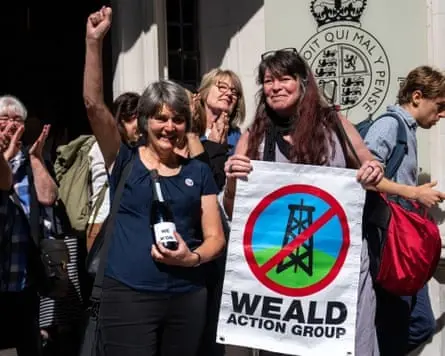
The fortunes of Horse Hill shifted dramatically in 2024 when the UK Supreme Court delivered a landmark judgment in a case brought forward by local environmental campaigner Sarah Finch, backed by the Weald Action Group.
The court ruled that a planning authority acted unlawfully by failing to consider the downstream greenhouse gas emissions—specifically, the emissions generated when the extracted oil is eventually combusted by consumers—as part of the project’s environmental impact assessment. This legal precedent, now globally recognized as the "Finch Ruling," effectively invalidated previous approvals granted by local councils and threw the regulatory status of fossil fuel extraction projects across the UK into profound uncertainty.
The Fire Sale and Corporate Metamorphosis
As the legal scaffolding supporting Horse Hill crumbled under the weight of the Supreme Court’s decision, the financial reality for UKOG became untenable. Prior to offloading the site for a nominal £1 million, UKOG’s internal financial accounts revealed that the company had already drastically written down the balance sheet value of its Horse Hill interests to a meager £55,360.
Facing what financial analysts termed "regulatory stranding," UKOG opted for a complete corporate overhaul. The company officially changed its name to the UK Energy Group, signaling a strategic exit from the domestic onshore oil and gas sector. By 2025, the newly rebranded entity managed to raise £1 million to pursue hydrogen-storage projects in south Dorset and Yorkshire, alongside an additional £500,000 to acquire land earmarked for a proposed East Yorkshire salt-cavern energy storage site.
Stephen Sanderson, the chief executive of UK Energy Group, acknowledged that while the company still believed "potentially material resources" remained at Horse Hill, the divestment presented a "timely and attractive opportunity to complete UKOG’s exit from the UK onshore oil and gas sector."
Supporting Context & Metrics: The Anatomy of a Stranded Asset
The collapse of Horse Hill’s valuation provides a textbook case study in the financial risks posed by the global energy transition. According to Guy Prince, head of energy supply at the energy transition think tank Carbon Tracker, the asset’s trajectory highlights the profound impact of regulatory shifts on fossil fuel investments.
"The same transition risk can have really radical financial consequences depending on who owns the asset," Prince observed. "For a major corporation, it might impair one investment opportunity. But for a small company concentrated on one project like this, it just transformed the entire business."
Financial and Environmental Metrics at a Glance
Peak Implied Value (Sept 2018): £46 million
Total Investment by UKOG: Over £25 million
Writedown Value Prior to Sale: £55,360
Final Sale Price to Energy B: £1 million
Proposed Extraction Volume: Approximately 678,693 tonnes of oil over 20 years
Projected Lifetime Emissions: ~2.3 million tonnes of greenhouse gases (including downstream combustion)
Estimated Carbon Budget Impact: Quoted in planning documents as roughly 0.05% of the projected UK carbon budget.
Despite these figures, the developers behind the renewed application argue that the environmental impact remains negligible. Planning documents submitted to Surrey County Council assert that Horse Hill’s contribution to climate change would be "insignificant," contending that it accounts for a fraction of a percent of the nation’s carbon limits.
Critics, however, reject this logic. Pointing to warnings from the International Energy Agency (IEA) that global climate targets preclude any new investments in unabated fossil fuel extraction, campaigners argue that framing individual projects as "insignificant" ignores the cumulative reality of global heating and the hard constraints of the 1.5°C Paris Agreement target.
Official Statements and Competing Arguments
The Developer’s Perspective
Energy B, through its newly acquired control of Horse Hill Developments Ltd, has taken over the mantle of pressing for production approval. The company submitted a renewed planning application to Surrey County Council, seeking permission for four new production wells, an expanded oil processing facility, tanker-loading bays, and a fluid reinjection well.
Defending the project, an Energy B spokesperson emphasized the geopolitical and economic arguments for domestic supply:
"At a time of global uncertainty and energy price shocks, domestic oil and gas production increases energy security. We are confident of meeting all the necessary legal and environmental requirements for the site. With the oil being refined in the UK and the gas serving the domestic market, the field will contribute positively to the UK economy."
The Campaigner’s Counter-Perspective
Sarah Finch, whose tireless legal crusade culminated in the 2024 Supreme Court victory, has strongly condemned the new application, identifying fundamental flaws in the developer’s updated environmental documentation.
"New guidance from the government and pre-existing guidance all say that they have to place the emissions from a new proposed project within a cumulative context of all current and approved fossil fuel projects," Finch said. "They didn’t make any attempt to do that, although the data is readily available out there."
Furthermore, Finch disputed the assertion that the project guarantees domestic energy security or shields British consumers from price shocks. She noted that domestically extracted oil is typically traded on open international commodity markets rather than being ring-fenced for domestic consumption, meaning local extraction offers little guaranteed shelter from global market volatility.
Future Outlook: A Crucial Test Case for UK Climate Jurisprudence
The impending decision by Surrey County Council represents far more than a localized planning dispute over a patch of the Surrey countryside. It serves as a litmus test for how local authorities across the United Kingdom interpret and implement the rigorous legal standards established by the Supreme Court’s Finch Ruling.
While the formal consultation window closed in July, the council indicated it would continue reviewing late submissions before rendering a decision, which could materialize as early as this month.
For the Weald Action Group and the broader environmental movement, the stakes are exceptionally high. Finch has confirmed that campaigners are actively preparing for contingencies, noting that her organization will not hesitate to pursue another judicial review if the council approves the development.
"We’re fairly confident that the environmental statement that’s been submitted isn’t compliant with the law and the new guidance," Finch warned.
As UK Energy Group fully distances itself from its past as an onshore driller and transitions into clean energy infrastructure, the ghost of its former flagship asset lingers in Surrey. Whether Horse Hill becomes a lingering relic of a bygone fossil-fuel era or a rare post-Finch exception will depend entirely on how local planners—and potentially the courts—navigate the shifting legal boundaries of the climate crisis.