EXECUTIVE OVERVIEW
The contemporary sustainability movement has arrived at a definitive, high-stakes inflection point. For decades, practitioners, corporate executives, and policymakers operated under a shared assumption: that incremental improvements in environmental stewardship, social responsibility, and corporate governance (ESG) would gradually bend the arc of global commerce toward a regenerative future. Today, that foundational consensus is fracturing.
According to recent findings from the Trellis State of the Profession Report, alongside broader macroeconomic indicators and mounting geopolitical tensions, the old operational paradigms of sustainability are no longer viable. The challenges confronting modern society—ranging from accelerating climate disruption and deepening inequality to systemic economic shifts—are no longer peripheral line items managed by corporate compliance departments. They are existential tests for the enterprise of global business itself.
The core realization dawning upon forward-thinking leaders is that the ultimate project of the sustainability movement is not simply carbon reduction, social justice advocacy, or enhanced institutional governance. The true project is the fundamental redefinition of the role of business in human society. As the architecture of Sustainability 1.0 buckles under the weight of political backlash, economic nationalism, and administrative fatigue, the imperative to engineer "Sustainability 2.0" has become absolute.
Currently, five distinct and competing models dominate the global discourse, yet each proves fundamentally unsatisfactory when measured against the scale of the crises at hand. To move forward, the sustainability profession must dissect these legacy frameworks—ranging from hyper-bureaucratic accounting to aggressive corporate rollbacks—and forge a resilient, practical, and action-oriented model for the decades ahead.
The Anatomy of a Movement in Transition: A Detailed Chronology of Sustainability
To understand how the corporate world arrived at this critical juncture, it is essential to trace the evolution of sustainability from an ethical fringe concern to a global economic driver, and finally, into its current state of ideological warfare.
Phase I: The Rise of Compliance and the Accounting Model (Late 1990s–2010s)
For the better part of three decades, the prevailing approach to corporate sustainability was defined by measurement. Underpinned by the basic premise that "you manage what you measure," the accounting model brought an administrative mindset to environmental and social challenges. The formula was deceptively simple: Data + Disclosure/Transparency = Accountability for ESG Performance.
A massive ecosystem of reporting standards, regulatory frameworks, and third-party ratings agencies emerged, successfully dragging sustainability out of the corporate basement and into the boardroom. However, this model suffers from a critical flaw: good accounting is a necessary condition, but it is never a sufficient one.
Financial accounting does not inherently drive profit and loss statements or establish bulletproof commercial business cases; public accounting alone does not deliver measurable, positive socio-environmental impact. Furthermore, when subjected to intense political opposition and regulatory rollbacks, the accounting mindset tends to default to legalistic negotiations, watering down vital rules and disclosure requirements to appease critics. While a healthy investment in accounting remains essential for operational rigor, the over-financialization and hyper-bureaucratization of sustainability have crowded out vital strategic innovation. Accounting must remain a tool, not the master.
Phase II: The Weaponization of Skepticism and the Rollback Model (2020–Present)
As sustainability standards gained legislative teeth globally—particularly in Europe and through localized securities regulations—a powerful counter-movement emerged. Historically, the traditional rollback model argued a simple Milton Friedman-esque dogma: the business of business is business, leaving socio-environmental stewardship strictly to sovereign governments.
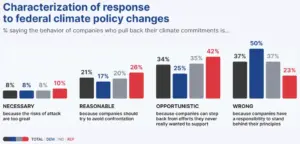
In recent years, however, a much more aggressive and regressive iteration of this model has usurped its politer predecessor. This modern rollback model systematically dismantles environmental and social apparatuses to protect entrenched economic interests, often shielding overt corruption and monopolistic market dominance.
Champions of this approach deploy familiar rhetorical tropes regarding "climate hoaxes" and "regulatory overreach," but their underlying, unspoken message is stark: extract maximum value from the dying carbon economy before the regulatory door slams shut. They recognize that fossil-fuel-dependent systems have a finite lifespan, and they intend to capture the remaining economic rents at any cost to public health or ecological stability.
Supporting Context & Metrics: The Competing Forces Shaping Global Commerce
Beyond the boardroom battles over accounting and regulatory rollbacks, two massive, conflicting socio-economic forces are currently vying for supremacy over the future of the global economy: the state-driven geopolitics of the green transition and the radical anti-corporate pushback from progressive civil society.
The Power Politics Model
Countering the rollback faction is the sustainability power politics model. Here, sovereign states compete aggressively for control over critical minerals, rare earth elements, renewable energy technologies, and the complex supply chains required to execute the global green transition. The ultimate prize is nothing less than structural dominance over the 21st-century global economy and geopolitical security landscape.
- Geopolitical Rivalries: China and the European Union are heavily investing in industrial policy to secure green supply chains. Meanwhile, the United States and Russia frequently pivot between domestic energy production and green-tech competition.
- The Global South’s Dilemma: Petrostates in the Middle East balance their fossil-fuel legacy with aggressive investments in solar and hydrogen infrastructure, while nations across the Global South attempt to hedge their bets amid rising superpower tensions.
- The Double-Edged Sword: While massive public investments and green industrial policies hold the potential for unprecedented environmental restructuring, they also generate profound inequities. For instance, whereas traditional sustainability preaches global, collective stewardship of fresh water, power politics asks a transactional question: How can my nation weaponize or control water resources to secure leverage over yours? Furthermore, critical human rights issues that fall outside traditional geopolitical calculations are frequently marginalized.
The Anti-Corporate Model
Disillusioned by the voluntary nature of ESG reporting and corporate self-regulation, a progressive anti-corporate sustainability model has gained significant traction among civil society and academic circles.
Proponents of this view argue that the traditional corporate partnership model is an abject failure. They advocate for heavy-handed regulatory state intervention, sweeping systemic overhauls, and experimental egalitarian economic models like the "degrowth" movement. They reject the premise that corporations can be trusted to reform themselves, asserting that big business must be heavily commanded rather than politely invited to the table. While their diagnosis of systemic institutional failure is frequently accurate, their reliance on rapid, near-revolutionary institutional restructuring at a global scale remains practically unfeasible within the narrow timeframes dictated by the climate crisis.
The Personal Advancement Model
Operating alongside these grand ideological frameworks is a quieter, pervasive dynamic: the careerist or personal advancement model. For many organizational leaders caught in the crossfire, ESG is viewed primarily as a transient corporate trend—a vehicle for personal branding, career advancement, and internal risk mitigation. In practice, this manifests as a commitment to professional self-preservation, ensuring that one never "rocks the boat" while navigating shifting corporate priorities.
Official Perspectives and Expert Insights
To chart a viable path forward, industry leaders, institutional investors, and civil society actors must confront the limitations of these five competing archetypes. According to insights gathered by the Trellis network and leading corporate strategists, the professional community is actively demanding a unified platform that transcends compliance-driven box-ticking and ideological polarization.
Experts emphasize that the current impasse stems from a fundamental failure of imagination. For over thirty years, sustainability professionals have struggled to answer a foundational question posed by line managers and operational leads: “What does this abstract sustainability mandate actually mean for my specific business unit, my daily operations, and my key performance indicators?”
Because Sustainability 1.0 failed to provide clear, actionable operational pathways, it left the door wide open for political weaponization and corporate greenwashing accusations. To reclaim momentum, institutional leaders argue that the upcoming era of Sustainability 2.0 must move away from defensive compliance and toward offensive, value-creating integration.
The Path Forward: Designing Sustainability 2.0
If the five dominant models outlined above represent the entirety of our choices, the global business community is in severe trouble. Practitioners must actively participate in reshaping the discourse to establish a practical, resilient, and transformative vision for Sustainability 2.0.
Building this new paradigm requires adherence to five foundational pillars:
1. Inspire with Purpose
The modern sustainability movement has historically struggled to articulate an appealing, magnetic vision of the future. Too often, public discourse is dominated by punitive rhetoric, messaging rooted in fear and doom, and dry, impenetrable reporting frameworks. Sustainability 2.0 must reclaim the narrative by offering a deeply optimistic, economically viable, and culturally resonant vision of a regenerative society that people actively want to build, rather than one they are simply coerced into accepting.
2. Structure Compelling Incentives
System-wide, scalable economic transformation cannot rely solely on the indirect pressures of public opinion and transparency-based accounting. It requires robust, multi-layered incentives built on a balanced foundation of both commercial rewards ("carrots") and strict regulatory boundaries ("sticks"). The economic architecture of sustainability must be re-engineered so that sustainable choices are inherently the most profitable and frictionless choices for enterprises.
3. Embed Directly into Business Operations
Sustainability can no longer function as an isolated corporate social responsibility (CSR) department or a communications afterthought. For sustainability to survive and thrive, it must be completely interwoven into core business strategy, capital allocation, product design, and daily operational execution. Every business unit and job function must understand its direct contribution to the enterprise’s broader social and environmental goals.
4. Provide a Soft Landing for the "Losers"
Opponents of sustainability initiatives continue to wield formidable economic and political power, and recent history proves they will not surrender their institutional status willingly. A genuinely just transition must incorporate what economists term compensating variation—mechanisms through which the beneficiaries of a new economic paradigm actively compensate those displaced by it. Without addressing the legitimate economic anxieties of workers and communities tied to legacy industries, peaceful and rapid systemic transition will remain deeply elusive.
5. Take Tangible Action Without Gatekeeper Approval
There is no longer any time to wait for flawless global treaties, comprehensive international legislation, or universal industry consensus. A credible new sustainability model must be anchored in immediate, decentralized, and scalable action. If corporate leaders wait for regulatory perfection before moving forward, the ecological and economic tipping points will have already passed.
Future Outlook
The transition from Sustainability 1.0 to Sustainability 2.0 is not a distant theoretical exercise; it is an active, ongoing transformation playing out in boardrooms, supply chains, and legislative chambers across the globe.
The convergence of geopolitical competition, economic volatility, and ideological polarization means that passive compliance is no longer a viable corporate strategy. The business leaders who thrive in the coming decades will be those who refuse to let the prevailing political backlashes or bureaucratic accounting models dictate their trajectory.
The era of Sustainability 2.0 is already upon us. The definitive question facing today’s corporate stewards is no longer whether they will be impacted by global transformation, but whether they possess the courage and strategic clarity to actively shape it.