

Executive Overview
The intersection of late-stage capitalism, institutionalized fossil fuel extraction, and high-art cinema has long proven to be a treacherous landscape. In his latest cinematic endeavor, Digger, visionary director Alejandro González Iñárritu attempts to map the planetary catastrophe of global climate change through the claustrophobic, megalomaniacal lens of a single corporate titan. Starring Tom Cruise in a startling physical transformation as oil plutocrat Digger Rockwell, the film aims to be the definitive satire of the carbon-industrial complex. However, it ultimately crashes against the jagged rocks of its own heavy-handed allegorical ambitions.
Drawing clear parallels to real-world energy barons like Continental Resources founder Harold Hamm—whose vast wealth and political influence have actively fueled the rollback of green energy initiatives—Digger sets out to interrogate both individual culpability for climate displacement and the limits of political art. Yet, rather than establishing a profound cinematic dialogue on the collapse of planetary life-support systems, the film devolves into a relentless, deafening cacophony of shrieking parables and exhausted culture-war tropes.
This review-analysis explores the anatomy of Digger, evaluating its narrative mechanics, its place within the lineage of climate satire (succeeding Adam McKay’s Don’t Look Up), its thematic engagement with the real-world Carbon Majors, and its ultimate failure to balance artistic utility with emotional resonance. As environmental pressures mount globally, Digger serves as a symptom—rather than a critique—of our current cultural impasse, offering audiences a deafening echo chamber of climate anxiety stripped of grace, heart, or redemption.
Detailed Chronology: The Narrative Arc of Digger
To understand the polarizing impact of Digger, one must trace its aggressively literal plot, which unfolds with the subtlety of an industrial catastrophe.
Act I: The Tectonic Warning
The film opens by inviting audiences to marvel at Tom Cruise’s bodily metamorphosis into a flabby, weathered, Texas-accented oil executive. Digger Rockwell, heir to a wildcat empire spanning offshore drilling platforms from Alaska to Greenland, sits in his private jet surrounded by monogrammed leather seats, more preoccupied with the medical decline of his decomposing white cat, Maggie, than the state of the biosphere.
The plot proper detonates with the subtlety of a tornado siren. A terrified technician on Digger’s offshore rig in Greenland calls to report an unmitigated methane leak. A massive fracture has compromised the structural integrity of the local ice sheet. Before Digger can finish a rambling monologue dismissing the threat—declaring he will not shutter a billion-dollar platform over a "tiny crack"—a team of corporate executives bursts into his office. The rig has catastrophic-failed, triggering the total collapse of the Greenland ice sheet. A skyscraper-sized iceberg breaks free, careening toward Europe with enough displacement water to flood the continent and eradicate hundreds of thousands of lives.
Instead of evacuating or mitigating, Digger confers immediately with the U.S. President (played with grizzled apathy by John Goodman). Their bipartisan consensus? Double down and keep drilling.
Act II: The Digital Firewall and Boardroom Cacophony
In a sequence that recalls and intensifies the bureaucratic cynicism of Adam McKay’s Don’t Look Up, Digger’s administration responds to the encroaching continental catastrophe through institutional denial and information suppression. Digger introduces a proprietary digital algorithm known as the "firewall," designed to systematically scrub terms like "methane," "iceberg," and "climate change" from the global internet. Meanwhile, conservative lawmakers offer predictable, parodic solutions, ranging from conventional military bombardment of the floating mountain of ice to national prayer breakfasts.
Throughout this descent, Digger engages in toxic, intellectual sparring matches with his in-house corporate scientist, Ganesh (Riz Ahmed). Ganesh attempts to inject systemic realities into the boardroom—pointing out the staggering 97 percent decline in the bluefin tuna population while refusing Digger’s offered sashimi, only to hypocritically devour it moments later. These interactions serve as compressed, exhausting digests of contemporary internet discourse, trading genuine character development for rapid-fire references to COP30 policy fiascos, thawing Arctic permafrost, and global warming potentials.
Act III: The European Showdown and the Meta-Twist
The film’s emotional nadir arrives during an excruciating sequence at the European Parliament in Brussels. Digger storms the legislative floor to berate European lawmakers, labeling them spineless hypocrites who condemn his extraction methods while eagerly burning his crude oil in their power plants. In response, German and Danish parliamentarians howl accusations of mass murder from the benches. Digger screams back at the top of his lungs for several minutes, delivering the thesis of the film: "You want me to keep producing! You demand, and I supply!"
Following this harrowing sequence, the U.S. Air Force scrambles a squadron of fighter jets to carpet-bomb the iceberg—the singular moment in the film where the deafening dialogue ceases.
Just as the audience prepares for a conventional resolution, Iñárritu executes a late-stage narrative pivot. The film reveals itself to be a parable about a parable—a meta-textual questioning of whether ham-fisted cinematic metaphors possess any political utility whatsoever. By breaking the fourth wall of its own allegory, Digger attempts to absolve itself of its structural clumsiness, arguing that even if art cannot stop the apocalypse, there is inherent value in documenting the sheer, ridiculous absurdity of how it happened.
Supporting Context & Metrics: The Reality of the Carbon Majors
While Digger operates in the realm of high-art caricature, its fictional antagonist is directly mirrored by the quantifiable mechanics of the real-world global economy. To evaluate Iñárritu’s target, one must examine the institutional structures of fossil fuel production documented by climate accountability initiatives.
The Carbon Majors Database
According to data compiled by the Carbon Majors project, a mere 178 corporate and state-owned producers are historically responsible for the vast majority of global industrial greenhouse gas emissions since the dawn of the industrial era.

- Continental Resources & Harold Hamm: While industry titans like Saudi Aramco and ExxonMobil dominate the top tiers of the Carbon Majors list, mid-to-large independent operators play an equally crucial role in sustaining high-emissions trajectories. Continental Resources, founded by Oklahoma oil pioneer Harold Hamm, ranks roughly 150th on the ledger. Yet, since 2005 alone, the firm has extracted enough hydrocarbons to release nearly 600 million tons of carbon dioxide into the atmosphere—an emissions volume equivalent to the combined carbon footprints of approximately 2 million American citizens over the same timeframe.
- Political Influence and Climate Hushing: Hamm’s career exemplifies the transition of fossil fuel wealth into organized political disruption. Serving as a top fundraiser and energy adviser for conservative political action committees, Hamm has routinely bankrolled legislative efforts to roll back green energy subsidies, dismantle environmental protection agency mandates, and promote what researchers term "climate hushing"—a deliberate political strategy to purge climate change terminology from public policy discussions, closely mirroring Digger’s digital "firewall."
Comparative Media Analysis: Digger vs. Don’t Look Up
In evaluating cinematic treatments of ecological collapse, critics inevitably draw comparisons between Digger and Adam McKay’s 2021 Netflix feature Don’t Look Up.
| Metric / Dimension | Don’t Look Up (2021) | Digger (2026) |
|---|---|---|
| Primary Allegory | Comet impact (Sudden extinction event) | Calving Greenland Ice Sheet / Methane leak (Systemic industrial failure) |
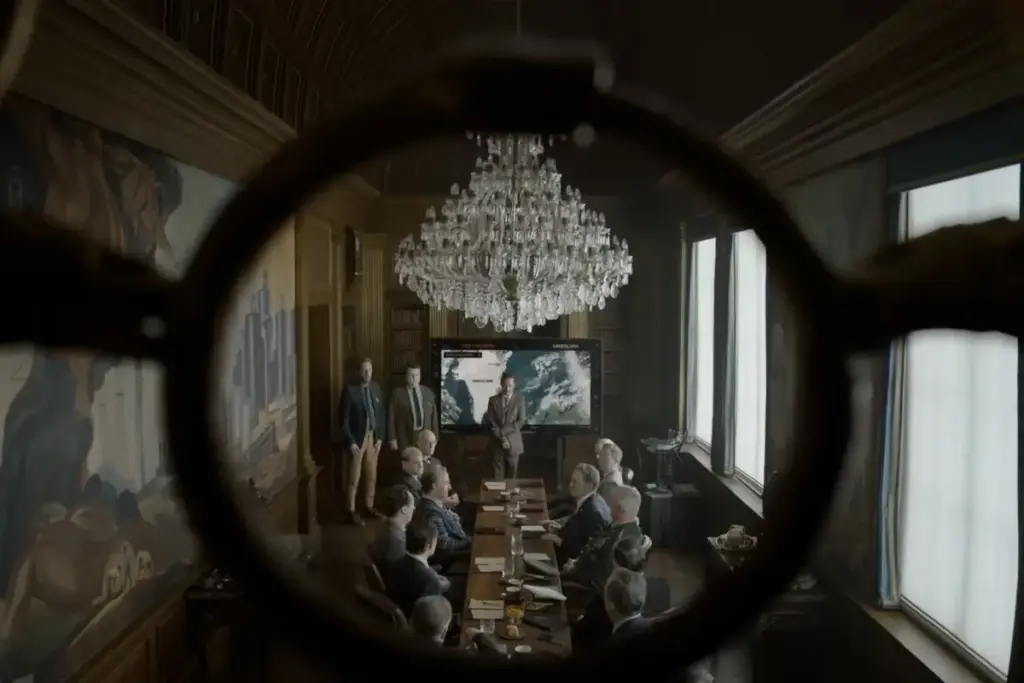
| Aesthetic Tone | CNN-toned corporate realism & mainstream satire | Wes Anderson meets Thomas Hart Benton (Art Deco murals, stylistic maximalism) |
| Narrative Approach | Satirical farce tracking institutional and media incompetence | Hyper-aggressive psychological melodrama and meta-parable |
| Political Outcome | Direct planetary destruction amidst public distraction | Meta-textual interrogation of the utility of political art |
While McKay opted for a recognizable, media-saturated satire that compared climate denialism to a runaway comet, Iñárritu rejects realism entirely. By employing stylized, Art Deco boardrooms featuring self-consuming ouroboros sculptures and operatic shouting matches, Digger leans heavily into theatrical absurdity, ultimately sacrificing narrative accessibility for avant-garde provocation.
Official Statements and Industry Reception
The release of Digger has ignited fierce debate among film critics, environmental advocates, and industry insiders regarding the boundaries of ecological storytelling on the silver screen.
In an interview with Film Comment following the picture’s press screenings, director Alejandro González Iñárritu defended the confrontational nature of his screenplay:
"We live in an era of profound cognitive dissonance where the architects of our planetary undoing operate in plain sight, adorned in the language of economic populism. If the film feels loud, aggressive, and uncomfortable, it is because the reality we are sleepwalking into is infinitely worse. Art is not required to be a sedative; sometimes, it must act as a siren."
Conversely, industry analysts and trade publications have questioned the commercial viability and therapeutic value of such aggressive cinematic polemics. Writing for prominent cultural outlets, environmental critics noted that the film’s relentless cynicism risks alienating the very audiences it seeks to mobilize.
"Watching Tom Cruise scream obscenities about crude oil supply chains for two and a half hours does not inspire civic engagement," wrote one prominent climate culture critic. "It induces emotional exhaustion. When the most relieving moment of a movie about global catastrophe is an active military bombing run that finally makes everyone shut up, the satire has lost its moral compass."
Representative bodies within the energy sector have largely dismissed the film as a caricature of modern enterprise. Trade associations representing independent oil and gas producers released brief statements characterizing Digger as a "disconnected Hollywood fantasy that ignores the foundational role affordable energy plays in lifting global populations out of poverty," declining to engage directly with the film’s specific artistic critiques of corporate accountability.
Future Outlook: The Crisis of Climate Storytelling
As the global community faces compounding ecological tipping points—ranging from the collapse of Atlantic meridional overturning circulation to accelerating Amazonian deforestation—the cultural industries find themselves at a historic crossroads. The fundamental question raised by Digger is not merely whether Alejandro González Iñárritu succeeded in lampooning modern oil barons, but whether narrative cinema is structurally capable of addressing slow-moving, systemic crises without collapsing into didactic caricature.
The Limits of Parable in the Anthropocene
For decades, artists attempting to engage with climate change have struggled against the "tragedy of abstraction." Carbon dioxide is invisible; systemic economic incentives are deeply entrenched; and the apocalyptic future is distributed unevenly across time and geography. Fables like Digger and Don’t Look Up attempt to force these abstract realities into concrete, dramatic shapes—comets striking the earth, icebergs threatening European capitals, cartoonish executives cradling dying pets.
Yet, as political trends globally lean toward increased fossil fuel extraction and institutional retrenchment—evidenced by massive voter support for climate-skeptic political figures and the systematic suppression of environmental terminology—it becomes increasingly evident that artistic parable has reached a point of diminishing returns. No amount of cinematic mockery directed at fictionalized executives will deter real-world capital from chasing profitability, nor will it convince skeptical electorates to embrace green infrastructure transitions.
Where Do We Go From Here?
If the critical reception of Digger teaches us anything, it is that future storytelling must move beyond the exhausting binary of corporate demonization and despairing fatalism. Audiences suffering from profound climate anxiety do not require cinematic lectures reminding them that billionaires are greedy or that political systems are compromised.
Instead, the next wave of ecological narrative must explore themes of resilience, community adaptation, decentralized power, and the complex human emotional landscapes of a changing world. Until filmmakers abandon the tired tropes of the screaming boardroom and the hyper-stylized megalomaniac, cinematic explorations of the climate crisis will remain trapped in their own self-referential feedback loops—loud, expensive, and ultimately incapable of shifting the planetary trajectory.



