

Executive Overview
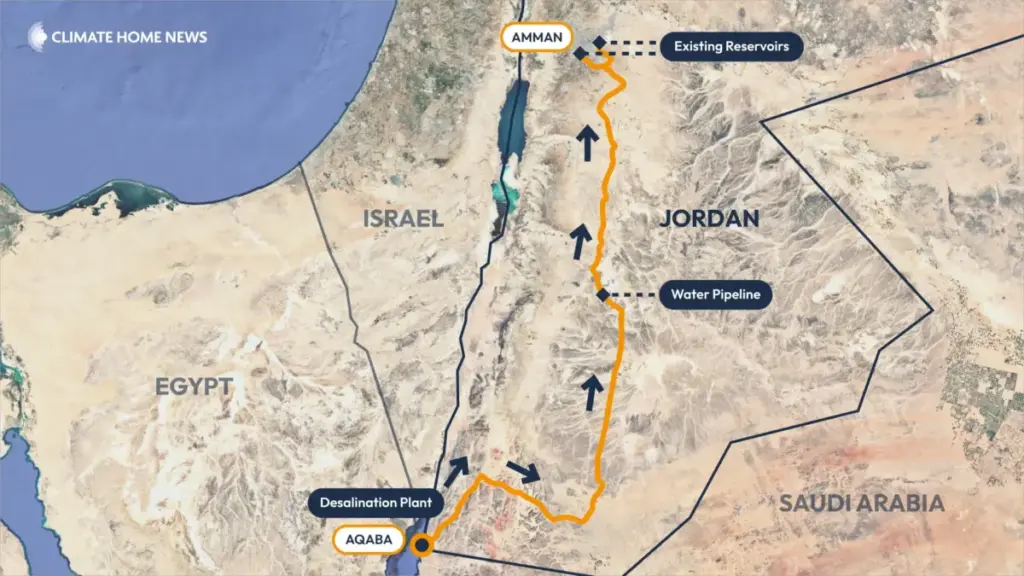
Along the arid, sun-scorched coastline of the Gulf of Aqaba, Jordan is advancing one of the most ambitious engineering initiatives in its modern history: the $6-billion Aqaba-Amman Water Conveyance Project (AAWCP). Designed to pump desalinated drinking water hundreds of kilometers inland and uphill to the bustling capital of Amman, the project represents an existential attempt to fortify national water security in one of the world’s most hyper-arid nations.
However, the megaproject is far more than an engineering feat; it sits at the crossroads of intense regional geopolitics and a perplexing climate paradox. The urgency of the project has been amplified by deteriorating diplomatic relations between Jordan and Israel following the outbreak of the Gaza war. Historical arrangements and proposed "water-for-energy" trades with Israel have grown politically fragile, prompting Amman to prioritize self-reliance over cross-border resource dependence.
+-----------------------------------------------------------------------------------+
|                        AQABA-AMMAN WATER CONVEYANCE PROJECT                        |
+------------------------------------+----------------------------------------------+
| Estimated Total Cost               | ~$6.0 Billion USD                            |
| Target Capacity                    | 300 Million Cubic Meters / Year              |
| Pipeline Distance                  | ~450 Kilometers (Aqaba to Amman)             |
| Green Climate Fund (GCF) Support   | $295 Million Grant & Financing               |
| Dedicated Solar Power Share        | ~27% (Purpose-built PV in Aqaba Desert)      |
| National Grid Power Share          | ~73% (Primarily Fossil/Natural Gas Driven)   |
+------------------------------------+----------------------------------------------+
Simultaneously, the initiative highlights the uncomfortable trade-offs embedded in large-scale climate adaptation. Supported by a landmark $295 million grant from the United Nations-backed Green Climate Fund (GCF), the desalination plant and its massive pumping infrastructure will double the energy consumption of Jordan’s entire water sector.
Despite its green adaptation branding, the project will source only 27% of its electricity from a purpose-built solar farm in the desert. The remaining 73% will be drawn directly from Jordan’s national grid—an energy network powered overwhelmingly by fossil gas. The project illustrates the complex reality facing climate-stressed, developing nations: the immediate imperative for survival often forces reliance on carbon-intensive infrastructure.
Detailed Chronology
[Historic Water Deficits] ---> [2021: "Project Prosperity"] ---> [Oct 2023: Gaza War Breakout] ---> [GCF $295M Grant] ---> [Current: Procurement & Fast-Tracking]
  Groundwater depleted         Underwritten by UAE/US            Diplomatic rupture freezes         International funding        Amman treats project as absolute
  & regional projects stall    Water-for-Energy deal             bilateral hydro-diplomacy          approved for adaptation       national security priority
The Deepening Hydrological Crisis (2010–2020)
For decades, Jordan has faced a worsening structural water deficit. The over-extraction of underground aquifers, coupled with reduced flows along the Yarmouk and Jordan Rivers, left major urban centers facing severe water rationing. The situation was compounded by rapid population growth and successive waves of refugee inflows, most notably over one million refugees fleeing the Syrian civil war.
Initial attempts to address the deficit through large-scale regional cooperation—such as the long-discussed Red Sea–Dead Sea Water Conveyance Project—stagnated for years due to complex multi-lateral negotiations, funding shortfalls, and political friction.
The "Water-for-Energy" Interlude (2021–2023)
In November 2021, Jordan, Israel, and the United Arab Emirates signed a landmark Declaration of Intent for "Project Prosperity." Under this diplomatic framework:
- Prosperity Green: Jordan was to construct 600 megawatts of solar power capacity to export clean energy to Israel.
- Prosperity Blue: In return, Israel was to supply Jordan with 200 million cubic meters of desalinated water annually from its Mediterranean coast.
While praised internationally as a model for climate diplomacy and regional integration, the deal faced intense domestic opposition inside Jordan, where public sentiment remained skeptical of deepening resource reliance on Israel.
The Gaza Conflict and Geopolitical Pivoting (Late 2023–Present)
The outbreak of the Gaza war in late 2023 severely disrupted the regional hydro-political landscape. As diplomatic friction between Amman and Tel Aviv intensified, Jordan’s political leadership paused formal progress on the "Water-for-Energy" deal, emphasizing that critical national infrastructure could not remain vulnerable to external geopolitical instability.
The Jordan Government re-centered its national strategy on total water self-reliance, elevating the Aqaba-Amman Water Conveyance Project from a prospective infrastructure goal to an urgent, non-negotiable matter of national security.
Financial Acceleration and GCF Approval
Recognizing the acute vulnerability of Jordan’s water supply, international climate finance institutions stepped in. The Green Climate Fund approved $295 million in direct support, framing the project as a critical climate adaptation endeavor aimed at protecting millions of vulnerable citizens from acute water stress. This funding served as a catalyst, crowding in additional concessional loans, donor grants, and private sector interest to finance the $6 billion capital expenditure required for construction.
Supporting Context & Metrics
The Scale of Hydrological Scarcity
Jordan ranks as the second most water-scarce country on Earth. The metrics defining its water emergency are stark:
- Per Capita Water Availability: Jordan’s renewable water resources stand at below 61 cubic meters per person per year, far beneath the absolute international water scarcity threshold of 1,000 cubic meters, and lower than the extreme threshold of 500 cubic meters.
- Aquifer Over-exploitation: Out of Jordan’s 12 major groundwater basins, 10 are being extracted at rates double—and in some cases triple—their natural recharge capacities, causing water tables to drop by meters each year and leading to worsening salinization.
- Infrastructure Loss: Non-revenue water (NRW)—water lost due to aging municipal pipe networks, physical leaks, and unauthorized illegal line taps—exceeds 45% across several governorates.
PER CAPITA RENEWABLE WATER AVAILABILITY (m³/year)
--------------------------------------------------
International Water Poverty Line : [==========] 1,000 m³
Extreme Scarcity Threshold       : [=====] 500 m³
Jordan Current Supply            : [=] 61 m³
Engineering and Infrastructure Specifications
The Aqaba-Amman Water Conveyance Project is an immense physical and technical undertaking:
- Desalination Capacity: The facility will process Red Sea seawater to produce up to 300 million cubic meters of potable water annually.
- Conveyance Distance: Water must travel across approximately 450 kilometers of desert terrain from the Gulf of Aqaba in the south to the high-density urban areas of Amman and surrounding northern provinces.
- Elevation Lift: Pipelines must lift water from sea level at Aqaba to the high plateau of Amman, which sits more than 1,000 meters above sea level, requiring series of massive high-pressure pumping stations.
The Energy Consumption and Carbon Footprint Paradox
Reverse osmosis desalination and long-distance, high-elevation pumping require massive energy inputs. The baseline calculations for the project’s power dynamics illustrate a central tension in modern climate adaptation:
ENERGY DYNAMICS OF THE AAWCP
+--------------------------------------------------------------------------+
| Total Sector Power Expansion: Doubles the entire water sector load       |
+--------------------------------------------------------------------------+
| Power Source Breakdown:                                                  |
|   [██████████████████████] 27% Dedicated Solar Photovoltaic (Aqaba)       |
|   [██████████████████████████████████████████████████████████] 73% Grid  |
+--------------------------------------------------------------------------+
| National Grid Mix: >80% Natural Gas Generation                           |
+--------------------------------------------------------------------------+- Grid Impact: Operating the AAWCP will essentially double the electricity demand of Jordan’s water sector, which already accounts for roughly 15% of the country’s total national electricity consumption.
- The Renewables Gap: To offset emissions, plans include a dedicated photovoltaic solar plant near Aqaba. However, physical space constraints, grid stabilization requirements, and high nighttime baseline pumping operations limit the solar contribution to 27% of total energy needs.
- Fossil Fuel Reliance: The remaining 73% of power will come directly from Jordan’s national grid. Over 80% of Jordan’s grid electricity is produced by burning fossil natural gas. Consequently, the carbon footprint of keeping Amman hydrated will remain intrinsically linked to fossil fuels for the foreseeable future.
Official Statements and Stakeholder Perspectives
The Government Imperative: Sovereignty and Survival
Jordanian officials emphasize that while energy decarbonization remains a national goal, basic water access takes precedence over pure emissions metrics.
"Water security is the ultimate foundation of national security," stated senior officials from the Ministry of Water and Irrigation during public briefings. "We are operating in an environment of unprecedented climate stress combined with complex geopolitical volatility. The Aqaba-Amman project gives Jordan total sovereign control over its most vital survival resource. We cannot delay drinking water access for our people while waiting for a fully decarbonized power grid."
Ministry technical directors also point out that high-pressure continuous reverse osmosis requires steady, baseline grid power that intermittent solar installations cannot currently sustain without massive, cost-prohibitive battery storage installations.
The Climate Finance Dilemma: Green Climate Fund Perspective
The Green Climate Fund’s decision to allocate $295 million to a project reliant on fossil-heavy power highlights an ongoing evolution in international climate finance criteria. Sources close to the GCF board note that funding decisions must weigh mitigation (reducing carbon footprints) against adaptation (protecting human populations from severe climate impacts).
In its formal project rationale, the GCF underscored that without major infrastructure intervention, millions of Jordanians would face critical water shortages that threaten public health, domestic stability, and economic stability. While acknowledging the high energy footprint, GCF project documents emphasize that securing reliable water access for a highly vulnerable population is a priority climate adaptation objective.
Environmental Analysts and Critical Experts
Energy and environmental analysts have voiced mixed reactions, calling the project a necessary but flawed climate response.
"The Aqaba-Amman pipeline exposes the paradox of modern climate adaptation," says a regional energy expert. "You are using high-carbon energy to adapt to a climate crisis caused by fossil fuel emissions. While Jordan desperately needs this water, locking the water supply into a natural-gas-dominated grid creates long-term financial exposure to volatile fossil fuel costs and undermines net-zero targets."
Local marine conservationists in Aqaba have also raised concerns regarding the discharge of hyper-saline brine waste back into the Gulf of Aqaba. They warn that improper brine diffusion could disrupt delicate coastal ecosystems, particularly the high-latitude coral reefs in the Gulf that have shown resilience to warming waters.
Future Outlook
+------------------------------------------------------------------------------------+
|                                FUTURE HORIZONS                                     |
+------------------------------------------------------------------------------------+
| Near-Term (1-3 Years)    | Finalize private procurement consortia, begin major     |
|                          | earthworks and marine intake construction in Aqaba.     |
+--------------------------+---------------------------------------------------------+
| Medium-Term (4-6 Years)  | Complete pipeline laying to Amman; commission solar     |
|                          | plant; begin preliminary water pumping tests.           |
+--------------------------+---------------------------------------------------------+
| Long-Term (7+ Years)     | Scale up national renewable integration (wind/solar) to |
|                          | systematically green the power feeding the project.     |
+------------------------------------------------------------------------------------+
Decarbonizing the Grid
The long-term environmental sustainability of the Aqaba-Amman Water Conveyance Project depends heavily on Jordan’s broader national energy strategy. The government has pledged to increase the share of renewable energy in its national power mix to 31% by 2030. If Jordan can rapidly expand utility-scale wind and solar projects across its eastern desert while modernizing its transmission grid, the high carbon intensity of the desalination plant could decrease over time.
The New Hydro-Political Reality
The project marks a fundamental realignment of Middle Eastern resource management. By prioritizing internal megaprojects over cross-border utility dependencies, Jordan is shifting toward strategic self-reliance. While regional trade deals like "Project Prosperity" promised high efficiency on paper, real-world political conflicts have demonstrated the risks of relying on neighboring nations for essential survival commodities like water and power.
Lessons for Global Climate Adaptation
The Red Sea desalination initiative serves as a crucial case study for arid, developing nations worldwide. As global warming accelerates desertification, nations across North Africa, the Middle East, and South America will increasingly turn to energy-intensive technological solutions to address water scarcity.
Jordan’s experience demonstrates that climate adaptation rarely offers clean choices. When facing immediate water exhaustion, nations will prioritize human survival and political stability, even if it requires a temporary compromise with the fossil fuel economy. The ultimate challenge for Jordan—and the international donor community supporting it—will be ensuring that this critical water lifeline transitions toward a green energy foundation before its carbon footprint compounds the very climate emergency it was built to survive.



