

Executive Overview
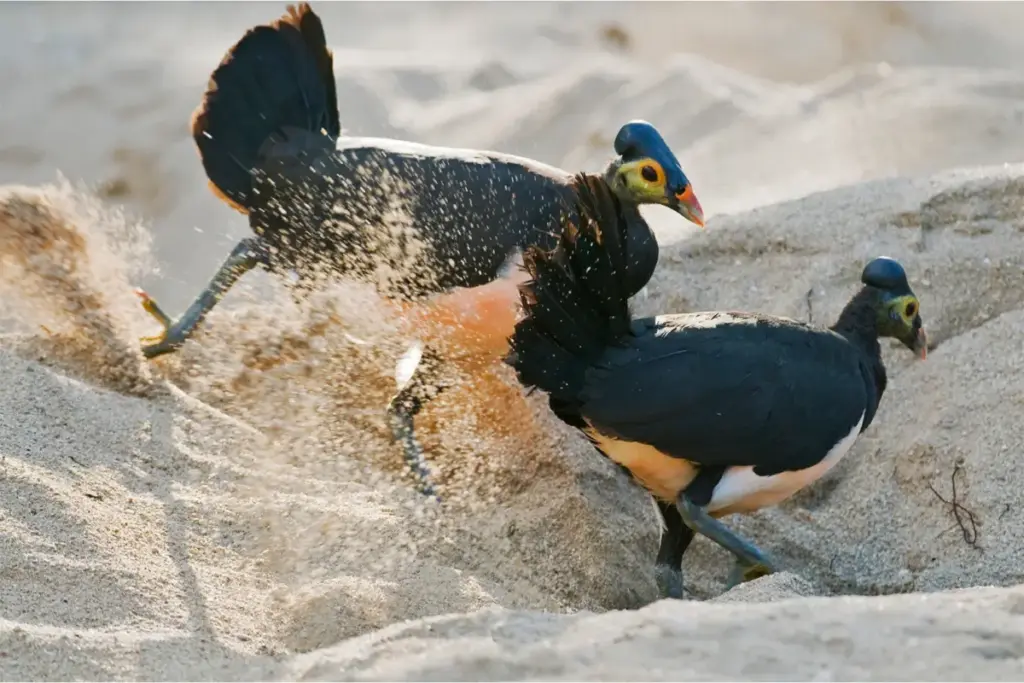
Deep within the thick tropical jungles of Sulawesi, Indonesia, a truly remarkable avian species fights a quiet, losing battle for survival. The maleo (Macrocephalon maleo), an iconic black-and-white ground bird standing 60 centimeters (2 feet) tall and adorned with a striking, vibrant splash of blue, orange, and yellow across its face, has long captivated naturalists. Renowned as the official faunal mascot of Central Sulawesi province and the Bogani Nani Wartabone National Park, the maleo employs a unique reproductive strategy: leaving its dense forest homes behind, pairs gather at communal nesting grounds—sun-baked sandy beaches or areas warmed by the earth’s geothermal energy. Using their webbed blue feet, female maleos excavate deep burrows, bury their oversized eggs, and immediately abandon them. Within months, the precocial young hatch, miraculously equipped to fly and fend for themselves within hours of breaking the shell, completely bypassing parental care.
For generations, the threats facing the maleo were well-mapped: rampant deforestation, human encroachment, and, most aggressively, the systematic poaching of their highly prized eggs, which are consumed locally as a delicacy. However, a startling and disturbing new crisis has burst onto the conservation radar. According to a landmark study recently published in the Journal of Asian Ornithology, international trafficking of live maleos for the illicit exotic pet trade has emerged as an active, grave threat to the species.
Documenting a series of alarming seizures throughout 2024, researchers revealed that these critically endangered birds are increasingly being smuggled out of Southeast Asia to feed a booming, unregulated domestic market in India. With global population estimates lingering at a fragile 4,000 to 7,000 breeding pairs, the sudden appearance of live maleos in international criminal supply chains threatens to push an already teetering species past the point of no return.
Detailed Chronology: The 2024 Incidents and Smuggling Modus Operandi
While historical records maintained by the CITES (Convention on International Trade in Endangered Species of Wild Fauna and Flora) database indicate that international commercial transactions involving live maleos have historically been restricted to rare, legal exchanges between captive-breeding programs and accredited zoos in the United States, the wild narrative shifted dramatically over the course of 2024. Indonesia has never reported a single legal export of a maleo, and India has logged zero legal import applications. Yet, when conservationists and wildlife trade researchers scoured international media reports and law enforcement logs, a chilling pattern emerged: three major customs seizures within a single year involving a total of 25 live maleos.

The first of these red-flag incidents occurred on June 18, 2024, at the Chhatrapati Shivaji Maharaj International Airport in Mumbai, India. Customs officials intercepting a passenger arriving directly from Jakarta, Indonesia, discovered five live maleos packed alongside other rare and endangered regional fauna, including magnificent riflebirds (Ptiloris magnificus), pale-billed sicklebills (Drepanornis bruijnii), and a critically endangered proboscis monkey (Nasalis larvatus). Tragically, due to the acute stress of transport and the absence of immediate specialized care, the confiscated birds perished within weeks before any repatriation efforts could be initiated.
Just over a month later, on July 29, 2024, enforcement agencies intercepted another major shipment in Jakarta—this time halting a batch of 12 young maleos before they could board a flight bound for Mumbai. Indonesian authorities arrested four Indian nationals implicated in the operation. The method of concealment was brutal: the live birds, alongside a host of other wildlife, had been tightly crammed inside ordinary suitcases. Despite the gravity of smuggling a critically endangered animal protected under both CITES Appendix I and strict Indonesian conservation laws, the suspects faced minimal legal penalties, escaping with a meager fine of just 10,000 Indian rupees (approximately $107 USD at the time).
The third incident materialized in December 2024 at Cochin International Airport in southern India. Officers flagged and intercepted eight live maleos arriving on a Thai Airways flight from Bangkok, Thailand, flown in alongside various birds of paradise and two endangered Visayan hornbills (Penelopides panini), a species endemic to the Philippines. Two Indian nationals were arrested on site. Local media reports subsequently revealed that these couriers had been recruited and paid roughly 75,000 Indian rupees (around $875 USD) to complete the smuggling run.
Researchers note that these operations rely on sophisticated, highly exploitative recruitment strategies. According to study co-author Uttara Mendiratta, a wildlife trade researcher and consultant with the Wildlife Trust of India, traffickers frequently target vulnerable demographics to act as couriers.

"The modus operandi seems to be that the couriers are offered an all-paid-for holiday in Southeast Asia [Thailand or Indonesia] and additional cash for their role," Mendiratta explained. "We have seen families with young children, young couples, and a young single mother who have been exploited in this way… Since families with kids usually clear screening faster, traffickers try to exploit this."
Supporting Context & Metrics: A Species Squeezed from All Sides
To comprehend the devastating impact of this newly discovered international trade route, one must understand the perilous baseline status of the maleo (Macrocephalon maleo). Once widely distributed across the lowland and hill forests of Sulawesi, the species has been decimated over the past four decades. The International Union for Conservation of Nature (IUCN) classifies the bird as Critically Endangered, backed by estimates indicating that only 4,000 to 7,000 breeding pairs remain in the wild.
The primary pressures driving this decline are structural and historical. Since 1983, maleos have lost more than two-thirds of their 149 known communal nesting grounds. Unmitigated residential and commercial development has systematically paved over sandy riverbanks and coastal beaches. Meanwhile, interior habitats have been heavily fragmented, degraded by mining operations, and sliced apart by a web of new roadways.
Compounding habitat loss is the relentless harvesting of maleo eggs by local human populations. Because the large eggs—which are roughly five times the size of a chicken egg—are rich in nutrients and viewed as a luxury food item, poachers routinely intercept nesting sites. This egg-raiding strips the wild population of successive generations, stunting recruitment rates.

The emergence of the live pet trade introduces a catastrophic new variable. The 25 birds documented in the 2024 seizures were all young juveniles, implying they were captured shortly after hatching. While 25 birds may appear numerically insignificant on a global scale, conservationists emphasize that every single individual taken from such a small, fragile wild pool represents an irreplaceable loss. Furthermore, wildlife trafficking mortality rates are notoriously high; dozens of animals typically perish during the capture, holding, and smuggling phases for every single specimen that successfully reaches a buyer.
Furthermore, investigators warn that the intercepted shipments likely represent only the tip of the iceberg. "In the past, international trade probably has not been a threat to the species, but now I think it could be a huge threat," noted Chris Shepherd, senior conservation advocate at the Center for Biological Diversity and lead author of the study. Researchers are now urgently calling for the IUCN Red List assessment for the maleo to be officially updated to incorporate international trafficking as a recognized primary threat.
Official Statements and Expert Perspectives
The discovery of live maleos within illicit international trade channels has sent shockwaves through the global conservation community.
"We didn’t set out looking at maleos," admitted Chris Shepherd, explaining that his team initially targeted the broader surge of exotic wildlife seizures flowing out of Indonesia and into India. "We were not expecting to see maleos because we have not seen them in international trade before. This discovery rang alarm bells for me."

Marcy Summers, director and co-founder of the Alliance for Tompotika Conservation—an NGO dedicated to maleo preservation in Sulawesi—expressed deep dismay upon learning of the study’s findings. "This paper issues a wake-up call to local and international authorities, adding another iconic, popular, and desperately imperiled species to the list of those threatened by illegal trafficking," Summers remarked. "It is already known that the taking of maleo eggs by humans is the single biggest threat to maleo survival, but until reading this paper, I was not aware of international trade in live maleos, which is just as concerning."
The destination markets within India are largely driven by a growing, affluent appetite for exotic and status-symbol pets. Uttara Mendiratta pointed to the pervasive presence of online exotic pet markets and social media influencers flaunting rare fauna. "All evidence we have so far points to a domestic pet market in India," Mendiratta stated. "We see a lot of online trade in exotic birds that include endangered birds [including] many species of macaws, parrots and cockatoos… We also see social media posts where influencers or celebrities are seen with rare wildlife as pets." With certain rare birds commanding hundreds of thousands of rupees on the black market, the financial incentives for smugglers remain exceptionally high.
A major point of contention among experts surrounds the exact origin of the smuggled juveniles. Because wild maleo chicks hatch predominantly at night, in remote forest or beach environments, and disperse rapidly without parental guidance, capturing them directly from unmanaged wild nesting grounds is exceptionally difficult.
Consequently, Marcy Summers theorizes that the smuggled birds likely originate from human-managed conservation hatcheries. Indonesia operates two primary models of maleo hatcheries: "semi-natural" facilities situated directly adjacent to natural nesting grounds (such as those at Tambun or Muara Pusian in Bogani Nani Wartabone National Park, or Saluki in Lore Lindu National Park), where rangers excavate eggs to protect them from poachers during the 60-to-90-day incubation period; and corporate-sponsored hatcheries tied to industrial projects.

While these facilities are designed to boost population numbers by releasing chicks back into the wild, Summers warns that they inadvertently create dangerous vulnerabilities. "By supplying these maleo chicks for the illegal pet trade, [traffickers] are feeding an international appetite for live maleos that will only exacerbate the already-severe pressures on maleos," Summers cautioned. "It will create a temptation for those with access to birds waiting to be released… It could also create an incentive for traffickers to frequent the remaining unmanaged maleo nesting grounds in hopes of capturing one of the few chicks that still manage to hatch at such sites."
Future Outlook and Policy Recommendations
Addressing this multifaceted crisis requires urgent, coordinated interventions across multiple jurisdictions—specifically Indonesia, Thailand, and India—alongside a fundamental overhaul of wildlife repatriation and enforcement protocols.
Currently, the legal handling of confiscated specimens highlights glaring loopholes in regional and international treaties. Following the December 2024 seizure in India, the eight surviving maleos were repatriated to Thailand (the transit country from which they were shipped), in accordance with CITES mandates. There, they were placed in government-run rescue facilities managed by the Thai Department of National Parks, Wildlife and Plant Conservation (DNP). However, because non-native species listed under CITES do not automatically receive rigorous protection inside Thailand unless explicitly added to a domestic "controlled species list"—a classification the maleo currently lacks—these birds face the prospect of remaining indefinitely confined within bureaucratic rescue centers rather than being returned to their native habitat.
Conservationists argue that this system is fundamentally flawed. Chris Shepherd has strongly urged governments to establish streamlined, conservation-first repatriation frameworks that prioritize returning smuggled wildlife directly to the wild.

"There’s a lot of wildlife in Thailand that needs to be repatriated back to wherever it came from," Shepherd stressed, asserting that the seized maleos must ultimately be sent back to Indonesia to reinforce depleted wild populations.
Simultaneously, pressure is mounting on Indonesian enforcement agencies to look inward. Researchers point out that despite the strict legal protections afforded to maleos under Indonesian conservation law, there is a glaring absence of successful court cases prosecuting individuals for trafficking the species domestically. Authorities must launch rigorous investigations into airport security vulnerabilities, shipping logistics, and potential corruption or lax oversight at semi-natural and industry-run hatchery operations.
Without immediate, aggressive crackdowns on airport smuggling rings, thorough audits of captive-rearing and hatchery facilities, and robust cross-border cooperation between India, Thailand, and Indonesia, the maleo risks being loved—and looted—to extinction. For a bird that relies on the raw warmth of the earth to bring new life into the world, the cold machinery of the international pet trade may prove to be an insurmountable trial.



