

Executive Overview
For two decades, the Biodiversity Heritage Library (BHL) has served as a digital ark, preserving and democratizing access to the foundational texts of natural history. As the BHL celebrates its 20th anniversary through its commemorative series, BHL at 20: Treasures from the Biodiversity Heritage Library, institutions across its global network are highlighting remarkable artifacts from their collections.
Recently, a digitization and transcription initiative at the Academy of Natural Sciences of Drexel University thrust a forgotten 19th-century intellectual back into the historical spotlight: Carrie Baily Aaron.
Through the collaborative efforts of catalogers, archivists, and student interns, a fragile, handwritten entomological notebook penned by Aaron between 1889 and 1901 has been digitized, transcribed, and uploaded to the BHL. This seemingly standard archival processing task quickly evolved into a larger story about historical erasure, the vital importance of robust metadata, and the unexpected joys of digital historical detective work.
Initially cataloged under the flattened, patriarchal descriptor "Mrs. Aaron" with virtually no contextual background, Carrie Aaron’s archival footprint has now been rescued from obscurity. Backed by a newly minted BHL Creator ID and a dedicated Wikidata identifier, Aaron’s brilliant observations—ranging from dynamic theories on mosquito eradication to vivid epistolary accounts of early 20th-century natural history networks—are finally receiving the institutional recognition they deserve.
Detailed Chronology
The rediscovery of Carrie Aaron is a story told in chapters across more than a century, unfolding through a meticulous timeline of archival recovery, scientific inquiry, and modern digital librarianship.
1889–1901: The Notebook and the Mosquito Eradication Essay
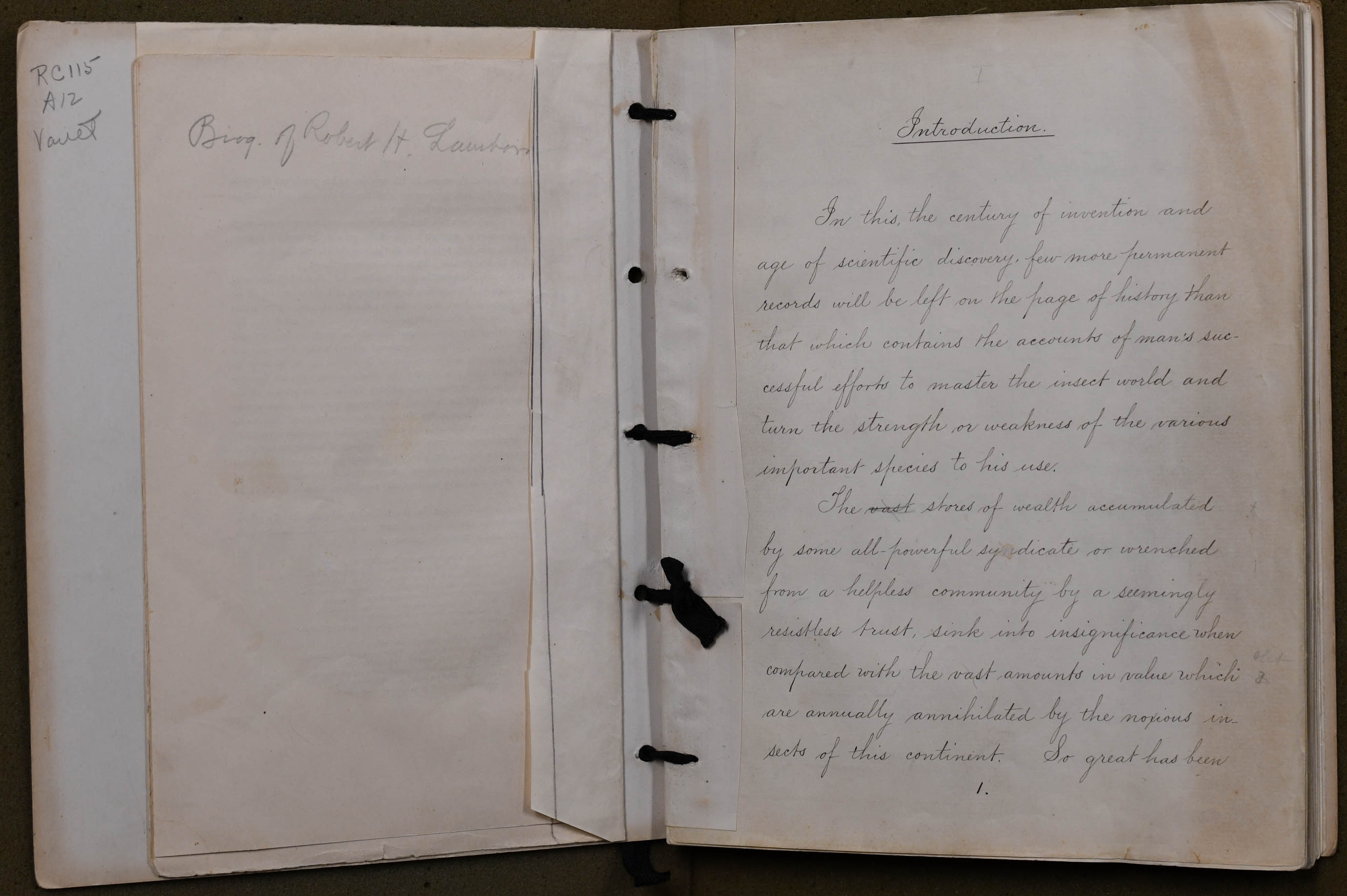
The core artifact of this discovery is a meticulously handwritten manuscript titled A notebook containing an entomological essay by Carrie Aaron. Composed across the turn of the 20th century, the notebook captures a period of intense public and scientific interest in vector-borne diseases.
Aaron submitted her comprehensive essay to a high-stakes competition established by Dr. Robert Henry Lamborn. Lamborn’s motivation to find solutions for mosquito populations stemmed from his miserable personal experiences while overseeing the construction of the Lake Superior Railroad, where he was repeatedly besieged by clouds of insects. In response, Lamborn offered cash prizes for the three most insightful essays detailing methods to eradicate or mitigate the pest.
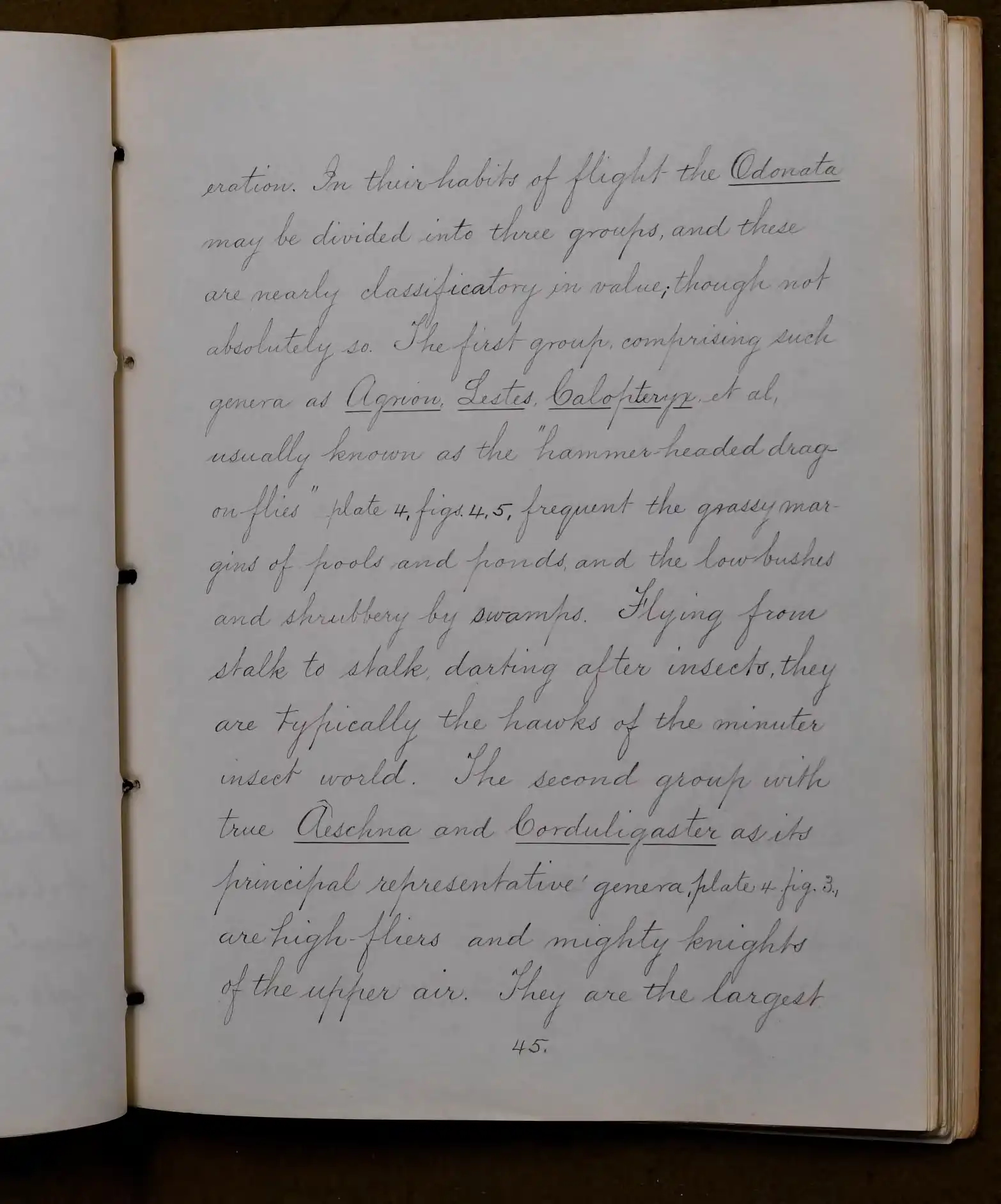
Aaron’s submission, later published alongside other select entries in the compiled volume Dragon Flies vs. Mosquitoes: Can the Mosquito Pest be Mitigated? under the title "The Dipterous Enemies of Man," showcased a sophisticated grasp of entomology. Within her notebook, Aaron analyzed various biological controls. Notably, she championed dragonflies, famously dubbing them "the hawks of the minuter insect world."
In a testament to the hands-on, fearless nature of 19th-century amateur and professional naturalists, Aaron and her research peers even attempted to inoculate themselves with what was then thought to be poisonous fluid extracted from mosquitoes. The experiment ultimately failed—a shortcoming Aaron wryly attributed to the "inferiority of the needle as an injector, compared with the delicate hypopharynx."
1890: Praise from Henry Skinner
Following her success in the competition, prominent entomologist Henry Skinner sent Aaron a warm congratulatory letter, affirming that her essay and prize placement meant her reputation in the field would "now be well established." This letter became a foundational anchor within her personal manuscript collection preserved at the Academy.
January 11, 1900: Resignation from the American Entomological Society
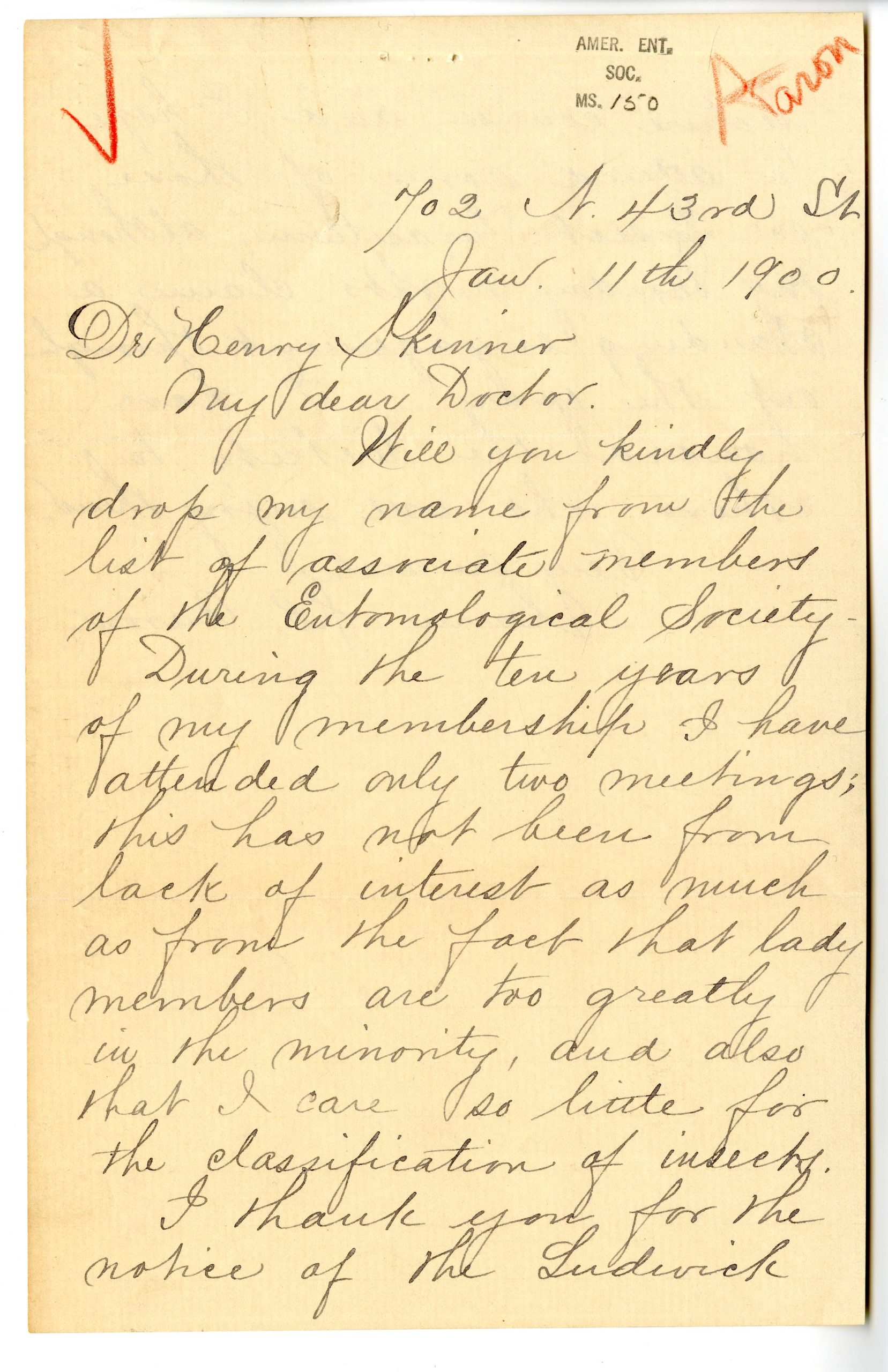
Despite her established expertise, Aaron experienced firsthand the systemic barriers and professional isolation facing women in 19th- and early 20th-century science. Exactly ten years after receiving Skinner’s glowing letter, Aaron penned a candid communication to him requesting that her name be permanently removed from the associate membership list of the American Entomological Society (AES).
In her letter, she explained her detachment:
"During the ten years of my membership I have attended only two meetings; this has not been from lack of interest as much as from the fact that lady members are too greatly in the minority, and also that I care so little for the classification of insects."
1900–1923: A Lifelong Epistolary Friendship
While Aaron stepped away from formal society meetings, her relationship with the broader scientific community—and particularly with Henry Skinner—persisted. Her correspondence reveals a rich intellectual life sustained across decades. In a later letter written in 1923, Aaron expressly thanked Skinner for a "more than thirty year sympathetic friendship," highlighting that her withdrawal from institutional memberships was not a rejection of science itself, but rather of the exclusionary and dryly taxonomic cultures dominating formal societies at the time.
March 8, 1926: Dispatch from Southern California
Later letters digitized through contemporary projects capture Aaron traveling in Santa Monica, California, which she poeticized as "the land of perpetual bloom and uninterrupted sounds of birds and insects."
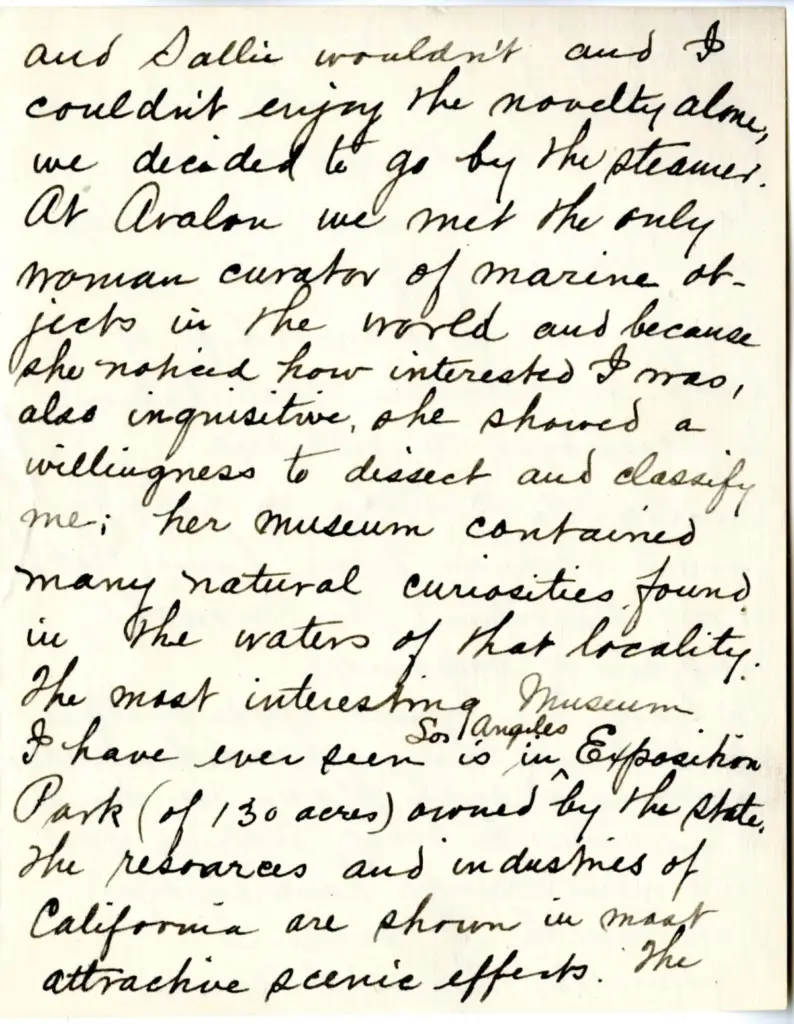
In a particularly evocative dispatch to Skinner, Aaron recounted an encounter that continues to captivate modern researchers:
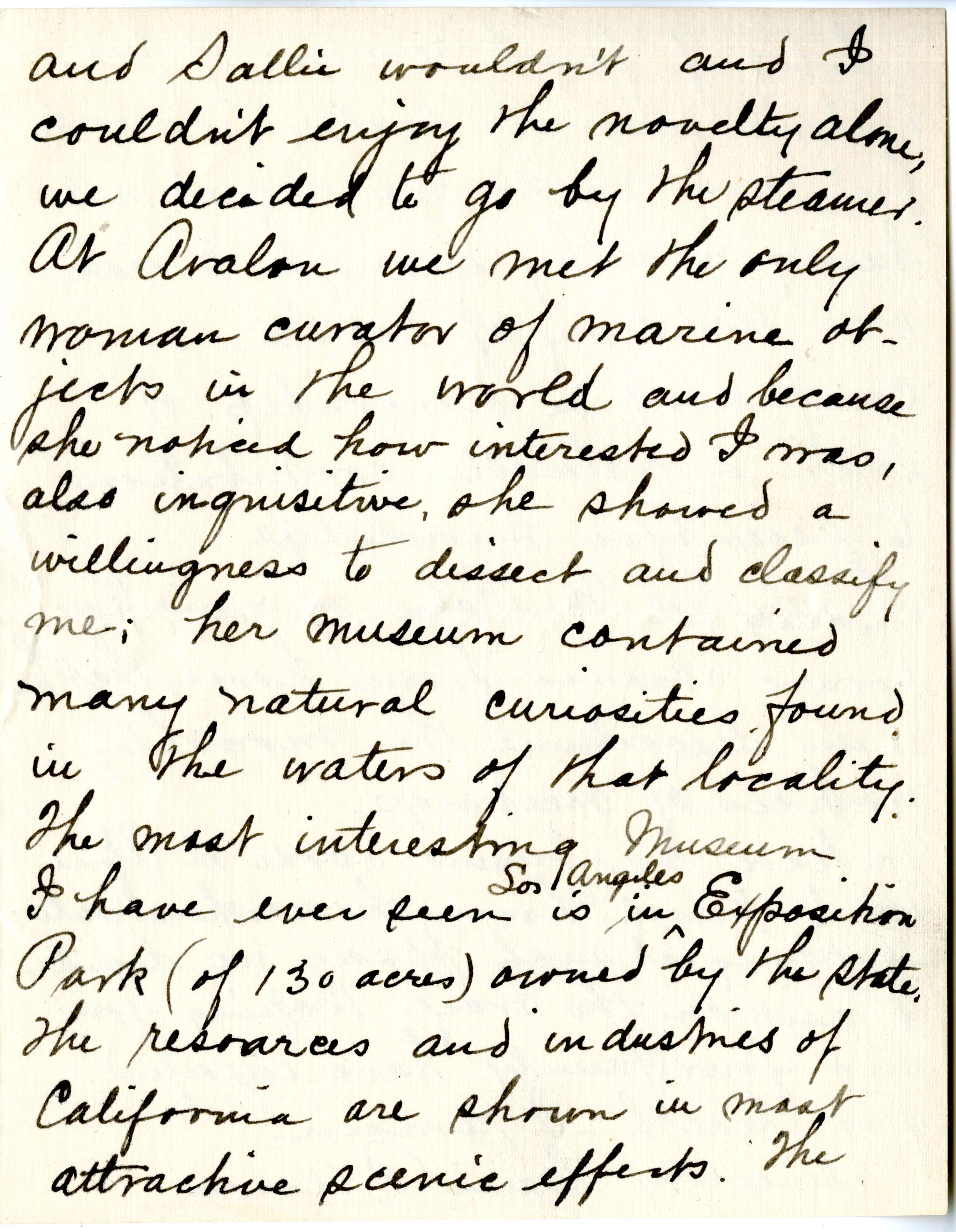
"At Avalon we met the only woman curator of marine objects in the world and because she noticed how interested I was, also inquisitive, she shared a willingness to dissect and classify me; her museum contained many natural curiosities found in the waters of that locality. The most interesting museum I have ever seen is in Los Angeles, Exposition Park (of 130 acres) owned by the state, the resources and industries of California are shown in most attractive scenic effects. The exhibit of fossil remains of prehistoric animals really is wonderful, and made me regret not being healthy enough to make our Academy of Nat. Sci. a competitor in ownership of such a valuable contribution to scientific knowledge."
Present Day: Digital Resurrection
Fast forward nearly a century. As the Academy of Natural Sciences of Drexel University prepared contributions for the BHL’s 20th anniversary, library staff targeted 83 historical scientists’ notebooks and field journals for digitization and transcription under the BHL Field Journal Fixup initiative. Among them was Carrie Aaron’s entomological notebook.
Supporting Context & Metrics
The rediscovery of Carrie Aaron underscores a systemic issue deeply familiar to gender historians and digital humanities scholars: the historical minimization of women in natural science archives.
Metadata Remediation and the Power of Identifiers
When Briana Giasullo, Cataloging and Digital Resources Librarian at the Academy, first encountered the manuscript, the legacy finding aid record identified the author merely as "Mrs. Aaron." This practice—common in historic library cataloging—strips women of their given names, subsuming their professional and intellectual identities entirely beneath their marital status. Such entries render historical female scientists virtually invisible to modern researchers utilizing keyword searches.
Recognizing the error, Academy Archivist Jessica Lydon intervened, providing critical biographical details. This allowed Giasullo to execute a vital technological intervention: constructing a dedicated BHL Creator ID for Carrie Aaron and bridging it to an official Wikidata identifier (Q125503946).
While metadata updates can appear dry or administrative to outside observers, these digital hooks are the lifeblood of modern historical research. They allow disparate databases to recognize Carrie Aaron not as an anonymous housewife, but as a distinct historical actor, researcher, and author.
Project Metrics and Institutional Collaboration
The rescue of Aaron’s narrative was made possible through a tightly coordinated institutional effort:
- 83: Notebooks and field journals digitized and transcribed for the BHL project from the Academy’s collections.
- 1: Comprehensive digitization initiative targeting the American Entomological Society (AES) correspondence collection, spearheaded by student intern Will Le.
- 20 Years: The milestone anniversary of the Biodiversity Heritage Library, celebrated globally by a network of natural history and botanical libraries.
- PA Photos and Documents: The digital repository platform hosting the newly accessible AES correspondence, funded generously by Dr. William Day and the American Entomological Society.
Official Statements & Institutional Perspectives
The collaborative framework driving these discoveries relies on passionate professionals dedicated to blending archival preservation with modern digital accessibility.
Reflecting on the unexpected journey sparked by the project, Briana Giasullo noted the profound impact of working with primary sources:
"After working with archival notebooks and reading Carrie Aaron’s letters, I’m thrilled to see how digitization and public access to collections spur research into lesser-known individuals and uncover more potential research subjects! I don’t consider myself a historian, but it’s difficult to resist historical research when presented with easily accessible primary sources and when given the tools to link subjects across different platforms. I hope to continue this energizing work at the Academy of Natural Sciences in collaboration with BHL for years to come."
The BHL central administration similarly emphasizes the human stories hidden within dusty library stacks. For two decades, the platform has actively dismantled structural siloes in scientific literature, ensuring that historical records are not merely preserved, but brought to life by new generations of scholars, students, and digital explorers.
Future Outlook
Carrie Aaron’s return to the historical record does not end with the digitization of her mosquito essay. In fact, her letters have opened up an entirely new avenue of historical inquiry.
Library staff at the Academy are now actively pursuing a fresh research question sparked by Aaron’s 1926 letter: Who was "the only woman curator of marine objects in the world" operating in Avalon whom Aaron was so thrilled to meet?
This ongoing detective work exemplifies the cascading value of digital archives. When institutions invest in digitization, transcription, and robust metadata linking, they do not just preserve the past—they ignite dynamic, open-ended investigations that draw everyday librarians, researchers, and students into the thrill of discovery.

As the Biodiversity Heritage Library looks toward its next chapter, the story of Carrie Aaron stands as a shining testament to why these digital preservation efforts matter. By rescuing overlooked voices from the margins of history, platforms like BHL ensure that the full, diverse tapestry of scientific discovery is visible, searchable, and celebrated worldwide.



