

Executive Overview
As the impacts of a warming planet intensify, communities worldwide are confronted with an escalating climate crisis characterized by more frequent, severe, and unpredictable flooding. Driven by the dual engines of climate change and rapid urbanization, nearly 2 billion people are projected to be exposed to catastrophic floods by the year 2100—an alarming surge of 300 million people compared to 2020 baselines. Traditional engineering paradigms, which rely heavily on massive, permanent infrastructure projects such as concrete levees, sea walls, and dam networks, are increasingly proving to be financially prohibitive, ecologically disruptive, and too slow to deploy in the face of sudden climate shocks.
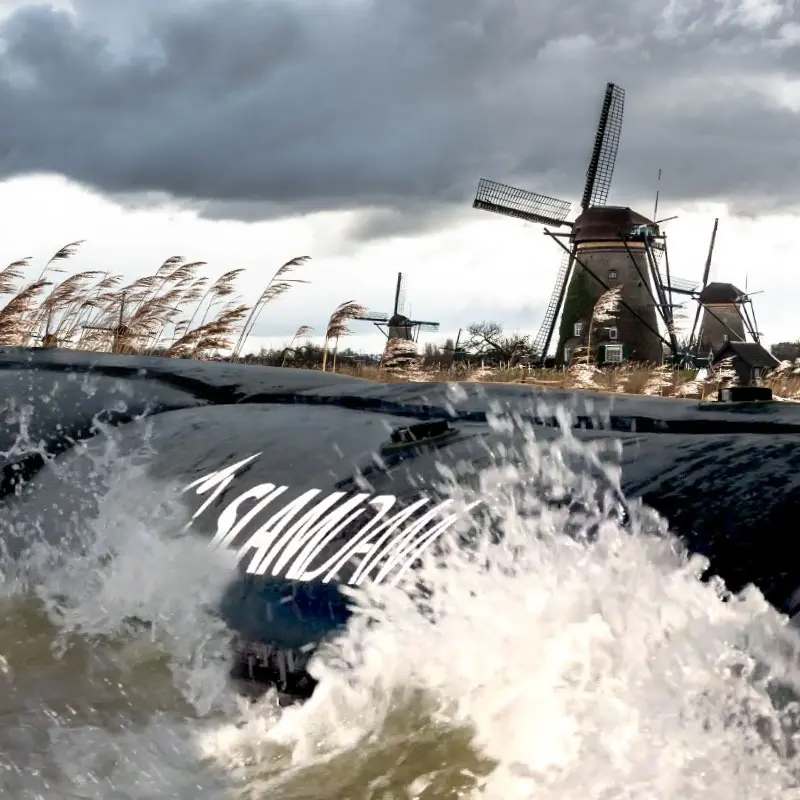
Enter WaveSave, a pioneering Dutch climate-tech enterprise that has reimagined emergency flood defense through a deceptively simple yet profoundly effective innovation: the SlamDam. Designed as a portable, rapidly deployable rubber dam, the SlamDam allows communities, regional water authorities, and industrial operators to establish robust flood defenses in the critical early hours of an impending disaster. Unfurled along vulnerable riverbanks, coastlines, or urban perimeters and rapidly inflated using standard portable water pumps, the device swells into a formidable barrier standing up to 1.3 meters high.
Beyond its immediate utility as a shield for residential properties, agricultural lands, and critical infrastructure—including hospitals and water treatment plants—the SlamDam offers a secondary, transformative benefit. By functioning as a temporary reservoir during freshwater floods, it captures millions of liters of vital water. In the ensuing dry seasons, this stored water can be drawn upon for crop irrigation, turning a destructive natural hazard into a lifeline for drought-prone regions.
With a lifespan exceeding 40 years, deployments spanning at least a dozen countries across Europe, Africa, and Southeast Asia, and ambitious plans for regional manufacturing hubs, WaveSave is carving out a unique niche in the global climate adaptation market. This in-depth report explores the genesis, mechanics, socioeconomic impacts, hurdles, and future trajectory of the SlamDam, illuminating how low-tech ingenuity is transforming the architecture of disaster resilience.
Detailed Chronology: The Evolution of SlamDam
Inception and Dutch Roots (2013–2015)
The story of the SlamDam began in 2013 within the water-conscious landscape of the Netherlands, a nation uniquely attuned to the existential threats of rising sea levels and overflowing rivers. Developed by WaveSave, the concept was born out of a pressing need for a flexible, temporary alternative to rigid dikes and sandbags—the latter of which are labor-intensive to fill, prone to seepage, and difficult to dispose of safely after use.
During its formative years, the SlamDam underwent rigorous testing by regional Dutch water authorities (waterschappen), entities renowned for managing some of the world’s most sophisticated water defense systems. These early trials validated the product’s core engineering principles: rapid deployment by untrained personnel, structural integrity under dynamic water pressure, and ease of deflation, cleaning, and storage for future emergency cycles.
International Expansion (2016–2021)
Buoyed by domestic validation, WaveSave began looking outward, recognizing that developing economies in the Global South often bore the brunt of climate-induced flooding without access to multi-billion-dollar state engineering budgets. The company expanded its operational footprint into regions of Africa and Southeast Asia.
Rather than relying solely on high-tech, capital-intensive infrastructure sales, WaveSave tailored its deployment model to work alongside local disaster management agencies, non-governmental organizations (NGOs), and community groups. The SlamDam was successfully integrated into flood-preparedness frameworks in vulnerable river basins, proving its adaptability across diverse geographies, from tropical floodplains to densely populated rural communes.
The Turning Point in Burundi (2022)
A watershed moment for WaveSave occurred during the 2022 flood season in the rural Mpanda commune of Burundi, East Africa. Deployed as a localized barrier to protect agrarian communities from seasonal overflows, the SlamDam demonstrated its dual-purpose value proposition.
While the barrier successfully diverted raging floodwaters away from arable land and homesteads, it simultaneously acted as an intentional storage basin. In the weeks following the cresting of the floods, local farmers tapped the clean freshwater retained inside the mobile dams to irrigate their crops through the ensuing dry spell. According to a landmark United Nations Environment Programme (UNEP) Climate Technology Centre and Network (CTCN) report, farmers with access to this stored water achieved remarkable gains, successfully producing additional crop yields and effectively doubling their annual incomes. This real-world success shifted perceptions of the SlamDam from a purely defensive emergency tool to an integrated water-security asset.
Scaling and Recent Contracts (2023–Present)
As global climate volatility accelerated, demand for decentralized adaptation tools surged. WaveSave has recently secured pivotal contracts totaling approximately $5.3 million for four major resilience projects across Djibouti, Guinea, and Burundi. Concurrently, Managing Director Omar Saleh reports a "substantial pipeline" of municipal and institutional interest developing across Southeast Asia and Latin America.
Operating leanly as a self-financed enterprise with a dedicated team of just seven employees, WaveSave has navigated this growth phase by reinvesting profits organically. To address burgeoning international demand and reduce logistical overhead, the company is preparing to transition from centralized European manufacturing to localized production facilities.
Supporting Context & Metrics: The Economics and Science of Resilience
The Macro Threat: Flooding by 2100
The urgency underpinning WaveSave’s mission is underscored by stark demographic and climatic forecasts. According to research published in scientific literature analyzing global exposure trends (such as projections highlighted in Nature), nearly 2 billion people will be directly exposed to significant riverine and coastal flood risks by the year 2100. This represents an increase of 300 million individuals compared to 2020 figures. Rapid population growth in flood-prone river deltas and coastal mega-cities, combined with shifting meteorological patterns that spawn more intense precipitation events, means that static defense measures will inevitably fall short.

Cost-Benefit Analysis: Temporary vs. Permanent Infrastructure
Traditional flood mitigation involves massive capital expenditures (CapEx). Constructing concrete levees, elevating entire industrial facilities, or relocating municipal infrastructure requires years of planning, environmental impact assessments, and millions—sometimes billions—of dollars.
In contrast, the SlamDam operates on a modular, on-demand financial model:
- Unit Pricing: A standard five-meter section of the SlamDam costs between €1,000 and €3,000 (approximately $1,140 to $3,400 USD), depending on the specified height requirements.
- Scalable Footprint: Protecting a single residential doorway or critical facility entrance may require as little as 10 meters of barrier. Conversely, surrounding a small hospital, water treatment plant, or agricultural perimeter typically demands 200 to 300 meters of deployment.
- Lifespan and Reusability: Fabricated from heavy-duty, puncture-resistant rubber polymers, each SlamDam boasts an operational lifespan exceeding 40 years. Because they can be repeatedly deployed, deflated, washed, and stored, their amortized cost per emergency deployment is exceptionally low compared to single-use sandbagging operations or recurring flood-damage repairs.
Operational Logistics
Deploying a SlamDam does not require heavy machinery or specialized engineering corps. Using standard portable water pumps readily available to local municipalities or agricultural co-ops, installers unfurl the collapsed rubber tubes along a predetermined alignment and fill them with ambient water. As internal pressure mounts, the dam self-anchors and forms a watertight seal against the ground. When the floodwaters recede, the drainage valves are opened, the water is safely released or harvested, and the deflated material is folded into compact storage units.
Official Statements and Industry Insights
Despite its commercial traction, WaveSave operates within a competitive landscape populated by other mobile flood barrier manufacturers, such as AquaFence, MegaSecur, and NOAQ Flood Protection. However, WaveSave has carved out a distinct market position by prioritizing rapid, low-logistical-footprint emergency deployment in developing nations, coupled with the unique hydrological capability of water harvesting.
Nevertheless, transitioning innovations from European testing grounds to the frontlines of climate-vulnerable nations is fraught with operational hurdles. A comprehensive academic study conducted by an independent research team analyzing the introduction of SlamDams in Kenya illuminated several critical adoption barriers:
- Institutional Governance and Ownership: In many decentralized rural communities, ambiguity surrounding institutional ownership proved challenging. Questions arose regarding who bore ultimate responsibility for purchasing, maintaining, storing, and deploying the barriers when an emergency alert was issued.
- Upfront Capital Constraints: While the SlamDam is cost-competitive over its lifecycle, the initial purchase price of €1,000 to €3,000 per five-meter section remains prohibitively expensive for individual smallholder farmers or cash-strapped local governments in the Global South.
Addressing these challenges head-on, WaveSave’s Managing Director, Omar Saleh, has articulated a forward-looking strategy designed to democratize access to the technology. Recognizing that upfront purchasing barriers can stifle adoption where resilience is needed most, Saleh revealed that WaveSave is actively exploring a "SlamDam-as-a-Service" (DaaS) operational model. Under this framework, barriers would be maintained in regional depots and deployed on demand or leased to municipalities and cooperatives, transforming a capital expenditure into a manageable operational expense.
Furthermore, Saleh emphasizes that the company’s growth strategy is deliberately measured. By maintaining a lean, seven-person core team and relying on organic revenue reinvestment rather than dilutive venture capital, WaveSave aims to preserve its mission-driven focus on grassroots climate adaptation.
Future Outlook: Scaling Production and Integrated Water Management
As WaveSave looks toward the horizon of 2027 and beyond, its strategic roadmap centers on geographic decentralization, supply chain optimization, and holistic water service integration.
Localized Manufacturing Hubs
Currently, all SlamDams are manufactured by an external production partner based in the Netherlands and subsequently shipped to international clients. While this ensures strict quality control, international shipping costs and import tariffs can inflate acquisition expenses for buyers in the Global South.
To mitigate this, WaveSave has established an ambitious timeline to inaugurate its first local production facility in Southeast Asia in early 2027, followed by a second regional manufacturing hub in East Africa. By shifting production closer to key emerging markets, WaveSave expects to significantly reduce unit costs, slash delivery lead times, and stimulate local green-collar job creation.
Expanding into Integrated Water Services (IWS)
True to its evolution from a barrier manufacturer to a comprehensive resilience partner, WaveSave is expanding its service portfolio. Future company growth will heavily involve advisory and consulting services. WaveSave plans to partner with local governments and NGOs to guide communities on how to design, install, and operate simple, off-the-shelf rainwater harvesting and irrigation networks.
By framing flood defense not merely as an emergency barricade exercise, but as an integral component of comprehensive water resource management, WaveSave is helping climate-stressed regions turn their greatest environmental vulnerability into an enduring agricultural asset.
Conclusion
As global temperatures continue to rise and extreme weather events become the new normal, humanity must move beyond reactive disaster management and embrace proactive, adaptable resilience strategies. WaveSave’s SlamDam exemplifies the power of decentralized, low-tech climate innovation. By bridging the gap between immediate flood protection and long-term water security—turning raging, destructive floods into life-giving irrigation reserves—WaveSave is proving that the most effective climate solutions are often those that work with nature rather than attempting to brute-force it into submission. With localized manufacturing on the horizon, innovative service models in development, and a proven track record from the riverbanks of Europe to the agrarian communes of East Africa, the SlamDam stands ready to hold back the rising tide for decades to come.



