

Executive Overview
As the autumn of 2026 unfolds, communities across the western coast of the United States are bracing for what scientists warn could be a historic and tumultuous winter. Driven by a rapidly intensifying El Niño climate pattern—dubbed "super" and "Godzilla" by forecasters—the Pacific Ocean is brewing conditions that experts fear could soon climb completely off the charts. The consequences extend far beyond local flooding; they represent a terrifying glimpse into a hyper-accelerated climate future where compounding environmental hazards strike simultaneously.
In the San Francisco Bay Area, the U.S. National Weather Service issued two separate coastal flood advisories in a single month—a phenomenon that had literally zero historical precedent for September prior to this year. Down the coast, surging waters have swallowed major intersections, eroded public beaches, and battered marine infrastructure.
While state officials and emergency managers mobilize resources on an unprecedented scale, severe concerns linger regarding the federal government’s capacity to respond. Budget cuts, mass layoffs, and systematic rollbacks targeting frontline federal agencies like FEMA and NOAA have left the nation uniquely vulnerable. As California prepares for a harrowing collision of raging seas, flash floods, landslides, and lingering wildfire threats, experts warn that this winter will serve as a definitive, high-stakes test of modern disaster resilience.
Detailed Chronology of an Escalating Crisis
The early indicators of this extraordinary climate event began materializing months before the traditional rainy season, signaling an unusually aggressive atmospheric and oceanic transition.
Late Summer: Unprecedented September Advisories
For the first time since record-keeping began, the National Weather Service was forced to issue September coastal flood advisories for the San Francisco Bay Area. Traditionally a month of transitional weather and mild warmth, September 2026 brought anomalous sea levels and high tides that pushed saltwater over coastal infrastructure. These early warnings served as a jarring wake-up call for emergency personnel who typically do not activate flood protocols until late November.
Mid-September: The State of Emergency
On September 21, California Governor Gavin Newsom formally declared a state of emergency. This executive action cut through bureaucratic red tape to rapidly mobilize funding, equipment, and logistical resources. It catalyzed an immediate flurry of preparedness activities across local municipalities, from the Mexican border up to the Oregon state line. Infrastructure fortification projects were fast-tracked, and public awareness campaigns were launched to alert residents to the impending danger.
Early October: Compound Hazards in Southern California
By October, the state was forced to grapple with a dangerous hydrological paradox. While Pacific storms battered Southern California with explosive surf and strong coastal currents, the region simultaneously baked under a historic autumn heatwave. Record-shattering temperatures fueled high wildfire risks across parched landscapes, forcing emergency managers like Los Angeles County Office of Emergency Management Director Kevin McGowan to manage concurrent crises of fire and flood.
Ongoing Recovery and Reinforcement
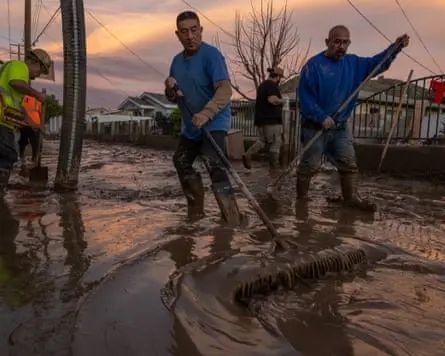
Communities hit hard by early-season storm surges are currently engaged in a frantic race against time. In Long Beach, crews have lined seawalls with industrial-grade sandbags to block destructive waves. In Orange County, engineering teams are pumping more than half a million cubic yards of sand onto eroding beaches. Meanwhile, municipal workers in San Diego are going door-to-door in vulnerable flood zones, helping small business owners elevate inventory and protect commercial storefronts ahead of the winter peak.
Supporting Context & Metrics: The Science of a "Godzilla" El Niño
To understand the severity of the current crisis, one must examine the staggering meteorological metrics underpinning the 2026–2027 El Niño event.

The Numbers Behind the Monster
- 90%+ Probability: According to the latest forecasts from the U.S. National Oceanic and Atmospheric Administration (NOAA), there is a greater than 90% chance that this El Niño cycle will reach "very strong" status.
- 75% Historic Potential: Climate models project roughly a three-in-four chance that this event will rank as historic, matching or exceeding the intensity of legendary benchmark years like 1997–1998 and 2015–2016.
- Global Mortality Projections: Climate scientists project that by February, more than 450,000 people worldwide could succumb to temperature spikes, extreme floods, severe droughts, and violent storms linked directly to the disruption of global weather systems.
- Sea Level Amplification: State Climatologist Michael Anderson notes that the physical effects of El Niño will add an immediate extra foot of sea level rise along the California coast. This is layered directly on top of the 8 to 12 inches of permanent sea level rise driven by global warming over the past century.
The Burn Scar Hazard
The danger is acutely amplified in regions recently impacted by catastrophic wildfires. Slopes in Big Sur that burned during the summer, alongside neighborhoods scarred by recent firestorms in Los Angeles, present an extreme risk of deadly debris flows and mudslides. According to watershed management experts, it typically takes a minimum of five years for burnt hillsides to regenerate sufficient vegetation and root stability to withstand high-volume precipitation events without collapsing.
Global Ripple Effects
Beyond the shores of North America, the macroeconomic and humanitarian ramifications are profound. The World Food Programme (WFP) has ramped up emergency preparedness plans, warning that tens of millions of people across vulnerable global regions could face acute food insecurity. Disruptions to agricultural yields in key breadbasket nations threaten to push international food prices significantly higher, triggering cascading economic and social instability.
Official Statements and Frontline Perspectives
As federal, state, and local entities brace for impact, leaders and emergency directors have offered sobering assessments of the challenges ahead.
- Governor Gavin Newsom: Emphasizing the necessity of proactive intervention during his emergency declaration, the governor stressed that California is deploying every available tool to protect lives, property, and critical infrastructure from the impending weather onslaught.
- Mark Pestrella, Los Angeles County Public Works Director: During a comprehensive briefing on local flood control systems, Pestrella confirmed that municipal reservoirs and storm-drain networks have been fully optimized. However, he offered a stark caveat regarding structural limitations:
"Our systems are ready, but they are only designed to withstand a so-called 100-year event. While those have historically carried a 1% chance of occurring in any given year, this El Niño significantly amplifies those odds."
- Kevin McGowan, LA County Office of Emergency Management: Highlighting the multifaceted nature of the unfolding crisis, McGowan noted:
"We are in the middle of traditional fire season and about to head into a significant heatwave… People should continue to prepare not just for one hazard—but all hazards."
- Monica Medina, Former Principal Deputy Administrator of NOAA: Expressing deep concern regarding federal readiness following recent budget cuts and staffing reductions implemented under the Trump administration, Medina warned:
"Agencies, particularly NOAA and FEMA, were already stretched because we have been seeing more and more extreme weather events. I worry about loss of life and about our inability to be protected at a time when you know we need our government the most. If this is a real test of a hotter, more precarious future, we’re going to flunk."
Future Outlook: A Critical Test for Climate Resilience
The unfolding "Godzilla" El Niño is more than a powerful seasonal anomaly; it serves as an uncompromising stress test for modern civil infrastructure and emergency management frameworks. As global temperatures continue to rise, extreme weather patterns that were once considered statistical anomalies are rapidly becoming the new baseline.
For California, the coming months will determine whether aggressive local preparations—such as beach replenishment, sandbag fortifications, and early emergency declarations—can successfully mitigate the worst-case scenarios. Yet, the broader institutional reality remains deeply troubling. At the exact moment in history when scientific precision, robust disaster response, and coordinated federal backing are most vital, institutional capacities have been hollowed out by political and financial retrenchment.
As Pacific storms line up off the coast and warm waters continue to feed the engine of this historic climate driver, the world watches and waits. Whether current defenses hold against the fury of the Pacific will offer a terrifyingly clear preview of humanity’s readiness for the unfolding climate reality of the decades ahead.



