

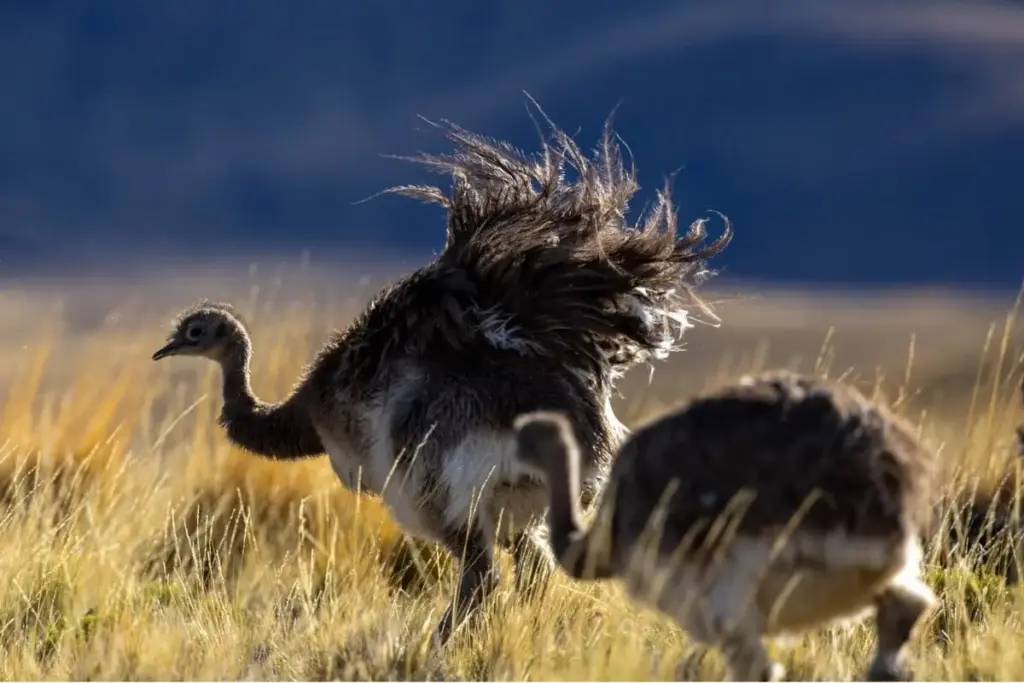
Executive Overview
Deep in the sweeping, wind-scoured steppes of Chile’s Patagonia National Park, a quiet ecological revolution is unfolding. For more than a century, the Chacabuco Valley was dominated by intensive sheep and cattle ranching—a legacy of heavy industrial agriculture that left the land laced with miles of dividing wire fences, stripped of its native flora via overgrazing, and nearly devoid of its characteristic fauna. Among the casualties of this century-long habitat degradation was the Darwin’s rhea (Rhea pennata), a flightless, ground-dwelling bird native to the South American pampas and steppes, which slipped toward local extinction.
Today, however, the tide is turning. In April 2026, Mongabay embedded with a dedicated, women-led conservation team to document one of South America’s most ambitious rewilding operations. Working in tandem with the Rewilding Chile Foundation—an offshoot of the visionary Tompkins Conservation—these rangers spend months tending to a cohort of 13 Darwin’s rheas in a high-stakes, around-the-clock preparation effort. Facing volatile Patagonian weather, predatory pumas, illegal livestock grazing, and the lingering scars of historical land management, this all-female team is orchestrating the birds’ reintegration into a landscape striving to heal.
More than just a species reintroduction, this initiative represents a foundational pillar of ecosystem restoration. Often described by park rangers as the “gardeners of the steppe,” rheas play a vital, irreplaceable role in seed dispersal and native vegetation dynamics. This report examines the intricate mechanics of the April 2026 release, the broader context of the Tompkins-led rewilding crusade in Chile, the ecological metrics governing the Chacabuco Valley’s recovery, and the profound philosophical lessons imparted by a decade of persistent, ground-level conservation work.
Detailed Chronology: Anatomy of a Release
The Preparatory Phase: A Year of Diligent Stewardship
The journey toward releasing 13 Darwin’s rheas back into the wild is not a spontaneous event; it is the culmination of nearly 365 days of continuous labor, veterinary oversight, and behavioral monitoring. Stationed at the park’s specialized Rheas Reproduction Center, rangers have spent years fine-tuning the captive-breeding and acclimation protocols.
"This release will be the third release of the year," notes a senior ranger who has dedicated a decade of her life to the facility. "It’s a process that takes practically an entire year of work. Here, they go through about two months of acclimation before they can be released."
During this critical two-month pre-release window, the birds are kept in specialized enclosures designed to minimize human imprinting while maximizing their physical fitness. Rangers closely monitor the cohort’s nutrition, ensuring optimal body condition, robust feather development, and strong social cohesion within the flock. Because Darwin’s rheas are highly social animals that rely on group dynamics rather than individual survival instincts, maintaining a cohesive flock structure during the captive phase is paramount.
Navigating Natural and Anthropogenic Threats
Life at the edge of the Patagonian wilderness is fraught with peril. The reproduction center and the surrounding release sites sit squarely within territory heavily populated by pumas (Puma concolor), the apex mammalian predator of the region.
"We also live in a landscape where pumas are the main predator," the ranger explains. "We’re always making sure they don’t get into the corrals. This kind of fence also has an angle that reduces the possibility of a puma crossing it by jumping."
Beyond natural predators, the legacy of human infrastructure looms large. Although Tompkins Conservation has systematically dismantled thousands of kilometers of legacy fencing across former ranchlands, lingering interior barriers, illegal livestock grazing, and poorly monitored park boundaries continue to threaten the fragile recovery of the steppe. The team must constantly balance the physiological readiness of the birds against external environmental factors—chief among them being Patagonia’s notoriously volatile weather patterns.
The Day of Release: Wind, Empathy, and the Open Steppe
As the targeted release day arrived in April 2026, environmental conditions presented immediate operational hurdles. Patagonia is globally infamous for its gale-force winds and sudden, drastic temperature drops.
"Our biggest concerns are the environmental conditions on release day," notes the team lead. "We’re in an area where winds are very strong. And we have drastic temperature changes. If the wind remains like this, we might release them over there close to the guanacos."
The decision to release the rheas near populations of guanacos (Lama guanicoe) is intentional; the two native species share broad ecological niches and frequently co-exist across the Patagonian plains, providing the newly freed birds with familiar, reassuring behavioral cues.
The logistical challenge of transferring the 13 rheas from the reproduction center into custom transport boxes is executed with meticulous care to minimize stress.
"We get stressed about stressing them," the rangers confess, displaying a profound empathy for their charges. "We don’t want to harm them when we put them in the transport boxes."
Invited witnesses, including local science educators and students, watched in hushed anticipation as the transport box lids were unlatched.
"The lid is small. You raise the first one. And then you take the second one off. Three, two, one. Go."
The moment of liberation was electric yet remarkably serene. Far from bolting in blind panic, the birds emerged into the open Chacabuco Valley with measured calm.
"It was a very emotional moment," the team recounted. "It was super calm. They’re eating. The animals were super calm. We immediately saw them grazing, eating, and for us, that’s a very good sign. They explored and are already kilometers and kilometers away."
Supporting Context & Metrics: The Science of Steppe Rewilding
Historical Context of the Chacabuco Valley
To understand the significance of the 2026 rhea release, one must look backward across a century of profound ecological disruption. For generations, the Chacabuco Valley was managed primarily for sheep and cattle production. This industrial pastoralism demanded absolute control over the landscape: native vegetation was cleared or heavily grazed down, predators like pumas and foxes were systematically targeted, and the landscape was carved into a rigid chessboard of wire fencing.
These fences did more than just demarcate property lines; they acted as severe ecological barriers. Large herbivores and flightless birds like the Darwin’s rhea were cut off from their traditional migration and foraging routes. Consequently, historical wildlife surveys conducted prior to the establishment of Patagonia National Park painted a grim picture.
"There were surveys estimating a very small number, only around 11 to 15 individuals," field experts note regarding the baseline rhea population when modern conservation interventions began. "When I arrived in 2016, you simply didn’t see many rheas."
The Tompkins Conservation Intervention
The trajectory of the Chacabuco Valley shifted dramatically when Tompkins Conservation stepped in, purchasing vast tracts of defunct ranchland and subsequently donating them to the Chilean government to form the core of Patagonia National Park.
The strategy was straightforward yet revolutionary: remove the human-made boundaries, restore natural hydrological and ecological flows, and reintroduce extirpated keystone species. Thousands of kilometers of obsolete sheep fencing were painstakingly rolled up and hauled away by conservationists and volunteers, opening up expansive corridors for wildlife movement.
The Ecological Role of the Darwin’s Rhea
Why focus so intensely on a flightless bird? Ecologists view the Darwin’s rhea not merely as an aesthetic addition to the park’s fauna, but as an indispensable ecosystem engineer.
"For me, the rhea is the gardener of the steppe," notes a long-serving conservationist. "We’ve found many different seeds in their droppings. This shows us they’re excellent seed dispersers. We believe their role is extremely important for restoring the steppe."
As these birds traverse vast home ranges in search of vegetation, seeds ingested during foraging are transported across kilometers and deposited via guano, effectively jump-starting the regeneration of native grasses and shrubs. Furthermore, researchers monitoring the park have observed cascading ecological recovery:
"We’ve seen more chicks over the years. More interactions between guanacos and rheas. More natural dynamics returning."
Official Statements and Perspectives
The rewilding of Patagonia National Park is deeply collaborative, drawing on insights from field biologists, park administrators, and educational partners who recognize that ecological restoration is as much a cultural challenge as it is a biological one.
On the Challenges of Cultural and Land-Use Integration:
"These changes take time. After more than a century of ranching, you can’t expect people to understand that the park has to be protected in just 10, 20 years." — Park Conservation Ranger
On Educational Outreach and Intergenerational Impact:
"As a science teacher, we thought it was very important for students to come visit a National Park, where conservation actions as powerful as a release are carried out." — Visiting Educator during the April 2026 release
On the Existential Lessons of Wildlife Stewardship:
"Releasing wildlife is an emotion you can’t really explain. You feel it from deep inside. What matters most to them is the group, not the individual. I think that’s an important lesson for us as humans who have always believed ourselves to be so superior." — Lead Wildlife Ranger, Patagonia National Park
Future Outlook: The Road Ahead for Patagonia National Park
As the dust settles over the April 2026 release of the 13 Darwin’s rheas, the work in Patagonia National Park is far from complete. The immediate priority for the women-led ranger team is post-release monitoring. Utilizing camera traps strategically positioned along wildlife corridors and water sources, researchers will track the dispersal, foraging efficiency, and survival rates of the newly integrated cohort.
Challenges on the Horizon
- Climate and Weather Extremes: As regional weather patterns become increasingly erratic due to global climate shifts, managing the delicate balance between captive acclimation and wild release will require heightened adaptability.
- Human-Wildlife Boundaries: While the park interior is heavily protected, managing buffer zones where park boundaries intersect with active pastoral lands remains a delicate, ongoing negotiation. Fencing removal is an ongoing project that requires continuous community engagement.
- Predator-Prey Equilibrium: Ensuring that the growing rhea populations can successfully navigate puma predation without artificial intervention is the ultimate benchmark of a fully functioning ecosystem.
A Beacon for Global Conservation
The success witnessed in the Chacabuco Valley offers a powerful blueprint for rewilding initiatives worldwide. By marrying rigorous scientific monitoring with deep emotional dedication, grassroots community engagement, and philanthropic vision, damaged landscapes can indeed be brought back from the brink.
For the gardeners of the steppe—the resilient Darwin’s rheas—the expansive plains of Patagonia National Park are wild once more. And for the women standing on the windy ridges watching them run, their work is proof that healing the earth is a collective, generational obligation.



