As summer temperatures regularly breach 40°C across the European continent and North America, modern electricity infrastructure is confronting an existential challenge. Heatwaves—amplified in frequency and intensity by anthropogenic climate change—are creating a dangerous operational scissors effect: simultaneously driving electricity demand to record highs while degrading the physical capacity and operational efficiency of nearly every major source of power generation.
When scorching conditions enveloped Europe in June and July 2026, electricity networks sagged under the weight of surging domestic and commercial air conditioning demand. In France alone, daily power consumption spiked by almost 20% over a two-week stretch. Simultaneously, nuclear reactors were forced to curb output, gas-fired turbines suffered severe thermodynamic penalties, wind speeds plummeted under persistent atmospheric high-pressure systems, and power transmission lines lost carrying capacity.
Despite the universal nature of these heat-induced operational constraints, political and media commentary frequently weaponizes extreme weather events to target renewable energy. Opponents routinely point to the "intermittency" of solar panels and wind turbines during hot spells while glossing over the acute vulnerabilities of traditional thermal power generation, including natural gas and nuclear energy.
A rigorous physical and economic examination reveals that no energy technology is immune to extreme heat. Understanding how each power generation source copes with thermal stress—and how grid operators navigate these overlapping vulnerabilities—is critical to building a resilient, decarbonized energy future.
Detailed Chronology: The Anatomy of a Modern Grid Crisis
The vulnerability of global energy infrastructure to extreme thermal events is not a novel phenomenon, but its frequency has accelerated dramatically over the past two decades. A historical timeline reveals a compounding pattern of heat-induced generation curtailments and grid emergencies:
                               HISTORICAL HEATWAVE CRITICAL EVENTS
┌─────────────────────────────────────────────────────────────────────────────────────────────────┐
│ 2003 European Heatwave: French nuclear fleet loses 5.5 TWh to thermal discharge limits          │
│ 2020 California Blackouts: Gas plants comprise ~79% of dropped capacity during heat dome         │
│ July 2024 US Sunbelt Crisis: Battery storage and solar prevent catastrophic Western grid failure│
│ June–Aug 2026 Pan-European Heatwave: Multi-sector generation drop triggers price spikes         │
└─────────────────────────────────────────────────────────────────────────────────────────────────┘
August 2003: A record-breaking European heatwave forces French utility EDF to curtail nuclear power output drastically, resulting in a 5.5 TWh loss in generation—the largest single-season heat loss on record for a national nuclear fleet.
July 2006 – August 2019: Successive heatwaves across Europe lead to recurring curtailments in France, Germany, and Switzerland, establishing thermal river limits as an annual operational risk for river-cooled plants.
August 2020: A prolonged heat dome across the Western United States triggers rolling blackouts in California as power demand outstrips supply. Post-event forensics reveal that natural gas power plants accounted for roughly 79% of the generation capacity that unexpectedly tripped or ramped down during peak demand hours on August 14.
Summer 2022: Severe drought and record heat sweep Western Europe, forcing France to reduce nuclear output across major river basins including the Rhône and Garonne, while river shipping disruptions restrict coal supply to German power stations.
June 2024: Amid a prolonged heatwave across the US Southwest, grid operators in California successfully avert rolling outages due to a massive deployment of utility-scale battery energy storage systems (BESS), which discharged stored solar power during critical evening peak hours.
June 24, 2026: Extreme temperatures and dead-calm winds force Great Britain’s National Electricity System Operator (NESO) to pay astronomical spot-market prices—up to £1,400 per megawatt-hour (MWh), nearly 20 times the monthly average—to balance supply and import emergency power via subsea interconnectors.
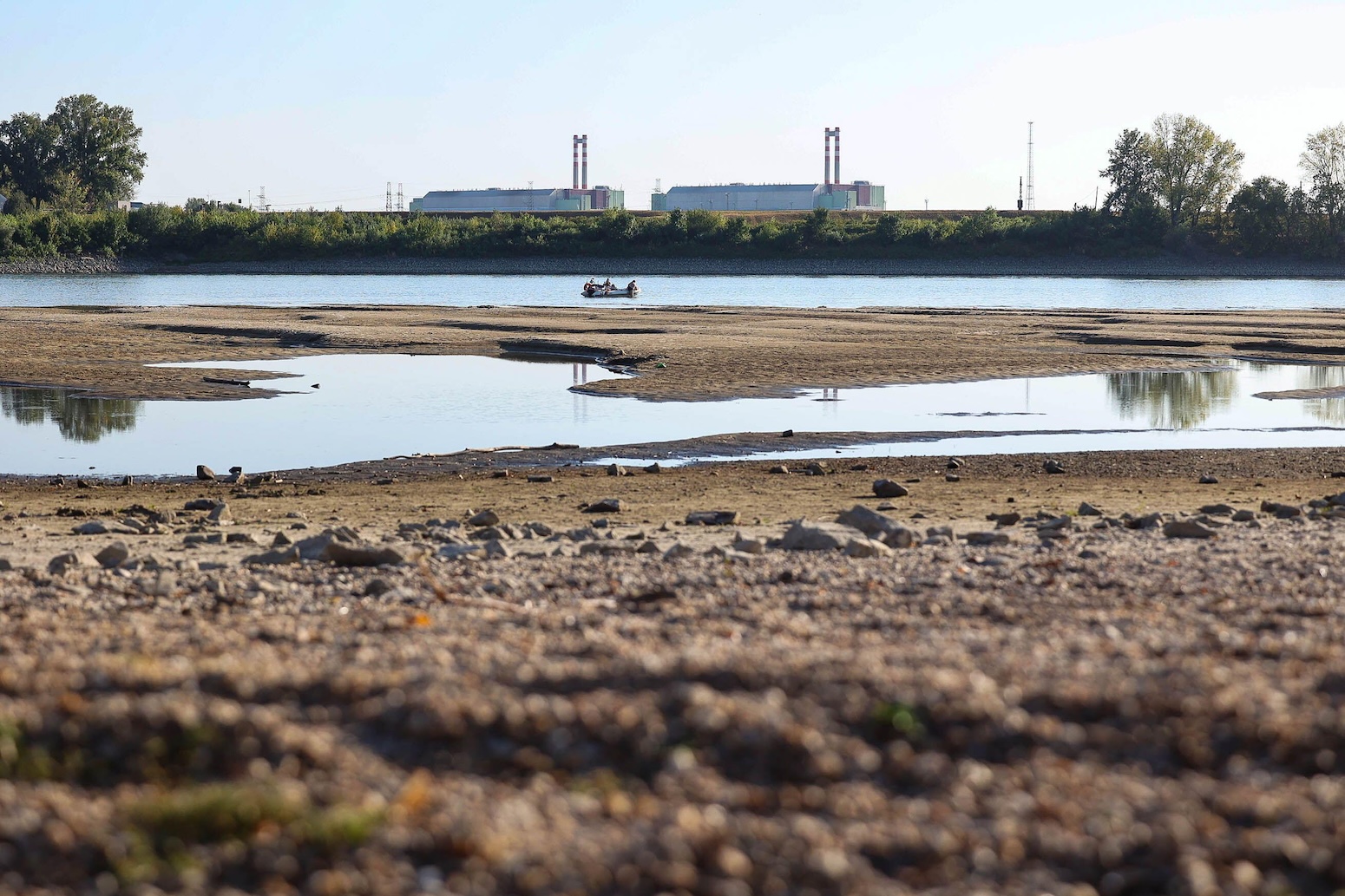
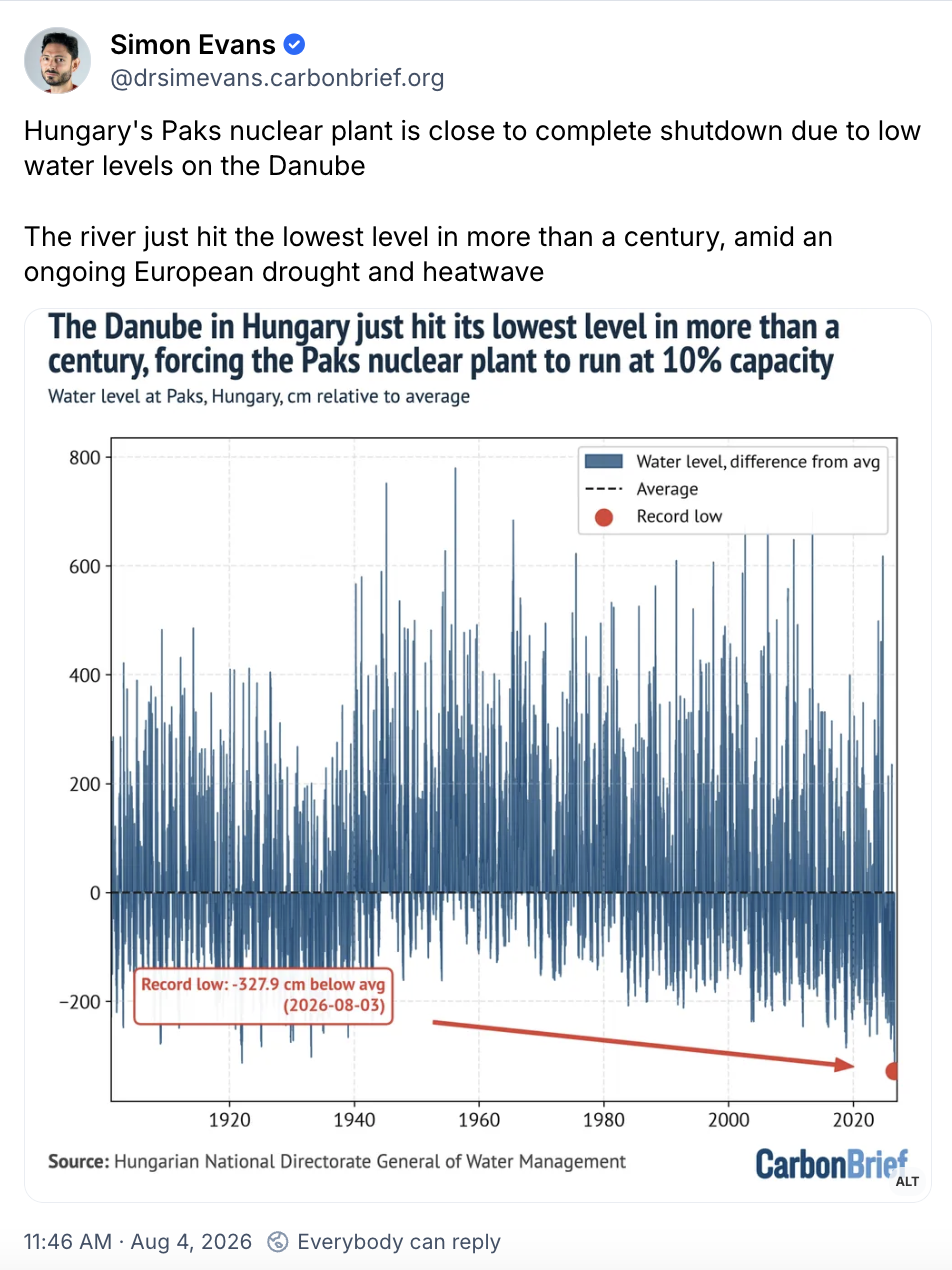
July–August 2026: A severe prolonged drought and heatwave hit Central and Eastern Europe. Water levels on the Danube drop to critical lows, forcing Romania and Hungary to shut down or throttle nuclear reactors. By August 3, roughly 2.44 gigawatts (GW)—or 40%—of Southeast Europe’s total nuclear capacity is forced offline, pushing regional power spot prices to winter-like peaks.
Supporting Context & Metrics: How Heat Affects Generation
To understand the systemic strain on the grid, each major electricity technology must be evaluated through its specific thermodynamic, mechanical, or meteorological constraints during extreme heat.
                      GENERATION EFFICIENCY LOSSES AT HIGH TEMPERATURES
┌──────────────────────┬───────────────────────────────────────────┬──────────────────────────────┐
│ Technology           │ Primary Heat Risk Mechanism               │ Performance Penalty          │
├──────────────────────┼───────────────────────────────────────────┼──────────────────────────────┤
│ Nuclear              │ Cooling water discharge limits & low flow │ 0.6%–1.0% efficiency drop/°C │
│ Natural Gas (CCGT)   │ Lower intake air density & thermal load   │ ~13% capacity drop at 40°C   │
│ Wind                 │ Stagnant heat domes & lower air density   │ 30%–50% output fall in heat  │
│ Solar PV             │ Photovoltaic cell thermal coefficient     │ 0.2%–0.5% loss per °C >25°C  │
│ Battery Storage      │ HVAC cooling overhead & thermal runaway   │ Reduced efficiency & runtime │
└──────────────────────┴───────────────────────────────────────────┴──────────────────────────────┘
1. Nuclear Power: Hydrological Dependencies and Regulatory Thresholds
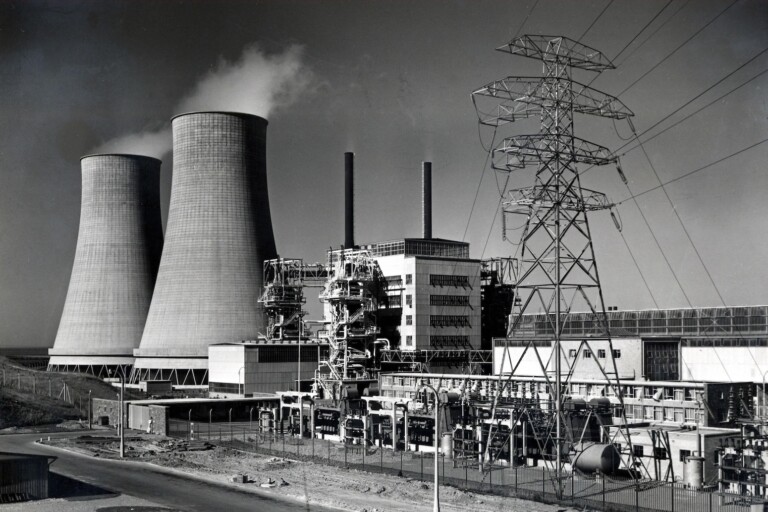
Nuclear plants generate heat through atomic fission, producing steam to spin turbines. To complete the thermodynamic cycle, this steam must be condensed back into water using vast volumes of cooling water drawn from sea or river sources. Roughly 14% of the global nuclear fleet (about 60 of 440 operational reactors globally) relies on once-through river cooling systems.
The impact of high ambient temperatures on nuclear facilities is governed by two distinct factors:
Thermodynamic Efficiency: As intake water temperature rises, the temperature differential inside the condenser narrows, reducing overall thermal efficiency. A nuclear facility loses between 0.6% and 1.0% in cycle efficiency for every additional degree Celsius increase in intake water temperature.
Legal and Ecological Limits: The far more acute constraint is regulatory. Environmental laws restrict the maximum temperature of water returned to natural ecosystems to prevent lethal thermal shock to fish and aquatic wildlife. When river temperatures reach statutory thresholds (typically around 28°C to 30°C depending on the jurisdiction), reactors must legally reduce output or shut down completely.
During the heatwave of July 2026, France saw three of its 57 reactors shut down completely, with output reduced at seven others, driving a temporary 9% to 12% loss in national nuclear production. In Eastern Europe, drought-induced low water levels on the Danube posed an even more severe operational threat: unlike brief water temperature spikes, persistent low river flows physically prevent cooling water intake, forcing prolonged plant outages such as those seen at Romania’s Cernavodă and Hungary’s Paks stations.
2. Natural Gas: Air Density and Combustion Penalties
Natural gas plants—frequently labeled "firm, dispatchable" capacity—face severe physical degradation when operating in hot air environments. Open-cycle gas turbines (OCGT) and combined-cycle gas turbines (CCGT) depend heavily on air mass flow for combustion and compression.
Air Density Effects: Warmer air is less dense than cooler air. Because a gas turbine is a constant-volume machine, lower air density reduces the total mass of oxygen entering the combustion chamber, directly lowering peak electrical output.
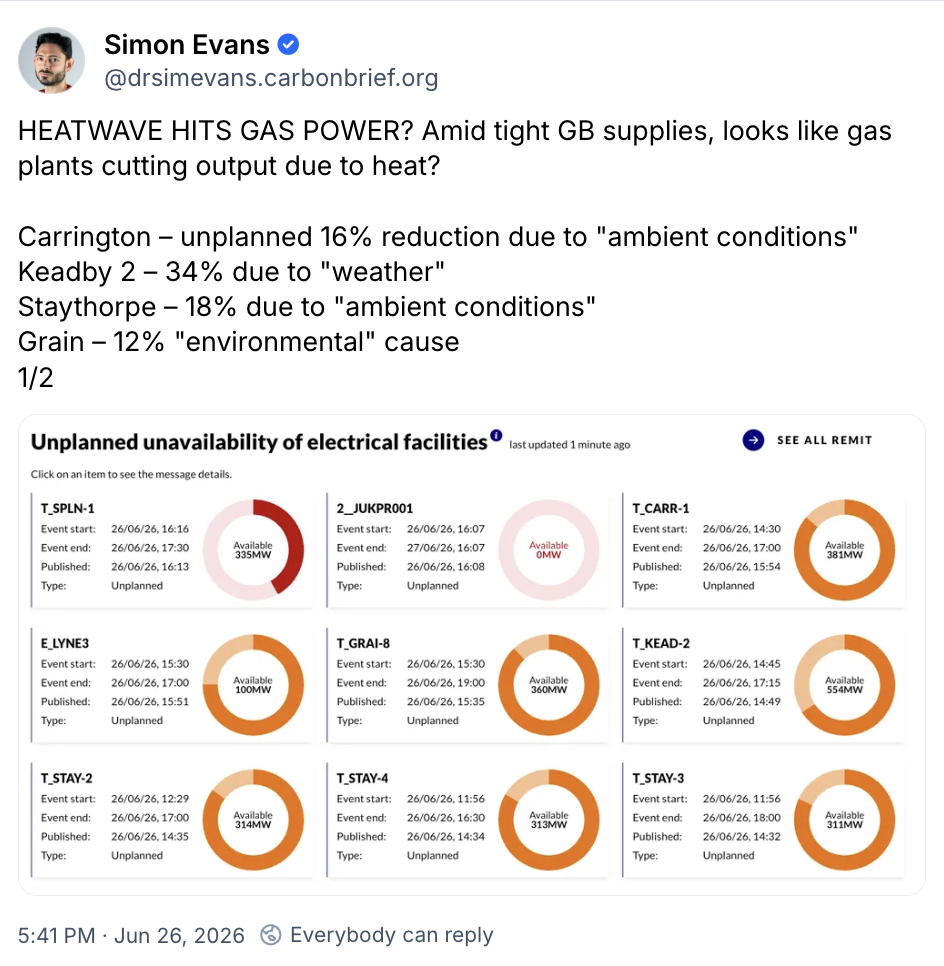
Thermal Penalty: According to data from Electric Insights, when ambient temperatures rise from a standard operating baseline of 20°C to 40°C, a gas power plant suffers an average capacity reduction of 13% and an efficiency drop of 7%. Simple-cycle peaker plants—the very units called upon to meet rapid peak demand spikes—experience an output drop of roughly 10% for every 10°C rise in temperature.
                   GAS TURBINE THERMODYNAMIC DEGRADATION
 Low Temp Air (20°C) ──> [ High Mass Flow ] ──> 100% Nominal Capacity
 High Temp Air (40°C) ──> [ Low Mass Flow  ] ──> ~87% Effective Capacity (-13%)
This thermodynamic dynamic explains why gas fleets consistently underperform during extreme summer events, despite having nominal installed capacity available on paper.
3. Wind Power: Atmospheric Highs and Heat Domes
The relationship between heatwaves and wind energy production is atmospheric rather than thermodynamic. Summer heatwaves are typically produced by persistent, stagnant high-pressure meteorological systems known as "heat domes."
Wind Velocity Reductions: High-pressure heat domes feature descending air currents that flatten horizontal pressure gradients, leading to sustained periods of extremely low surface wind speeds. A study examining global data from 1980 to 2023 published in Communications Earth & Environment revealed that high temperatures are strongly correlated with reduced wind speeds across three-quarters of the globe, cutting wind power output by 30% to 50% during heatwaves across Europe, Northern Asia, and Australia.
Air Density Factors: Similar to gas turbines, warmer air exerts less dynamic pressure on turbine blades, slightly reducing kinetic energy capture per unit of wind velocity.
During the Great Britain heatwave event on June 24, 2026, wind’s contribution to the national electricity generation mix plunged to 15%, compared to its monthly average of roughly 30%. However, energy analysts emphasize that summer wind drops are predictable, seasonal dynamics factored into annual system planning.
4. Solar Photovoltaics: The Efficiency Trade-off
A pervasive misconception in energy reporting is that intense summer heat "breaks" or renders solar panels ineffective. In reality, while elevated ambient temperatures do degrade the efficiency of photovoltaic (PV) materials, high summer irradiance far outweighs the thermal penalty.
Temperature Coefficient: Solar PV panels are rated at a standard laboratory testing temperature of 25°C. For every degree Celsius that the panel temperature exceeds 25°C, electrical efficiency drops by an industry average of 0.2% to 0.5%. On a day where ambient temperatures reach 40°C, rooftop or utility-scale panel surface temperatures can reach 65°C, causing a temporary output drop of 8% to 20% relative to peak theoretical output.
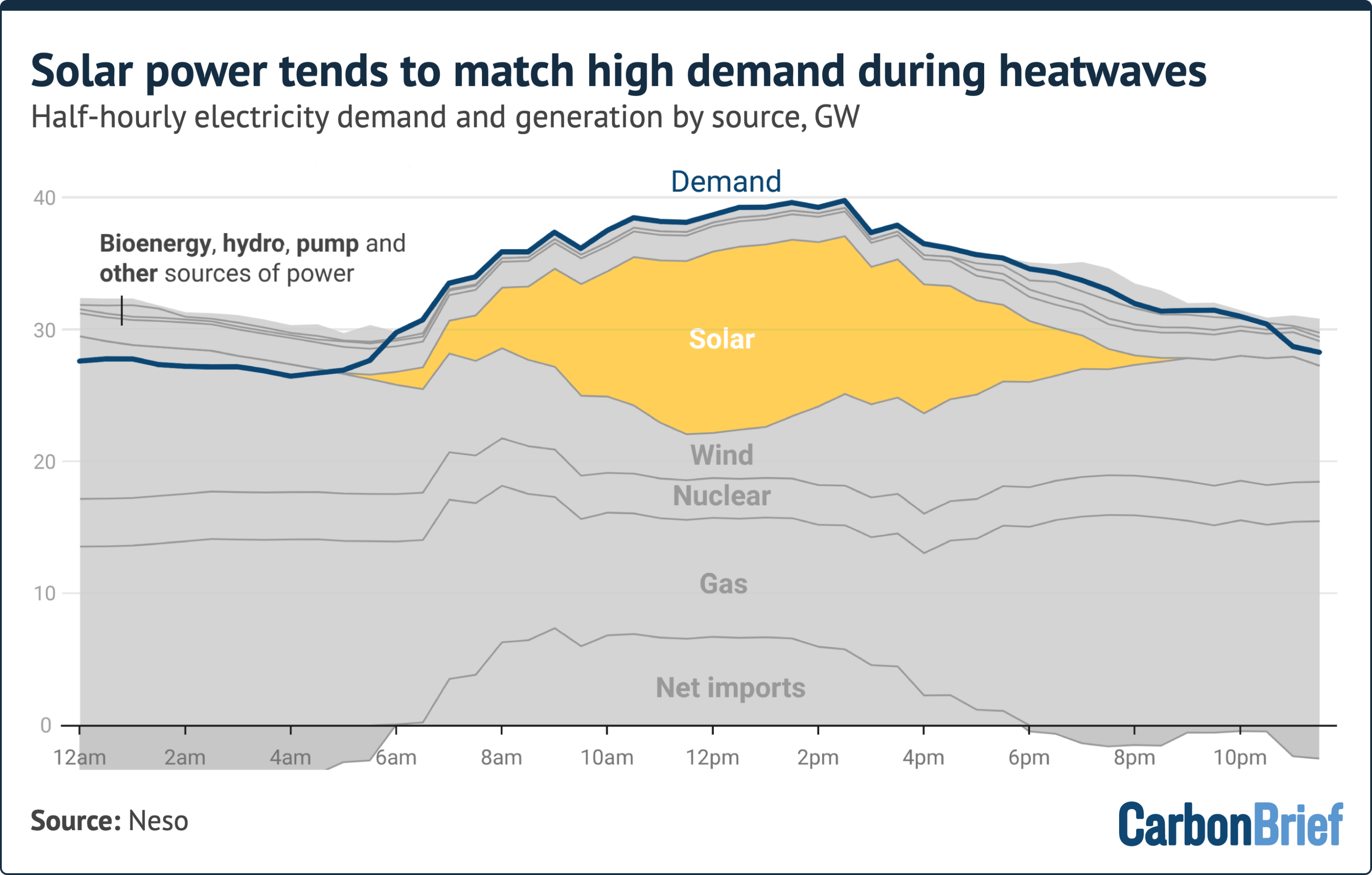
Net Irradiance Gain: Because heatwaves coincide with long, cloudless days and maximum solar irradiance, total energy yield during heatwaves remains exceptionally high. During a four-day UK heatwave in late June 2026, total solar generation soared to 484 GWh—a 46% increase over the cooler, cloudier period just one week prior. Across the European Union, solar generation hit a historic record of 52 TWh in June 2026.
Crucially, solar PV generation curves align closely with daytime summer air conditioning demand profiles, providing maximum power precisely when the grid experiences its highest daytime cooling loads.
Utility-scale Battery Energy Storage Systems (BESS)—dominated by lithium-ion chemistry—play a critical role in bridging the gap between peak daytime solar output and evening cooling demand. However, batteries face thermal operating parameters that must be actively managed:
Thermal Degradation & Safety: Lithium-ion cells operate optimally between 15°C and 35°C. Above 45°C, battery degradation accelerates rapidly, and the risk of thermal runaway increases.
HVAC Parasitic Load: To maintain safe internal operating temperatures during extreme ambient heat events, battery enclosures rely on heavy-duty HVAC cooling systems. Operating these cooling units consumes a portion of the battery’s stored energy (parasitic load), slightly reducing net system efficiency and discharge runtime.
Official Statements & Expert Commentary
Experts across academic, regulatory, and industrial domains emphasize that while heatwaves present technical challenges to all generation types, public debate often fundamentally misconstrues physical realities.
Addressing the misperceptions surrounding nuclear power’s vulnerability, Michael Tadrous, a researcher at McMaster University’s DeGroote School of Business, stresses that headline-grabbing reactor outages must be put into context:
"The impact of heatwaves on nuclear generation is real, but it is far smaller than many headlines suggest, and the effect of heat is gradual. Warmer intake water makes a reactor slightly less efficient—even an extreme 15°C rise in cooling-water temperature would cost a large reactor only about 6% of its output.
The real pressure point during a heatwave is usually legal rather than technical. Plants return their cooling water to the river a few degrees warmer than they drew it, and the law limits how warm that water may be in order to protect aquatic life."
Henry Preston, spokesperson for the World Nuclear Association, confirms that environmental regulations drive operational shifts:
"Reactor shutdowns due to high river temperatures are typically an automatic response to comply with regulations to protect local ecosystems, rather than a technological fault. In contrast to high river temperatures, which can quickly return to acceptable levels once a heatwave passes, low river levels can persist for much longer if drought conditions continue."
Focusing on thermal gas infrastructure, Dr. Iain Staffell, associate professor in sustainable energy at Imperial College London, highlights the hidden financial penalties of relying on gas plants during summer heat spikes:
"Simple gas turbines—the kind which turn on rapidly to meet peak demand—are hit harder than solar, with their power output falling by about 10% per 10°C. Gas power stations are thought of as reliable because of how we use them; on average, only around 40% of the gas fleet is in use at any one time, so we have slack to call on more of them. The issue is less that they can’t deliver, but that we have to pay through the nose to persuade more to turn on at critical times, adding to sky-high energy bills."
Evaluating the structural balance provided by renewables and storage, Dr. Chris Rosslowe, senior energy analyst for Europe at the energy think-tank Ember, emphasizes the complementary nature of clean technology pairings:
"Power systems are less reliant on wind power in the summer months, and its lower-than-average output is already expected and planned for. Heatwaves often bring still, but clear conditions, highlighting the benefit of wind and solar as a duo—poor conditions for one often mean good conditions for the other.
Solar, battery storage, and air conditioning are a highly complementary trio of technologies during heatwaves. Problems arise when the sun goes down, but demand for cooling remains high. In the early evening hours, when gas power typically ramps up to replace solar, we have seen prices spike to extreme levels, made worse by high international gas prices."
Reflecting on long-term power market design, Pawel Czyzak, Europe programme director at Ember, notes:
"Heatwaves will not go away—they will only get more severe in the future. Solutions that can help mitigate their impacts, such as battery storage, interconnection, demand flexibility, and dynamic tariffs, should become a key part of grid planning and power market design."
Future Outlook: Adaptation and Grid Resilience
As climate models project increasingly frequent, intense, and prolonged summer heatwaves globally, energy utilities and system operators are moving rapidly from reactive emergency measures to proactive structural adaptation.
Thermal generators are investing heavily in hardware modifications to decouple generation from vulnerable freshwater bodies. Utilities such as France’s EDF are evaluating the construction of additional dry cooling towers and mechanical draft systems at river-adjacent nuclear facilities.
By shifting from once-through cooling to closed-loop evaporation systems or air-cooled condensers, thermal facilities can operate continuously through extreme heat and drought conditions without violating downstream environmental temperature regulations. While these retrofits require substantial capital investment and slightly reduce baseline turbine efficiency, they effectively eliminate catastrophic summer outage risks.
2. Transmission System Enhancements
Electric grids are installing Dynamic Line Rating (DLR) technology. Overhead power transmission lines sag and lose current-carrying capacity in extreme ambient heat. DLR systems utilize real-time sensor networks to monitor conductor temperature, wind speed, and line sag, allowing grid operators to safely maximize line capacity rather than relying on static, highly conservative summer operating limits. High-temperature composite core conductors are also replacing legacy aluminum cables in heat-vulnerable transmission corridors.
3. Deep Deployment of Storage and Flexibility
The key to handling the evening "sunset ramp"—when daytime solar output drops while domestic cooling and evening demand remain high—is the aggressive scaling of multi-hour energy storage. Combining four-hour and eight-hour lithium-iron-phosphate (LFP) BESS assets with high-capacity interregional high-voltage direct current (HVDC) interconnectors allows power grids to store surplus mid-day solar power and import clean power from regions unaffected by local heat domes.
                        THE EVENING FLEXIBILITY BRIDGE
 Solar Surplus (Mid-Day) ──> [ BESS Charge ] ──> [ BESS Discharge ] ──> Evening Peak Cooling Load
                                                                   (Displaces Gas Ramp)
Simultaneously, market design reforms—such as dynamic retail tariffs, automated demand-response programs, and smart air-conditioning integration—allow consumers and commercial facilities to pre-cool buildings during peak solar hours, flattening evening demand surges without sacrificing comfort.
Conclusion
Extreme heat is an inescapable stress test for the physics of power generation. While political rhetoric often seeks simple scapegoats, the thermodynamic reality is clear: thermal facilities like gas and nuclear plants face severe operational penalties from water shortages and warm air, while clean energy sources face meteorological shifts that can be managed through intelligent system architecture. Building a resilient grid for an overheating world requires discarding ideological biases in favor of dynamic flexibility, enhanced storage, cross-border grid integration, and modern heat-resistant engineering.